| Table tabled in debate |
| Ed Slavin, a frequent speaker at City commission meetings, urged "table the table," and commissioners did just that Monday after discussing commission room designs - and costs. The existing table has been on loan from Lightner Museum since 1972, and will be moved to the museum's new board room. A replacement table was estimated at $8,500, and room redesigns including a raised platform for commissioners, $20,000 to $25,000. Facing uncertainty in fundraising for the 450th commemoration, and a smaller city budget for next year, commissioners decided not to tackle the table at this time. |
Tuesday, July 26, 2011
George Gardner's St. Augustine Report/City of St. Augustine re: Saving Tens of Thousands of Dollars By Not Wasting More of Our Money on Flubdubs


St. Augustine City Commission Votes Against Raising Our Taxes -- Thank You!
City 'holds the line' on millage
Staff says this risks deep cuts, layoffs
Posted: July 25, 2011 - 11:11pm
By 
A St. Augustine City Commission tie vote on the 2012 tentative millage Monday could result in the city retaining its current property tax rate at 7.5 mills next year.
That news may cheer taxpayers, but that level of taxation will hamstring the city's finances, according to Assistant City Manager Tim Burchfield.
If that level is adopted, the city must cut $700,000 more from an already lean budget, he said.
"We're bare bones now. There have been no raises. We're down to salary cuts," he said. "We'll either be forced into layoffs or will lose popular events like our fireworks."
Burchfield had just recommended the tentative millage rate of 8.146 mills, which would have raised an additional $682,000.
"We can balance the budget with 7.5 mills," he said. "But the higher millage would allow us to handle future unbudgeted expenses such as the M&M Market, Galimore pool, Excelsior Building, 450th anniversary and Spanish Quarter."
He said the city's under time pressure to get its recommended millage to the state by Aug. 3.
Later, during budget hearings scheduled for 9 a.m. Aug. 24 and 25, the City Commission may lower the millage rate from 7.5 mills, but cannot raise it.
Mayor Joe Boles made a motion to approve the higher amount, seconded by Commissioner Errol Jones.
However, commissioners Bill Leary and Nancy Sikes-Kline voted against. Vice Mayor Leanna Freeman was absent, so the tie automatically meant the 8.146 millage was defeated.
City Manager John Regan, seeing a stalemate on the board, told them to come up with something.
"We want to walk out of here with a number," he said.
The city's recommended millage would stay the same.
If it had been raised to 8.146 mills, a house worth $100,000 would pay $64 more.
Burchfield said the city's taxable value of $1.116 billion is down from this year's value of $1.213 billion, so there is $100 million less value to tax.
Leary said that with this vote the commission may be tacitly approving the big ticket items.
"I'm not comfortable with that. I voted against the M&M Market and the Spanish Quarter. It's too big a drain. This is just not the time to be doing this. The votes are not here tonight," he said.
Sikes-Kline said a lot of people live paycheck to paycheck.
"There's going to be a tax increase by the county," she said. "We have a balanced budget. We have to hold the line (on raising taxes). We'll just have to keep cutting until we make it work."
She said she believed the other commissioners -- Boles and Jones, apparently -- were using the threat of public safety layoffs to increase taxes.
"I understand you want to close the Spanish Quarter," she said in an emotional blast. "You want to make this (city) a tacky tourist town. I'm really not happy with the way this is happening."
Boles warned Sikes-Kline that once the tentative millage was sent to Tallahassee, "We don't get to do this again. (But) I don't have any problem going into our reserves. I don't see us going out for bonds for a while."
Jones said more money was needed because the city hasn't budgeted street resurfacing, building maintenance, general maintenance or infrastructure improvements since 2007.
"The work you see being done in the city, they're pulling that money from reserves," he said. "We have 31 percent fewer employees since 2007 and our reserves have decreased by 30 percent. (We're supposed to) save that money for a rainy day. Well, it rains every time a water line breaks."
St. Augustine Record Still Mum on National Historical Park and National Seashore, Neglects to Cover Emerging Democracy on City Commission
Real newspapers lead their readers to learn more about their world, from City Hall to the Courthouse to the White House.
Real newspapers lead their communities to change for the better.
Real newspapers expose and fight wrongdoing, remembering that Justice Brandeis said, “sunlight is the best disinfectant.”
Real newspapers “comfort the afflicted and afflict the comfortable.”
Real newspapers file Open Records and Freedom of Information Act requests. If stymied, they don’t take “no” for an answer – they appeal and sue and work tirelessly, doggedly to inform their readers.
Then there is the St. Augustine Record, which sadly is no longer functioning much like a real newspaper in this down economy. Nearly run into the ground by the Morris family of Augusta, Georgia, the Record has seen declining news room budgets, declining full-time equivalent reporters and declining space for news (the “news hole,” in journalese).
Led down the primrose path by the infamous Morris Communications empire, the WRecKord’s editors and reporters are burned out. Are they bored, or not allowed to report about citizens when we make our government responsive? Why is the Record still seemingly currying favor with government employee apparatchiks, like Paul Williamson and Tim Burchfield? See Peter Guinta’s story, above. When will the Record cover all of the news, including citizen participation?
Last night, senior reporter Peter Guinta put his notebook on the chair beside him, taking nary a note, while the City’s abortive plan to waste money on an $8500 table was debated and trounced – and the City’s effort to raise our taxes failed on a tie 2-2 vote. Guinta’s story read like it was written by Williamson, making it sound like a bad idea that City Commission did not raise our taxes last night.
I asked Commissioners to reject it a proposal for an $8500 table and talk of “reconfiguring” the Commission meeting room at a cost of tens of thousands of dollars. I asked them to “table the table.” They did it. The “table was tabled.” The Record did not report it (see above), although former Mayor George Gardner did so in his City Hall newsletter today, and controversial former Commission candidate (and government contractor) Michael Gold wrote about it on his blog, Historic City News, using “table the table” in his headline. (Credit goes to Gold for opposing the $8500 table ab initio).
The table was a dumb idea – the City could get one free. Lack of imagination in City purchasing officials still persists – they need to sharpen their pencils and stop wasting money on flubdubs.
After a briefing by architect Jerry Dixon, all four City Commissioners present and voting agreed unanimously that there was no rush to spend tens of thousands of dollars – as architect Jerry Dixon suggested – to put City Commissioners on a raised platform, as if they were Spanish royalty, which would have required ramps or lifts for disabled persons.
Dixon seemed out of touch with average citizens as he proposed spending tens of thousands of dollars to make the Commission meeting room less secure, with the Commissioners’ backs literally up against the windows. Dixon acted as if WILLIAM B. HARRISS were still the City Manager, and money could be wasted without Commission and public scrutiny. Those days are over. Democracy has broken out.
But old habits die hard for some officials – City Commissioner Errol Jones thrice said the City’s current table was “very eloquent (sic).” Jones said the word “eloquent” thrice. Jones reportedly has a Master’s Degree and is the former “Dean of Students” (e.g., disciplinarian) at St. Augustine High School. When WILLIAM B. HARRISS was City Manager, Jones often and loudly defended every single controversial former City Manager HARRISS’ works and pomps to the point of insulting neighborhood residents, whether the subject was Amerigas trucks on Leonardi Street, illegal dumping in our Old City Reservoir, or the evisceration of the beautiful former Ponce de Leon Golf Course, which Commissioners annexed and allowed developer Chester Stokes to destroy in the name of mindless real estate speculation.
Commissioner William Leary agreed with Jones that it was an “elegant table” and an “elegant room,” but he and Commissioners Nancy Sikes-Kline said the City need not waste any more money on flubdubs.
Commissioner Nancy Sikes-Kline later said of the elegant (or “eloquent”) St. Augustine City Commission table, in place since 1972, “if only this table could talk.”
The Record failed to appreciate the significance of Monday night’s vote – there is now a functioning democracy on the City Commission. No longer does the City Manager function as a dictator, with absolute power, electing and funding candidates and exercising a Philistine’s veto on projects (as HARRIS did on the Civil Rights Footsoldiers Monument).
No longer does the St. Augustine City Manager violate Sunshine laws, “polling” Commissioners to see how they will vote. You can see the spontaneity at City Commission meetings now.
Watching the St. Augustine City Commission grow into a functioning democracy last night, I was proud of our public officials. Much has changed in a few short years.
The evolving St. Augustine City Commission is something to be proud of, not ashamed of. The situation reminds me of how proud I was to see the Anastasia Mosquito Control Commission grow with new leadership (Jeanne Moeller, John Sundeman, Janice Bequette and Catherine Brandhorst, et al.)
Once citizens become active, speak out and elect candidates, we must keep them honest by attending meetings and speaking out – thanking them when they do a good job and asking them to do better.
Check out former Florida U.S. Senator Bob Graham’s excellent 2010 book “America – the Owner’s Manual – Making Government Work for You.”
As evidence of the sea change in City Hall, Folio Weekly today awarded City Commissioner William Leary a “bouquet” for his work on beautification for the 450th – encouraging people and businesses to do it without government expense.
Foreign-funded developers and their enablers once ruled the roost in St. Augustine City Hall. When WILLIAM HARRISS (a/k/a “WILL HARASS”) was City Manager, our City government did things that would gag a maggot – like destroying a 3000-4000 year old Indian village archeological site next to St. Augustine High School. Why? Controversial New York developer ROBERT MICHAEL GRUBARD asked them to do so. When HARRISS was City Manager, citizens were threatened for participating in their government, and treated with disrespect, ridicule and disdain (as we were so often treated on matters of environmental pollution).
With new City Manager John Regan, there has been a sea change – City Hall is listening to people and working to be a good steward. “It takes a village” – every citizen of St. Augustine deserves credit. We did it. We had what Andrew Young calls “soul force.”
Our ideas have prevailed – the same ideals with which our Founders established this country 235 years ago. We now have a City government that increasingly inspires pride, not embarrassment. Not unlike a possum, we have awakened in a new world.
Congratulations, St. Augustine residents – your government is no longer working against you – it is listening. Peoples’ concerns are being heard and heeded.
We stopped a City tax increase last night. And we “tabled the table.”
Next, there will be budget workshops and hearings. This time, we expect that our questions will be answered.
In 2007, working with the advice of three (3) accountants and many knowledgeable City residents, I propounded some 140 questions on the City’s gold-plated budget. The questions were not answered. The questions were not acknowledged. Some City Commissioners said I asked “too many questions.” The Record ignored the questions, and demanded no answers.
Tatterdemalion City Manager HARRISS never even thanked us for our efforts to build a better budget.
Sadly, WILLIAM B. HARRIS was an habitual violator of the First Amendment and was repeatedly found by federal courts to have violated free speech rights – of artists, entertainers, Gays, Lesbians and others. We’re glad he “retired.”
This time, we expect a new ballgame – our City Hall works for us (and not the way around). Expect City officials to ask questions, and hear answers.
It’s our money.
Now, if only the St. Augustine Record would provide gavel-to-gavel coverage of government meetings, quote citizens who speak, and cover all sides of every issue – that would be greatly appreciated. It is time for the Record to treat its readers as adults to be informed and inspired.
And why is the Record still mum on the proposal for a St. Augustine National Historical Park and National Seashore, which it first reported in June 1939 – 72 years ago --, when it was proposed in Congress by United States Senators Claude Pepper and Charles Andrews and U.S. Rep. Joseph Hendricks, with support of St. Augustine’s then-Mayor Walter Frazier.
For years, the St. Augustine Record has never written a news story about it, and refuses to take an editorial position in favor of it. Why?
I still believe in a place called Hope, and it is called St. Augustine. Expect the unexpected. Controversial Michael Gold has performed a public service by exposing proposed waste (by a City government that once gave his family business no-bid uniform contracts). Thomas Jefferson believed in the perfectability of humankind. Our planet’s major religious traditions teach forgiveness.
Now, in that spirit, it is not too much to expect that the St. Augustine Record can support healing and growth by publicizing and supporting the St. Augustine National Historical Park and National Seashore. www.staugustgreen.com
It is not too much to expect that the Record will report and editorialize on the park, which promises to save our economy, create jobs, celebrate our 450th anniversary and provide lasting environmental protection for future generations, preserving wildlife, marshes, beaches and forests forever?
Is that too much to ask?
What do you reckon?
Monday, July 25, 2011
Summer Breeze:Spotlight on Clean Up City of St. Augustine, Florida
Spotlight on Clean Up City of St. Augustine, Florida
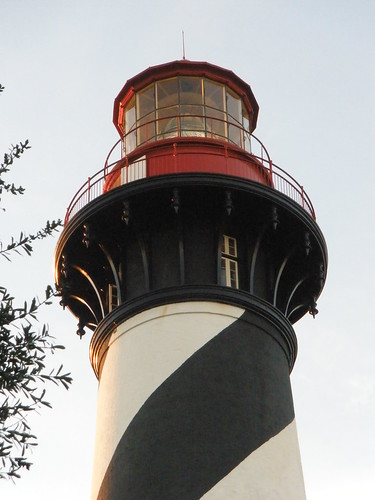
Clean Up City of St. Augustine is a blog by resident Ed Slavin
If you’re a frequent reader of St. Augustine news in print or online, you may have run across, or be familiar with, a blog called Clean Up City of St. Augustine, Florida. It’s a no-nonsense, bare bones website written by St. Augustine resident Ed Slavin. The blog is dedicated to community activism in the area. Slavin’s been at it (as well as a few other blogs) since 2006 and shows no signs of slowing down.
Slavin, a former lawyer, is a controversial figure in the St. Augustine blog world, as he demands answers for pressing issues that public figures avoid answering (among a slew of other things). The blogger also criticizes questionable platforms put forth by public figures and other bloggers that support them… and endures criticism himself. In one case, Slavin was even arrested for making numerous (perhaps too many?) public records requests… to the sheriff. Civil disobedience?
Slavin’s latest literary kick is over St. Augustine’s 450th anniversary commission. There are also several links to key topics, such as city preservation and the importance of national parks.
Photo source: simoneladybug
Copyright © 2011 · All Rights Reserved · Powered by WordPress and NCI · Privacy Policy · User Agreement · Fair Housing · Log in
Huffington Post: U.S. House of Representatives' Extinction Amendment Puts All of God's Creatures in Danger

GET UPDATES FROM Jamie Rappaport Clark
Extinction Rider Puts Us All in Danger
Posted: 7/22/11 05:38 PM ET
React

Follow
When I began my career almost 30 years ago, peregrine falcons were in dire straits. For decades, these graceful birds of prey had been slowly poisoned by the widespread use of the harmful pesticide DDT, which altered their internal chemistry and made their egg shells thinner. As result, fewer eggs hatched and the population plummeted, wiping out the species across much of the United States.
I spent a summer in college working with the Cornell University Lab of Ornithology in Ithaca, New York, where I had the chance to help make history. I was a member of a team of biologists that was releasing captive-bred peregrine falcon chicks back into the wild. Having disappeared east of the Mississippi by 1970, the species was about to take its first steps on the road to recovery, and I was helping make it happen.
As a young biologist, I would have never dreamed that nearly 20 years later, I would be Director of the U.S. Fish and Wildlife Service and part of history again, as I announced the full recovery of the peregrine falcon. That incredible success was a direct result of the Endangered Species Act -- our nation's most forward-thinking and effective wildlife conservation law. Because of dedicated recovery efforts made possible by the act, peregrine falcons were able to fly off the endangered species list. And today, the species is thriving once again.
Unfortunately, it seems like not too many of us remember these triumphant moments. Too many have forgotten how instrumental the Endangered Species Act has been in saving America's imperiled wildlife. Too many are willing to go backwards on our nation's commitment to good stewardship. Too many are ready to give up on preserving the entire web of life for our children and grandchildren.
Next week, the U.S. House of Representatives plans to pass an ill-conceived budget bill for the Interior Department that would paralyze our nation's programs for protecting imperiled plants and animals. A provision included by Rep. Mike Simpson (R-Idaho), and approved by the Appropriations Committee on July 12, would block crucial life-saving protections for more than 260 "candidate species" currently awaiting listing decisions under the Endangered Species Act.
Many of these species have already been waiting a decade or longer for protection as they continue their slide toward extinction. The lesser prairie chicken, for example, has been awaiting protection since 1998 when the U.S. Fish & Wildlife Service first added it to the candidate list. This colorful bird used to be abundant from southern Kansas to central Texas, but now exists in less than 15 percent of its historic range due to the ongoing destruction of its native habitat.
Other species, such as the wolverine, were only recently added to the candidate list. Scientists estimate there are fewer than 300 wolverines left in the lower 48, living on isolated peaks across the Rocky Mountains. To make matters worse, wolverines are losing habitat quickly as global warming disrupts the annual snowpack that the species depends on for survival.
The Extinction Rider, if passed, would prevent the U.S. Fish and Wildlife Service from taking further action to save not only the wolverine and the lesser prairie chicken, but also the Pacific walrus, the red knot shorebird, the New England cottontail rabbit, the Sonoran desert tortoise, and hundreds of other species that need our help to survive.
As a former director of the U.S. Fish and Wildlife Service, I know first-hand how difficult it can be to watch these species struggle while the government fails them. During my tenure, Congress passed a moratorium on funding for endangered species similar to the Extinction Rider in the current proposal. The effect of that moratorium was to delay protection and recovery efforts far beyond the immediate fiscal year, because while we were forced to put vital programs on hold, imperiled plants and animals had to fend for themselves. Delaying much-needed protection for these imperiled species did nothing to suspend their slide toward extinction. It only ignored what science was telling us at that time.
The recovery of the peregrine falcon is just one of many great victories that our country has been able to celebrate because of the Endangered Species Act. In its nearly 40 years of existence, fewer than two dozen species have disappeared out of nearly 2,000 that have been protected. Iconic species like the bald eagle, American alligator, Florida panther and gray whale might not exist today if it weren't for dedicated conservation efforts initiated under the act.
But all those victories came after decades of careful planning and hard work. If we cut off funding now for protecting imperiled wildlife, there's no telling how long it will take to get back on track. And for many species on the brink, they don't have much longer to wait.
2007 St. Augustine Record Editorial re: National Park: Gift Idea for St. Augustine's 450th -- when will Record endorse the Park and Seashore?
Support for National Park: Gift ideas few for city's big 4-5-0
From Staff
Publication Date: 10/06/07
Gift ideas few for city's big 4-5-0
We asked readers last week to suggest the best gift for the city of St. Augustine's 450th birthday in 2015.
We got a few.
Perhaps most people don't think there's any gift to be had when you reach 450.
Here's what readers told us:
Editor: Our Minorcan family has lived here for some 230 years. For our 450th, to save St. Augustine, our city needs a national historical park, seashore and scenic coastal highway to showcase to the world and to preserve forever our precious cultural, environmental and wildlife heritage.
Drayton Manucy
St. Augustine
Editor: I support Ed Slavin's Nov. 13, 2006 proposal for a St. Augustine National Historic Park, National Seashore and National Scenic Coastal Highway. This beautiful historic place must be preserved forever (or else our history and heritage and beauty will be destroyed forever). Congress must act swiftly.
David Brian Wallace
St. Augustine
Editor: The newly formed Theatre Saint Augustine has planned a meeting for all members of the community to develop thoughts on how the artistic and historic community can work together towards events for the 450th celebration. The possible development of a revised Cross and Sword, Florida's state play, will be a focus of discussion at the St. Johns County Main Public Library, 1960 N. Ponce de Leon Blvd., for Oct. 22, at 6 p.m., For additional information visit www.theatresaintaugustine.com
Kiki Tovey
Theatre Saint Augustine
St. Augustine
Those are some good ideas.
We'd add, too, that perhaps city officials should visit Kansas City, Mo., where beautiful fountains and bronze statues of all sizes delight visitors and residents alike.
Some commemorate events, others people. We've got some statues and fountains already but nothing like you will find in KCMO.
The city is proof, you can never have too many fountains or statues.
Click here to return to story:
http://staugustine.com/stories/100607/opinions_10062007_037.shtml
© The St. Augustine Record
Friday, July 22, 2011
Secretary of the Interior Salazar Comes Close to Endorsing St. Augustine National Historical Park and National Seashore – St. Augustine Record is Mum

Renee Stone, Deputy Chief of Staff to U.S. Secretary of the Interior Ken Salazar; John Regan, now City Manager, City of St. Augustine; Dana Ste. Claire, Director of Historic Tourism ; Ken Salazar, Secretary of the U.S. Department of the Interior; Joseph Boles, Mayor of the City of St. Augustine; Bill Leary, now St. Augustine City Commissioner and former employee of the Department of the Interior; and Ray Rivera, Director of External and Intergovernmental Affairs for the U.S. Department of the Interior, photographed March 9, 2010.
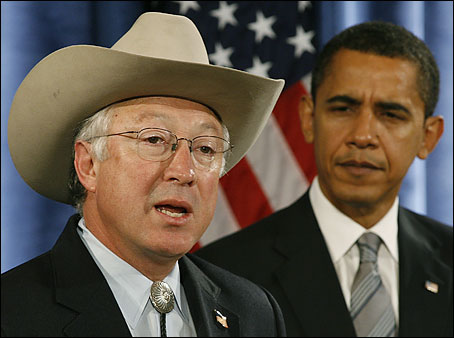
Secretary of the Interior Kenneth Salazar and President Barack Obama
Monday, July 18, 2011, was a great day in the history of making St. Augustine a better place. At Flagler College Auditorium, Secretary of the Interior Kenneth Salazar came very close to endorsing a St. Augustine National Historical Park and National Seashore Monday at the inaugural meeting of the St. Augustine 450th Commemoration Commission, enacted thanks to the efforts of U.S. Rep. John Mica and Senator Bill Nelson.
Congressman Mica lobbied hard for funds support for the Castillo San Marco Visitor Center.
On the videotape of the 450th Commission meeting, Secretary Salazar can be heard referring to the “St. Augustine National Parks here” and praised the “leadership of Gordy Wilson,” longtime superintendent of Castillo de San Marcos National Monument and Fort Matanzas National Monument. Yes, St. Augustine currently has only two small national monuments – but we do need a St. Augustine National Historical Park and Seashore and Salazar’s remarks give us great hope for that goal.
Secretary Salazar’s speech was ad lib – the Department of the Interior responded to me by E-mail yesterday that there was no prepared text.
Again, Secretary Salazar referred to the “St. Augustine National Parks here,” telling us that the goal of a St. Augustine National Historical Park and Seashore is within our grasp.
How do we get there? How do we get the park enacted? What do you reckon?
Salazar’s speech suggests some answers.
The Department of the Interior will work “hand in hand” with St. Augustine to celebrate a “national event.” St. Augustine is a “very special place,” Secretary Salazar said. In fact, St. Augustine, Florida is “one of our Creator’s most special places.” We agree. That is the premise of the St. Augustine National Historical Park and National Seashore Act of 2011.
Secretary Salazar said the contributions of St. Augustine and Florida to our history need to be made “known to our Nation and are known to the world.” St. Augustine has “history that we carry in our hearts,” he said. We agree.
Secretary Salazar talked about how much he loves his job and how he gets to “celebrate Yosemite, Acadia and the Everglades” in his job (as opposed to the Transportation Secretary, Ray LaHood, who gets to celebrate roads and bridges)(.
Secretary Salazar talked about the inexorable link between outdoor recreation and tourism and growing the economy – “hopefully we’ll restore this economy to greatness” and “make it happen.”
“Never since the Great Depression has America lived in such an unsettled economy,” Salazar said.
Salazar talked about how important the Everglades are to tourism and the economy, noting it is a World Heritage site.
Could St. Augustine one day become a World Heritage site? Why not?
Salazar talked about how important is “the investment we make” in “one of the Creator’s most important places on this Earth.” He was referring to the Everglades, but in terms of history and the environment, he could easily have been referring to St. Augustine. Salazar said that the Everglades is “important to the economy of Florida – without it, the economy would wither.”
Salazar then praised St. Augustine …. a jewel that tells the story of the founding of America, first city in America,” which “created much of the blueprint of what we now know as America.” “The history of this place… is not very well known throughout the United States … that history is important to tell.”
Drawing affectionate and appreciative laughter from St. Augustine residents, Secretary Salazar told about how Director Eric P. Johnson of the Mission of Nombre de Dios and the Shrine of Our Lady of La Leche (the Catholic shrine) told him Sunday night about how young Eric Johnson corrected his teachers about Plymouth Rock and Jamestown when he was in school, telling them that they were not where America began.
Likewise, Secretary Salazar said, to gentle laughter, that he was among the tens of millions of Americans who were falsely given the impression their ancestors came over on the Mayflower. This was despite the fact that Salazar grew up in a Hispanic community some 265 miles South of Denver. In Salazar’s household, everyone spoke Spanish – his family has been in America for eight generations, and his ancestors helped found Santa Fe, New Mexico.
Secretary of the Interior Kenneth Salazar pointed the way toward a National Civil Rights Museum in St. Augustine said that, “We as a nation have been the beacon for the world in terms of the progress of humanity --- the arc of justice bends toward more perfect humanity, as Dr. King said – what is important for us is as we tell the story …”
Secretary Salazar talked about the strong, inextricable, irrefragable link between economics, tourism and outdoor recreation. He spoke of working with 450th Commission Chairman Jay Kislak and other members of the National Parks Foundation to promote outdoor recreation and economic growth.
Secretary Salazar kvelled that “Outdoor recreation alone creates 6.5 million jobs,” with some $700 billion added to the economy” from outdoor recreation.
Salazar said that St. Augustine presents “a very important mission for me as Secretary of the Interior.”
“As we struggle with the economic crisis of our time, we ought not to forget that we need to keep investing in the conservation agenda,” Salazar said.
Salazar said that prposed 22% cuts in the National Park Service budget set forth in the House of Representatives in Appropriations Committee bill would “set back our efforts significantly.”
Salazar asked everyone to support our National Parks and their “job creation agenda,” which is “so important to all America.”
Salazar said he was “here in St. Augustine in large part due to the efforts of your Mayor,” Joseph Boles, who “came to my office,” saying he “would not be here today” but for Mayor Boles’ “advocacy along with the local leadership here” and Senator Bill Nelson.
Salazar said he looked forward to “working here with you hand-in-hand, celebrating” the 450th anniversary of St. Augustine (2015) and the 500th
Anniversary of Spanish Florida (2013), saying it would be a “wonderful several years,” promising to “work on this agenda. “
Salazar reiterated how America is the “beacon of the world,” with its message of “freedom and democracy,” stating that the job of “telling the stories of America” and of “St. Augustine is incredibly, incredibly important.”
The Record barely reported what the Secretary of the Interior had to say.
Then the Record was mum, and also did not report the fact that, when public questions were allowed, the audience applauded the request to make a presentation to the 450th Commission about the proposed St. Augustine National Historical Park and National Seashore.
Subscribe to:
Posts (Atom)