
This sandhill crane and other Florida critters deserve wildlife habitat. Our citizens deserve good jobs at good wages. Our visitors and our future deserves a St. Augustine National Historical Park and National Seashore.
Editor: Of all the preposterous claims made by U.S. Rep. John Mica in his guest column of Sept. 18, the most outrageous has to be that it is the EPA that is “gutting the Clean Water Act” by simply carrying out its statutory authority to protect the nation’s waterways. Now that the EPA, as required by the CWA, is setting standards that Mica and his friends at Koch Industries find objectionable, his response is to attempt to pass a law, HR 2018, that removes this fundamental authority.
Mica complains that Florida “is now required to implement these standards with little scientific basis …” Little scientific basis? The Florida Department of Environmental Protection has already determined that 1,918 miles of rivers, 376,000 acres of lakes, and 569 square miles of estuaries in the state are polluted. Obviously the current standards, which Mica wants to preserve, are not doing the job.
Mica has the audacity to claim that his legislation is an attempt to “maintain the federal/state partnership that has been the law for nearly 40 years.” The foundation of this partnership has always been the authority of the EPA to enforce the provisions of the CWA that Mica now seeks to remove. The CWA is not and never has been a voluntary system; it has been successful precisely because the states must comply with federally mandated standards.
It’s interesting that Mica’s talk about cooperation and maintaining a partnership is nowhere to be found in the text of his bill. Instead, you find in clear black and white terms that the administrator of EPA would be stripped of key authorities if the states “don’t agree” with his determinations. That is an odd way to nurture a partnership and clean up our state’s waterways.
Robin E. Nadeau
St. Augustine
All of us want clean water and air. As someone who has worked to restore the Everglades and Rose Bay Estuary, and to acquire a natural buffer to protect the St. Johns River, I must correct some of the mischaracterizations of my legislation titled the "Clean Water Cooperative Federalism Act" and of my commitment to clean water in Florida. (This in response to a guest column on Sept. 11 in The St. Augustine Record.)
All of us want clean water and air. ¿As someone who has worked to restore the Everglades and Rose Bay Estuary, and to acquire a natural buffer to protect the St. Johns River, I must correct some of the mischaracterizations of my legislation titled the "Clean Water Cooperative Federalism Act" and of my commitment to clean water in Florida. (This in response to a guest column on Sept. 11 in The St. Augustine Record.)
The best way to achieve our environmental goals is by making advances at a pace that is economically sustainable. ¿ Otherwise, we degrade both our economy and our environment. ¿
Florida was making advances in water quality in a responsible manner before the Environmental Protection Agency (EPA), in its response to a lawsuit by an activist group, nullified its previous agreement with the state and imposed new nutrients requirements. ¿ ¿Florida is now required to implement these standards with little scientific basis, while the state's deliberative effort, which would have led to scientifically robust and sustainable standards, is put on the back burner. ¿ Meeting these EPA-imposed standards, if it is possible at all, will cost Floridians billions of dollars and reduce economic activity, possibly with no environmental benefit. ¿
H.R. 2018, the Clean Water Cooperative Federalism Act, was crafted by Republicans and Democrats at the request of state and local governments and community leaders who want to protect our waters with responsible regulation. ¿ Anyone who says H.R. 2018 would dismantle the Clean Water Act (CWA) ignores the facts and doesn't understand the law. When enacted in 1972, the Clean Water Act established a cooperative relationship between EPA and the states in carrying out this important function. For nearly four decades this partnership has worked remarkably well, providing all Americans with cleaner water. ¿ But it is EPA that is gutting the CWA by upsetting this successful cooperative relationship and replacing it with federally-dominated edicts that overturn state decisions that EPA previously had approved. ¿
Critics say my bill would be a step backward and turn over regulation of pollutants to states. ¿These statements are uninformed. Even a casual reading of the CWA reveals that it is precisely the states that must regulate pollutants under the law. ¿ The problem in 1972 was not that states were operating without oversight, it was that states were not operating at all to protect the nation's waters.
The Clean Water Act created the framework and the funding to get states to act. ¿ Under the law, states established clean water programs that included regulatory schemes. ¿ EPA provided, and still provides, technical assistance, funding, and approval authority for the state programs. ¿ Once the programs are approved, the states carry them out. ¿ It is not a reversal of progress for me and a bipartisan group of legislators to try to maintain the federal/state partnership that has been in law for nearly 40 years and has proven to be very successful. ¿
No doubt there is still much to be done. But replacing the federal/state partnership with dictatorial EPA actions that ignore science and the proper role of states will not be successful in the long run. ¿ The states, including Florida, can and must protect their waters. They know how to create scientifically based standards for their watersheds, and they know what standards are achievable and on what timeline. ¿
Requiring EPA to honor its approvals and allow states to manage their waters in accordance with EPA-approved plans is the foundation of the Clean Water Cooperative Federalism Act. It restores the process that has been working well for nearly four decades and assures a sustainable pace of environmental improvement. ¿
*
U.S. Rep. John L. Mica represents District 7 which includes all of St. Johns County. He was first elected to Congress in 1992. ¿ ¿He is chairman of the House Committee on Transportation and Infrastructure. As chairman, he serves on all six ¿Transportation and Infrastructure subcommittees. ¿Among them is the ¿Water Resources and Environment subcommittee. He resides in Winter Park.
There seems to be a consensus that despite improvements in some areas, water quality in Florida remains a serious problem that poses a threat to public health, wildlife, and to the huge tourist-related industry. A recent study by the Florida Department of Environmental Protection found impaired conditions due to pollution in 569 square miles of estuaries, 1,918 miles of rivers, and over 376,000 acres of lakes throughout the state. Locally, the St. Johns River has been beset by a variety of pollution-related problems, including algae blooms and fish kills. Rice Creek, a tributary of the St. Johns River, has a history of high levels of industrial contaminants, including dioxins and other toxic waste, much of it linked to discharge from a Georgia-Pacific paper mill.
Now Georgia-Pacific is trying to get approval for a 3.5 mile-pipeline into the St. Johns River that would spread 23 million gallons of pollutants per day, adversely affecting marine wildlife and anybody using the river for recreational purposes. The state has already signaled that they are likely to approve the pipeline.
In light of these threats, you would think U.S. Rep. John Mica would be seeking more aggressive enforcement of the Clean Water Act (CWA). Instead, he has introduced a bill, HR 2018, that would dismantle core provisions of the CWA and prevent the United States Environmental Protection Administration from requiring Florida to adhere to reasonable standards in cleaning up waters the DOEP has acknowledged are polluted. Mica's bill, which has already passed the House, would have far reaching implications throughout the country and would be a major step backward, as it essentially turns over regulation of pollutants to individual states. One of the principal reasons for the CWA's passage in 1972 was because states were operating with no oversight, and the result was widespread pollution of waterways, including some of the Great Lakes, which had become so toxic they were unfit for human contact. Due to the successful implementation of the CWA, water quality nationwide was greatly improved. In fact, the federal Clean Water Act is one of the most successful pieces of legislation ever enacted by Congress. Mica's bill would reverse this progress under the disingenuous guise of state's rights and the familiar claim that federal regulators are "out of control," which is often a euphemism for "they have the audacity to actually try to do their jobs."
How aggressive does anybody think Rick Scott would be if given unfettered authority over the state's waterways? To give just two examples of Scott's sensitivity to environmental issues, he recently appointed Lad Daniels, President of the First Coast Manufacturer's Association, to the Board of Governors of the St. John's River Water Management District, which is supposed to protect local rivers and streams. Daniels has already supported approval of Georgia-Pacific's pipeline, which would further despoil the St. John's River. Scott also recently appointed Juan Portuondo to the board of the South Water Management District. Portuando's main qualification for the post seems to be that the company he formerly ran was fined over $640,000 for dumping mercury and a toxic stew of other pollutants into the Everglades.
Perhaps not coincidentally, Georgia-Pacific is a subsidiary of Koch Industries, a company with one of the worst environmental records in the nation, and a generous contributor to none other than John Mica. It has been reported, in fact, that Mica has received over $100,000 in campaign contributions from industries that would benefit from HR 2018.
Sen. Marco Rubio's office says he hasn't taken a formal position on the bill. It is somewhat troubling, however, that Rubio has received $31,200 in campaign contributions from Koch Industries.
*
Bruce Kading has lived in St. Augustine for three years. He is a freelance journalist whose work has appeared in the Chicago Tribune and the Taos News. In 2002, he received an award for investigative journalism from the New Mexico Press Association for an article on the legal, social, and economic impacts caused by a surge in drunk driving in Taos County.
 Comments (3)
All that Koch Industries thing. Never once did he mention the over 1,000 people that make their living in that plant. The pipeline will bring the plant into compliance with the standard what more does he want? Simple, he wants the plant shut down. He probably also wants the majority of us to disappear as well. All in the name of Gaia.

If we do not respect our Earth and stop fouling our own nest, we will be the ones to suffer. We need to stop operating on greed. At the least our quality of life will be dramatically impaired; at worst, we'll simply cease to exist -- but that may well be a good thing for the other earthlings with whom we share the planet.
"Life does not cease to be funny when people die, any more than it ceases to be serious when people laugh." G.B.Shaw
she needs to do better than that weak response. The Koch brothers are leading the charge when it comes to destruction of our environment. All anyone needs to do, is check the amount of fines their companies have been assessed for violations of environmental policies. Tell us Pat, how you would really like to see the EPA dismantled, and the clean air and clean water acts be repealed. The two Koch brothers involved with Koch Industries are not a pair of citizens I would want to guide me in policy decisions affecting our country.
If you are willing to sell your soul for a few shekels, and follow their lead in destroying our environment, I truly do pity you. But you are not alone, Congressman Mica is right there with you.
Dr.MacMantazas

Stetson Kennedy was an American investigative journalist who became the scourge of the Ku Klux Klan after he infiltrated the white supremacist group and exposed its secret rituals to ridicule.
He died Aug. 27 at the age of 94.
The Klan's origins lay in Tennessee and dated from shortly after the American Civil War, but by early in the 20th century, it had all but disappeared. Then, on Thanksgiving 1915, it was relaunched in an infamous mountaintop cross-burning ceremony. Over the next 50 years, Klansmen staged equally sinister rallies intended to recruit new members and terrorize black people and the sect's new targets - Jews, Roman Catholics and Communists.h
In the mid-1940s, masquerading as an encyclopedia salesman called John Perkins (a name inspired by his uncle Brady Perkins, who had been the Grand Titan of the Florida Realm of the Klan), Kennedy infiltrated the sect's high command in Atlanta, Ga.
While working as a consultant to the Superman radio show, he provided the producers with information on the Klan's rituals and secret code words. When he learned of the Klan's plans, Kennedy would thwart them by ensuring that they were broadcast.
Despite the best effort of the Klan to discover the identity of their mole, Kennedy managed to escape detection until 1951, when he blew his cover by testifying against the Klan before a federal grand jury investigating bomb attacks aimed at black, Catholic and Jewish centres in Florida, one of which had killed a leader of the National Association for the Advancement of Colored People.
Once unmasked, Kennedy wrote a book, I Rode With The Ku Klux Klan (1954), in the style of a Mickey Spillane novel.
William Stetson Kennedy was born on Oct. 5, 1916, in Jacksonville, Fla., and was related on his mother's side to John Stetson, the hat manufacturer. He was exposed at an early age to segregation and the unequal treatment of minorities.
In 1937, he left the University of Florida to take a job with the government's Work Projects Administration. He travelled the state gathering folklore, oral histories and data for the agency's guidebook series before becoming director of the Anti-Nazi League of New York.
He launched his crusade against the Klan during the Second World War. "All my friends were in service, and they were being shot at in a big way. They were fighting racism whether they knew it or not," he said.
In 1952, after the Klan posted a bounty on his head, Kennedy unsuccessfully ran for governor of Florida. He then travelled to Europe to testify in Geneva before a United Nations commission about forced labour in the American South. When Kennedy wrote a mock tourist handbook about the so-called Jim Crow laws that governed every aspect of racial segregation in the South, no American publisher would handle it. The Jim Crow Guide was eventually published in France in 1956 by Jean-Paul Sartre.
Kennedy spent the rest of his professional life working for community development agencies in the Jacksonville area of Florida. But late in life he faced charges that some of his Klan writings had been fabricated or exaggerated. Kennedy duly acknowledged that some of the material in I Rode With the Ku Klux Klan had come from another Klan infiltrator who had not wanted his name used, which seemed reasonable as, even after turning 90, Kennedy continued to receive threats from angry Klan members.
Kennedy said he wove his and the other man's experiences into a narrative to make them more compelling. Moreover, he had admitted as much to Peggy Bulger 20 years before. "It was hardly a coverup," Kennedy said. "I've been doing this for too many decades to owe anybody much of an apology."


Most of the proposed Everglades Headwaters National Wildlife Refuge and Conservation Area would consist of up to 100,000 acres of pasture land to be protected through conservation easements purchased from willing landowners. Ranchers would retain ownership of their land but agree not to allow development there. Another 50,000 acres would be targeted for outright purchase by the U.S. Fish & Wildlife Service to create the refuge itself where public hunting, fishing, and hiking would be permitted. The area extends from southwest Osceola County south to the Lake Okeechobee, including swaths of Polk, Okeechobee and Highlands counties.
Federal officials acknowledge fully accomplishing the plan is years away and could cost more than $600 million, with no money yet set aside. But, they say, it’s worth the effort.
“We found a conservation landscape. We found a gap between those lands. We wanted to make connectivity to these places. We wanted to make sure the ranching community is on board,” said Charlie Pelizza of the U.S. Fish & Wildlife Service.
Pelizza said the areas targeted for conservation are a mosaic of habitats, such as pinelands, wetlands, prairies, and scrub that support 98 threatened and endangered species, including the Florida black bear, panther and scrub jay. They are also critical to the state’s drinking water supply by slowing down and filtering pollutants in water that flows from farms and suburbs into Lake Okeechobee.
“This is a softer touch of restoration of the Everglades,” he said. “Others rely very heavily on infrastructure. What we’re hoping for here is a more natural approach.”
Osceola County cattle rancher Mike Adams, who attended Wednesday’s news conference, said he supports the program.
“The easement type of program keeps people employed, which is critical,” Adams said. “Working through an easement program keeps lands on the tax rolls. We see this as a win-win for the Adams family and for the wildlife.”
When the idea of a new refuge first was floated early this year, many South Florida hunters and anglers became alarmed because they feared they’d be excluded from some of their favorite recreation areas on dry land and in wetlands, rivers and lakes. But both federal and state officials emphasized that won’t happen.
“The Service will defer to the Florida Fish and Wildlife Conservation Commission to decide on hunting opportunities and managing public access for hunting and fishing,” said FWC northeast regional director Dennis David.
Added Pelizza: “We hope to show the sportsman community we’re really serious about providing that access.”
Now that the feds have a map of the area to show people, they will seek public comment through October 24. Public hearings will be Sept. 24 at South Florida Community College in Avon Park and Oct. 1 at Kissimmee’s Osceola Heritage Park. Written comments may be submitted by email to EvergladesHeadwatersProposal@fws.gov.
If the approval process goes smoothly, the deal could be done as soon as early 2012. Then funding would need to be obtained in a process that would likely stretch over many years. The Department of the Interior’s funding for land acquisition and conservation easement such as this typically comes from the Land and Water Conservation Fund. Royalties from federal leases of offshore oil and gas drilling go to that fund, and many projects compete annually for some of the money. It’s also possible that private land donations could be part of the equation.
Meanwhile, the U.S. Department of Agriculture’s National Resources Conservation Service recently announced it would spend $100 million to acquire development rights to some 24,000 acres in four counties around Lake Okeechobee that overlap the proposed refuge and conservation area. The two programs are separate, but the Fish and Wildlife Service and Agriculture say they will work together on their common goals.
 Thursday, September 8, 2011
By Rick Bowers
We recently lost a champion of the civil rights movement. We also lost a colorful character with a flair for drama.
Stetson Kennedy was a folklorist, activist, author and spy with a lifelong passion to eradicate racism from our cultural landscape. He was also a perpetual self-promoter who took flack for embellishing his exploits and hyping his accomplishments. On Aug. 27, Kennedy died at age 94 at a hospice near his home in St. Augustine Fla. His death closed the curtain on an era that few of us today can even imagine – when racism ruled as the social norm and bigotry hid behind hoods and robes.
Back in the 1940s, Kennedy worked with a team of infiltrators to get inside the Ku Klux Klan. Their goal was to expose the secrets of the invisible empire to civil rights organizations, law enforcement authorities and the media. Kennedy filed reports to his sponsors in the civil rights community revealing secrets he gleaned at KKK meetings. He also served as a handler for a deeply embedded mole who gained access to the most militant factions of the infamous Nathan Bedford Forrest Klavern No. 1 in Atlanta, Georgia. Kennedy leaked sensitive KKK information to friendly journalists and even advised the producers of the Adventures of Superman radio show, who were creating a 16-part series for kids that pitted the Man of Steel against the men of hate.
Just a couple weeks before his death, I spent most of a day with Kennedy at his home in St. Augustine. I was there to conduct the final interview for my upcoming book Superman versus the Ku Klux Klan – the True Story of How the Iconic Superhero Battled the Men of Hate. (National Geographic Press, Jan. 2012.) That interview culminated a year of research into Kennedy, which included studying his extensive writings, pouring through his papers, tracking down old spy reports and weighing the praise of his allies and barbs of his critics. In the end, I had no doubt that Stetson Kennedy was one of those characters who – despite his flaws – had to be credited for making a positive mark on history. Despite his tendencies to exaggerate the record and play the hero, Kennedy’s dedication to his cause remained strong right up to his final days. Even as he warned me that his health was failing, Kennedy talked about history and social issues with a gleam in his eyes and wry sense of humor, like the time he declined to answer one of my questions because, he smiled, “I have you pegged as a CIA agent!” For me, the best way to address his legacy is to look back at his life.
Stetson Kennedy was born in Jacksonville, Florida, in 1916, and grew up in a white-columned house of a traditional Southern family that boasted blood ties to Confederate war heroes and wealthy cotton planters. Even as a boy he recoiled at racism and resented the presence of the KKK in his community. “I’ve always felt like an alien in the land of my birth,” he recalled later.
After a year at the University of Florida he moved to Key West to take a job with the Florida Writer’s Project — a Depression-era program that provided work to unemployed writers, editors, and historians. Lugging around a clumsy recording machine that used a sapphire needle to cut sound directly onto a 12-inch acetate disc, he collected the life stories, tall tales, folk songs and fables of ordinary people. He never forgot visiting the back-woods camps where black workers served as indentured servants to their white bosses. “Why don’t you leave and get out of it?’ he asked one elderly worker. The man responded: “The onliest way out is to die out.”
Kept out of World War II by a bad back, he decided to fight fascism at home. As a writer, he penned dozens of exposes for newspapers ranging from left-leaning PM to the African American Pittsburg Courier. Under his byline flowed account after account of KKK violence and political influence as well as predictions of an imminent KKK revival. He learned about extremist groups by subscribing to hate sheets published by organizations such as the American Gentile Army, the White Front and the Union of Christian Crusaders and continued to cozy-up to the KKK. By 1946 Kennedy and a team of spies had forged a direct pipeline into the Atlanta Klan, reporting on plots to kill black families who were moving into white neighbourhoods, hit lists targeting anti-Klan journalists and the role of Atlanta police in KKK violence. Terrifying stuff. One report noted that a policeman named John ‘Itchy Trigger Finger’ Nash received a commendation from the Grand Dragon for “the slaying of a Negro on Decatur Street last week… This makes the thirteenth Negro he has killed ‘in his line of duty.”
Kennedy’s work against the forces of racism is supported by the historical record. He certainly infiltrated the Klan and stood up against racism for decades. His credibility problem stemmed from his book The Klan Unmasked. Breaking with the tone of his previous writings, the Klan Unmasked read like a hard-boiled detective novel, with fanciful accounts and made up dialog woven around his Klan-busting capers. Under fire from critics for embellishing history, Kennedy had to admit that he novelized the book to sell more copies and raise more awareness of Klan violence. In the end, however, his actual accomplish were extensive and important — more than enough to secure his legacy as a tireless champion of civil rights.
A strong strategic planner and natural entrepreneur, Rick Bowers has launched and managed programs across all major media channels, including newspapers, magazines, online, music, books, television, radio and new media. Rick is currently the Director of Creative Initiatives for AARP, developing game-changing branding programs and integrated multi-media campaigns for the nearly 40-million-member organization.
Rick’s new book is entitled Spies of Mississippi: The True Story of the Spy Network that Tried to Destroy the Civil Rights Movement. Published by National Geographic, it tells the story of a pro-segregation state espionage agency that infiltrated civil rights groups with the express intent of stopping integration.
My friend and mentor, Stetson Kennedy, died last Saturday at the age of 94. Stetson was a true American hero, of whom Studs Terkel wrote:
"Stetson Kennedy, in all the delightful years I've known him, has always questioned authority -- whether it be the alderman or the president. He has always asked the question 'Why?' Whether it be waging a war based on an outrageous lie or any behavior he considers undemocratic, he has always asked the provocative question. In short, he could well be described as a ''troublemaker'' in the best sense of the word. With half a dozen Stetson Kennedys, we can transform our society into one of truth, grace and beauty."
Nearly six years ago, I was introduced to Stetson Kennedy by our mutual friend, David Thundershield Queen (now-deceased Native American advocate) at Stetson's birthday party at Beluthahatchee. Stetson impressed me with his courage, intellect and dogged determination. I enjoyed the pleasure of his company, whether talking about life or poring over FBI documents. Stetson was a kindred spirit. I was humbled and flattered when Stetson called me "Stetson Kennedy, Jr." upon our second meeting.
I had lunch with Stetson Kennedy earlier this year, at Athena (local Greek Restaurant, across from the former Slave Market, where two civil rights monuments now stand). I asked Stetson if he knew where our City Manager was that day. "I don't usually follow him," Stetson said. I told him that City Manager John Regan was visiting three Civil Rights Museums, then on his way to meeting our former UN Ambassador Andrew Young, to discuss a National Civil Rights Museum here. Upon hearing the news, Stetson Kennedy was so proud -- he almost cried. Our City of St. Augustine has come so far in such a short time, and Stetson Kennedy got to see it all. Stetson exemplified Mahatma Gandhi's precept: "Be the change you want to see in the world."
Stetson Kennedy was proud that our Nation's Oldest European-founded city will soon have a National Civil Rights Museum, thanks to the courage of the people who demonstrated here in 1964, including Ambassador Andrew Young.
Stetson Kennedy lived to see an African-American elected president of the United States and another African-American elected to be mayor of Jacksonville, Florida. That's where it all began for Stetson, as a young boy who heard about his African-American nanny raped by vicious Klansmen, retaliation for asserting her rights on a Jacksonville bus. Kennedy helped end the Klan as he knew it: the motto of his life might be "Eracism."
Stetson Kennedy's ideas live on, in the spirit of the character Tom Joad from John Steinbeck's The Grapes of Wrath: "I'll be all around in the dark -- I'll be everywhere. Wherever you can look -- wherever there's a fight, so hungry people can eat, I'll be there. Wherever there's a cop beatin' up a guy, I'll be there. I'll be in the way guys yell when they're mad. I'll be in the way kids laugh when they're hungry and they know supper's ready, and when the people are eatin' the stuff they raise and livin' in the houses they build -- I'll be there, too."
Stetson Kennedy didn't live nearly long enough to see all of his goals achieved, but he pointed the way for future generations. He was a true hero, ahead of his time. As Pulitzer Prize-winning novelist Bernard Malamud wrote in The Natural, "Without heroes, we are all plain people, and don't know how far we can go."
*
Ed Slavin received a B.S. in Foreign Service, Georgetown University; a J.D. from Memphis State University, now University of Memphis, and is a leader on environmental justice issues.

Kennedy was a courageous writer and activist for racial justice. But more, he was a champion of that passing 'other America'

You wouldn't think it to look at us now, but the United States used to grow a fine crop of progressives.
Stetson Kennedy, who died 27 August at the age of 94, was one of the great ones. Political provocateur, author of books on social justice and folklore, civil rights campaigner, friend of Zora Neale Hurston, Jean-Paul Sartre and Woody Guthrie, subject of a Billy Bragg song, southern gentleman and object of constant death threats from angry racists, Kennedy dedicated his long life to the struggle for equality. According to historian Gary Mormino, "At one time Stetson Kennedy was the most hated man in America." He was also a genuine American hero.
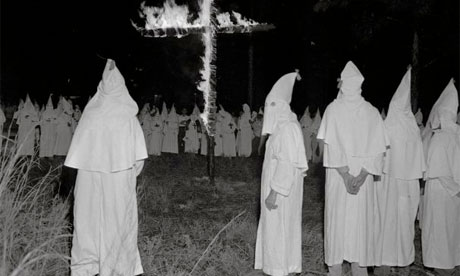
Kennedy is most famous for infiltrating the Ku Klux Klan in the 1940s. Denied the chance to fight fascism in the second world war because of a bad back, he decided to fight it at home. He impersonated an encyclopedia salesman and joined a "Klavern", swearing to "uphold the principles of White Supremacy and the purity of White Womanhood." He funnelled information on Klan rituals (a juvenile mix of Freemasonry and college fraternity, complete with secret handshakes, elaborate titles and a rule book called "The Kloran") and, more importantly, whatever violence they were planning, to the police, the Anti-Defamation League and the Washington Post. He gave closely guarded Klan passwords to the writers of the popular "Superman" radio show, who used them in a story line in which the "Man of Steel" battles the hateful forces of the Grand Dragon.
In 1946, Kennedy wore his white robe and hood to crash a meeting of the House Un-American Activities Committee. He wanted them to investigate the Klan. They had him thrown out of the capitol. Mississippi Congressman John Rankin, chair of Huac, said, "After all, the KKK is an old American institution."
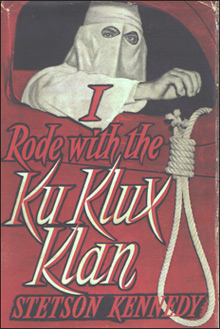 Cover image of Stetson Kennedy's I Rode With the Ku Klux Klan (1954), later renamed The Klan Unmasked. Photograph: Kennedy Archives
 Kennedy published two books based on his undercover activities, Southern Exposure in 1946 and in 1954, the lurid I Rode With the Ku Klux Klan, written in hardboiled detective style (it was later retitled The Klan Unmasked). He became Klan Enemy No 1, with Grand Dragon Sam Green offering a reward for killing him: "Kennedy's ass is worth $1,000 a pound!"
William Stetson Kennedy was a traitor to his race and to his class. What's more, he was proud of it.
He was born in 1916 to a well-off Florida family, a descendant of plantation-owning signers of the Declaration of Independence, Confederate officers and John Batterson Stetson, maker of the famous cowboy hats. He recalled that when he was a child in the 1920s, local Klan thugs beat and raped the beloved Kennedy family maid for "sassing whitefolks". Perhaps that spurred his precocious antipathy to the racial politics of the south: "At a very tender age, I became aware that grownups were lying about a whole lot more than Santa Claus."
In 1936, while a student at the University of Florida, he collected boots and blankets for the Republican side in the Spanish civil war. In the late 1930s, he went to work for the federal writers project of Franklin Roosevelt's Works Progress Administration collecting folklore with Zora Neale Hurston, later famous for her novel Their Eyes Were Watching God. Together, they'd travel the back roads, the revolver-packing black preacher's daughter and the word-besotted Confederate general's grandson, collecting the rapidly disappearing tales of Old Florida, stories of voodoo, talking alligators, jook joints and neo-slavery in the turpentine camps. In an interview in 2004, Kennedy recalled, "Zora and I were at a camp near Cross City where we met this octogenarian who'd been born 'on the turp'mntine.' I asked why he didn't just leave, and he said 'the onliest way out is to die out and you have to die 'cause if you tries to leave, they'll kill you.'"
His WPA material became the basis of his first book, Palmetto Country, published in 1942. Woody Guthrie, whose "This Land is Your Land" is still beloved of schoolchildren who have no idea they're singing a socialist anthem, fell in love with Kennedy's work. The proletarian troubadour who inspired Bob Dylan sent Kennedy a Joycean fan letter, asking for songs he'd collected – "the sort that make the wives of senators faint when they hear them" – praising Kennedy's "lecturetalks against the KKK and all the rest of the stoolies, gooners and fonies in general, the raceyhaters, pinkybaiters, deadbrainers, and fraidy cats."
The McCarthyite, Jim Crow America of the 1950s wasn't exactly friendly to the likes of Stetson Kennedy. New York publishers would touch him, and besides, the Klan had tried to burn down his house in Florida. So he left for Paris, where he got to know black writer and fellow southerner Richard Wright, and Jean-Paul Sartre who helped him publish The Jim Crow Guide to the USA. Meanwhile, Woody Guthrie, always in need of a place to stay, wrote dozens of songs there, but also stationed a shotgun by the front door in case the Klan came calling.
Stetson Kennedy's house "Beluthahatchee" still stands by a lake ringed with cypress trees full of snowy egrets and osprey. The name comes from a black Seminole folktale collected by Zora Neale Hurston – Beluthahatchee is a sort of Garden of Earthly Delights, a place where "all is forgiven". After wandering for a decade, Kennedy came home to Florida, determined to find what he called "the other America", the one "envisioned by the Founding Fathers and Lincoln, Whitman, Guthrie, Robeson et al. Which is to say a democratic society and government functioning for the common good of the people, as opposed to megaprofit for the few."
He joined lunch counter protests in southern cities throughout the 1960s and agitated for environmental protection until he went into hospital for the last time. In 2006, the authors of Freakonomics, who based an admiring chapter on Kennedy's The Klan Unmasked, concluded they had been "hoodwinked", and challenged his account of Klan infiltration. This ignited a fiery protest, with Studs Terkel angrily defending his old friend in a letter to the New York Times:
"[Stetson] could well be described as a 'troublemaker' in the best sense of the word. With half a dozen Stetson Kennedys, we can transform our society into one of truth, grace and beauty."
Investigations by several newspapers, and evidence from Peggy Bulger, director of the American Folklife Centre at the Library of Congress, generally exonerated Kennedy.
In his tenth decade of life, Stetson Kennedy would say, "I like to think I haven't mellowed." He hadn't: he was still marching for farmworkers' rights at the age of 93. In hospice care a few days ago, a doctor came into check his mental facilities: "Where are you from?" said the doctor. Stetson Kennedy replied, "Planet Earth."
| U.S. Attorney’s Office September 02, 2011 |
WASHINGTON—Joe L. Parrish, 51, and Gregory A. Scott, 59, both inspectors at the District of Columbia Department of the Environment (DDOE), Air Quality Division, were arrested yesterday by agents from the FBI and the D.C. Inspector General’s Office and charged in a criminal complaint with demanding and receiving $5,000 in cash as a bribe for not reporting serious environmental infractions and assessing fines and penalties.
The arrests were announced today by U.S. Attorney Ronald C. Machen Jr.; James W. McJunkin, Assistant Director in Charge of the FBI’s Washington Field Office; and Charles J. Willoughby, Inspector General for the District of Columbia.
Parrish, of Windsor Mill, Maryland, and Scott, of Temple Hills, Maryland, were charged with receipt of a bribe by a public official. If convicted of the charge, they face up to 15 years in prison. They appeared this afternoon in the U.S. District Court for the District of Columbia.
The arrests followed an investigation by the FBI’s Washington Field Office and the D.C. Inspector General’s Office. In court today, prosecutors said the men accepted an additional $15,000 immediately preceding their arrests yesterday, for a total of $20,000 in payments.
“Yesterday’s events demonstrate how closely law enforcement is working together to root out corruption in our city,” said U.S. Attorney Machen. “We will remain vigilant in our efforts to detect and disrupt public corruption schemes in the District of Columbia.”
“Corruption erodes the public’s confidence in our institutions and we take these matters seriously,” said Assistant Director McJunkin. “Fighting public corruption remains one of the FBI’s top priorities and the men and women of the Washington Field Office work every day to investigate and bring to justice those who choose illegal gain over public service.”
According to the affidavit filed in support of the complaint, as DDOE inspectors, Parrish’s and Scott’s primary duties and responsibilities included inspecting, monitoring and investigating air quality complaints, and preparing and submitting reports to DDOE attorneys to take action against the violators, including the assessment and collection of fines. They also were responsible for ensuring that contractors who were removing asbestos did so in a manner that protected the health and safety of the asbestos workers, building occupants and general public, and that all work was done in accordance with D.C. regulations and the federal Clean Air Act.
On the afternoon of August 23, 2011, at approximately 2 p.m.—just minutes after the earthquake hit the Mid-Atlantic area—Inspectors Parrish and Scott met with a cooperating witness at an apartment building on P Street in Southwest Washington that was undergoing major renovations and demanded cash payments in return for not reporting to the DDOE various environmental infractions that had been uncovered.
Specifically, during the meeting with the cooperating witness, Inspectors Parrish and Scott detailed the infractions that had been uncovered at the building, and the amount of potential fines associated with them. The inspectors then explained that based on their calculations, the fines owed by the management company of the building and the general contractor who were performing renovation work were at least $20,000 per day, multiplied by 18 days.
Inspectors Parrish and Scott further explained that they had already prepared a report and taken photographs and that they were obligated to submit the materials concerning the serious environmental infractions to the attorneys at the DDOE so they could institute proceedings against the management company and general contractor to collect hundreds of thousands of dollars in fines.
Finally, Parrish and Scott stated that the violations, which purportedly included the illegal dumping and transportation of hazardous materials (asbestos), were also violations of the federal criminal environmental laws, and punishable by jail sentences.
Inspectors Parrish and Scott advised the cooperating witness that they were willing to “help” the management company, but they needed to be “compensated” for their efforts. They also stated that they had already prepared their written report, but were willing to “burn” it and not inform the DDOE of the infractions. The cooperating witness then paid a bribe of $2,500 cash each to Inspectors Parrish and Scott, who agreed that they would not file their written report, and other evidence of infractions with the DDOE.
Charges contained in criminal complaints are merely allegations that a defendant has committed a violation of criminal laws and every defendant is presumed innocent until, and unless, proven guilty.
|
|
|
|
|
|


 Posted by