See below.
Our community is united, as never before, by the overt acts of WILLIAM L. PROCTOR, lame-duck State Representative, wh0 is pushing eminent domain legislation for FSDB, and who has embroiled FSDB in his hare-brained scheme, complete with the illegal hiring of two firms -- one law firm and one lobbying law firm, in violation of F.S. 11.062, against the peace and dignity of the State of Florida, and in violation of our Florida and U.S. Constitutions. Just say no.
Sunday, February 12, 2012


St. Augustine Record Editorial: Vote No on FSDB Eminent Domain Legislation
Our view: Don't give FSDB eminent domain
Posted: January 29, 2012 - 12:34am

Officials of The Florida School for the Deaf and the Blind want the Florida Legislature to give the school the same powers of eminent domain other public education institutions have. They say they don’t have any plans to use it now but would like it, just in case for the future. And they say it would save public dollars on land costs.
But they want it without local government oversight and that’s where we part ways with the school, the bill and state Rep. Bill Proctor.
In his last term in the Florida House of Representatives, Proctor is pushing House Bill 1037 which would give the school eminent domain. Proctor is not the sponsor of the bill but he might as well be. The bill’s sponsor is Rep. Doug Broxson of Gulf Breeze.
Proctor is the political face of FSDB and has been for more than two decades, including his 18 years on the board of trustees, 12 of them as chairman. There’s little doubt in our mind that the bill is being pushed as a “thank you gesture” from his colleagues. Proctor would disagree with us because he said to the Record Editorial Board recently that the bill is needed to give FSDB what other public educational entities already have — the power to take private property, if necessary, for the institution’s use and at reasonable costs. We agree those powers are allowed for public schools, colleges and universities. But, along with the power in the law, there are also requirements that those entities work with local governments on their expansion and master plans.
Until Wednesday, HB 1037 included those same kinds of requirements. But Wednesday night, during the House Community & Military Affairs committee, those requirements to cooperate were deleted from the bill. And the bill analysis at myfloridahouse.com said it passed without objection.
The bill must face other committees before the full House votes. But, the new version is so badly gutted of checks and balances that we have to question what the House wants the bill to be? It appears the only goal is to allow the school unregulated powers of eminent domain. We do not believe this should occur. We fully expect that if this bill passes the House and Senate that FSDB will have greater powers than any other public school or college or university over eminent domain.
This bill is about the future. While FSDB has said it has no expansion plans now, a future board of trustees and administration could change that. With the wrong people in power, and eminent domain authority without local government oversight, we could see whole neighborhoods disappear.
The Florida Legislature should let this bill die. Should it pass, we hope Gov. Rick Scott has the political will to veto it.
St. Augustine Record: Even Ex-County Commission Bruce Maguire Opposes FSDB Eminent Domain
Guest Column: Eminent domain should not be given to non-elected boards
Posted: January 10, 2012 - 11:14pm
By 
I am strongly opposed to granting eminent domain (ED) authority to The Florida School for the Deaf and the Blind. While a County Commissioner, we denied a similar request to delegate ED powers to a non-governmental agency for several reasons. Those reasons stand just as strongly today.
Here are just a few.
First, I firmly believe eminent domain should never be granted to any organization which does not have direct accountability to the people in the community. Emphatically, the organization must be comprised of elected officials. Political appointees may be empathetic to the community, but they do not have accountability.
Second, FSDB Trustees have a fiduciary responsibility to the school, not the community. They may temper their decisions based on inputs from the city of St. Augustine and the community, however, legally they must do what is best for FSDB. On the other hand, elected officials represent the people, not the organization. To restate The St. Augustine Record… “with eminent domain, FSDB could remove [zoning]… restrictions.” I don’t believe our community really wants that.
Third, the argument that all other schools have ED authority is not justification to grant it to FSDB. It is merely background support for those who want to have the authority. This is the same argument parents face when their children say, “All the other kids do it!” Is FSDB going to jump off the same cliff?
Fourth, historical records of eminent domain in Florida vividly show that ED costs to the organization range between 125 percent to 200 percent of true market value. That is much higher than a negotiated price. Remember, the condemning organization must pay “all” costs associated with the condemnation.
Fifth, if FSDB truly believes they need to condemn a property, they can approach the city and request support and assistance from the City Commission on an “as needed” basis. By working with the city, both the school and the community should benefit.
Sixth, St. Augustine is not your average city with a state school nestled within its limits. We are the oldest city in the United States. Maintaining our historical character is paramount, which may place it at odds with the FSDB goals and capabilities.
Finally, the school does not need it. Both Rep. Bill Proctor and FSDB President Danny Hutto stated there are no acquisition plans. Then, why? The answer can only be “Because!” The “hamstring” argument just doesn’t fly.
Eminent Domain is one of the most powerful tools a government possesses. Commissioner Leanna Freeman was correct when she said, “It is a threat!” I encourage all our residents to contact our North Florida state legislators and senators to not support this bill.
■
Bruce Maguire served on the St. Johns County Commission, 2002-06, and County Commission chairman.
 Comments (1)
ADVISORY: Users are solely responsible for opinions they post here and for following agreed-upon rules of civility. Comments do not reflect the views of The St. Augustine Record or StAugustine.com. Comments are automatically checked for inappropriate language, but readers might find some comments offensive or inaccurate. If you believe a comment violates our rules, click the "Flag as offensive" link below the comment.

Thank you Bruce Maguire
By DavidWiles | 01/11/12 - 01:18 pm
For the public record, I believed that I would never agree with or side with Bruce Maguire on any form of St. Johns politics and policy. Yet his comments about the Deaf&Blind politics (handicapped child versus land use) are spot on in accruate description of the 2012 session context..
Of the seven points noted, I would only question the seventh. Should there be some even grander scheme in the minds of Vilano Town Center development interests then the A1A roadway expansion and investment parcels might be the true Bill Proctor story. It may be safer to suggest that no overt signs of developer 'need' yet but watch the transfer development rights struggle in Vilano and ripple effects along all the *infrastructure* corridor of existing services.
However, after also reading the assault on higher education that the good Doctor and Dean Cannon gush about in anoither Record article I believe The Last Proctor Term this session will be a multiple stage performance to behold. As Bruce put it so beautifully, ' the hamstring' argument don't hold water when this Educator legislator uses it. More to come as the spring unfolds, for sure...
St. Augustine Record: Commissioner Leanna Freeman Coluum Opposing FSDB Eminent Domain
Guest column: FSDB doesn't need eminent domain
Posted: January 6, 2012 - 12:42am
By 
Our lawmakers were sent to Tallahassee to bring about fiscal responsibility and smaller government for state residents. We rely on them to advocate sound financial decisions and legislation that will strengthen municipalities and individual rights. They have been asked to pass House Bill 1037 which will give powers of eminent domain to the Florida School for the Deaf and the Blind, and remove the requirement that the school’s expansion be subject to City approval. The bill is being lobbied by State Rep. William Proctor, who will retire in 2012.
Lawmakers should not pass House Bill 1037. Our state should not support a bill that negatively impacts our community’s economy. FSDB is located within the City of St. Augustine, a community of 13,000 residents. I have been told by Realtors and appraisers that the impact of the proposal has already devalued neighboring properties and made them less desirable to potential buyers. Reducing property values reduces the city’s tax base. The 13,000 residents who finance a city, which supports five million visitors per year, will be faced with a heavier burden.
The school in recent years purchased and removed from our local tax rolls at least two city blocks. The State funded the purchase of property zoned mostly single family residential for the purpose of building non-single family facilities. I wonder how the multi-million dollar purchase was approved and whether the right questions were asked at the time. These properties were removed from the tax base and again shifted the weight to residents.
Every property owner should ask how the value of their property would be impacted if their neighbors were given powers of eminent domain. I suspect all response would be negative. While visitors love our city because of its “livability,” it is clear that neighboring properties will be much less desirable when neighbors have powers of eminent domain and streets formerly lined with homes are lined with massive institutionally-designed structures.
The school, its students and its employees are unarguably assets to our community. I hear no one speak more fondly of the students and their goals than the residents with whom they have the most interaction, the school’s neighbors. There are about 650 students at the 73- acre school, which is down nearly 10 percent from five years ago. So, why the urgent need for unrestricted expansion?
In Proctor’s letter to the editor he quoted the school president‘s declaration that there “are no current plans to acquire additional properties.” If there are no plans to acquire additional property, enrollment is on the decline and the impact of passing the bill is negative on property values and our community, then why seek eminent domain and why would a lawmaker support the passage? As to building on the acquired property, why not do so in a way that would compliment the neighborhood? How about a structure designed to compliment the neighboring homes? Let’s hope the right questions are asked this time around.
■
Leanna Freeman was elected to the St. Augustine City Commission in 2008 for a four-year term. In 2010, she was elected by commissioners to a two-year term as vice mayor.
Comments (9)
ADVISORY: Users are solely responsible for opinions they post here and for following agreed-upon rules of civility. Comments do not reflect the views of The St. Augustine Record or StAugustine.com. Comments are automatically checked for inappropriate language, but readers might find some comments offensive or inaccurate. If you believe a comment violates our rules, click the "Flag as offensive" link below the comment.

FSDB
By DavidNealBenson | 01/06/12 - 11:03 am
Thanks, Commissioner, for speaking up on this clearly negative legislation to award powers of eminent domain to the Florida School for the Deaf and Blind. The House Bill 1037 is so obviously political, and so glaringly arrogant, that all citizens of St. Augustine should call Representative Proctor to task. If Dr. Proctor is seeking a gift/legacy to leave behind for his community, a weakened tax base is not it. This bill will be a lasting embarrassment for him. Thanks for asking the right questions.
DNBenson
Thanks Commissioner Freeman
By marine1941 | 01/06/12 - 12:10 pm
for truly representing the citizens of St. Augustine. It's clear that Rep. Proctor does not.

Ditto - thank you!
By me | 01/06/12 - 03:38 pm
Well written, Commissioner Freeman!
“It is difficult to get a man to understand something, when his salary depends upon his not understanding it.” - Upton Sinclair

VICE MAYOR FREEMAN IS RIGHT ON
By hearmeroar | 01/06/12 - 04:57 pm
Well done! Brava! I hope you will continue to push this point at every opportunity. It wouldn't hurt for your four commissioners to jump on board.
Please speak to this at Monday night's meeting.
stupid people
By working today | 01/07/12 - 07:04 am
"I have been told by Realtors and appraisers that the impact of the proposal has already devalued neighboring properties and made them less desirable to potential buyers." yeah and I was told the moon was made of cheese. Jeez, FSDB tore down a crack motel, a transmission repair shop (in need of repair itself) and some pretty unsightly houses. Doesn't anyone remember what that blocked looked like before?
"As to building on the acquired property, why not do so in a way that would compliment the neighborhood?" Really? Would you people actually go drive around North City and get a reality check?
And lastly, the whole reason for the "eminent domain" proposal was all the crap the "community" gave them when they tore down the previously mentioned unsightly building and put up some very nice buildings and green space. Please take drive over to my old neighborhood, N. city and look for yourself. There is no devil lurkin around waiting to take neighbors property.
negatively impact
By patek | 01/08/12 - 08:26 am
Tell us Ms. Vice Mayor how the community will be negatively impacted. Oh, the city coffers will lose some tax money. Just what percentage would that be? How much less will our "heavy burden" become if we lose these few properties?
I think those who have been offering to sell their property to FSDB are expecting to be positively impacted, particulaly at the prices they want!
As "working today" pointed out, the area is much more positive today than it was 10 to 15 years ago, and we can thank FSDB for that!
Who are we "looking out" for? The Vice Mayor is looking for votes, FSDB is looking out for those who truly need our assistance.
But I guess we can say we do have a liberal wanting a smaller government, but more tax dollars.
neighborhood 'dis'
By divas@bellsouth.net | 01/17/12 - 01:40 pm
I take issue with the comments about 'unsightly' comments in regard to the residential neighborhood. I've grown up around that area. North city has been a desirable neighborhood, with affordable housing that offers much more appeal that most options. The ever-sprawling tall, black industrial fences cutting the school off from the community are just one of the more invasive elements of the school's increasing dominance of a residential neighborhood. The fences actually do qualify as unsightly, not to mention ominous, and give the campus a creepy, old school-institutional look, while cleaving up the neighborhood. If the viewpoint of a community fighting for its existence is "crap" what does that mean for someone expressing their opinion in a comments arena? As to "more tax dollars", you might want to research (per the audit that criticized the FSDB) how the school actually acquired those properties, set the 'comps by offering fraudulent excessive prices, and then also, allegedly, double billing the state - which would be we, the tax payers (therefore 'pissing away' our money). All this done without having the required zoning to actually build what they professed to want on that property.
neighborhood 'dis'
By divas@bellsouth.net | 01/17/12 - 01:43 pm
I take issue with the comments about 'unsightly' comments in regard to the residential neighborhood. I've grown up around that area. North city has been a desirable neighborhood, with affordable housing that offers much more appeal that most options. The ever-sprawling tall, black industrial fences cutting the school off from the community are just one of the more invasive elements of the school's increasing dominance of a residential neighborhood. The fences actually do qualify as unsightly, not to mention ominous, and give the campus a creepy, old school-institutional look, while cleaving up the neighborhood. If the viewpoint of a community fighting for its existence is "crap" what does that mean for someone expressing their opinion in a comments arena? As to "more tax dollars", you might want to research (per the audit that criticized the FSDB) how the school actually acquired those properties, set the 'comps by offering fraudulent excessive prices, and then also, allegedly, double billing the state - which would be we, the tax payers (therefore 'pissing away' our money). All this done without having the required zoning to actually build what they professed to want on that property.
St. Augustine Record: Commission William Leary's Guest Column Opposing FSDB Eminent Domain
Guest column: City and FSDB must work out problems locally not by legislative fiat
Posted: January 29, 2012 - 12:35am
By 
At Friday’s emergency meeting of the Board of Trustees of The Florida School for the Deaf and the Blind (FSDB), at which angry and fearful neighbors were gratefully allowed to speak their minds, I was struck by how much it seems we are all puppets dancing to the strings of Bill Proctor.
Act One was 10 years ago when the school, under his leadership, purchased several residences in the block bordered by Genopoly and Alfred streets for future use. Proctor concluded the school paid too much and vowed to run for the Florida Legislature to give FSDB eminent domain powers so it would never have to over-pay again.
Act Two began last spring involving the Collins House, a large carriage house on a residential lot owned by FSDB used to house students. After two years of disuse, FSDB decided to renovate rather than demolish the structure and expand its use and size beyond that allowed under city single-family residential zoning. Nearly all neighbors were pleased the building was being saved, but many objected to the code violations. Over their and the city’s objection, FSDB nonetheless implemented its restoration plan and has moved students back into the building.
Into this cauldron of discord and mistrust Proctor thrust legislation to (1) resolve the Collins zoning issues in favor of the school by legislative fiat; (2) replace the requirement that the school cooperate with the city in its expansion with a requirement that the city serve FSDB’s interests even if that means ignoring the will of its citizens; and (3) give the appointed board of trustees the power to take private property by eminent domain even if over the objections of the owners or their elected officials.
Some have said that Proctor has chosen in his last year in office to represent FSDB rather than St. Augustine. I believe that in his personal quest to right a perceived affront a decade ago, Proctor now represents the best interests of neither. Clearly his quest is at odds with the City of St. Augustine and its residents. But in the long run, it does not further the interests of the school. Long after Proctor stops pulling the strings, FSDB, the city and its residents will have a relationship. Surely the school’s board does not wish it to continue as it is. I understand the board’s priority to protect and meet the needs of the students and their families. We all honor them for what they do.
Likewise, I respect Proctor’s devotion to FSDB, but on this matter, we clearly disagree. He says it’s just fair to give the school eminent domain because the other public schools have it. But that is casuistry. Even if those school systems did not, I believe he would argue FSDB should because it is unique. The simple fact is that one must view his quest not as filling in the last piece of some educational governance puzzle, but as pouring oil onto a raging fire. His legislation will ensure that for many years to come, the relationship between the school and its neighbors and the city will remain needlessly cold.
It will be hard to stop Proctor’s personal quest because through patience and political cunning he is positioned to effect trades with other legislators to achieve his goal. But it a misuse of the Legislature to keep us here locally from working this out ourselves. There is a saying that “things work out best for those who make the best of the way things work out.” If he will allow it, FSDB and we will work this out. For our future, we simply must.
■
Bill Leary was elected to the St. Augustine City Commission for a four-year term in 2010. He previously served on the city’s Planning and Zoning Board.
Comments (1)
ADVISORY: Users are solely responsible for opinions they post here and for following agreed-upon rules of civility. Comments do not reflect the views of The St. Augustine Record or StAugustine.com. Comments are automatically checked for inappropriate language, but readers might find some comments offensive or inaccurate. If you believe a comment violates our rules, click the "Flag as offensive" link below the comment.
Bill Leary
By NEFLNative | 01/29/12 - 12:05 pm
The best thing the city residents ever did was elect Bill Leary to the City Commission! Excellent editorial, Commissioner Leary!
NEFLNative
St. Augustine Record: Another guest column opposes FSDB eminent domain
Guest column: Eminent domain bill tarnishes Proctor's legacy
Posted: February 12, 2012 - 12:20am
By 
Rep. Bill Proctor has a bill going through the Legislature (House Bill 1037/Senate Bill 1348) which gives unrestricted eminent domain, the power to take people’s homes, to the Florida School for the Deaf and the Blind, and deletes Florida Statutes regarding local oversight and requiring FSDB to cooperate with local government and the community. Several people, including myself, traveled at 3:30 a.m. to speak against the bill before the House Economic Affairs committee meeting on Feb.1.
As reported, after extensive discussions on previous bills, public comment on his bill, last on the agenda, was limited to 30 seconds per speaker. Though all were in opposition the bill passed committee and will continue on to the House calendar.
Despite having pre-promised their votes, many on the committee were clearly uncomfortable with the disingenuous arguments by sponsor Rep. Doug Broxson, R-Gulf Breeze, and Proctor for giving FSDB the power to take historic homes — particularly when they admit there is no need. Student enrollment is down and the current campus is sufficient.
In closing Proctor challenged, “Give me a logical reason why …(FSDB) should not have eminent domain.” Our local delegation, prepared with many conclusive reasons, were not given the chance to answer.
Proctor then said, “…it must be because the kids are blind, and deaf and disabled, and that’s a pretty sorry reason.”
That statement was shamelessly manipulative, reprehensible — and illuminating.
Having listened to Proctor slander the neighborhood in two committees, misrepresent his opinions as fact, and justify past poorly conceived land “acquisitions,” that statement made it clear that his argument was not about the needs of the school, nor did it reflect a sincere interest in the children.
Funding the needs of FSDB students — education, housing, services — is not the question. State allocations to the school flow virtually unencumbered, devoid of discrimination based on the kids being blind, deaf or disabled. FSDB receives money unimaginable to regular public schools due to those disabilities.
This bill is about Proctor’s want, not FSDB’s need. It is his intent is to shut down any opposition to that “want” which is rooted in a strong sense of entitlement, by any means necessary, including exploiting the disabilities of the students, destroying historic structures, and sacrificing the interest of his actual constituents, the people of St. Augustine.
Why should the school be given eminent domain when there is a conclusive history, based on audits from the State Auditor General, of financial mismanagement, waste of public funds, violation of law and disregard for the city of St. Augustine’s efforts to protect the historical components that are at the core of its economy?
The intentional deception Proctor has employed in the past, and in pursuing the passage of this bill indicates complete disregard for the city of St. Augustine and should generate fear in homeowners throughout the community, that FSDB will gain the power to claim their homes, against their will, with no oversight whatsoever.
This bill also damns a positive relationship between FSDB and the community that has long embraced its students and its mission.
Proctor said the only reason he ran for the Legislature was to get this bill through. He’s used his seniority in the Legislature, not to benefit his constituents, but on this bill.
Proctor has accomplished important things in the community. However, the respect once his due, will now be forfeited by this eminent domain bill. Proctor will be remembered not for his achievements but for his deception and in his denial of his own community of St. Augustine.
■
Lisa Parrish Lloyd said she grew up in Nelmar Terrace. She is active with Memorial Presbyterian Children’s Ministry and Betty Griffin House. A graduate of Florida State University, she worked in legislative offices and has written for various publications.
Comments (2)
ADVISORY: Users are solely responsible for opinions they post here and for following agreed-upon rules of civility. Comments do not reflect the views of The St. Augustine Record or StAugustine.com. Comments are automatically checked for inappropriate language, but readers might find some comments offensive or inaccurate. If you believe a comment violates our rules, click the "Flag as offensive" link below the comment.

What legacy?
By me | 02/12/12 - 07:53 am
The one that already was tarnished by his unflagging efforts to dismantle public education and villify teachers?
“It is difficult to get a man to understand something, when his salary depends upon his not understanding it.” - Upton Sinclair
St. Augustine Record: Another guest column opposes FSDB eminent domain
Guest column: Supports FSDB's mission but opposes its quest for eminent domain
Posted: February 12, 2012 - 12:20am
By 
I am writing to voice my support of the mission of the Florida School for the Deaf and Blind in St. Augustine, and my strong opposition to House Bill CS/HB 1037, which gives FSDB almost unlimited eminent domain powers over surrounding neighborhoods, as well as over any part of the city they see fit. The wording “at the school’s convenience,” which is actually included in the bill verbatim, stands out as an indication of this bill’s ridiculous overreach, as does the stipulation that FSDB will no longer have to comply with any city planning and zoning ordinances whatsoever. Taken to its logical extreme, FSDB could decide that any historic personal city property should belong to them for whatever unspecified purpose they come up with.
Essentially, this gives a single unelected entity the powers of unjustified seizure and indemnity from accountability in our nation’s oldest city. FSDB could, without reason or justification, seize, and remove from our city’s tax rolls, any property they desire.
I understand that the power of eminent domain is an essential tool for a government that has been elected by the people and tasked with considering the greater good of the larger population when making land use decisions. Normally, these decisions are made by our elected representatives when the greater good can be shown to overwhelmingly outweigh the property rights of those affected. As Americans, we are intrinsically wary of government power. Consequently, the power of seizure in this country has historically been used sparingly, openly, and only when absolutely justified. House Bill CS/HB 1037 would give an unelected board unprecedented powers of seizure without due process or accountability.
Rep. Bill Proctor has stated openly that passage of this bill is the main reason he ran for office. I would like to humbly remind him that he was elected as our representative in Tallahassee, and we, his constituents, as well as the city of St. Augustine strongly oppose its passage. If he would like to, he would be welcome to our house — one block away from FSDB — to explain to our child how a school can evict him, whenever they want and for whatever reason, from the only home he has ever known.
Republicans have traditionally fought against government size and power, and for individual property rights. Being that the Florida Legislature has a Republican majority, I am surprised that this bill even made it out of committee.
I sincerely hope that those of our elected representatives who do truly represent their constituents will vote against House Bill CS/HB 1037 before a precedent is set that my family and my neighbors will regret in the short-term, and that all of Florida’s residents will come to regret in the future.
■
David Haynes is a middle school science teacher in St. Johns County public schools, a native Floridian and St. Augustine resident for 10 years.
Two Florida Government Entities Guilty of Not Paying Attention


On February 1, 2012, the Florida State House of Representatives Economic Affairs Committee gave former Mayor George Gardner, and other local residents, 30 seconds or less to oppose eminent domain for the Florida School for the Deaf and Blind.
Then on February 10, 2012, our Florida School for the Deaf and Blind Board of Trustees members were guilty of not paying attention when we asked them to pull the eminent domain legislation. Michael Gold writes on Historic City News that: "At one point during early comments, while community activist Ed Slavin was addressing the Board, one of the members was observed browsing the CNN Money website; seemingly more interested in what finance ministers in Greece had to say about their nation’s steps to qualify for a second financial bailout than what Mr. Slavin had to say."
Thank you, Mr. Gold.
Now, based on this reporting, anyone in the City of St. Augustine who wants to challenge FSDB's refusal to pull its eminent domain legislation can cite to the California Court of Appeals case (below) -- he who decides must pay attention. He who isn't paying attention isn't fit to decide.
California Court of Appeals Holds "He Who Decides Must Hear" -- LA City Council Members Not Paying Attention Required Remand for New Hearing
Filed 12/30/04
CERTIFIED FOR PUBLICATION
IN THE COURT OF APPEAL OF THE STATE OF CALIFORNIA
SECOND APPELLATE DISTRICT
DIVISION EIGHT
LACY STREET HOSPITALITY
SERVICE, INC.,
Plaintiff and Appellant,
v.
CITY OF LOS ANGELES,
Defendant and Respondent.
B170716
(Los Angeles County
Super. Ct. No. BS 084476)
APPEAL from the judgment of the Superior Court of Los Angeles County.
David P. Yaffe, Judge. Reversed and remanded.
Roger Jon Diamond for Plaintiff and Appellant.
Rockard J. Delgadillo, City Attorney, Jeri L. Burge, Assistant City Attorney,
Michael L. Klekner and Steven N. Blau, Deputy City Attorneys for Defendant and
Respondent.
2
Appellant Lacy Street Hospitality Services, Inc. (“LSHS”) appeals from the trial
court’s judgment denying it an administrative writ of mandate. We reverse and remand
for a hearing before the Los Angeles City Council that satisfies appellant’s due process
right to be heard.
FACTS AND PROCEDURAL HISTORY
LSHS leased commercial property in Los Angeles to operate an adult cabaret
known as The Blue Zebra, which showcased nude female dancers. When LSHS took
over the property, it assumed 20 land use restrictions imposed by the City of Los Angeles
on the property’s previous tenant, who had unsuccessfully tried to operate an adult
cabaret on the site. The city had imposed the conditions in order to mitigate the previous
cabaret’s harmful secondary effects on the surrounding neighborhood. (See Los Angeles
Municipal Code, § 12.27.1 [permits administrative nuisance abatement proceedings].)1
After taking over the property, LSHS exercised its right to seek a modification of
the city’s 20 conditions. (L.A.M.C. 12.27.1 (D) [allows modification of existing zoning
conditions].) One condition limited the cabaret’s hours from 6 p.m. to 2 a.m. seven days
a week. The second required LSHS to use independent contractors as security guards.
Claiming it needed longer operating hours in order to make a profit, LSHS sought
permission to open at 11 a.m. every day and to extend its weekend closing hours to 4 a.m.
Friday through Sunday. LSHS also sought permission to hire its own licensed guards to
provide security, instead of using an independent contractor.
1 Although nude dancing is protected expressive activity under the First
Amendment, government may regulate where such activity occurs provided it does not
ban it outright. (Barnes v. Glen Theater, Inc. (1991) 501 U.S. 560, 566.) In addition,
government may regulate harmful secondary effects associated with nude dancing so
long as the regulations do not target protected First Amendment expression. (E.W.A.P.,
Inc. v. City of Los Angeles (1997) 56 Cal.App.4th 310, 317, 325-327.)
3
LSHS submitted its requested modifications to the city’s Zoning Administrator
(“ZA”). After holding a public hearing and visiting the property, the ZA granted the
modifications. In support of his decision, the ZA filed a detailed 22-page report,
describing the evidence for and against the modifications and the reasons for his ruling.
Neighborhood and community members who opposed the modifications appealed
the ZA’s decision to the Los Angeles City Council, which referred the appeal to its
Planning and Land Use Management (“PLUM”) Committee. The PLUM committee held
a hearing on the proposed modifications. After hearing of the purportedly deleterious
effects of expanding LSHS’s operating hours and loosening security guard requirements,
the PLUM committee recommended that the city council reverse the ZA and reinstate the
original conditions. The city council scheduled a public hearing on the PLUM
committee’s recommendations and overturned the ZA.
LSHS filed a petition for a writ of administrative mandate. The trial court
reviewed the city council’s reversal of the ZA. The court found substantial evidence
supported the council’s action, and thus the council’s decision was not an abuse of
discretion. The court therefore denied the petition. This appeal followed.
DISCUSSION
Instead of reviewing the trial court’s judgment, we review the city council’s
decision reversing the ZA. Regardless of how the trial court assessed the matter, we will
reverse the city council if we find it abused its discretion. (Stolman v. City of
Los Angeles (2003) 114 Cal.App.4th 916, 922; Code Civ. Proc., § 1094.5, subd. (b).)
The city council was obligated to be fair and impartial. (Haas v. County of San
Bernardino (2002) 27 Cal.4th 1017, 1024-1026; Nightlife Partners v. City of Beverly
Hills (2003) 108 Cal.App.4th 81, 90-91.) Its duty to discharge its powers responsibly is
4
especially weighty when, as here, the city asserts the ZA’s decision did not constrain the
council.2
A picture is worth a thousand words, and here the picture was a videotape. LSHS
recorded the city council hearing, slowly moving the camera’s gaze back and forth from
one end of the council table to the other, at times lingering on particular council
members, capturing their behavior at that moment. The tape shows that when the council
president summoned LSHS to the speaker’s lectern to present its case, eight council
members--three of whom were absent--were not in their seats. Only two council
members were visibly paying attention. Four others might have been paying attention,
although they engaged themselves with other activities, including talking with aides,
eating, and reviewing paperwork.
One minute into LSHS’s presentation, a council member began talking on his cell
phone and two council members, one of whom had been paying attention when the
hearing opened, started talking to each other. A minute later, two other council members
struck up their own private conversation. Three minutes into his presentation, LSHS’s
counsel complained “it doesn’t appear that too many people are paying attention,” an
observation the videotape verifies, as only a few council members were sitting in their
seats not talking to others.
2 The city argues its municipal code allows the city council the broadest possible
de novo review of the ZA’s decision. We note, however, that the Los Angeles Municipal
Code states, “When considering an appeal from the decision of an initial decision maker,
the appellate body shall make its decision, based on the record, as to whether the initial
decision maker erred or abused his or her discretion.” (L.A.M.C. 12.24(I)(3).) When
the municipal code provides a standard, the city must apply it. (BreakZone Billiards v.
City of Torrance (2000) 81 Cal.App.4th 1205, 1221 & fn. 10; Civil Service Assn. v.
Redevelopment Agency (1985) 166 Cal.App.3d 1222, 1225-1227.) The city’s argument
makes the phrases “error” or “abuse of discretion” a nullity, a reading we must avoid.
Only when a municipal code is silent about the standard of review may we presume
de novo review. (Lagrutta v. City Council (1970) 9 Cal.App.3d 890, 894-895.) We need
not decide this issue, however, because whether de novo or abuse of discretion, the city
council did not conduct itself as a fair and impartial body.
5
Despite LSHS’s public reproach of council members, their private conversations
and pursuit of other activities continued. For example, the council member with the cell
phone started another conversation on it and four council members talked among
themselves or with others. One council member was especially peripatetic, walking from
one side of the council chamber to the other to talk to different colleagues. Only five
council members and the council president sat at their desks spending most of their time
not talking to anyone--but even some of them turned their attention to other things from
time to time.
After 10 minutes, LSHS’s presentation ended and those opposed to the zoning
modifications began. Although the speakers changed, the council’s behavior did not.3
Some members paid attention, but even some of them divided their attention among
things such as reviewing paperwork and getting up from their seats to talk to others. At
one point, the camera zoomed out for a wide angle shot of the entire council table. At
that moment, only five members were at their seats, and only one member appeared to be
focusing on what the speakers were saying.
We do not presume to tell the city council how it must conduct itself as a
legislative body. Here, however, the city council was sitting in a quasi-judicial role,
adjudicating the administrative appeal of constituents. A fundamental principle of due
process is “he who decides must hear.” (Vollstedt v. City of Stockton (1990) 220
Cal.App.3d 265, 276.) The inattentiveness of council members during the hearing
prevented the council from satisfying that principle. (Haas v. County of San Bernardino
(2002) 27 Cal.4th 1017, 1024 [“due process requires fair adjudicators in administrative
tribunals”]; Henderling v. Carleson (1974) 36 Cal.App.3d 561, 566 [takes as a given that
administrative decision maker listens at hearing] disapproved on another point by Frink
3 The city’s argument that the hearing was “fair” because council members treated
LSHS and its opponents alike is unavailing because LSHS and its opponents had the right
to be equally heard, not equally ignored.
6
v. Prod (1982) 31 Cal.3d 166, 180; Chalfin v. Chalfin (1953) 121 Cal.App.2d 229, 233
[fact finder must listen to the evidence before making a decision].) Sitting as “judges” in
the appeal, the council was obligated to pay attention as is the obligation of sitting
members of the judiciary. (Accord, In re Grossman (1972) 24 Cal.App.3d 624, 629
[“Members of the bar have the right to expect and demand courteous treatment by
judges . . .”]; Model Code of Judicial Conduct Canon 3 (B)(4) (American Bar
Association 2000) [“A judge shall be patient, dignified and courteous to litigants, jurors,
witnesses, lawyers and others with whom the judge deals in an official capacity . . .”].)
The council’s distraction with a multitude of other things during the hearing is especially
troubling because it was reversing its own zoning administrator who took great care to
reach his decision. It is not our province to insist that the council members consider
every word of every witness. Good judgment and common sense are entitled to prevail.
(Vollstedt v. City of Stockton, supra, 220 Cal.App.3d at p. 276.) Here, however, the tape
shows the council cannot be said to have made a reasoned decision based upon hearing
all the evidence and argument, which is the essence of sound decision making and to
which LSHS was entitled as a matter of due process. Accordingly, we reverse and
remand.
DISPOSITION
We reverse and remand to the city council for a hearing that satisfies appellant
Lacy Street Hospitality Service’s due process right to be heard. The parties are to bear
their own costs.
CERTIFIED FOR PUBLICATION
RUBIN, J.
We concur:
COOPER, P.J. BOLAND, J.
CERTIFIED FOR PUBLICATION
IN THE COURT OF APPEAL OF THE STATE OF CALIFORNIA
SECOND APPELLATE DISTRICT
DIVISION EIGHT
LACY STREET HOSPITALITY
SERVICE, INC.,
Plaintiff and Appellant,
v.
CITY OF LOS ANGELES,
Defendant and Respondent.
B170716
(Los Angeles County
Super. Ct. No. BS 084476)
APPEAL from the judgment of the Superior Court of Los Angeles County.
David P. Yaffe, Judge. Reversed and remanded.
Roger Jon Diamond for Plaintiff and Appellant.
Rockard J. Delgadillo, City Attorney, Jeri L. Burge, Assistant City Attorney,
Michael L. Klekner and Steven N. Blau, Deputy City Attorneys for Defendant and
Respondent.
2
Appellant Lacy Street Hospitality Services, Inc. (“LSHS”) appeals from the trial
court’s judgment denying it an administrative writ of mandate. We reverse and remand
for a hearing before the Los Angeles City Council that satisfies appellant’s due process
right to be heard.
FACTS AND PROCEDURAL HISTORY
LSHS leased commercial property in Los Angeles to operate an adult cabaret
known as The Blue Zebra, which showcased nude female dancers. When LSHS took
over the property, it assumed 20 land use restrictions imposed by the City of Los Angeles
on the property’s previous tenant, who had unsuccessfully tried to operate an adult
cabaret on the site. The city had imposed the conditions in order to mitigate the previous
cabaret’s harmful secondary effects on the surrounding neighborhood. (See Los Angeles
Municipal Code, § 12.27.1 [permits administrative nuisance abatement proceedings].)1
After taking over the property, LSHS exercised its right to seek a modification of
the city’s 20 conditions. (L.A.M.C. 12.27.1 (D) [allows modification of existing zoning
conditions].) One condition limited the cabaret’s hours from 6 p.m. to 2 a.m. seven days
a week. The second required LSHS to use independent contractors as security guards.
Claiming it needed longer operating hours in order to make a profit, LSHS sought
permission to open at 11 a.m. every day and to extend its weekend closing hours to 4 a.m.
Friday through Sunday. LSHS also sought permission to hire its own licensed guards to
provide security, instead of using an independent contractor.
1 Although nude dancing is protected expressive activity under the First
Amendment, government may regulate where such activity occurs provided it does not
ban it outright. (Barnes v. Glen Theater, Inc. (1991) 501 U.S. 560, 566.) In addition,
government may regulate harmful secondary effects associated with nude dancing so
long as the regulations do not target protected First Amendment expression. (E.W.A.P.,
Inc. v. City of Los Angeles (1997) 56 Cal.App.4th 310, 317, 325-327.)
3
LSHS submitted its requested modifications to the city’s Zoning Administrator
(“ZA”). After holding a public hearing and visiting the property, the ZA granted the
modifications. In support of his decision, the ZA filed a detailed 22-page report,
describing the evidence for and against the modifications and the reasons for his ruling.
Neighborhood and community members who opposed the modifications appealed
the ZA’s decision to the Los Angeles City Council, which referred the appeal to its
Planning and Land Use Management (“PLUM”) Committee. The PLUM committee held
a hearing on the proposed modifications. After hearing of the purportedly deleterious
effects of expanding LSHS’s operating hours and loosening security guard requirements,
the PLUM committee recommended that the city council reverse the ZA and reinstate the
original conditions. The city council scheduled a public hearing on the PLUM
committee’s recommendations and overturned the ZA.
LSHS filed a petition for a writ of administrative mandate. The trial court
reviewed the city council’s reversal of the ZA. The court found substantial evidence
supported the council’s action, and thus the council’s decision was not an abuse of
discretion. The court therefore denied the petition. This appeal followed.
DISCUSSION
Instead of reviewing the trial court’s judgment, we review the city council’s
decision reversing the ZA. Regardless of how the trial court assessed the matter, we will
reverse the city council if we find it abused its discretion. (Stolman v. City of
Los Angeles (2003) 114 Cal.App.4th 916, 922; Code Civ. Proc., § 1094.5, subd. (b).)
The city council was obligated to be fair and impartial. (Haas v. County of San
Bernardino (2002) 27 Cal.4th 1017, 1024-1026; Nightlife Partners v. City of Beverly
Hills (2003) 108 Cal.App.4th 81, 90-91.) Its duty to discharge its powers responsibly is
4
especially weighty when, as here, the city asserts the ZA’s decision did not constrain the
council.2
A picture is worth a thousand words, and here the picture was a videotape. LSHS
recorded the city council hearing, slowly moving the camera’s gaze back and forth from
one end of the council table to the other, at times lingering on particular council
members, capturing their behavior at that moment. The tape shows that when the council
president summoned LSHS to the speaker’s lectern to present its case, eight council
members--three of whom were absent--were not in their seats. Only two council
members were visibly paying attention. Four others might have been paying attention,
although they engaged themselves with other activities, including talking with aides,
eating, and reviewing paperwork.
One minute into LSHS’s presentation, a council member began talking on his cell
phone and two council members, one of whom had been paying attention when the
hearing opened, started talking to each other. A minute later, two other council members
struck up their own private conversation. Three minutes into his presentation, LSHS’s
counsel complained “it doesn’t appear that too many people are paying attention,” an
observation the videotape verifies, as only a few council members were sitting in their
seats not talking to others.
2 The city argues its municipal code allows the city council the broadest possible
de novo review of the ZA’s decision. We note, however, that the Los Angeles Municipal
Code states, “When considering an appeal from the decision of an initial decision maker,
the appellate body shall make its decision, based on the record, as to whether the initial
decision maker erred or abused his or her discretion.” (L.A.M.C. 12.24(I)(3).) When
the municipal code provides a standard, the city must apply it. (BreakZone Billiards v.
City of Torrance (2000) 81 Cal.App.4th 1205, 1221 & fn. 10; Civil Service Assn. v.
Redevelopment Agency (1985) 166 Cal.App.3d 1222, 1225-1227.) The city’s argument
makes the phrases “error” or “abuse of discretion” a nullity, a reading we must avoid.
Only when a municipal code is silent about the standard of review may we presume
de novo review. (Lagrutta v. City Council (1970) 9 Cal.App.3d 890, 894-895.) We need
not decide this issue, however, because whether de novo or abuse of discretion, the city
council did not conduct itself as a fair and impartial body.
5
Despite LSHS’s public reproach of council members, their private conversations
and pursuit of other activities continued. For example, the council member with the cell
phone started another conversation on it and four council members talked among
themselves or with others. One council member was especially peripatetic, walking from
one side of the council chamber to the other to talk to different colleagues. Only five
council members and the council president sat at their desks spending most of their time
not talking to anyone--but even some of them turned their attention to other things from
time to time.
After 10 minutes, LSHS’s presentation ended and those opposed to the zoning
modifications began. Although the speakers changed, the council’s behavior did not.3
Some members paid attention, but even some of them divided their attention among
things such as reviewing paperwork and getting up from their seats to talk to others. At
one point, the camera zoomed out for a wide angle shot of the entire council table. At
that moment, only five members were at their seats, and only one member appeared to be
focusing on what the speakers were saying.
We do not presume to tell the city council how it must conduct itself as a
legislative body. Here, however, the city council was sitting in a quasi-judicial role,
adjudicating the administrative appeal of constituents. A fundamental principle of due
process is “he who decides must hear.” (Vollstedt v. City of Stockton (1990) 220
Cal.App.3d 265, 276.) The inattentiveness of council members during the hearing
prevented the council from satisfying that principle. (Haas v. County of San Bernardino
(2002) 27 Cal.4th 1017, 1024 [“due process requires fair adjudicators in administrative
tribunals”]; Henderling v. Carleson (1974) 36 Cal.App.3d 561, 566 [takes as a given that
administrative decision maker listens at hearing] disapproved on another point by Frink
3 The city’s argument that the hearing was “fair” because council members treated
LSHS and its opponents alike is unavailing because LSHS and its opponents had the right
to be equally heard, not equally ignored.
6
v. Prod (1982) 31 Cal.3d 166, 180; Chalfin v. Chalfin (1953) 121 Cal.App.2d 229, 233
[fact finder must listen to the evidence before making a decision].) Sitting as “judges” in
the appeal, the council was obligated to pay attention as is the obligation of sitting
members of the judiciary. (Accord, In re Grossman (1972) 24 Cal.App.3d 624, 629
[“Members of the bar have the right to expect and demand courteous treatment by
judges . . .”]; Model Code of Judicial Conduct Canon 3 (B)(4) (American Bar
Association 2000) [“A judge shall be patient, dignified and courteous to litigants, jurors,
witnesses, lawyers and others with whom the judge deals in an official capacity . . .”].)
The council’s distraction with a multitude of other things during the hearing is especially
troubling because it was reversing its own zoning administrator who took great care to
reach his decision. It is not our province to insist that the council members consider
every word of every witness. Good judgment and common sense are entitled to prevail.
(Vollstedt v. City of Stockton, supra, 220 Cal.App.3d at p. 276.) Here, however, the tape
shows the council cannot be said to have made a reasoned decision based upon hearing
all the evidence and argument, which is the essence of sound decision making and to
which LSHS was entitled as a matter of due process. Accordingly, we reverse and
remand.
DISPOSITION
We reverse and remand to the city council for a hearing that satisfies appellant
Lacy Street Hospitality Service’s due process right to be heard. The parties are to bear
their own costs.
CERTIFIED FOR PUBLICATION
RUBIN, J.
We concur:
COOPER, P.J. BOLAND, J.
IN HAEC VERBA: DID CONFLICTED STATE REP. WM. PROCTOR EMBROIL FSDB IN AN ILLEGAL LOBBYING SCHEME FOR EMINENT DOMAIN BILL? What do you reckon?
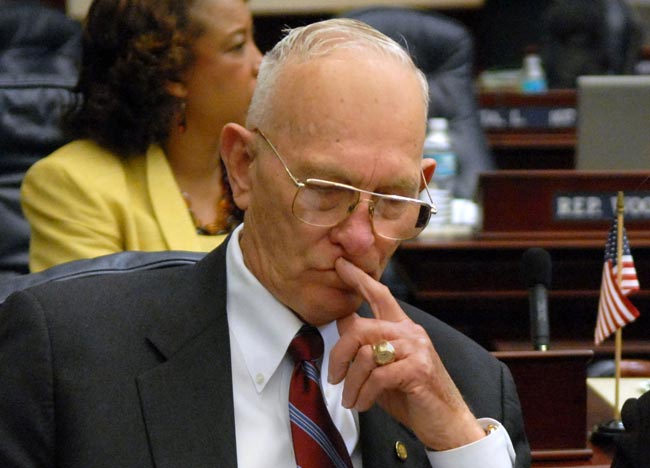
WALKING CONFLICT OF INTEREST -- Controversial WILLIAM L. PROCTOR, State Representative (R-20th), Flagler College Chancellor (and longtime President), longtime Florida School for the Deaf and Blind Chairman, FSU Interim Athletic Director -- Has WILLIAM L. PROCTOR now shown his true colors, embroiling the School for the Deaf and Blind in A Scheme to Hire Two Firms to Do Illegal Lobbying, 2011-2012 in Support of Eminent Domain?


SIDNEY F. ANSBACHER, Senior Partner in GRAYROBINSON:
Registered as FSDB Lobbyist 2011-2012, in Violation of F.S. 11.062, Faces Potential Two-year Ban on Lobbying?


From: Ed Slavin
Sent: Sunday, February 12, 2012 1:51 PM
To: bmarshall@gray-robinson.com; 'Sidney F. Ansbacher'
Cc: huttol@fsdb.k12.fl.us;
Subject: RE: FSDB's Lobbying for Eminent Domain Legislation, in Possible Violation of F.S. 11.062; Open Records Request No. 12
Dear Messrs. Marshall and Ansbacher:
1. I wrote you both on February 9, 2011.
2. You did not respond.
3. Do we infer correctly from your three (3) days’ silence that you have no choice but to concede that your lobbying work for FSDB was illegal?
4. Is it fair to say that GRAY ROBINSON must withdraw from representing FSDB? Will you please fax or E-mail me tomorrow a copy of any refund check that GRAY ROBINSON is sending to FSDB?
5. Do you agree that GRAY ROBINSON is a “person” within the meaning of F.S. 11.016(d)?
6. Do you agree that, since GRAY ROBINSON is a “person,” and as a result of Mr. Ansbacher’s illegal lobbying activities at the behest of Rep. Wm. L. Proctor (former FSDB Chair for fifteen years), every single one of GRAY ROBINSON’s 250 lawyers could be barred from lobbying for two (2) years -- including some 21 who have registered as lobbyists during 2011 or 2012?
7. By copy of this E-mail to FSDB President Danny Hutto, I am requesting that FSDB kindly provide all requested records tomorrow morning, without any further delays.
8. Senator Wise’s committee hearing on eminent domain is 2/14 at 1:30 PM – less than 48 hours from now. Time is of the essence.
9. We need the requested documents for committee testimony and other First Amendment protected activity.
10. Meanwhile, will FSDB please advise us tomorrow morning whether the FSDB eminent domain bill is being withdrawn?
11. FSDB’s answers to these questions will affect many our travel plans, and potentially those of many other people here in St. Augustine and St. Johns County, including public officials and private citizens who are concerned about abuse of eminent domain powers affecting two (2) neighborhoods protected by the National Register of Historic Places.
12. We look forward to hearing from you at your earliest opportunity.
Thank you for your prompt attention to these urgent matters.
With kindest regards, I am,
Sincerely,
Ed Slavin
Three days earlier I wrote the head of the 250-lawyer GRAY ROBINSON firm:
From: Ed Slavin
Sent: Thursday, February 09, 2012 8:49 PM
To: 'bmarshall@gray-robinson.com'
Cc: 'Sidney F. Ansbacher';
Subject: FW: FSDB's Lobbying for Eminent Domain Legislation, in Possible Violation of F.S. 11.062; Open Records Request No. 12
Dear Mr. Marshall:
Please call to discuss.
Thank you.
Sincerely,
Ed Slavin
From: Ed Slavin
Sent: Thursday, February 09, 2012 8:32 PM
To: 'Sidney F. Ansbacher'
Cc: 'huttol@fsdb.k12.fl.us'
Subject: FSDB's Lobbying for Eminent Domain Legislation, in Possible Violation of F.S. 11.062; Open Records Request No. 12
Dear Mr. Ansbacher:
1. Thank you again for your kind assistance this past week.
2. Please provide, as FSDB Open Records request No. 12, GRAY ROBINSON’s retainer agreement with FSDB, and any and all documents reflecting communications leading to its formation, modification, interpretation or cancellation[.]
3. Will FSDB please add to its agenda for the February 10, 2012 meeting an item to consider whether GRAY ROBINSON’s retainer agreement with FSDB must now be rescinded and cancelled, nunc pro tunc, with a full refund to be paid by GRAY ROBINSON to FSDB? Please see Restatement of Contracts, 2d, Section 178 (Contract Violation of Public Policy), which states in haec verba:
Restatement (Second) of Contracts § 178 (1981)
§ 178. When A Term Is Unenforceable On Grounds Of Public Policy
(1) A promise or other term of an agreement is unenforceable on grounds of public policy if legislation provides that it is unenforceable or the interest in its enforcement is clearly outweighed in the circumstances by a public policy against the
enforcement of such terms.
(2) In weighing the interest in the enforcement of a term, account is taken of
(a) the parties' justified expectations,
(b) any forfeiture that would result if enforcement were denied, and
(c) any special public interest in the enforcement of the particular term.
(3) In weighing a public policy against enforcement of a term, account is taken of
(a) the strength of that policy as manifested by legislation or judicial decisions,
(b) the likelihood that a refusal to enforce the term will further that policy,
(c) the seriousness of any misconduct involved and the extent to which it was deliberate, and
(d) the directness of the connection between that misconduct and the term.
4. This is the same contract law principle that persuaded our Anastasia Mosquito Control Commission of St. Johns County (AMCD) to vote unanimously cancel, in August 2007, its controversial contract with BELL HELICOPTER (a division of TEXTRON) for purchase of a $1.8 million no-bid luxury jet helicopter, in violation of AMCD’s purchasing policy.
5. With the informed support of St. Johns County public opinion, our AMCD voted unanimously to cancel the contract, and it won a full refund of its deposit on the illegal purchase of a helicopter without competitive bidding.
6. This was one of the proudest moments in recent St. Johns County history – our AMCD voted 5-0 to cancel the helicopter contract, thereby rejecting the “culture of corruption” that too long festered here, in a place that Rev. Dr. Martin Luther King, Jr. called in 1964 the “most lawless” city in America.
7. Do you agree that -- due to GRAY ROBINSON’s lobbying for FSDB, in possible violation of F.S. 11.062 --- GRAY ROBINSON must now immediately cease and desist from all lobbying on FSDB’s eminent domain bill?
8. Do you agree that GRAY ROBINSON and you must cancel your lobbying registration for FSDB, nunc pro tunc?
9. Do you agree that GRAY ROBINSON must advise our Legislature, Governor and Attorney General of its illegal lobbying and hire an outside law firm to investigate how this happened?
10. Do you agree that FSDB and GRAY ROBINSON should also self-report its conduct to the Florida Commission on Ethics?
11. Do you agree that GRAY ROBINSON cannot and must not give any legal advice to FSDB on the legality of GRAY ROBINSON’s questionable retainer?
12. Do you agree that GRAY ROBINSON cannot and must not advise FSDB on the sequelae of GRAY ROBINSON’s illegal lobbying on FSDB’s behalf, e.g., the potential loss of FSDB’s ability to lobby the Florida State Legislature for two (2) years?
13. Do you agree that GRAY ROBINSON should immediately notify its legal malpractice carrier of a possible claim by FSDB?
14. Do you agree that, since you and GRAY ROBINSON registered as lobbyists on FSDB’s behalf, this same two (2) year penalty could potentially apply to both you and to every single one of GRAY ROBINSON’s 250 lawyers?
15. I have not yet received promised FSDB Open Records cost estimate, as you promised. I do look forward to receiving it.
16. Is FSDB agreeable to waiving any and all fees in the public interest?
17. Or will GRAY ROBINSON agree to pay any search or copying fees as part of its commitment to pro bono work. This will help clear the air about FSDB’s 30 year history vis a vis Nelmar Terrace and Fullerwood neighborhoods, including other possible illegalities that you and I have not yet discussed in detail.
18. Will FSDB kindly agree to place all of the records that I have requested, February 3rd to date, upon FSDB’s website, without charge?
19. I look forward to hearing from you soon.
20. I have read your bio and you have a very interesting background.
21. I look forward to meeting you at tomorrow’s FSDB board meeting.
With kindest regards, I am,
Sincerely yours,
Ed Slavin
earlier that day I wrote:
From: Ed Slavin
Sent: Thursday, February 09, 2012 3:49 PM
To: 'Sidney F. Ansbacher'
Cc: 'huttol@fsdb.k12.fl.us';
Subject: Proposed Late Agenda Item for February 10, 2012 FSDB Board meeting --- Possible Illegal Lobbying for Eminent Domain Legislation, in Violation of F.S. 11.062; Open Records Request No. 11
Dear Mr. Ansbacher:
1. As our next request, No. 11, will FSDB please provide by E-mail attachments:
11A. All documents on any complaints of any kind (federal or state) about allegations of illegal lobbying and sequelae?
11B. Copies of all cancelled checks showing FSDB paid for the services of non-employee registered lobbyists?
2. Does FSDB’s lobbying of the 2011-2012 Florida legislature on eminent domain legislation violate F.S. 11.062 (reprinted below with emphasis added)?
3. Does this lobbying activity now subject FSDB, you, GRAY ROBINSON and the other lobbyist to penalties? See below.
4. Has GRAY ROBINSON’s ethical counsel advised you before you registered as a lobbyist for FSDB for the 2012 Legislature?
5. Was the GRAY ROBINSON ethics counsel made aware of the 2002 Audit findings re: illegal FSDB lobbying (Finding No. 5: School Lobbyist)?
6. Is it true that the other currently-registered non-employee FSDB lobbyist (in addition to you) currently working for FSDB [is] the same lobbyist whose illegal work was reported by the 2002 audit?
7. Will FSDB please place this matter (possible illegal lobbying in violation of F.S. 11.062) on tomorrow’s FSDB agenda?
8. Will FSDB now kindly withdraw its request for eminent domain legislation in light of F.S. 11.062?
9. Will you now call me ... to discuss my February 3 and later Open Records requests?
Thank you again.
With kindest regards, I am,
Sincerely yours,
Ed Slavin
2011 Florida Statutes
Title III
LEGISLATIVE BRANCH; COMMISSIONS Chapter 11
LEGISLATIVE ORGANIZATION, PROCEDURES, AND STAFFING
11.062 Use of state funds for lobbying prohibited; penalty.—
(1) No funds, exclusive of salaries, travel expenses, and per diem, appropriated to, or otherwise available for use by, any executive, judicial, or quasi-judicial department shall be used by any state employee or other person for lobbying purposes, which shall include the cost for publication and distribution of each publication used in lobbying; other printing; media; advertising, including production costs; postage; entertainment; and telephone and telegraph. Any state employee of any executive, judicial, or quasi-judicial department who violates the provisions of this section shall have deducted from her or his salary the amount of state moneys spent in violation of this section.
(2)(a) A department of the executive branch, a state university, a community college, or a water management district may not use public funds to retain a lobbyist to represent it before the legislative or executive branch. However, full-time employees of a department of the executive branch, a state university, a community college, or a water management district may register as lobbyists and represent that employer before the legislative or executive branch. Except as a full-time employee, a person may not accept any public funds from a department of the executive branch, a state university, a community college, or a water management district for lobbying.
(b) A department of the executive branch, a state university, a community college, or a water management district that violates this subsection may be prohibited from lobbying the legislative or executive branch for a period not exceeding 2 years.
(c) This subsection shall not be construed to prohibit a department of the executive branch, a state university, a community college, or a water management district from retaining a lobbyist for purposes of representing the entity before the executive or legislative branch of the Federal Government. Further, any person so retained is not subject to the prohibitions of this subsection.
(d) A person who accepts public funds as compensation for lobbying in violation of this subsection may be prohibited from registering to lobby before the legislative or executive branch for a period not exceeding 2 years.
(e) A person may file a written complaint with the Commission on Ethics alleging a violation of this subsection. The commission shall investigate and report its finding to the President of the Senate, the Speaker of the House of Representatives, and the Governor and Cabinet. Based upon the report of the Commission on Ethics or upon its own finding that a violation of this subsection has occurred, a house of the Legislature may discipline the violator according to its rules, and the Governor or the Governor and Cabinet, as applicable, may prohibit the violator from lobbying before the executive branch for a period not exceeding 2 years after the date of the formal determination of a violation. The Commission on Ethics shall adopt rules necessary to conduct investigations under this paragraph.
History.—s. 2, ch. 74-161; s. 4, ch. 93-121; s. 10, ch. 95-147.
(Emphasis added)
Subscribe to:
Posts (Atom)
Don't give FSDB eminent domain power
If you've been here long enough, you'll remember the fiasco of our Airport Authority being legislated eminent domain. The 80-85
families in Araquay and Jackson Park, some third generation homeowners were "displaced" by pressure from the airport authority.
Approximately 304-309 parcels of land CURRENTLY are owned by the Airport Authority; patch-work parcels on both sides of U.S. 1, OFF the tax rolls, for expansion. Do ya' think that the same grasping attitude might be budding at FSDB ?
New, tax subsidized hangars now stand where these 'just plain folks'
homes once stood. Our previous av valorem taxes paid to the airport, helped squeeze out those homeowners not wanting to sell.
If eminent domain is granted to FSDB, essentially ANY property
owned by residents can be "needed" by FSDB for some 'worthwhile'
purpose. Our / your taxes will pay for it; their attorney ( paid by your taxes) will fight you for ownership of YOUR home. YOU will have to retain an attorney, if you want to keep YOUR home ( possibly to pass on to your heirs).
It was interesting how FAST a fence was constructed along the
City / FSDB property line: perhaps a reader might want to do a
Freedom of Information request of Mr. Hutto and FSDB Board Members' emails / correspondence, to see if the decision to construct the fence was done in the sunshine. Was
the formality of a bid to several vendors done ?
I plan to send copies of the " Our View," and St. Augustine Commissioner Bill Leary's guest column to all of our Florida
Legislators, as well as Governor Scott.
It might be interesting to obtain, under the Freedom of Information
Act, copies of emails / letter correspondence from and to the bill's
sponsor, Representative Doug Broxson and Representative Bill
Proctor, for the past 10 months or so.
Why would Representative Doug Broxson, from Gulf Breeze, Fl.
sponsor House Bill 1037, for Representative Proctor ?
Mr. Proctor has had some positive for St. Augustine during his terms. Will this apparent eminent domain "thank you gesture" be a stain on his and Representative Broxson's political career ?
Coach Paterno won hundreds of games during his coaching years.
Most people will remember his inaction re. Coach Sandusky's conduct; a major 'forever smear' on all of Jo-Pa's successes.
Last bad acts
Watcchinourbucks, your mention of Paterno and Sandusky reminded me of a line from the TV show "Blue Bloods" in which Tom Selleck's police commissioner character says
"Sometimes we judge ourselves by our good intentions, but we are judged by our last worst act."
The reactions to Gov Haley Barbour's pardons come to mind, as well. Like those pardons, Rep. Proctor's bill smacks of a final out-the-door gift to his FSDB constituency.