
 |

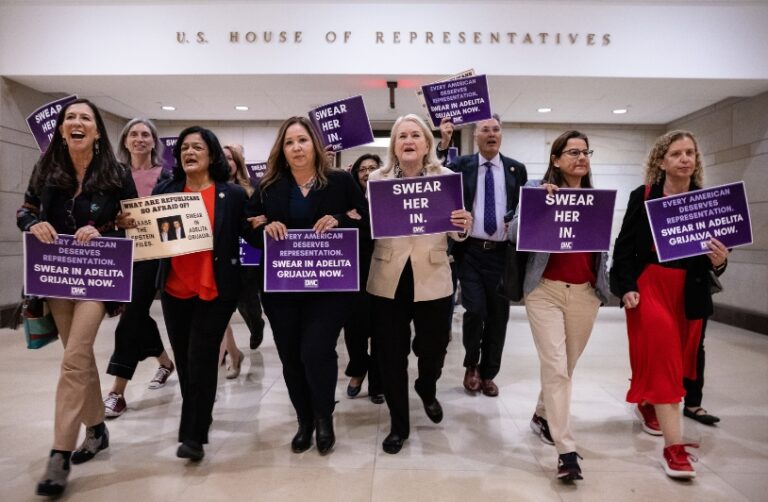
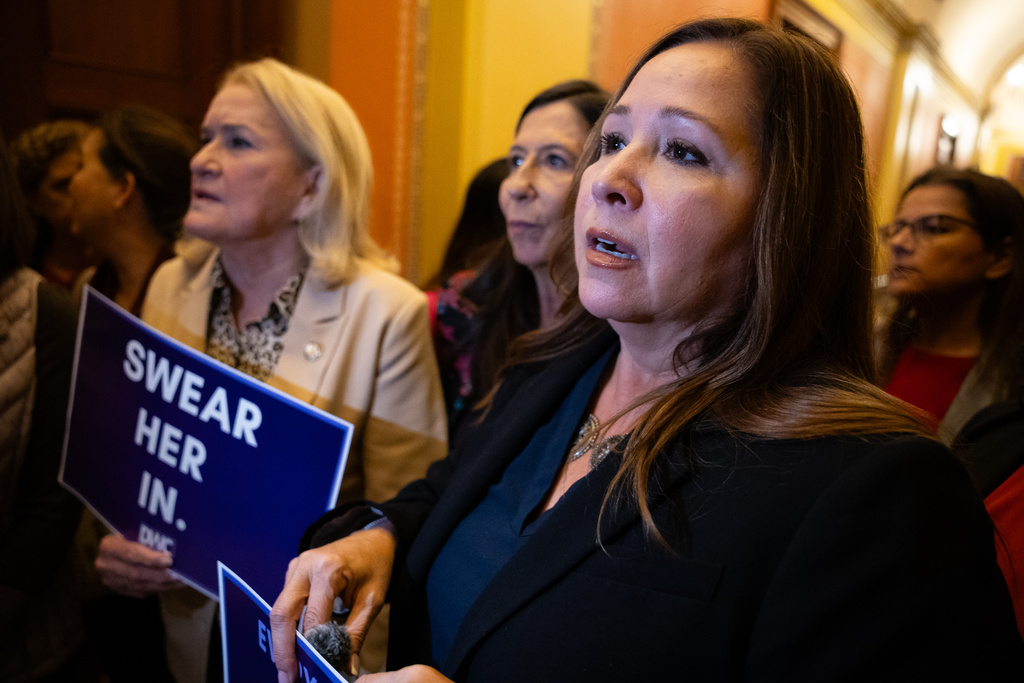
Read text of Arizona's lawsuit against the U.S. House of Representatives, filed in the United States District Court for the District of Columbia:
UNITED STATES DISTRICT COURT
DISTRICT OF COLUMBIA
STATE OF ARIZONA and ADELITA
GRIJALVA,
No. 1:25-cv-03740
_
Plaintiffs,
v.
COMPLAINT FOR DECLARATORY
RELIEF
UNITED STATES HOUSE OF
REPRESENTATIVES, A LEGISLATIVE
CHAMBER; KEVIN McCUMBER, CLERK,
IN HIS OFFICIAL CAPACITY; and
WILLIAM McFARLAND, SERGEANT AT
ARMS, IN HIS OFFICIAL CAPACITY,
Defendants.
INTRODUCTION
1. This case is about whether someone duly elected to the House – who indisputably
meets the constitutional qualifications of the office – may be denied her rightful office simply
because the Speaker has decided to keep the House out of “regular session.”
2. If the Speaker were granted that authority, he could thwart the peoples’ choice of
who should represent them in Congress by denying them representation for a significant portion
of the two-year term provided by the Constitution.
3. Fortunately, the Constitution does not give that authority to the Speaker—or anyone
else.4. Rather, “the Constitution leaves the House without authority to exclude any person,
duly elected by his constituents, who meets all the requirements for membership expressly
prescribed in the Constitution.” Powell v. McCormack, 395 U.S. 486, 522 (1966).
5. Indeed, as Speaker Johnson explained this weekend when answering a hypothetical
question about the election of a member of his own party, “[T]hat’s our system. If the people duly
elect a representative, then we will welcome them into the body. That would be the job of a
speaker.” Speaker Mike Johnson Youtube Channel, Speaker Johnson Joins the Sunday Briefing
on Fox News (Oct. 19, 2025), https://www.youtube.com/watch?v=qnJ4P_zix9o, at 5:35
timestamp (discussing seating George Santos if reelected to Congress).
6. On September 23, 2025, the voters in Arizona’s Seventh Congressional District
elected Adelita Grijalva to serve as their Representative in the House, with 68.94% of the vote.
The election was canvassed and the certificate of election delivered to the House on October 14,
2025.
7. The outcome of the election is not in dispute.
8. Ms. Grijalva’s constitutional qualifications have likewise never been in dispute.
She meets all of the constitutional qualifications to serve in the House of Representatives, save for
the fact that she has not yet taken the oath of office. See U.S. Const. art. VI, cl. 3 (“The …
Representatives … shall be bound by Oath or Affirmation, to support this Constitution.”); 5 U.S.C.
§ 3331 (specifying the language of the oath); 2 U.S.C. § 25 (providing that the Speaker shall
administer the oath to Representatives).
9. Speaker Johnson has acknowledged that Ms. Grijalva was duly elected and is
qualified to serve in the House once she has taken the oath of office.
210. Ms. Grijalva has for weeks requested that Speaker Johnson administer the oath to
her and seat her, consistent with 2 U.S.C. § 25, House precedents, and his uniform practice, but he
has refused to do so until a time of his choosing, which he now says will be when the House comes
back into regular session, even though he initially said he would do it as soon as Ms. Grijalva
wanted.
11. The Constitution does not specify who must administer the oath, only that
Representatives must take it.
12. The Speaker may not use his statutory obligation to administer the oath under 2
U.S.C. § 25 to arbitrarily delay seating a member when there is no dispute as to the election or
qualifications and no practical reason why he is unable to administer the oath.
13. Speaker Johnson has been in the Capitol during this time and has not identified any
reason that he (or a designee) is unable to administer the oath to Ms. Grijalva.
14. Speaker Johnson has not identified any valid reason for refusing to promptly seat
Ms. Grijalva.
15. Instead, on information and belief, Speaker Johnson wishes to delay seating Ms.
Grijalva to prevent her from signing a discharge petition that would force a vote on the release of
the Epstein files and/or to strengthen his hand in the ongoing budget and appropriations
negotiations.
16. Defendants’ refusal to promptly seat Ms. Grijalva, and to treat her as a member of
the House, injures her by denying her the ability to exercise the authority of a member of the
House—e.g., to sign petitions, sponsor bills, obtain and provide information to her constituents
about federal programs and matters pending before federal agencies, and advocate with federal
agencies, all on behalf of her constituents.
317. Defendants’ refusal to promptly seat Ms. Grijalva, and to treat her as a member of
the House, likewise injures the State of Arizona, which is denied the number of Representatives
provided for by law.
18. The State and Ms. Grijalva therefore request that this Court enter a declaratory
judgment that (1) Ms. Grijalva shall be deemed a Member of the House of Representatives once
she has taken the oath prescribed by law, see 5 U.S.C. § 3331; and (2) if Speaker Johnson has not
administered the oath, the oath may be administered to Ms. Grijalva by any person authorized by
law to administer oaths.
JURISDICTION AND VENUE
19. This Court has jurisdiction under Article III, § 2 of the United States Constitution
and 28 U.S.C. § 1331 and 2201(a).
20. The Court may grant declaratory and other relief pursuant to 28 U.S.C. §§ 2201–
02.
21. § 2201(a).
22. An actual controversy exists between the parties within the meaning of 28 U.S.C.
Venue is proper in the District of Columbia under 28 U.S.C. § 1391(b)(2) because
the events and omissions took place in the District of Columbia.
PARTIES
Plaintiffs
23. Plaintiff the State of Arizona is a sovereign state of the United States. Arizona is
represented by Attorney General Kris Mayes. The Attorney General is Arizona’s chief law
enforcement officer and is authorized to pursue this action pursuant to Arizona Revised Statutes
§ 41-193(A)(3).
424. Plaintiff Adelita Grijalva has been duly elected to serve as the Member of the House
from Arizona’s Seventh Congressional District.
Defendants
25. Defendant House of Representatives is a chamber of the United States Congress,
the legislative branch of the United States.
26. Defendant Kevin McCumber is the Clerk of the United States House of
Representatives. He establishes the roll of members-elect of the House, seals all formal documents
issued by the House, certifies the passage of all joint resolutions of the House, and manages the
office and supervises the staff of any vacant member until a successor is seated. He also oversees
staff who manage the electronic voting system, and certifies the records of votes cast on legislation.
27. Defendant William McFarland is the Sergeant at Arms of the United States House
of Representatives. As part of the former role of the Doorkeeper transferred to this office, he
admits members to the House floor.
LEGAL FRAMEWORK
Statutory and Constitutional Framework
28. The House of Representatives “shall be the Judge of the Elections, Returns and
Qualifications of its own Members.” U.S. Const. art. I, § 5, cl 1.
29. The House may expel a member “with the Concurrence of two thirds.” U.S. Const.
art. I, § 5, cl. 2. This power does not extend to the time before a member is seated, when a member
may only be excluded. See Powell, 395 U.S. at 512 (“[E]xclusion and expulsion are not fungible
proceedings.”).
530. The power to exclude is not absolute or plenary. The three reasons given in the
Constitution for exclusion are exhaustive; the House may not reject a member-elect except for one
of them, and “qualifications” means only those listed in the Constitution. Powell, 395 U.S. at 522.
31. Those qualifications are:
a. “hav[ing] attained to the Age of twenty five Years,” U.S Const. art. I, § 2,
cl. 2;
b. having “been seven Years a Citizen of the United States,” id.;
c. “be[ing] an inhabitant of that State in which [s]he shall be chosen,” id.;
d. “be[ing] bound by Oath or Affirmation, to support this Constitution”; id.
art. VI, cl. 3; and
e. not being disqualified from holding office under Section Three of the 14th
Amendment.
32. “[T]he Constitution leaves the House without authority to exclude any person, duly
elected by his constituents, who meets all the requirements for membership expressly prescribed
in the Constitution.” Powell, 395 U.S. at 522 (footnote omitted).
33. Therefore, if the House wishes to remove a member for other reasons, it must first
seat the member, then expel by a two-thirds vote. Id.; see id. at 508, 512 (“[E]xclusion and
expulsion are not fungible proceedings.”).
34. The question of whether an individual has a right to a House seat, and whether the
House is wrongfully denying that person admission, is justiciable and is not a political question.
Powell, 395 U.S. at 548.
635. It is a constitutional qualification for office that a member take the oath of office
before assuming office. U.S. Const. art. VI, cl. 3 (“The … Representatives … shall be bound by
Oath or Affirmation, to support this Constitution.”).
36. The Constitution provides neither the language of the oath nor any requirements as
to who must administer it.
37. One statute, 5 U.S.C. § 3331, gives the language of the oath, but does not specify
how it is to be administered.
38. A second statute, 2 U.S.C. § 25, describes the procedure for swearing in the Speaker
and members-elect.
39. Per that process, “any Member of the House of Representatives” swears in the
Speaker upon the Speaker’s election. The Speaker then swears in the members-elect. But the
individual who swears in the Speaker (usually the Dean of the House) has not yet been sworn for
that Congress, and so is at that time a member-elect, establishing that non-members of the House
may and do constitutionally administer the oath.
40. Nothing in 2 U.S.C. § 25 makes the administration of the oath discretionary on the
part of the Speaker.
House Precedents
41. House rules and precedents are neither law nor binding on this Court.
42. Nothing in this case requires, or invites, the Court to interpret or apply House rules,
precedents, or recent practices. Cf. Nixon v. United States, 506 U.S. 224, 228 (1993) (holding
interpretation of Senate rules committed to the Senate).
43. Nonetheless, to provide context, Plaintiffs briefly describe the relevant precedents
and recent practices.
744. Under House precedents, the Speaker or an elected Speaker pro tem typically
administers the oath to new members, including those elected mid-Congress in special elections.
Precedents (2017 Series), ch. 2, § 3, at 182; id. § 3.12.
45. At times, others have administered the oath (including a non-elected pro tem), on
the Speaker’s designation and by a resolution of the House permitting the administration. Id.; see
id. §§ 3.7–3.9, 3.13–3.15. These have included non-members of the House.
46. When the certificate of election for a mid-Congress special election is available, or
an authenticated fax or scan, the Speaker administers the oath without House action. Id. §§ 3.5,
3.6.
47. If “no question or contest exist[s]” and the appropriate state official conveys the
unofficial returns of the election, the Speaker administers the oath with a resolution of the House.
Id. § 3.10.
48. Prior to the election of Ms. Grijalva, every time a special election has been
conducted during Mr. Johnson’s tenure as Speaker of the House, the winner has been sworn in
immediately upon unofficial notification of the results.
49. Never during this time has the House insisted on waiting for a certificate of election,
nor has the administration of the oath been delayed past a pro forma session. This practice has not
varied based on party or other differences.
50. Celeste Maloy was elected in a special election for Utah’s Second Congressional
District on November 21, 2023. She was sworn in on Tuesday, November 28, 2023. Utah had not
provided a certificate of election, but an unofficial letter from the Director of Elections was deemed
sufficient. 169 Cong. Rec. H5928 (daily ed. Nov. 28, 2025).
851. Vince Fong was elected in a special election for California’s 20th Congressional
District on May 21, 2024. The House was notified of the results on May 29, 2024, and he was
sworn in on Monday, June 3, 2024, the next business day. 170 Cong. Rec. H3568 (daily ed. June
3, 2024).
52. Jimmy Patronis was elected in a special election for Florida’s First Congressional
District on April 1, 2025. He was sworn in on April 2, 2025, in a pro forma session. 171 Cong.
Rec. H1409 (daily ed. Apr. 2, 2025).
53. Randy Fine was elected the same day as Mr. Patronis, and also sworn in the
following day. Id.
54. James Walkinshaw was elected in a special election for Virginia’s 11th
Congressional District on September 9, 2025. He was sworn in the next day. 171 Cong. Rec.
H4214 (daily ed. Sept. 10, 2025).1
1 Speaker Johnson has referred to the “Pelosi precedent,” specifically the case of Dr. Letlow. These
cases are not comparable. In December 2020, Luke Letlow, representative-elect from Louisiana’s
Fifth Congressional District, passed away. His wife, Dr. Julia Letlow, was elected in a March 20,
2021 special election. Alex Seitz-Wald, Republican Julia Letlow Wins Special Congressional
Election in Louisiana, NBC News Projects, NBC News (updated Mar. 21, 2021, 10:47 MST),
https://www.nbcnews.com/politics/elections/polls-close-louisiana-special-congressional-
elections-n1261680. She was sworn in April 14, 2021. Congresswoman Julia Letlow Press
Release (Apr. 14, 2021), available at https://letlow.house.gov/media/press-releases/taking-oath-
office. But, on information and belief, then-Speaker Pelosi communicated with Dr. Letlow
immediately after the election, and the swearing in was scheduled at a time convenient for all
parties. Ms. Grijalva would be delighted if Speaker Johnson would contact her to commit to a
mutually agreeable time, as Speaker Pelosi did for Dr. Letlow.
9FACTUAL BACKGROUND
Arizona’s Congressional Representation
55. In 2020, as required by the Constitution, the United States Department of
Commerce, Bureau of the Census, conducted a census. See U.S. Const. art. I, § 2, cl. 3; id. amend.
XIV, § 2.
56. On April 26, 2021, population counts were delivered to the President.2
57. That same day, the President reported to the Clerk the number of representatives
each state is entitled to for the period ending with the 2030 census.
58. Following that notification, the Clerk of the House informed the Governor of
Arizona that Arizona was entitled to nine representatives.
59. As of today, Arizona remains entitled to nine representatives.
60. But Arizona presently has eight representatives sworn and seated in Congress, one
fewer than the number to which it is entitled.
61. The wrongful denial of full congressional representation “undoubtedly satisfies the
injury-in-fact requirement of Article III standing.” See Dep’t of Com. v. U.S. House of Reps., 525
U.S. 316, 331 (1999); see also Franklin v. Massachusetts, 505 U.S. 788, 802 (1992) (state had
standing to challenge apportionment because it would lose a representative).
62. Arizona lacks the full representation to which it is entitled because of the acts and
omissions of Defendants, satisfying causation.
63. As described below, judicial action, in the form of a declaratory judgment, will
remedy Arizona’s injury by ensuring its full representation.
2 These events were delayed due to the Covid-19 pandemic.
10Ms. Grijalva is Elected to the House but Not Seated
64. On September 23, 2025, Adelita Grijalva won the special election to represent
Arizona’s Seventh Congressional District, filling a vacancy created by her father’s passing. See
U.S. Const., art. I, § 2, cl. 3 (vacancies in the House are filled by election).
65. Ms. Grijalva received 68.94% of the vote.
66. When unofficial results were in, Arizona’s Secretary of State, Adrian Fontes,
provided the election results to the House. Speaker Johnson’s office confirmed receipt. See Nikki
McCann Ramirez, Dem Says Mike Johnson is Delaying Her Swearing-In to Prevent Epstein Vote,
Rolling Stone (Sept. 30, 2025, 10:38 a.m. MST), available at https://tinyurl.com/3k6tm2yr.
67. Nonetheless, Speaker Johnson denied Ms. Grijalva the opportunity to swear in
during subsequent pro forma sessions.
68. On October 14, 2025, Arizona’s Secretary of State completed the canvass, and the
Governor signed a certificate of election and transmitted it to the House.
69. That same day, Arizona Attorney General Kris Mayes sent a letter to Speaker
Johnson demanding that he promptly swear in and seat Ms. Grijalva. Speaker Johnson refused.
70. The non-partisan League of Women Voters sent a letter to Speaker Johnson
“urg[ing] [him] to make haste and swear in Adelita Grijalva as the newest member of the House
of Representatives immediately.” League of Women Voters, Letter to Speaker Johnson (Oct. 10,
2025), available at https://www.lwv.org/league-urges-speaker-swear-congresswoman-elect-
grijalva.
No Valid Reason is Given for the Delay and Ms. Grijalva Must Be Seated
71. Speaker Johnson’s statements, and those of staff, were initially inconsistent.
Speaker Johnson indicated initially that he would swear in the new representative “as soon as she
11wants.” Morgan Rimmer, et al., Speaker Johnson Said He’d Swear in New House Democrat “As
Soon as She Wants.” Now Republicans are Backtracking, CNN (updated Oct. 7, 2025),
https://www.cnn.com/2025/10/07/politics/johnson-adelita-grijalva-swearing-in.
72. Later, perhaps after rethinking and deciding to attempt to gain partisan advantage
by delaying, Speaker Johnson indicated that the swearing in would be delayed. Id.
73. A leadership aide stated the House will “swear in Rep.-Elect [Grijalva] as soon as
the House returns to session when Chuck Schumer, Mark Kelly and Ruben Gallego decide to open
up the government.” Id.
74. Constitutional rights cannot be used as a bargaining chip.
75. After receiving the letter from Attorney General Mayes, Speaker Johnson stated
that he would swear in Ms. Grijalva once the House comes back into regular session.
76. Speaker Johnson’s office has stated that he “intends to schedule a swearing in for
the Representative-elect when the House returns to session.” Ramirez, supra.
77. Indeed, Speaker Johnson on October 17, 2025 encouraged Ms. Grijalva to “serve
her constituents.
”
78. And on ABC This Week with Jonathan Karl on October 19, 2025, he stated he
would swear her in “when Senator Schumer lets us reopen the government,” again suggesting a
partisan fight. ABC News, “This Week” Transcript 10-19-25: Speaker of the House Mike Johnson
and Minority Leader Hakeem Jeffries (Oct. 19, 2025, 7:11 a.m.),
https://abcnews.go.com/Politics/week-transcript-10-19-25-speaker-house-
mike/story?id=126650215.
79. On October 20, 2025, Speaker Johnson stated that, as of that date, computers would
be set up for Ms. Grijalva and 16 staffers. He also continued his partisan jabs, claiming that
12Democratic leadership was responsible for Ms. Grijalva’s predicament. ABC News, Speaker Mike
Johnson Continues to Resist Swearing in Democratic Rep.-elect Grijalva (Oct. 20, 2025),
https://abcnews.go.com/Politics/video/speaker-johnson-continues-resist-swearing-democratic-
rep-elect-126685770.
80. Speaker Johnson has said the delay is in order to give Ms. Grijalva “pomp and
circumstance,” despite her willingness to forgo those in order to speedily serve her constituents.
Claudia Grisales, Adelita Grijalva Can Force a Vote on the Epstein Files, But She’s Still Not Sworn
In, NPR (Oct. 16, 2025, 4:30 p.m. ET).
81. Ms. Grijalva has made clear: “I don’t need pomp and circumstance. I just need to
get to work for southern Arizona.” Scott Wong, Democrats Ramp up Pressure on Speaker Johnson
to Seat Rep.-elect Adelita Grijalva, NBC (Oct. 15, 2025),
https://www.nbcnews.com/politics/congress/democrats-ramp-pressure-speaker-johnson-seat-rep-
elect-adelita-grijalv-rcna237785.
82. Ms. Grijalva’s name is on the door of her office in the Capitol.
83. Through these words and deeds, Defendants have made clear that they know Ms.
Grijalva has satisfied all requisites to take office. See Powell, 395 U.S. at 548 (Congress may
judge only “the qualifications expressly set forth in the Constitution.”). And they have made clear
that Ms. Grijalva’s swearing-in is a foregone conclusion.
84. Yet Defendants continue not to seat Ms. Grijalva and have thus failed to ensure that
she has the privileges and duties of membership, which exist regardless of whether the House is in
“regular session.”
13CAUSE OF ACTION
Ultra Vires
85. Plaintiffs incorporate the preceding allegations as if alleged herein.
86. A real controversy exists regarding the parties’ rights and obligations.
87. The effect of a declaratory judgment would be to resolve the controversy between
the parties and afford the Plaintiffs full relief, because Ms. Grijalva could then be sworn in to
represent Arizona’s Seventh Congressional District.
88. This action is ripe because Arizona’s right to full congressional representation and
Ms. Grijalva’s right to hold office are not limited to those times when the Speaker decides the
House will be in “regular session.”
89. The facts are fully developed and the purely legal issues presented are fit for
decision. See Delta Air Lines, Inc. v. Ex-Im Bank of United States, 85 F. Supp. 3d 250, 269 (D.
D.C. 2015).
90. The House, through Speaker Johnson and House staff, has acted ultra vires and in
violation of statute and the Constitution.
91. “[A]cts of all officers must be justified by some law, and in case an official violates
the law to the injury of an individual the courts generally have jurisdiction to grant relief.”
Chamber of Comm. of United States v. Reich, 74 F.3d 1322, 1327 (D.C. Cir. 1996) (quoting Amer.
School of Magnetic Healing v. McAnnulty, 187 U.S. 108, 110 (1902) (alteration rejected)); see
also Armstrong v. Exceptional Child Ctr., Inc., 575 U.S. 320, 327 (2015).
92. This is also true where relief is sought against an instrumentality of Congress. See
Clark v. Lib. of Cong., 750 F.2d 89, 102, 104 (D.C. Cir. 1984).
1493. Similarly, this suit is not barred by sovereign immunity because “it is well-
established that sovereign immunity does not bar suits for specific relief against government
officials where the challenged actions of the officials are alleged to be unconstitutional or beyond
statutory authority.” Id. at 102.
94. This, too, extends to instrumentalities of Congress, as it did in Clark. Id.
95. In the presence of a real case and controversy between the parties, the Court has the
power to make a declaration that would resolve the controversy.
96. The Court has the power to declare that Ms. Grijalva shall be deemed a Member of
the House of Representatives once she has taken the oath prescribed by law in 5 U.S.C. § 3331.
See Powell, 395 U.S. at 550 (issuing declaratory judgment that plaintiff was duly elected and
required to be seated).
97. The Constitution requires a Member of the House to take an oath to support the
Constitution. It does not say that the oath must be administered by the Speaker or any other
particular person.
98. By withholding the oath and the office that comes with it, the Speaker has
unlawfully interfered with Ms. Grijalva’s constitutional right to take office, and the State’s right
to the number of Representatives provided for by law.
99. Defendants should not be allowed to misuse a statutory oath procedure to violate
Plaintiffs’ constitutional right to have Ms. Grijalva promptly seated as a member of the House.
100. An oath administered by any person authorized by law to administer oaths would
comply with the constitutional requirement.
101. Thus, the Court should declare that the oath may be administered to Ms. Grijalva
by any person authorized by law to administer oaths.
15PRAYER FOR RELIEF
Because there is no dispute as to Ms. Grijalva’s election or qualifications, the Court should:
A. Issue a declaratory judgment stating that Ms. Grijalva shall be deemed a Member
of the House of Representatives once she has taken the oath prescribed by law, see 5 U.S.C. § 3331;
B. Issue a declaratory judgment stating that if Speaker Johnson has not administered
the oath, the oath may be administered to Ms. Grijalva by any person authorized by law to
administer oaths under the law of the United States, the District of Columbia, or the State of
Arizona; and
C. Award other relief as the Court deems just and proper.
Dated: October 21, 2025
Respectfully submitted,
KRISTIN K. MAYES
Attorney General for the State of Arizona
By: /s/ Joshua D. Bendor
Joshua D. Bendor
D.D.C. Bar ID 031908
Solicitor General
Joshua A. Katz
Assistant Attorney General
2005 North Central Avenue
Phoenix, AZ 85004
(602) 542-3333
Joshua.Bendor@azag.gov
Joshua.Katz@azag.gov
Attorneys for the State of Arizona
16Joseph E. Sandler D.C. Bar No. 255919
Neil P. Reiff D.C. Bar No. 448170
Sandler Reiff Lamb Rosenstein & Birkenstock, P.C.
1620 I Street, N.W. Suite 900
Washington, D.C. 20006
Tel: 202-479-1111
Fax: 202-479-1115
sandler@sandlerreiff.com
reiff@sandlerreiff.com
Attorneys for U.S. Representative-Elect
Adelita Grijalva
U.S. District Court
District of Columbia (Washington, DC)
CIVIL DOCKET FOR CASE #: 1:25-cv-03740
ARIZONA et al v. HOUSE OF REPRESENTATIVES OF THE CONGRESS OF THE UNITED STATES OF AMERICA et al Assigned to: Cause: 28:1331 Federal Question: Other Civil Rights | Date Filed: 10/21/2025 Jury Demand: None Nature of Suit: 890 Other Statutory Actions Jurisdiction: U.S. Government Defendant |
| Plaintiff | ||
| ARIZONA State of | represented by | Joshua Bendor ARIZONA ATTORNEY GENERAL'S OFFICE 2005 N Central Ave Phoenix, AZ 85004 602-542-8958 Email: joshua.bendor@azag.gov ATTORNEY TO BE NOTICED |
| Plaintiff | ||
| ADELITA GRIJALVA | represented by | Joshua Bendor (See above for address) ATTORNEY TO BE NOTICED |
V. | ||
| Defendant | ||
| HOUSE OF REPRESENTATIVES OF THE CONGRESS OF THE UNITED STATES OF AMERICA a legislative chamber | ||
| Defendant | ||
| KEVIN MCCUMBER Clerk, in his official capacity | ||
| Defendant | ||
| WILLIAM MCFARLAND Sergeant at Arms, in his official capacity | ||
| Date Filed | # | Docket Text |
|---|---|---|
| 10/21/2025 | 1 | COMPLAINT for Declaratory Relief against All Defendants ( Filing fee $ 405 receipt number ADCDC-12035182) filed by ARIZONA, ADELITA GRIJALVA. (Attachments: # 1 Civil Cover Sheet, # 2 Summons House of Representatives, # 3 Summons Kevin McCumber, # 4 Summons William McFarland)(Bendor, Joshua) (Entered: 10/21/2025) |
No comments:
Post a Comment