Every single one of the judicial candidates has Federalist Society ties. Every single one. From Florida Rising, via Florida Times Union:
Sweep the Bench: Let Judges Feel the Opposition’s Brunt from Voters
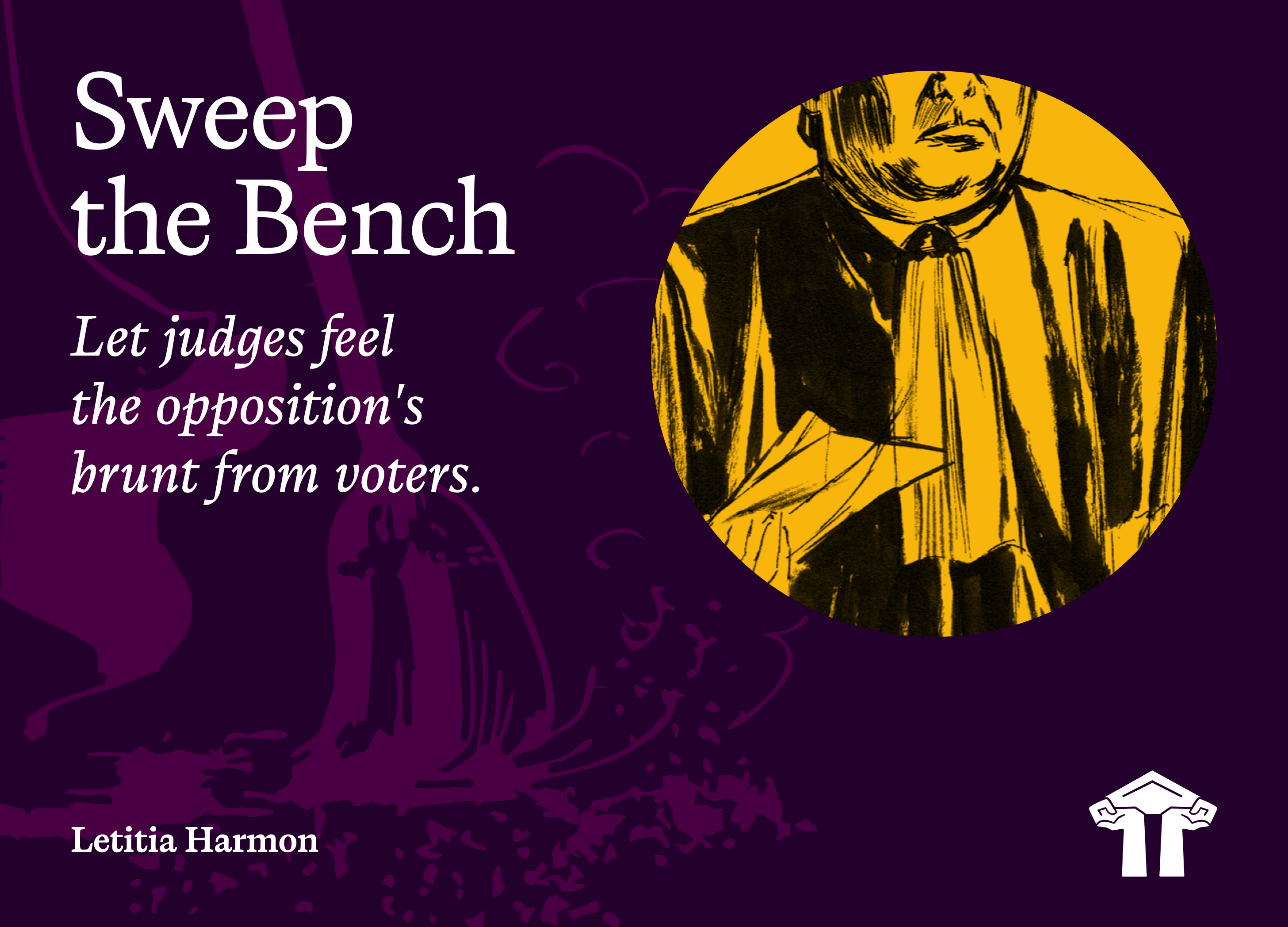
Written By: Letitia Harmon1
Most Floridians skip the judicial section of their ballot. It’s tucked near the bottom, full of unfamiliar names, and asks a question most voters have never been taught how to answer: should this judge or justice keep their job?
Voters don’t feel well-informed about judicial candidates, so they skip this portion. Conscientious voters try to prepare in advance by researching judges, but this is an overwhelming task. It leaves even the best-intentioned of us feeling disempowered and unable to make an informed choice.
That confusion and lack of knowledge could be coming to an end. This November, Florida Rising is showing Florida voters the path.
First of all, let’s be clear: Florida doesn’t elect its appellate and Supreme Court justices the way it elects a governor or a state representative. When a seat opens, a Judicial Nominating Commission sends the Governor three to six finalists, and the Governor picks one.
That judge serves six years, then voters get a single up-or-down question: keep them, or don’t. A “yes” gives another six years. A “no” creates a vacancy, which is filled through the same nominating and appointment process.
It’s important to note there’s no opponent on the ballot. Judges can’t personally solicit money, endorse candidates, or campaign like politicians unless they certify that there is “active opposition.” Only then can they fundraise and campaign.
That system was built to insulate judges from politics. In practice, it has mostly insulated them from accountability. No Florida appellate judge or Supreme Court justice has ever been removed through a retention vote. These races typically draw 62 to 75 percent approval, and organized opposition — when it exists — has almost always targeted the Supreme Court.
District Court of Appeal judges routinely face none at all; the Florida Bar’s own reporting describes the 2024 DCA races as drawing no active opposition, consistent with every cycle before it.
For most of these judges, this merit retention question has never really been a question.
This year, Florida Rising hired a researcher — a member of The Florida Bar — to evaluate all 22 appellate judges up for merit retention. Separately, Florida Rising member leader Beth Carpenter, active in the 2024 Yes on 4 campaign, researched Florida Supreme Court Justice Carlos Muñiz.
The findings were consistent. Every one of these judges — all appointed by governors, never elected by voters — showed ties to the Federalist Society (an extreme right-wing group), moderate-to-high alignment with right-wing political priorities, and low independence from political influence.
Fun fact: that’s the very quality that merit retention was supposed to protect.
Florida Rising evaluates judicial candidates on five criteria: diversity, qualifications, fairness, independence from political influence, and alignment with our commitment to social, racial, and economic justice. Across all 23 seats on this year’s ballot, the pattern held. These aren’t judges shaped by an independent process. They are judges shaped by a pipeline that rewards ideological alignment and donor interests.
That’s why Florida Rising is recommending “no” on all 23 retention votes, and asking voters to Sweep the Bench.
Objectors will challenge that approach with “shouldn’t every justice be judged on their own record?” First of all, they have been. Their individual records were evaluated. And beyond that, this isn’t one bad ruling from one judge. On the contrary: it’s a pattern across the bench, produced by a governor-dominated appointment pipeline that rewards sycophancy.
Treating each seat as an isolated case obscures what’s actually happening: a judiciary reshaped from the top down by wealthy interests and an authoritarian governor, protected by a ballot question voters were never equipped to answer.
Retention elections were built on the assumption that voters wouldn’t pay attention. It’s Theater of Democracy, rather than real democracy. Sweep the Bench is our answer: a coordinated push to educate voters, district by district, on who these judges are, how they got their seats, and why “no” is the accountable choice.
This is the first time in Florida and nationwide that a progressive organization has opened the gates to real voters’ participation to keep or reject a judge or justice by providing reliable information and the option to exercise the opposition alternative.
Florida’s courts shape reproductive rights, labor protections, environmental rules, and the limits of executive power. The people on those courts should answer to more than a ballot question most voters were never taught to assess. This year, Florida Rising is helping voters complete the assessment, give the justices proper scrutiny, and vote NOon retention. This is the only path Florida has to judicial integrity.
Letitia Harmon is the Senior Director of Policy and Research at Florida Rising.
No comments:
Post a Comment