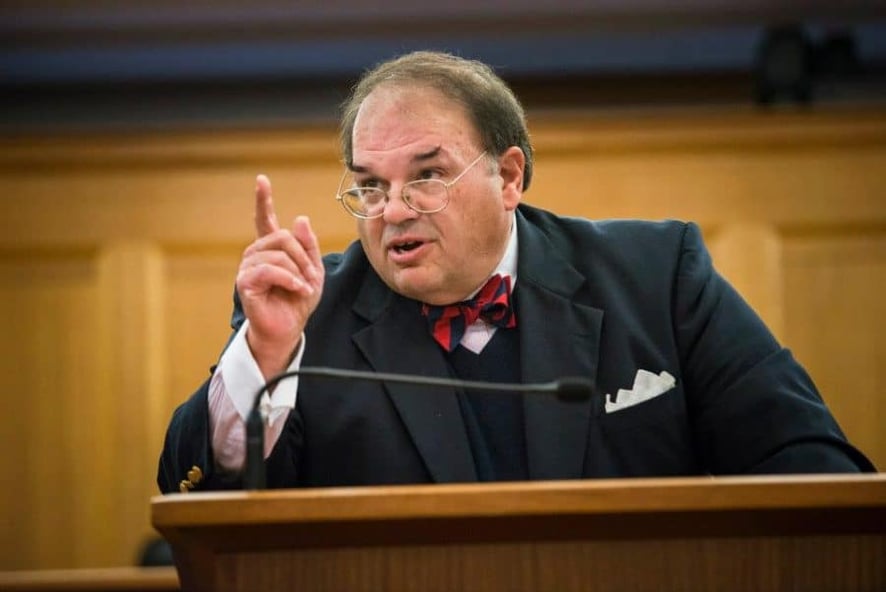
Nineteen (19) exclamation points! Three (3) cheers for Judge Richard J. Leon in National Trust for Historic Preservation in the United States v. National Park Service!
UNITED STATES DISTRICT COURT
FOR THE DISTRICT OF COLUMBIA
NATIONAL TRUST FOR HISTORIC
PRESERVATION IN THE UNITED
STATES,
Plaintiff,
V.
NATIONAL PARK SERVICE, et al.,
)
)
)
)
)
)
)
)
)
)
) Civil Case No. 25-4316 (RJL)
Defendants.
___ ___ _ _ __ )
,_,_
MEMORANDUM OPINION
March 31, 2026 [Dkt. #51]
The President of the United States is the steward of the White House for future
generations of First Families. He is not, however, the owner! President Trump ("the
President") claims that Congress has given him authority in existing statutes to construct
his East Wing ballroom project and to do it with private funds. The plaintiff, the National
Trust for Historic Preservation in the United States ("National Trust"), claims the President
has no such authority under existing statutes and that a preliminary injunction is necessary
to avoid irreparable harm. I have concluded that the National Trust is likely to succeed on
the merits because no statute comes close to giving the President the authority he claims to
have. As such, I must therefore GRANT the National Trust's Motion for a Preliminary
Injunction, and the ballroom construction project must stop until Congress authorizes its
completion.
1Case 1:25-cv-04316-RJL Document 60 Filed 03/31/26 Page 2 of 35
BACKGROUND
I. The White House
Shortly after the founding, Congress passed the Residence Act of 1790, which
authorized three commissioners to "provide suitable buildings for the accommodation
of ... the President." See An Act for Establishing the Temporary and Permanent Seat of
the Government of the United States, ch. 28, 1 Stat. 130 (1790). 1 The three commissioners,
empowered by Congress and appointed by the President, selected James Hoban as the
architect of the President's residence through a design competition. See Pl. 's Suppl. Br.,
Annex 1 ("Annex") [Dkt. #20-1] at 2. Congress funded construction of the White House
through several statutes. See id. In 1800, President John Adams moved into the still-
unfinished White House, and every President has resided in the White House since then.
Second Am. Compl. [Dkt. #50] 127.
Congress has continued to authorize and fund construction and maintenance at the
White House up until the present day. See generally Annex. For example, Congress
authorized repairs to the White House after it suffered extensive damage during the War of
1812,seeAnnexat2-3;ActofFeb.13, 1815,ch.41,3 Stat.205;ActofFeb.10, 1820,ch.
10, 3 Stat. 541, and received regular updates on progress, see H. R. Doc. No. 15-8, at 14-
1 Relevant filings are abbreviated as follows: Pl.'s Mem. in Supp. of Mot. for TRO & Prelim. Inj. ("Pl.'s
TRO Br.") [Dkt. #2-1]; Defs.' Mem. in Opp'n to Mot. for TRO & Prelim. Inj. ("Defs.' TRO Opp'n") [0kt.
#15-1]; Pis.' Suppl. Mem. in Supp. of Mot. for Prelim. Inj. ("Pl.'s Suppl. Br.") [0kt. #20]; Defs.' Suppl.
Resp. Br. in Opp'n to Pl.'s Mot. for a Prelim. Inj. ("Defs.' Suppl. Br.") [0kt. #30]; Pl.'s Reply Br. in Supp.
of Mot. for Prelim. lnj. ("Pl. 's Reply Br.") [0kt. #33]; Pl.'s Mem. in Supp. of Mot. for Prelim. Inj. ("Pl.'s
Renewed PI Br.") [Dkt. #51-1]; Defs.' Mem. in Opp'n to Pl.'s Second Mot. for Prelim. Inj. ("Defs.'
Renewed Opp'n") [0kt. #52]; Pl.'s Reply in Supp. of Mot. for Prelim. Inj. ("Pl.'s Renewed Reply Br.")
[0kt. #54].
2Case 1:25-cv-04316-RJL Document 60 Filed 03/31/26 Page 3 of 35
16 (1818). Congress appropriated funds for construction of the South Portico in 1823, the
North Portico in 1829, and the East and West Wings in 1902. See An Act Making
Appropriations for the Public Buildings, ch. 62, 3 Stat. 784 (1823); An Act Making
Appropriations for the Public Buildings, and for Other Purposes, ch. 51, 4 Stat. 362 (1829);
Act of June 28, 1902, ch. 1301, 32 Stat. 419,460.
In the late 1940s, after the discovery of major structural issues, Congress
appropriated funds for "the renovation, repair, and modernization" of the White House but
prohibited any "change of [the] present architectural appearance of the exterior of the
mansion or the interior of its main floor." Act of June 23, 1949, ch. 236, 63 Stat. 231,235;
see also Annex at 10-11. More recently, Congress funded the replacement of the White
House perimeter fence in 2019 through a series of appropriations. See Annex at 13-14;
Consolidated Appropriations Act, 2017, Pub. L. No. 115-31, 131 Stat. 135, 435;
Consolidated Appropriations Act, 2016, Pub. L. No. 114-113, 129 Stat. 2242, 2503.
Today, the White House remains the official residence of the President. Second Am.
Compl., 25. It sits in President's Park, a federal park administered by the National Park
Service in Washington, D.C. Id.
II. The East Wing Ballroom Project
On July 31, 2025, the White House issued a press release announcing plans to build
a "State Ballroom" on White House grounds. Second Am. Compl. , 36; see also Mot. for
TRO & Prelim. Inj., Ex. J [Dkt. #2-14]. The press release stated the ballroom would be
constructed at the site of the "small, heavily changed, and reconstructed East Wing" and
would encompass "approximately 90,000 total square feet." Ex. J. The press release also
3Case 1:25-cv-04316-RJL Document 60 Filed 03/31/26 Page 4 of 35
stated that "President Trump, and other patriot donors, have generously committed to
donating the funds to build" the ballroom. Id.; see also Mot. for TRO & Prelim. Inj., Ex.
X ("Ex. X") [Dkt. #2-28] (ballroom will have "zero cost to the American Taxpayer!").
On October 20, 2025-without advance notice or apparent approval-President
Trump announced on social media that "ground ha[ d] been broken on the White House
grounds to build the new, big, beautiful White House Ballroom." Second Am. Comp 1. ,r 51.
On October 21, 2025, media outlets confirmed that heavy machinery was demolishing the
East Wing. Id. ,r 53. The next day, President Trump showed new renderings of the
proposed ballroom to the press, noting that "many presidents have made changes" at the
White House but "[t]his ... obviously would be the biggest change." Id. ,r,r 59-60. By
October 23, 2025, the East Wing had been demolished in its entirety. Id. ,r 64.
After the demolition of the East Wing, the National Trust-a nonprofit with
"thousands of members" who "have a substantial interest in preserving and protecting
historic and cultural resources in Washington, D.C."---contacted various federal entities to
express concerns. Mem. Op. [Dkt. #47] at 3--4; see also Second Am. Compl. ,r 22. The
National Trust warned that the "massing and height of the proposed new construction
would overwhelm the White House itself and might also permanently disrupt the carefully
balanced classical design of the White House." Second Am. Compl. ,r 55 (cleaned up).
Receiving no response, the National Trust brought this lawsuit in December 2025.
See Comp 1. [Dkt. # 1]. Since then, there has been significant progress on construction of
the ballroom. The site of the former East Wing is a "bustling project site" with "heavy
construction machinery," "pile drivers," and a "construction crane." Second Am. Compl.
4Case 1:25-cv-04316-RJL Document 60 Filed 03/31/26 Page 5 of 35
,r,r 78, 81. Demolition work has been largely completed, and work on "footings and below-
grade structural concrete" began in February 2026. Deel. of John Stanwich ("Stanwich
Deel.") [Dkt. #14-6] ,r 20. "Above[-]grade structural work" is "anticipated to begin" in
April 2026. Id. Indeed, President Trump has stated that ballroom construction is "ahead
of schedule." Pl.'s Renewed PI Br. at 23 (quoting Donald J. Trump (@realDonaldTrump),
Truth Social (Feb. 10, 2026, at 1 :41 PM ET), https://truthsocial.com/@realDonaldTrump
/posts/116047799547098230).
According to the parties' filings, the ballroom plans are in the final stages of the
design approval process. The Commission of Fine Arts approved designs on February 27,
2026. See T. Luebke to J. Fisher, CFA 19/FEB/26-1, https://perma.cc/CV2F-VE6M (cited
in Suppl. Deel. of Heather Martin ("Martin Suppl. Deel.") [Dkt. #52-2] ,r 6). The National
Capital Planning Commission has reviewed detailed "final" plans for the ballroom and is
scheduled to vote on the design on April 2, 2026. See Martin Suppl. Deel. ,r 7. The plans
presented to these entities show a planned size of 89,000 square feet and a seated capacity
of 1,000 guests. Exec. Director's Recommendation, Nat'l Cap. Planning Comm'n (Mar.
5, 2026), https://perma.cc/4LFC-YDEJ (cited in Martin Suppl. Deel. ,r 7). The ballroom is
now projected to cost around $400 million, and the President has represented that private
donations will foot the bill. See Jan. 22, 2026 Hr'g Tr. [Dkt. #38] at 33:2-3; Ex. X.
III. Procedural History
I recounted the procedural history of this case in my previous opinions, which I
incorporate by reference here. See Mem. Order [Dkt. #17] at 2; Nat'/ Tr.for Historic Pres.
v. Nat'/ Park Serv., _ F. Supp. 3d _, 2025 WL 3672837 (D.D.C. Dec. 17, 2025); Mem.
5Case 1:25-cv-04316-RJL Document 60 Filed 03/31/26 Page 6 of 35
Op. [Dkt. #47]; Nat'! Tr.for Historic Pres. v. Nat'! ParkServ., _ F. Supp. 3d_, 2026 WL
533420 (D.D.C. Feb. 26, 2026). To summarize, I previously denied the National Trust's
motion for a temporary restraining order for lack of irreparable harm before the Court could
decide the motion for a preliminary injunction. See Mem. Order. On February 26, 2026, I
denied the National Trust's request for a preliminary injunction. See Mem. Op. While I
concluded that the National Trust had shown a "substantial likelihood" of Article III
standing, see id. at 7-12, I found that the National Trust's motion suffered from two fatal
flaws. As to its Administrative Procedure Act ("APA") claims, I concluded that "the Office
of the Executive Residence ... is not an 'agency,' so there is no 'agency action' to enjoin
under the APA." Id. at 13. As to the National Trust's constitutional claims, I concluded
that those claims were foreclosed by Dalton v. Specter, 511 U.S. 462 (1994) because they
were "statutory in nature." Mem. Op. at 13, 16-22.
On February 27, 2026, the National Trust sought leave to file a second amended
complaint, see Mot. for Leave to File Second Am. Comp 1. [Dkt. #49], which I granted, see
Minute Order (Mar. 1, 2026). The National Trust's second amended complaint adds four
new ultra vires claims challenging the Defendants' statutory authority to construct a
ballroom on White House grounds and to do it with private funds. Second Am. Compl.
,r,r 197-224.2 On March 5, the National Trust filed a renewed motion for a preliminary
injunction based on its ultra vires claims. See Second. Mot. for Prelim. Inj. [Dkt. #51].
2 Defendants named in the Second Amended Complaint include: the National Park Service; Jessica Bowron,
in her official capacity as Acting Director of the National Park Service; John Stanwich, in his official
capacity as Superintendent of the White House and President's Park; the Department of the Interior;
Douglas Burgum, in his official capacity as Secretary of the Interior; the General Services Administration;
6Case 1:25-cv-04316-RJL Document 60 Filed 03/31/26 Page 7 of 35
Defendants filed their opposition on March 12, see Defs.' Renewed Opp'n, and the
National Trust filed its reply on March 16, see Pl.'s Renewed PI Reply Br. I held a hearing
on March 1 7, 2026. The National Trust's motion is now ripe for decision.
IV. Statutory Background
The National Trust's claims require consideration of three main statutes.
3 U.S. C. § 105(d). Section 105, titled "Assistance and Services for the President,"
provides for the employment of staff members to assist the President and authorizes
appropriations for expenses related to White House administration. Most relevant here,
§ 105(d) provides: "There are authorized to be appropriated each fiscal year to the
President such sums as may be necessary for[] (1) the care, maintenance, repair, alteration,
refurnishing, improvement, air-conditioning, heating, and lighting (including electric
power and fixtures) of the Executive Residence at the White House.'' 3 U.S.C. § 105(d).
The statute continues: "Sums appropriated under this subsection for expenses described in
paragraph[] (1) ... may be expended as the President may determine, notwithstanding the
provisions of any other law." Id. This statute was enacted in 1948, see Act of June 25,
1948, ch. 644, §§ 109, 110, 62 Stat. 672, 679, and Congress added the language about
"care, maintenance, repair ... " in 1978, see Act ofNov. 2, 1978, Pub. L. No. 95-570, § 105,
92 Stat. 2445, 2446.
Michael J. Rigas, in his official capacity as Acting Administrator of the General Services Administration;
Donald J. Trump, in his official capacity as President of the United States; the Executive Office of the
President; Susie Wiles, in her official capacity as White House Chief of Staff; the Office of the Executive
Residence; and Robert B. Downing, in his official capacity as White House Chief Usher. They are referred
to collectively in this opinion as "Defendants."
7Case 1:25-cv-04316-RJL Document 60 Filed 03/31/26 Page 8 of 35
40 USC. § 8106. This statute provides that "[a] building or structure shall not be
erected on any reservation, park, or public grounds of the Federal Government in the
District of Columbia without express authority of Congress." 40 U.S.C. § 8106. This
provision was originally enacted in 1912, see Act of Aug. 24, 1912, ch. 355, 37 Stat. 417,
444 (codified at 40 U.S.C. § 68 (1912)), and was recodified in 2002, see Act of Aug. 21,
2002, Pub. L. No. 107-217, 116 Stat. 1062, 1206.
54 U SC. § 100101. The National Park Service ("NPS") Organic Act provides that
the Secretary of the Interior, acting through the director of the NPS,
shall promote and regulate the use of the National Park System by means and
measures that conform to the fundamental purpose of the System units,
which purpose is to conserve the scenery, natural and historic objects, and
wild life in the System units and to provide for the enjoyment of the scenery,
natural and historic objects, and wild life in such manner and by such means
as will leave them unimpaired for the enjoyment of future generations.
54 U.S.C. § 10010l(a). Congress later reaffirmed these purposes through a 1978
amendment known as the "Redwood Amendment." See Act of Mar. 27, 1978, Pub. L. No.
95-250, sec. I0l(b), 92 Stat. 163, 166 (codified at 54 U.S.C. § I00I0I(b)(2)). The
Redwood Amendment provides that the "management" and "administration" of NPS units
"shall not be exercised in derogation of the values and purposes for which the System units
have been established, except as directly and specifically provided by Congress." 54
U.S.C. § 10010l(b)(2).
LEGAL STANDARD
A preliminary injunction is "an extraordinary remedy that may only be awarded
upon a clear showing that the plaintiff is entitled to such relief." Winter v. NRDC, Inc. , 555
8Case 1:25-cv-04316-RJL Document 60 Filed 03/31/26 Page 9 of 35
U.S. 7, 22 (2008). To obtain a preliminary injunction, the movant "must establish that he
is likely to succeed on the merits, that he is likely to suffer irreparable harm in the absence
of preliminary relief, that the balance of equities tips in his favor, and that an injunction is
in the public interest." Id. at 20.
ANALYSIS
I. Likelihood of Success on the Merits
This case, in essence, is about whether the President has the authority to build a
ballroom on White House grounds with private funds without seeking authorization from
Congress. The National Trust asserts that Defendants' actions are ultra vires of statutory
authority and violate the APA. But why do Defendants even need statutory authority in the
first place? The Constitution shows why.
The Property Clause vests Congress with complete authority over public lands. See
U.S. Const. Art. IV, § 3, cl. 2 ("The Congress shall have Power to dispose of and make all
needful Rules and Regulations respecting the Territory or other Property belonging to the
United States."). "Congress exercises the powers both of a proprietor and of a legislature
over the public domain," Kleppe v. New Mexico, 426 U.S. 529, 540 (1976), and those
powers are "without limitations," id. at 539 ( quoting United States v. City & Cnty. of San
Francisco, 310 U.S. 16, 29 (1940)). This "broad" grant of authority "extend[s]
to ... personal and real property rightfully belonging to the United States." Ashwander v.
Tennessee ValleyAuth., 297 U.S. 288,331 (1936) (quoting Joseph Story, Commentaries on
the Constitution of the United States§§ 1325, 1326 (1833)).
9Case 1:25-cv-04316-RJL Document 60 Filed 03/31/26 Page 10 of 35
The Appropriations Clause "provides that money may be 'drawn from the Treasury'
only 'in Consequence of Appropriations made by Law."' Consumer Fin. Prot. Bureau v.
Cmty. Fin. Servs. Ass 'n of Am., Ltd., 601 U.S. 416, 426 (2024) (quoting U.S. Const. Art. I,
§ 9, cl. 7). "Since the earliest days of our Republic, Congress's 'power over the purse' has
been its 'most complete and effectual weapon' to ensure that the other branches do not
exceed or abuse their authority." Id. at 447-48 (Alito, J., dissenting) (quoting The
Federalist No. 58, at 359 (Clinton Rossiter ed., 1961) (James Madison)).
The District Clause gives Congress legislative authority over the District of
Columbia. See U.S. Const. Art. I,§ 8, cl. 17. The Constitution "confer[red]" this power
on Congress "in broad terms." Nat'! Mut. Ins. Co. of Dist. of Col. v. Tidewater Transfer
Co., 337 U.S. 582, 589 (1949).
Together, the Property Clause, the Appropriations Clause, and the District Clause
establish Congress's primacy over federal property, spending, and the District of Columbia.
Indeed, Defendants have declined to argue that they have any inherent constitutional
authority to build the ballroom. See Defs.' Suppl. Br. at 12, 30. So the President must
identify some law that allows him to demolish the East Wing and construct his planned
ballroom with private funds. For the following reasons, I conclude that the National Trust
is likely to succeed on the merits on its ultra vires claims because no law comes close to
giving the President this authority. 3
3 Defendants argue that successive preliminary injunction motions are improper. See Defs.' Renewed Opp'n
at 5--6. But there is no per se bar. And here, "change[s] in circumstances" counsel in favor of considering
the motion. US. Sec. & Exch. Comm 'n v. Young, 121 F.4th 70, 78 (10th Cir. 2024); see also Gill v. Monroe
Cnty. Dep't of Soc. Servs., 873 F.2d 647, 648-49 (2d Cir. 1989). It was only after the National Trust
10Case 1:25-cv-04316-RJL Document 60 Filed 03/31/26 Page 11 of 35
A. Ultra Vires
The National Trust argues that Defendants' construction of the ballroom is ultra
vires. "Literally translated, the Latin phrase 'ultra vires' means 'beyond the powers (of),'
and as a legal term, the phrase means 'unauthorized' or 'beyond the scope of power allowed
or granted by law.'" Adamski v. McHugh, 304 F. Supp. 3d 227, 236 (D.D.C. 2015) ( cleaned
up) (quoting Black's Law Dictionary 1755 (10th ed. 2014)).
To succeed on a nonstatutory ultra vires claim, the plaintiff must show that "(i) there
is no express statutory preclusion of all judicial review; (ii) there is no alternative procedure
for review of the statutory claim; and (iii) the agency plainly act[ ed] in excess of its
delegated powers and contrary to a specific prohibition in the statute that is clear and
mandatory." Fed. Express Corp. v. U.S. Dep 't of Com. ("FedEx"), 39 F.4th 756, 763 (D.C.
Cir. 2022) (internal quotation marks omitted). Defendants have not disputed the first two
factors, so the principal question before the Court is whether the President has '" stepped
so plainly beyond the bounds of [his statutory authority], or acted so clearly in defiance of
it, as to warrant the immediate intervention of an equity court.'" Id. at 7 64 ( quoting Griffith
v. FLRA, 842 F.2d 487, 493 (D.C. Cir. 1988)). Unfortunately, he has!
Ultra vires review is a high bar-the Supreme Court has described it as "a Hail
Mary pass." Nuclear Regul. Comm 'n v. Texas, 605 U.S. 665,681 (2025) (internal quotation
amended its complaint that "Defendants for the first time disclaimed the President's constitutional authority
to build the ballroom." Mem. Op. at 6 (emphasis omitted). Defendants' late-breaking abandonment of any
constitutional arguments, as well as Defendants' factual representations about the Office of the Executive
Residence, were crucial to my decision to deny the National Trust's first motion. See id. at 13. I find these
circumstances "[]sufficient reason why the grounds were not urged in the earlier application." 43A C.J.S.
Injunctions§ 365.
11Case 1:25-cv-04316-RJL Document 60 Filed 03/31/26 Page 12 of 35
marks omitted). But it is not insurmountable. Our Circuit has held that the U.S. Postal
Service's failure to maintain statutorily-mandated pay differentials was ultra vires, see
Nat'l Ass 'n of Postal Supervisors v. US. Postal Serv., 26 F.4th 960, 972-74 (D.C. Cir.
2022), and that an executive order barring government contractors from permanently
replacing lawfully striking employees was ultra vires under the National Labor Relations
Act, see Chamber of Com. of US. v. Reich, 74 F.3d 1322, 1324 (D.C. Cir. 1996). Most
recently, the Court of International Trade's decision invalidating the Trump
Administration's tariffs on ultra vires review was affirmed on the merits by the Supreme
Court. See V.O.S. Selections, Inc. v. United States, 772 F. Supp. 3d 1350, 1369-70 (Ct.
Int'l Trade), ajf'd in part, vacated in part, remanded sub nom. V.O.S. Selections, Inc. v.
Trump, 149 F.4th 1312 (Fed. Cir. 2025), ajf'd sub nom. Learning Res., Inc. v. Trump, 146
S. Ct. 628 (2026).
Here, the National Trust is likely to succeed in its argument that Defendants have
"stepped ... plainly beyond the bounds of' their statutory authority. FedEx, 39 F.4th at
763. Indeed, neither 3 U.S.C. § 105, nor the NPS Organic Act, authorize the President to
build a ballroom on White House grounds. Moreover, his actions run up against an explicit
statutory prohibition in 40 U.S.C. § 8106. In fact, Defendants' reading of the statutes
assumes that Congress has granted nearly unlimited power to the President to construct
anything, anywhere on federal land in the District of Columbia, regardless of the source of
funds. This clearly is not how Congress and former Presidents have managed the White
House for centuries, and this Court will not be the first to hold that Congress has ceded its
powers in such a significant fashion!
12Case 1:25-cv-04316-RJL Document 60 Filed 03/31/26 Page 13 of 35
1. 3 u.s.c. § 105
Defendants principally rely on 3 U.S.C. § 105(d)(l) as their authority to construct
the ballroom. See Defs.' TRO Opp'n at 16-17; Defs.' Suppl. Br. at 18, 32-35; Defs.'
Renewed Opp'n at 10-13. As I read it, 3 U.S.C. § 105(d)(l) is a statute authorizing the
President to conduct ordinary maintenance and repair of the White House, up to the limits
of the congressionally appropriated amount. Interpreting 3 U.S.C. § 105(d)(l) to grant
virtually unlimited authority to the President to demolish and build at will on White House
grounds is a "patent[] misconstruction of the Act." Changji Esque/ Textile Co. v.
Raimondo, 40 F.4th 716, 722 (D.C. Cir. 2022) (quoting FedEx, 39 F.4th at 764). How so?
Let's start with the kind of statute 3 U.S.C. § 105 is: an authorization for
appropriations. Section 105 says "[t]here are authorized to be appropriated each fiscal year
to the President such sums as may be necessary for" specific purposes. 3 U.S.C. § 105(d).
"The expression 'authorized to be appropriated' clearly indicates that no appropriation is
made or intended to be made, but the bill when enacted becomes the authority of law for
an expected appropriation in the future[.]" GAO, The Red Book 2-54 to 2-55 (4th ed.
2016) (quoting 27 Comp. Dec. 923 (1921) (ellipses omitted)). An "authorization act" is "a
directive to Congress itself, which Congress is free to follow or alter ... in the subsequent
appropriation act." Id. at 2-56 (citing B-323433 (Comp. Gen. Aug. 14, 2012)); see also,
e.g., Maine Cmty. Health Options v. United States, 590 U.S. 296, 307-10 (2020) (relying
on GAO Red Book to interpret federal appropriations law). Since § 105(d) is an
authorization act, it must be read in conjunction with the relevant appropriations statute,
13Case 1:25-cv-04316-RJL Document 60 Filed 03/31/26 Page 14 of 35
which is the Further Consolidated Appropriations Act, 2024. See Pub. L. No. 118-47, 138
Stat. 460, 532 (2024).
So what do these statutes authorize the President to do? Section 105(d)(l)
authorizes the use of appropriated funds for "the care, maintenance, repair, alteration,
refurnishing, improvement, air-conditioning, heating, and lighting (including electric
power and fixtures) of the Executive Residence at the White House." 3 U.S.C. § 105(d)(l).
The corresponding 2024 appropriations act provides "[f]or the repair, alteration, and
improvement of the Executive Residence at the White House" at a fixed sum-
$2,475,000-which is appropriated specifically "for required maintenance, resolution of
safety and health issues, and continued preventative maintenance." 138 Stat. at 532.
Section 105(d)(l) plainly authorizes the President to conduct ordinary maintenance
and upkeep of the White House, and nothing more! Reading the text as an "[o]rdinary
reader[] of English" would, Heating, Air Conditioning & Refrigeration Distribs. Int'! v.
EPA, 71 F.4th 59, 68 (D.C. Cir. 2023), the list of authorized actions-which includes words
like "care, maintenance, repair" and "air-conditioning, heating, and lighting"-bring to
mind things like replacing the lightbulbs, fixing broken furniture, and changing the
wallpaper, not wholesale demolition of entire buildings and construction of new ones.
Defendants point to "alteration" and "improvement," arguing that these terms are
"capacious" and permit the President to "modify" the White House and "make [it] better,"
including by constructing entirely new buildings like the ballroom. Defs.' Renewed Opp'n
at 10. A brazen interpretation, indeed! Those two words cannot bear that weight, for a few
reasons.
14Case 1:25-cv-04316-RJL Document 60 Filed 03/31/26 Page 15 of 35
First, the meanmgs of "alteration" and "improvement" are "narrowed by the
commonsense canon of noscitur a sociis-which counsels that a word is given more
precise content by the neighboring words with which it is associated." United States v.
Williams, 553 U.S. 285, 294 (2008). Here, the "neighboring words," id., including
"refurnishing," "heating," and "maintenance," all strongly suggest minor "alteration[s]"
and "improvement[s]," 3 U.S.C. § 105(d), not wholesale demolition and reconstruction.
See also, e.g., Learning Res., Inc. v. Trump, 146 S. Ct. 628, 643 (2026) (reading "regulate"
in the context of its "neighboring words" to conclude that "Congress did not intend for
'regulate' to include the revenue-raising power" (first quoting Williams, 553 U.S. at 294));
Yates v. United States, 574 U.S. 528, 544 (2015) (reading "tangible object" to refer
"specifically to the subset of tangible objects involving records and documents"). Reading
"alteration" and "improvement" narrowly also comports with the "cardinal principle" that
courts should "give effect, if possible, to every clause and word of a statute." Duncan v.
Walker, 533 U.S. 167, 174 (2001) (internal quotation marks omitted).
Second, reading § 105( d)(l) to grant limited authority to the President to maintain
the White House is consistent with the principle that Congress "does not ... hide elephants
in mouseholes"-meaning that Congress "does not alter the fundamental details of a
regulatory scheme in vague terms or ancillary provisions." Whitman v. Am. Trucking
Ass 'ns, 531 U.S. 457, 468 (2001). As our Circuit has explained, "the American Trucking
rule rests on a ... modest intuition about how we use language." Heating, Air Conditioning
& Refrigeration, 71 F.4th at 67. "Ordinary readers of English," id., would not expect
Congress to grant the President unchecked construction authority over the White House
15Case 1:25-cv-04316-RJL Document 60 Filed 03/31/26 Page 16 of 35
through two disparate words in a statute about replacing furniture. Cf Eiden v. Nebraska,
600 U.S. 477,513 (2023) (Barrett, J., concurring) ("[C]ontext is ... relevant to interpreting
the scope of a delegation.").4
Defendants argue that canons of construction have no place in ultra vires review.
Defs.' Renewed Opp'n at 11. Please! The Supreme Court itself has made it clear that
courts have a duty to locate the "single, best meaning" of the statute, no matter the cause
of action. Loper Bright Enters. v. Raimondo, 603 U.S. 369,400 (2024). Ultra vires review
does not suspend commonsense interpretive canons, nor does it grant the government
flexibility to adopt an "utterly unreasonable" reading of a statute that is "contrary to the
[statute's] plain language." Nat'! Ass 'n of Postal Supervisors, 26 F.4th at 977-80 (applying
canon of construction to reject agency's reading of statute in ultra vires case). Even in
ultra vires cases, courts retain their duty to apply "commonsense" canons of construction
grounded in the way ordinary people read English. Williams, 553 U.S. at 294.
Third, Defendants' interpretation of § 105(d)(l) lacks any discernible limits.
Courts, however, generally do not read statutes to give the "broadest imaginable definitions
ofits component words," divorced from "linguistic and statutory context." Dubin v. United
States, 599 U.S. 110, 120 (2023) (quoting Epic Sys. Corp. v. Lewis, 584 U.S. 497, 523
(2018) (alterations incorporated)). Under Defendants' reading, virtually any change to the
White House could be framed as an "alteration" or "improvement." Indeed, some might
even view tearing down the White House and building a modem skyscraper in its place as
4 The "American Trucking rule" is different from the major questions doctrine, which the National Trust
has not argued applies here. See Heating, Air Conditioning & Refh'geration, 71 F.4th at 67.
16Case 1:25-cv-04316-RJL Document 60 Filed 03/31/26 Page 17 of 35
an "improvement." As Defendants have argued it, so long as the White House grounds are
"developed" or "occupied by buildings and structures," Defs.' Renewed Opp'n at 10, the
President has complete authority to engage in whatever construction activity he sees fit. 5
How grand!
Fourth, Defendants' interpretation of§ 105(d) loses sight of its "statutory context."
Sackett v. EPA, 598 U.S. 651, 675 (2023). Section 105(d)(l) is an authorization of
appropriations. While it gives the President discretion to spend funds "as [he] may
determine, notwithstanding the provisions of any other law," that discretion applies only to
"[s]ums appropriated under"§ 105(d)(l). 3 U.S.C. § 105(d). Section 105(d) simply does
not speak to the President's authority to spend funds not appropriated under the statute.
Defendants must concede that the President is not spending "[s]ums appropriated under"
§ 105(d)(l) because $2.475 million does not come close to supplying the approximately
$400 million required to construct the ballroom. See Defs.' Suppl. Br. at 34. So both the
plain language of the statute and the annual amount that Congress has appropriated to the
President pursuant to§ 105(d)(l) limit the President's authority.6
To make up the gaping chasm between the § 105(d)(l) appropriations ($2.475
million) and the projected cost of the ballroom ($400 million), Defendants have identified
5 Defendants suggested at oral argument that "bulldoz[ing] the entire White House and build[ing] something
completely different in its place" would "exceed[] the scope of 'alteration and improvement."' Jan. 22,
2026 Hr'g Tr. 41:18-22. But if demolishing one wing of the White House and building a new structure is
permissible, it is difficult to understand how demolishing the rest of the complex would cross the line. Both
could conceivably "bring [the White House] into a more profitable or desirable state." Defs.' Renewed
Opp'n at 10 (quoting Improve, Oxford English Dictionary, 2d ed. 1989).
6 The precise and limited language of the 2024 appropriation-for "required maintenance, resolution of
safety and health issues, and continued preventive maintenance"-further supports a limited reading of
§ 105(d)(l). 138 Stat. at 532.
17Case 1:25-cv-04316-RJL Document 60 Filed 03/31/26 Page 18 of 35
a convoluted funding scheme that they argue permits the President to fund the ballroom
using private donations. Defendants' argument goes like this: Congress has authorized the
Secretary of the Interior to accept donations "for the purposes" of the National Park
System. 54 U.S.C. § 101101(2). National Park Service donations may be "appropriated
to be disbursed" as trust funds. 31 U.S.C. § 132l(a)(l 7), (b)(l). The Economy Act permits
the Secretary of the Interior to transfer funds to the White House account because NPS has
"contract[ ed]" with the Office of the Executive Residence ("EXR") for the ballroom
project. 31 U.S.C. § l 535(a); see Suppl. Deel. of Jessica Bowron [Dkt. #30-3] i1i112-13.
So, according to Defendants, this aptly described Rube Goldberg contraption authorizes
the President to use private donations to the Secretary of the Interior for the purposes of 3
U.S.C. § 105(d)(l).
While its legality is not squarely at issue here, this funding mechanism is, to say the
least, a far cry from affirmative congressional authorization. Defendants cannot evade the
limitations of§ 105(d)(l) and the 2024 appropriations act through a series of unrelated
statutes that say nothing about the President, the White House, or the construction of a
ballroom.
Finally, "[s]tatutory history points m the same direction" as my reading of
§ 105(d)(l). Sackett, 598 U.S. at 673. Plaintiff's historical annex lays out a nearly
unbroken history of congressional authorization for construction and major renovations at
the White House. See generally Annex. Not only did Congress authorize specific changes
through legislation, see id., but in some instances Congress exercised its oversight authority
over specific projects, see, e.g., H. R. Doc. No. 18-60, at 1 (1824) (examining the "work
18Case 1:25-cv-04316-RJL Document 60 Filed 03/31/26 Page 19 of 35
done on the South Portico of the President's House"); An Act To Provide for a Commission
on Renovation of the Executive Mansion, ch. 51, 63 Stat. 45 (1949). In other cases,
Congress authorized appropriations of funds for the "building to accommodate the offices
of the President" and left the "details" to be "approved by the President." See Act of June
28, 1902, ch. 1301, 32 Stat. 419, 460 (authorizing construction of the original East and
West Wings). There is zero evidence that when Congress enacted the relevant language in
§ 105( d)(l) in 1978, Congress intended a sea-change in the way that it authorizes and funds
construction at the White House.7
In sum, Defendants ask this Court to ignore the full text of the statute in favor of
two words plucked free from all statutory context. Because Defendants' reading of the
statute is clearly contrary to its plain meaning, their reliance on § 105( d)(l) is likely ultra
vires.
2. 40 u.s.c. § 8106
Because Congress holds the keys to the Nation's property, the President must have
some statutory basis to build the ballroom. Section 105(d)(l) doesn't work, so the Court
7 One clue that Congress did not intend to give the President vast construction authority in§ 105(d)(l) is
Congress's use of similar language in a different statute. See Smith v. City of Jackson, Miss., 544 U.S. 228,
233 (2005) ("[W]hen Congress uses the same language in two statutes having similar purposes, particularly
when one is enacted shortly after the other, it is appropriate to presume that Congress intended that text to
have the same meaning in both statutes."). In 1966-a little over a decade before the relevant version of
§ 105( d)(l) was enacted-Congress passed a law providing that "the Administrator of General Services is
hereby authorized to plan, design, and construct an official residence for the Vice President of the United
States in the District of Columbia." Pub. L. No. 89-386, § 1, 80 Stat. 106, 106 (1966). In a separate
subsection, Congress authorized the Administrator to provide "for the care, maintenance, repair,
improvement, alteration, and furnishing of the official residence and grounds, including heating, lighting,
and air conditioning." Id. § 3. Construction of the Vice President's residence was delayed indefinitely due
to "economic conditions." The Vice President's House, N.Y. Times (Apr. 27, 1966),
https://perma.cc/E7KK-4X38. But the statutory text indicates that Congress knew how to distinguish
between construction and maintenance.
19Case 1:25-cv-04316-RJL Document 60 Filed 03/31/26 Page 20 of 35
could find the President's actions ultra vires on that basis alone. But to underscore
Defendants' lack of statutory authority, Congress has affirmatively prohibited the
"erect[ion]" of "[a] building or structure" "on any reservation, park, or public grounds of
the Federal Government in the District of Columbia without express authority of
Congress." 40 U.S.C. § 8106.
Defendants do not dispute that, if the statute is valid and applicable, then the
ballroom qualifies as a "structure" in a "park ... of the Federal Government in the District
of Columbia." Defs.' Suppl. Br. at 29. Indeed, the statute appears to be a "specific and
unambiguous statutory directive." FedEx, 39 F.4th at 764 (quoting Griffith, 842 F.2d at
493). It commands, without reservation, that anyone who constructs a building on federal
parkland in the District of Columbia needs the "express authority of Congress." 40 U.S.C.
§ 8106.
Not surprisingly, Defendants raise a number of objections to the application of
§ 8106. None, however, overcome the statute's clear text.
First, Defendants argue that the phrase "express authority of Congress" in § 8106
refers to a general "authority from Congress to build-not to build a particular structure."
Defs.' Renewed Opp'n at 19. The National Trust's interpretation would, according to
Defendants, implausibly require Congress to approve specific buildings on a project-by-
project basis. But whether § 8106 requires general or specific authorization is beside the
point because Congress has not provided any authorization to Defendants. Without
question, Congress has not specifically authorized the ballroom construction! And, as
discussed throughout this opinion, Defendants have not identified any statute giving the
20Case 1:25-cv-04316-RJL Document 60 Filed 03/31/26 Page 21 of 35
President or any other Defendants freewheeling authority to construct buildings at the
White House or in the District of Columbia. So the level of specificity that § 8106 requires
is not dispositive here.
In my view, § 8106 is most naturally read to require some form of authorization from
Congress to construct a building, and an appropriation of funds-either a lump sum for
construction or a specific appropriation for a particular project-would easily satisfy that
requirement. Indeed, an appropriation from Congress is authorization to use funds for a
specified purpose. See 31 U.S.C. § 130l(a); see also U.S. Dep 't of Navy v. FLRA, 665 F.3d
1339, 1348 (D.C. Cir. 2012) ("The [Appropriations] Clause does not permit an
agency ... to authorize the expenditure of funds beyond what Congress has approved."
(internal quotation marks omitted)). It is as simple as that.
Second, Defendants argue that § 8106 should not be read to constrain the President
or limit construction at the White House absent a clear statement. Please! A clear statement
rule makes sense when Congress is legislating in an area where the President exercises
overlapping constitutional authority. See Franklin v. Massachusetts, 505 U.S. 788, 800-
01 (1992) (declining to read the APA as subjecting the President to judicial review "[o]ut
of respect for the separation of powers and the unique constitutional position of the
President"); Armstrong v. Bush, 924 F.2d 282, 289 (D.C. Cir. 1991). But Defendants here
have disclaimed that the President has any inherent constitutional authority over
construction at the White House and have conceded that Congress's constitutional authority
over federal property is "exclusive." Pl. 's Suppl. Br. at IO; see Defs.' Suppl. Br. at 12, 30.
In addition, Congress has continued to exercise, via its appropriations authority, close
21Case 1:25-cv-04316-RJL Document 60 Filed 03/31/26 Page 22 of 35
oversight over spending at the White House-including by prescribing the number of staff
and their compensation. See generally 3 U.S.C. § 105. I therefore decline to read§ 8106
as excluding the President. 8
Third, Defendants offer a series of historical points showing, Defendants contend,
that § 8106 cannot really mean what it says. Defendants argue that Congress did not intend
§ 8106 to apply to NPS or the White House. Defendants point to examples of buildings
constructed by NPS on national parkland and by the President on White House grounds to
argue that§ 8106 is not a viable constraint on Defendants' authority. See Defs.' Renewed
Opp'n at 19-23. Of course, when the "text is clear," courts "need not consider ... extra-
textual evidence." NLRB v. SW Gen., Inc., 580 U.S. 288,305 (2017); see also Exxon Mobil
Corp. v. Allapattah Servs., Inc., 545 U.S. 546, 568 (2005) ("[T]he authoritative statement
is the statutory text, not the legislative history or any other extrinsic material."). In any
event, Defendants' extratextual evidence is neither "uniform[]" nor "compelling." NLRB,
580 U.S. at 305.
Defendants first argue that Congress enacted § 8106 in 1912 to stop "unauthorized
third parties" from building on federal land in Washington, D.C. and did not intend§ 8106
to constrain the Government. See Defs.' Renewed Opp'n at 19 (explaining that at the time,
D.C. federal property was "illegally used as dumps, or occupied by shacks, gardens, [and]
railroad companies"). While other statutes from the era suggest "unlawful occupation" of
"public lands" in D.C. was a concern of Congress, see Act of April 28, 1902, ch. 594, 32
8 Defendants' point proves too little for yet another reason: even if § 8106 does not apply to the President
himself, it still applies to EXR and the other Defendants.
22Case 1:25-cv-04316-RJL Document 60 Filed 03/31/26 Page 23 of 35
Stat. 120, 152 (directing U.S. Army Corps of Engineers to prevent "unlawful occupation"
ofD.C. public lands), this vague historical evidence has no connection to the text of§ 8106.
Moreover, Defendants' argument cannot be reconciled with their suggestion that § 8106
applies to Government agencies besides NPS. See Defs.' Renewed Opp'n at 23. Nor does
Defendants' reliance on post-enactment legislative history, see id. at 20, move the needle.
See Bruesewitz v. Wyeth LLC, 562 U.S. 223, 242 (2011) ("Post-enactment legislative
history (a contradiction in terms) is not a legitimate tool of statutory interpretation.").9
Defendants next attempt to exclude NPS from the reach of§ 8106. They point to a
similar statute enacted in 1912 that applied to the Department of the Interior. See Defs.'
Renewed Opp'n at 22 ("No expenditure for construction of administration or other
buildings ... exceeding one thousand dollars shall hereafter be made in any national park
except under express authority of Congress." (quoting 16 U.S.C. § 451 (1912))). At the
time, federal parklands in D.C. were not part of the National Park System. See Exec. Order
6166 (June 10, 1933). So it appears that Congress enacted one rule for D.C.-no buildings
without express authority of Congress-and another rule for national parks-no buildings
over $1,000 dollars without express authority of Congress. 10
9 In fact, the post-enactment history cited by Defendants is consistent with the view that NPS has relied on
congressional appropriations for construction authorization. Major Ulysses S. Grant III testified to the
House Subcommittee on Appropriations in 1926 that § 8106 "has been never been construed to prevent
such construction by the park authorities within the limits of the appropriations." Dist. of Columbia
Appropriation Bill, 1927, Hr'g Before Subcomm. ofH. Comm. on Appropriations 533, 69th Cong. (1926)
( emphasis added). The transcript goes on to reflect that the buildings in question had, in fact, been presented
to Congress and that Congress had appropriated funds for their construction. Id.
10 Historical practice, including the way that Congress expressly exempted NPS from the prohibition in
what Defendants argue was a comparable statute in 16 U.S.C. § 451, see Defs.' Renewed Opp'n at 22,
suggests that NPS has never had a blank check under the NPS Organic Act to construct buildings, regardless
of the source of funds.
23Case 1:25-cv-04316-RJL Document 60 Filed 03/31/26 Page 24 of 35
The existence of a separate statute governing national parks does not mean,
however, that§ 8106 ceased to apply once federal parks in D.C. joined the National Park
System in 1933. While Congress repealed 16 U.S.C. § 451 in 1996, Congress has never
repealed 40 U.S.C. § 8106, and in fact recodified it in 2002. See Act of Aug. 21, 2002,
Pub. L. No. 107-217, 116 Stat. 1062, 1206. The stronger reading of this history is that
Congress means what it says! Congress has removed the threshold construction limitation
applicable to NPS for national parks across the country, but has maintained § 8106's
limitation on parks in the District of Columbia.
Undaunted, Defendants argue that NPS has erected "countless structures on national
parkland" without "express congressional approval" and suggest as a result that the Court
should read § 8106 as a dead letter. Defs.' Renewed Opp'n at 20. Unfortunately, that is
not how statutory interpretation works-the Court must give effect to the unambiguous
text of a statute even if there is contrary historical evidence. See Lexecon Inc. v. Milberg
Weiss Bershad Hynes & Lerach, 523 U.S. 26, 35 (1998) ("If we do our job of reading the
statute whole, we have to give effect to this plain command, even if doing that will reverse
the longstanding practice under the statute." (internal citations omitted)); Exxon Mobil
Corp., 545 U.S. at 568. In any case, it is not so clear that the structures identified by
Defendants were built without Congress's knowledge or authorization.11
11 For example, the National Capital Region Headquarters and U.S. Park Police Headquarters, see Defs.'
Renewed Opp'n at 14, were constructed as part of Mission 66: a "ten-year project" "proposed ... to
Congress in 1955" and "funded by Congress." Mission 66: Birth of the Modem National Park, NPS
(accessed Mar. 24, 2026), https://perma.cc/9VLT-C3V6; see also Act of June 13, 1956, Pub. L. No. 84-573,
70 Stat. 257, 262 (appropriating over $15 million for "construction ... of buildings, utilities, and other
physical facilities").
24Case 1:25-cv-04316-RJL Document 60 Filed 03/31/26 Page 25 of 35
Finally, Defendants point to a handful of examples of construction at the White
House since the enactment of § 8106 to argue that § 8106 does not apply to the White
House. See Defs.' Suppl. Br. at 31. I disagree. Congress authorized the 1933 West Wing
expansion and the 1942 East Wing expansion through general appropriations. 12 And to the
extent President Ford's 1975 pool and President Trump's 2019 tennis pavilion are
"building[s]" or "structure[s]," see 40 U.S.C. § 8106, they were never challenged in court,
are not visible to the public, and were for the President's private use. 13 Without question,
Defendants have never engaged in a construction project of this size and scale using
donated funds. "This 'lack of historical precedent,' coupled with the breadth of authority
that [Defendants] now claim[], is a 'telling indication' that [the ballroom] extends beyond
[Defendants'] legitimate reach." NFIB v. Dep 't of Lab., Occupational Safety & Health
Admin., 595 U.S. 109, 119 (2022) (quoting Free Enterprise Fund v. Public Co. Acct.
Oversight Bd., 561 U.S. 477, 505 (2010)). For these reasons, the National Trust is likely
to succeed on its ultra vires claims under both 3 U.S.C. § 105(d) and 40 U.S.C. § 8106.14
12 In 1933, Congress authorized a "comprehensive program of public works," including "construction,
repair, and improvement of ... public buildings." National Industrial Recovery Act, ch. 90, §§ 202, 220,
48 Stat. 195, 201, 210 (1933). One such construction project was the 1934 West Wing renovations. See
Annex at 7-8. The National Trust suggests that funding for the 1942 construction of an expanded East
Wing, including a secure underground bunker, came from a national-defense appropriation. See id. at 9;
Sixth Supplemental National Defense Appropriation Act, 1942, 56 Stat. 226, 236 (providing funds for
"public buildings and grounds in the District of Columbia").
13 To be sure, the one statute that expressly cites 40 U.S.C. § 8106-the statute authorizing the construction
of bonsai facilities at the National Arboretum, see Act of Oct. 21, 1993, Pub. L. No. 103-11, 107 Stat. 1046,
1051--does not fit neatly into the National Trust's narrative. Congress's practice of excluding construction
projects from the scope of § 8106 has not been consistent. But nothing in the text of § 8106 requires
Congress to cite § 8106 in authorizing legislation, and in any event inconsistent congressional practice
cannot limit the clear text.
14 Defendants argue that the National Trust's interests "are quite plainly beyond the zone of interests
protected by" 40 U.S.C. § 8106, Defs.' Renewed Opp'n at 25, and therefore the National Trust's ultra vires
25Case 1:25-cv-04316-RJL Document 60 Filed 03/31/26 Page 26 of 35
B. Administrative Procedure Act
Defendants have not been entirely consistent in this litigation as to which entities
remain involved with the ballroom. Before the Court's denial of the National Trust's first
motion for a preliminary injunction, Defendants represented that EXR was "managing the
[ballroom] project under the President's direction," Defs.' Suppl. Br. at 3, and that NPS
was "indisputably not directing the [ballroom] project," id. at 17 n.7; see also id. at 23. I
went on to hold that the National Trust was not likely to succeed on the merits as to its APA
claims because EXR was likely not an "agency" within the meaning of the APA. Mem.
Op. at 13-16. The National Trust added claims arguing that shifting responsibility from
NPS to EXR violated separation of powers and was ultra vires. See Second Am. Compl.
,r,r 217-24. Both the Court and the National Trust were under the impression that, as
Defendants themselves stated, NPS "had (and has) no role in directing the Project." Defs.'
Suppl. Br. at 23; see PI. 's Renewed Reply Br. at 16.
So it came as a surprise when Defendants' most recent brief invoked NPS's
construction authority as an independent basis for denying the National Trust's motion.
Defs.' Renewed Opp'n at 1. Indeed, it is difficult to understand how Defendants can rely
on NPS's construction authority while claiming that NPS "had (and has) no role in
claims premised on that statute must fail. I find it unlikely that the zone of interests test applies here. See
Haitian Refugee Ctr. v. Gracey, 809 F.2d 794, 812 n.14 (D.C. Cir. 1987) (reasoning that parties "need
not ... show that their interests fall within the zones of interests of the constitutional and statutory powers
invoked by the President in order to" bring ultra vires claims); see also Ctr. for Biological Diversity v.
Trump, 453 F. Supp. 3d 11, 48 (D.D.C. 2020) (whether the zone of interests test applies to ultra vires claims
has not been resolved). If it were otherwise, litigants injured by ultra vires action would often be precluded
from suit "since the litigant's interest normally will not fall within the zone of interests of the very statutory
or constitutional provision that he claims does not authorize action concerning that interest." Haitian
Refugee Ctr., 809 F.2d at 812 n.14; see also Ctr.for Biological Diversity, 453 F. Supp. 3d at 48.
26Case 1:25-cv-04316-RJL Document 60 Filed 03/31/26 Page 27 of 35
directing" the ballroom project. Defs.' Suppl. Br. at 23. In a sleight-of-hand maneuver,
Defendants argue that NPS chose to "contract" with EXR under the Economy Act, which
would suggest that NPS is still involved with the ballroom project as a party to a contract,
with EXR as its agent. See Defs.' Renewed Opp'n at 18. Therefore, in the alternative, to
the extent that NPS is directing or otherwise involved in the ballroom project, the National
Trust is likely to succeed on its claim under the APA that the ballroom construction is
"contrary to law" in violation of 40 U.S.C. § 8106.15
Regarding Defendants' arguments about the NPS Organic Act, nothing in the text
of the statute grants NPS blanket authority to engage in construction in national parks. The
statute provides that NPS "shall promote and regulate the use of the National Park System
by means and measures that conform to the fundamental purpose of the System units[.]"
54 U.S.C. § 10010l(a). Such purposes are "conserv[ing] the scenery, natural and historic
objects, and wild life in the System units" and "provid[ing] for the enjoyment of the
scenery, natural and historic objects, and wild life in such manner and by such means as
will leave them unimpaired for the enjoyment of future generations." Id. This general
statement of purpose does not say anything about NPS 's authority to construct buildings.
Instead, historical practice not surprisingly shows that Congress has given limited
authority to NPS to construct by authorizing appropriations for those purposes. See, e.g.,
Commerce, Justice, Science; Energy and Water Development; and Interior and
15 The Court must evaluate any APA claims in the alternative to the National Trust's ultra vires claims,
because if the National Trust is able to obtain "judicial review" via the APA, nonstatutory ultra vires review
is not available. See Changji Esque!, 40 F.4th at 722 ( quoting Griffith, 842 F.2d at 492).
27Case 1:25-cv-04316-RJL Document 60 Filed 03/31/26 Page 28 of 35
Environment Appropriations Act, 2026, Pub. L. No. 119-74, 140 Stat. 5, 100. 16 Defendants
identify a handful of structures built with donated funds in D.C. and argue that these were
authorized by only the NPS Organic Act. Defs.' Renewed Opp'n at 18. Please! Even if
these buildings were somehow comparable to the ballroom project, the available evidence
strongly suggests that Congress was aware of these projects and at least indirectly
authorized them. 17
The NPS Organic Act is best read for what it is-a statement of NPS's general
purposes. Defendants conflate taking actions "consistent with [NPS 's] enabling
legislation" with affirmative construction authorization. See Defs.' Renewed Opp'n at 16.
Particularly in light of 40 U.S.C. § 8106's express prohibition, the broad language of the
NPS Organic Act cannot supply the requisite authorization for construction of the ballroom.
II. Irreparable Harm
To obtain injunctive relief, the National Trust must show that it is "likely to suffer
irreparable harm in the absence of preliminary relief." Winter, 555 U.S. at 20. The threat
of harm must be "both certain and great, actual and not theoretical, beyond remediation,
16 Defendants do not purport to be relying on NPS's construction appropriation for the White House
ballroom. In any case, NPS construction appropriations in recent years expressly limit the use of "National
Park Service Donations" to "adjustments and changes within the origi,nal scope of effort for projects funded
by the National Park Service Constrnction appropriation." See Consolidated Appropriations Act, 2024,
Pub. L. No. 118-42, 138 Stat. 25,226 (emphasis added); see also, e.g., 140 Stat. at 101 (same). So NPS
cannot, in fact, use donations to construct buildings on national park lands outside the scope of construction
appropriations. And it is highly doubtful that NPS could "contract" with EXR to avoid the limitations on
NPS 's construction authority.
17 Defendants cite the new U.S. Park Police Stables on the National Mall as an NPS construction with
donated funds. But it appears that Congress initiated this project. See Commemorative Works Clarification
and Revision Act of 2003, Pub. L. No. 108-126, 117 Stat. 1349, 1353 (directing the Secretary of the Interior
to produce a report "setting forth plans" for the "relocat[ion]" of "the National Park Service's stable and
maintenance facilities").
28Case 1:25-cv-04316-RJL Document 60 Filed 03/31/26 Page 29 of 35
and of such imminence that there is clear and present need for equitable relief." Mexichem
Specialty Resins, Inc. v. EPA, 787 F.3d 544, 555 (D.C. Cir. 2015) (internal quotation marks
omitted). Aesthetic and environmental injuries are typically "irreparable" because they are
"seldom ... adequately remedied by money damages" and are "often permanent or at least
of long duration." Brady Campaign to Prevent Gun Violence v. Salazar, 612 F. Supp. 2d
1, 25 (D.D.C. 2009) (quoting Amoco Prod. Co. v. Vil!. of Gambell, 480 U.S. 531, 545
(1987)).
According to the National Trust, one of its members, Professor Alison Hoagland, is
a longtime D.C. resident and a professor of historic preservation who regularly visits
President's Park to "enjoy the historic buildings" and take in "the beauty of the L'Enfant
Plan." Deel. of Alison K. Hoagland ("Hoagland Deel.") [Dkt. #2-3] ,r 9. Hoagland also
gives walking tours and has published scholarly articles on Washington's historic
architecture, to which the White House is central. Id. ,r 8. Hoagland alleges that
construction of "a ballroom of the proposed form and scale" would cause "permanent and
irreparable harm to the White House and President's Park," thereby damaging her own
"aesthetic, cultural, and historical interests." Id. ,r,r 13-14.
I previously concluded that these alleged aesthetic injuries established a substantial
likelihood of Article III standing. See Mem. Op. at 7-13. 18 The National Trust's alleged
18 Defendants urge the Court to revisit its standing analysis, see Defs.' Renewed Opp'n at 29-33, but I
decline to do so. As I previously held, the National Trust has established a substantial likelihood of
associational standing to challenge the construction of the ballroom, see Mem. Op. at 7-13, and I
reincorporate that analysis today. Defendants offer two points in response, neither of which alter my
conclusion. Defendants first argue that Hoagland cannot claim aesthetic injury from the ballroom because
the new structure will "scarcely be seen from any public vantage point." Defs.' Renewed Opp'n at 29. That
29Case 1:25-cv-04316-RJL Document 60 Filed 03/31/26 Page 30 of 35
aesthetic injury also establishes irreparable harm for purposes of a preliminary injunction.
Hoagland has adequately described the "specific ways in which, in the absence of the
injunction," her "interests in ... [the] aesthetic ... use and enjoyment" of the White House
grounds "will be irreparably injured." Nat'/ Wildlife Fed'n v. Burford, 835 F.2d 305, 324
(D.C. Cir. 1987); see also, e.g., Fund for Animals v. Norton, 281 F. Supp. 2d 209, 220-22
(D.D.C. 2003) (aesthetic injury from hunting of mute swans sufficient for irreparable
harm).
At the temporary restraining order stage in December 2025, I held that the National
Trust had failed to demonstrate a "sufficiently imminent risk of irreparable harm" because
below-grade structural work had just begun and Defendants' construction plans were still
in flux. Mem. Order at 2-3. Things have changed. Above-ground construction will begin
sometime in April 2026. Stanwich Deel. ,r 20. Moreover, the design plans are nearly final.
On February 27, 2026, the Commission of Fine Arts approved the ballroom's concept
design submission as a "final design." See T. Luebke to J. Fisher, CFA 19/FEB/26-1,
https://perma.cc/CV2F-VE6M (cited in Martin Suppl. Deel. ,r 6). On March 5, 2026,
Defendants submitted "preliminary and final site and building plans" to the National
is pure fiction. Defendants' own renderings show that the proposed ballroom will be clearly visible from
Lafayette Park, see Exec. Director's Recommendation at 17-18, Nat'l Cap. Planning Comm'n (Mar. 5,
2026), https://perma.cc/4LFC-YDEJ (cited in Martin Suppl. Deel. ,I 7), and even from the steps of the U.S.
Capitol, id. at 23; see also Finding of No Significant Impact [Dkt. #14-2] at 6 (ballroom will "creat[ e] a
visual imbalance"). Defendants further argue that Hoagland's injury is not germane to the National Trust's
purposes, which, Defendants insist, relate only to the acquisition of property for preservation and exclude
the White House. Defs.' Renewed Opp 'n at 31-33. "The bar for germaneness, however, is low." AARP v.
EEOC, 226 F. Supp. 3d 7, 19 (D.D.C. 2016). To clear the bar, an organization need only show "a mere
pertinence between [the] litigation subject and [the] organization's purpose." Competitive Enter. Inst. v.
NHTSA, 901 F.2d 107, 111 (D.C. Cir. 1990) (internal quotation marks omitted). For the reasons articulated
in my prior opinion, the National Trust has easily done so here. See Mem. Op. at 12.
30Case 1:25-cv-04316-RJL Document 60 Filed 03/31/26 Page 31 of 35
Capital Planning Commission ("NCPC"). Martin Suppl. Deel. ,r 7. The NCPC is
scheduled to vote on the project at its April 2, 2026 meeting. Id. And once complete, the
building's foundation could accommodate only "modest changes" to the size and scale of
the structure. Deel. of Prof. Engineer [Dkt. #30-4] ,r 10.
As such, the National Trust has demonstrated that injuries to its "aesthetic, cultural,
and historical interests" are "imminen[t]," "certain," and "great" absent a preliminary
injunction. Mexichem, 787 F.3d at 555 (typeface altered). If construction continues, the
harm of an enormous ballroom overshadowing the White House grounds would indeed be
"permanent." Brady Campaign, 612 F. Supp. 2d at 25. Moreover, the harm will likely
materialize "before a decision on the merits can be reached." Nat'! Parks Conservation
Ass 'n v. Semonite, 282 F. Supp. 3d 284, 288-89 (D.D.C. 2017).19 Above-ground
construction begins in a matter of days, and continued construction will only further lock
in the size, scale, and styling of the proposed building.
Defendants contend that the National Trust faces no imminent aesthetic harm
because Hoagland "will not be able to see any part of the East Wing for many months."
Defs.' Renewed Opp'n at 35. But Defendants cannot seriously argue that Hoagland has no
claim for imminent aesthetic harm until the completed building is fully visible. Once the
19 As the National Trust points out, the Semonite case is a cautionary tale. The Semonite plaintiffs sought
to enjoin construction of seventeen electrical towers over a river. One of my colleagues found no irreparable
harm because the project was still in its infancy and therefore denied injunctive relief. See 282 F. Supp. 3d
at 289. After construction was completed, the court found in plaintiff's favor on the merits but concluded
that the towers were too costly to remove and, therefore, no injunctive relief was available. See Nat'/ Parks
Conservation Ass 'n v. Semonite, 422 F. Supp. 3d 92, 94, 100--01 (D.D.C. 2019). If I deny preliminary
injunctive relief now and allow construction to continue while the case progresses, any eventual victory on
the merits for the National Trust may likewise prove to be too little, too late!
31Case 1:25-cv-04316-RJL Document 60 Filed 03/31/26 Page 32 of 35
building is complete, any aesthetic harm would be "beyond remediation," Chaplaincy of
Full Gospel Churches v. England, 454 F.3d 290, 297 (D.C. Cir. 2006), and courts typically
find challenges to completed projects to be moot, see Finca Santa Elena, Inc. v. US. Army
Corps of Eng'rs, 62 F. Supp. 3d 1, 5 (D.D.C. 2014) (noting lack of cases where courts
"ordered a defendant to dismantle a completed construction project"). The National Trust
need not wait until the last brick is laid to obtain injunctive relief.
III. The Balance of the Equities and the Public Interest
The National Trust finally must show that "the balance of equities tips in [its] favor,"
and that "an injunction is in the public interest." Winter, 555 U.S. at 20. When, as here,
"the Government is the opposing party," these final two factors "merge." Nken v. Holder,
556 U.S. 418,435 (D.C. Cir. 2022).
Here too, the National Trust has carried its burden. It has demonstrated imminent,
irreparable harm in the form of ongoing construction of a ballroom that would, in its own
words, "overshadow[]" the White House and disrupt the appearance of a historic and
cultural icon. See supra Part II. The National Trust has shown that Defendants are making
these irreversible changes without statutory or constitutional authority. While the National
Trust would be deeply harmed in the absence of an injunction, the Government "cannot
suffer harm from an injunction that merely ends an unlawful practice." R.lL-R v. Johnson,
80 F. Supp. 3d 164, 191 (D.D.C. 2015) (quoting Rodriguez v. Robbins, 715 F.3d 1127, 1145
(9th Cir. 2013)).
The public interest, too, weighs in favor of enjoining this project pending approval
from Congress. Congress is the collective voice of the American people in our system of
32Case 1:25-cv-04316-RJL Document 60 Filed 03/31/26 Page 33 of 35
government, see Learning Res., 146 S. Ct. at 672 (Gorsuch, J., concurring) (Congress
reflects "the combined wisdom of the people's elected representatives, not just that of one
faction or man"), and the Constitution itself vests authority over federal property, including
the White House, in Congress! See U.S. Const. Art. I, § 8, cl. 17; id. Art. IV, § 3, cl. 2; cf
Clarkv. Cmty.for Creative Non-Violence, 468 U.S. 288, 289-90 (1984) (noting that federal
parkland in Washington, D.C. and around the White House are a "unique resource[] that
the Federal Government holds in trust for the American people"). After all, the White
House does not belong to any one man-not even a president!
Defendants predictably object, arguing that any delay to construction would imperil
national security and expose the White House to damage. Grasping for straws, Defendants
call the construction site a "coordinated and managed safety hazard" that has disrupted
existing security procedures. See Deel. of Matthew C. Quinn [Dkt. #30-5] ,r 8. Thus,
according to Defendants, any construction delay will undermine national security. Please!
While I take seriously the Government's concerns regarding the safety and security of the
White House grounds and the President himself, the existence of a "large hole" beside the
White House is, of course, a problem of the President's own making! Defs.' Renewed
Opp'n at 34. Bald assertions of"national security" cannot excuse the Government's failure
to follow the law and then insulate those failures from judicial review.20
20 The Court has reviewed the classified ex parte declarations submitted by Defendants. See Mot. for Leave
to File Deel. Ex Parte [Dkt. #13]; Not. of Lodging Suppl. Ex Parte Deel. [Dkt. #25]; Not. of Lodging
Second Suppl. Ex Parle Deel. [Dkt. #40]; Not. of Lodging Third Suppl. Ex Parle Deel. [Dkt. #59]. Based
on my review, I do not find that an injunction halting construction would in any way jeopardize national
security. But see TikTok Inc. v. Garland, 604 U.S. 56, 74 (2025) (Gorsuch, J., concurring) ("Efforts to inject
secret evidence into judicial proceedings present obvious constitutional concerns.").
33Case 1:25-cv-04316-RJL Document 60 Filed 03/31/26 Page 34 of 35
I acknowledge that this case raises novel and weighty issues, that halting an ongoing
construction project may raise logistical issues, and that Defendants intend to seek an
appeal immediately. I will therefore delay enforcement of the injunction for fourteen days,
as described in the attached Order. 21 I will also exclude construction necessary to ensure
the safety and security of the White House from the scope of the injunction.22
CONCLUSION
Where does this leave us? Unfortunately for Defendants, unless and until Congress
blesses this project through statutory authorization, construction has to stop! But here is
the good news. It is not too late for Congress to authorize the continued construction of
the ballroom project. The President may at any time go to Congress to obtain express
authority to construct a ballroom and to do so with private funds. Indeed, Congress may
even choose to appropriate funds for the ballroom, or at least decide that some other
funding scheme is acceptable. Either way, Congress will thereby retain its authority over
the nation's property and its oversight over the Government's spending. The National
Trust's interests in a constitutional and lawful process will be vindicated. And the
American people will benefit from the branches of Government exercising their
constitutionally prescribed roles. Not a bad outcome, that!
21 The Court gives fair notice to Defendants, however, that any above-ground construction over the next
fourteen days that is not in compliance with my Order is at risk of being taken down depending on the
outcome of this case.
22 I decline to exercise my "broad discretion" to require the National Trust to post a bond. See DSE, Inc. v.
United States, 169 F.3d 21, 33 (D.C. Cir. 1999).
34Case 1:25-cv-04316-RJL Document 60 Filed 03/31/26 Page 35 of 35
For the foregoing reasons, it is hereby ORDERED that the National Trust's Motion
for a Preliminary Injunction [Dkt. #51] is GRANTED. An accompanying order will issue
contemporaneously with this opinion.
Richard J. Leon
United States District Judge


No comments:
Post a Comment