April 26, 2010
Wal-Mart Gender Case Divides Court
By STEVEN GREENHOUSE
In a closely watched case, a sharply divided federal appeals court on Monday ruled 6-5 that a sex discrimination lawsuit against Wal-Mart could proceed as a class action for more than a million women. The suit is the biggest employment discrimination case in the nation’s history.
After a decade of pretrial maneuvering, the decision by the United States Court of Appeals for the Ninth Circuit, in San Francisco, was a victory for the plaintiffs. It hastens an eventual trial for the women,, who are seeking billions of dollars from Wal-Mart, the world’s largest retailer.
“Wal-Mart tries to project an improved image as a good corporate citizen,” said Brad Seligman, a lawyer for the plaintiffs. “No amount of P.R. is going to work until it addresses the claims of its female employees.”
The lawsuit, brought in 2001, accuses the retailer of systematically paying women less than men, giving them smaller raises and offering women fewer opportunities for promotion. The plaintiffs stressed that while 65 percent of Wal-Mart’s hourly employees were women, only 33 percent of the company’s managers were.
Wal-Mart said it disagreed with the ruling and would appeal to the United States Supreme Court. It argued that the case should not proceed as a class action on the ground that any claims of discrimination involved largely individualized determinations rather than a group.
“We do not believe the claims alleged by the six individuals who brought this suit are representative of the experiences of our female associates,” said Jeff Gearhart, general counsel for Wal-Mart, the country’s largest private-sector employer, with 1.4 million employees. “Wal-Mart is an excellent place for women to work and fosters female leadership among our associates and in the larger business world.”
Legal experts said the ruling would strengthen the plaintiffs’ leverage in settlement negotiations.
In the majority opinion, Judge Michael Daly Hawkins wrote: “Although the size of this class action is large, mere size does not render a case unmanageable.”
But the dissenting judges agreed with Wal-Mart and said that the case was too unwieldy for a class action.
“Never before has such a low bar been set for certifying such a gargantuan class,” Judge Sandra S. Ikuta wrote. Such a suit would leave large companies vulnerable “based on nothing more than general and conclusory allegations, a handful of anecdotes and statistical disparities that bear little relation to the alleged discriminatory decisions.”
Wal-Mart said that Monday’s ruling could reduce the size of the certified class by as much as two-thirds, but Mr. Seligman said it would mean at most a one-fifth cut.
The ruling asks the district court to determine whether women who worked at Wal-Mart from 1998 to 2001, but no longer work there should be included in the class, which by some estimates can total more than two million women.
The lead plaintiff, Betty Dukes, applauded the ruling.
“It has taken a very long time, and a tremendous amount of work, but it looks like we’re finally going to get our day in court. That’s all we’ve ever asked for,” she said in a statement.
Tuesday, April 27, 2010


Let 'Em Eat Handouts: The Strange Case of Plagiarism of City's Press Release on WILLIAM B. HARRIS Retirement

MICHAEL GOLD f/k/a "MICHAEL TOBIN" (Historic City News, Plazabum.com, JR Uniforms, Underwriter's Bureau private investigations, Republican apparatchik) with SHERIFF DAVID SHOAR f/k/a "DAVID HOAR"
When "journalists" accept and print press releases from large organizations like our City of St. Augustine, they are not journalists, they are prostitutes.
MICHAEL GOLD f/k/a "MICHAEL TOBIN" runs Plazabum.com and Historic City Media. Compare the City's Press Release to GOLD's handiwork (below). Wikipedia defines Plagriarism: "Plagiarism, as defined in the 1995 Random House Compact Unabridged Dictionary, is the 'use or close imitation of the language and thoughts of another author and the representation of them as one's own original work.'" http://www.blogger.com/post-edit.g?blogID=25979735&postID=7957866596080196392.
Did Historic City Media, Plazabum.com, MICHAEL GOLD f/k/a "MICHAEL TOBIN" et al. intentionally plagiarize from the City's press release without attribution?
Compare the two stories. Word for word, huh?
Also compare the Peter Guinta story (below GOLD's) with the press release. While Guinta cadged a few quotes to add to the City's spin, they are all one-sided.
We spend one half million dollars on public relations in the CIty of St. Augustine to plant stories portraying HARRISS & Co. in a positive light.


ST. AUGUSTINE CITY MANAGER WILLIAM B. HARRISS (a/k/a "WILL HARASS")
Photo credit: J.D. Pleasant (and a cast of thousands)
Here's the City of St. Augustine Press Release on WILLIAM B. HARRISS Retirement

St. Augustine City Manager Bill Harriss
Announces Retirement After 25 Years With City
After a quarter century of service to the City of St. Augustine, William B. “Bill” Harriss announced today that he will retire this summer. Harriss, who has been City Manager since 1998, will make a formal announcement to the City Commission at its next regular meeting on April 26.
Harriss began his career with the City of St. Augustine in 1985 as the Financial Services Director bringing with him over a dozen years experience in finance management and accounting for the private sector. Prior to his appointment to the position of City Manager, Harriss served as General Services Director and then Assistant City Manager under Joe Pomar. Harriss was appointed to the position of City Manager upon the retirement of Pomar.
As the city’s chief executive officer, the City Manager is responsible for the administrative management and delivery of all the city’s services and programs. As such, it is critical for the city manager to have a working knowledge of every aspect of municipal operations. Harriss often credits his coming up through the ranks, and in particular through the financial side of government, as his best source of that working knowledge.
“Since my first day with the city I have been involved with the numbers, the financial side of everything,” said Harriss, adding “and there is no better way to understand how something works than by understanding how it is financed.”
Known for being in the field more than his office, wanting to see firsthand the day-to-day work of city crews, Harriss has had the opportunity to preside over challenges and witness successes. Perhaps because of his training as an accountant, he points to the nation’s continuing financial crisis and its effect on small, local governments as one of the biggest challenges.
“How do we continue to deliver the same, or higher level of service to all our constituents without having the cost of those services become a burden? That is the everyday, every hour question a city manager has to ask himself, staff and ultimately the city commission,”
said Harriss. “And in St. Augustine, because of who we are, the Nation’s Oldest City, our level of service is higher than other cities our size and our revenue source is limited because of a high percentage of exempt properties.’
“The challenge is unique and ongoing, but I have been very fortunate to work with a team of professionals who are not just committed to their work, but are committed to their work for St. Augustine,” said Harriss.
It’s not surprising that Harriss would point to a financial related achievement as one with which he is most proud to be associated.
“I recall when St. Augustine’s bond rating was so low the risk was worse than junk bonds. We had a lousy credit rating. But over the years through nothing more than living within our means, spending money wisely, and saving when we could, this city now has the highest possible rating, said Harriss. That means that the best in the business say we are financially sound.”
Among other accomplishments during his time as city manager, which Harriss describes as “having the privilege to manage and see to completion” are:
• a well planned expansion of water service with a steady increase in the number of utility customers, the opening of a new reverse osmosis water plant, and the installation of two new water mains under the Matanzas River to serve Anastasia Island’s needs and increase firefighting capacity;
• construction of facilities to replace aging ones including a fleet maintenance facility, central warehouse, solid waste facility, main fire station, new financial services center developed by remodeling the former fire station, and a rehabilitated Visitor Information Center and construction of the adjacent Historic Downtown Parking Facility which serves over a quarter million vehicles a year;
• creation of a community redevelopment agency to fund the city’s ongoing challenges related to traffic, both vehicular and pedestrian and including signage and parking, whose dedicated funding source relieves that commitment from the city’s residential property owners.
The city manager is one of three positions, along with city attorney and city clerk, hired directly by city commission action. The process for seeking and naming a replacement for Harriss has not yet been discussed by the commission.
Harriss is a native of Florida having grown up in Okaloosa, Brevard and Volusia Counties. He is a graduate of the University of West Florida where he received his Bachelor’s of Arts degree in Accounting with a minor in Finance. He has been a resident of St. Johns County since 1985 and is a reserve deputy with the St. Johns County Sherriff’s Department.
http://www.ci.st-augustine.fl.us/the-city/featured-stories-archive/4_10/Wm.B.HarrissRetire.cfm
Here's the local hate websites' "news" story on HARRISS retirement -- Historic City Media and Plazabum.com Plagiarism of City Press Release

City Manager Bill Harriss retires this summer
Historic City Media and Plazabum.com
April 19, 2010
Local news reporters at Historic City News received word today that, after a quarter century of service to the City of St. Augustine, William B. “Bill” Harriss will retire this summer.
Harriss, who has been City Manager since 1998, will make a formal announcement to the City Commission at its next regular meeting on April 26.
Harriss began his career with the City of St. Augustine in 1985 as the Financial Services Director bringing with him over a dozen years experience in finance management and accounting for the private sector.
Prior to his appointment to the position of City Manager, Harriss served as General Services Director and then Assistant City Manager under Joe Pomar. Harriss was appointed to the position of City Manager upon the retirement of Pomar.
As the city’s chief executive officer, the City Manager is responsible for the administrative management and delivery of all the city’s services and programs. As such, it is critical for the city manager to have a working knowledge of every aspect of municipal operations. Harriss often credits his coming up through the ranks, and in particular through the financial side of government, as his best source of that working knowledge.
“Since my first day with the city I have been involved with the numbers, the financial side of everything,” said Harriss, adding “and there is no better way to understand how something works than by understanding how it is financed.”
Known for being in the field more than his office, wanting to see firsthand the day-to-day work of city crews, Harriss has had the opportunity to preside over challenges and witness successes. Perhaps because of his training as an accountant, he points to the nation’s continuing financial crisis and its effect on small, local governments as one of the biggest challenges.
“How do we continue to deliver the same or higher level of service to all our constituents without having the cost of those services become a burden? That is the everyday, every hour question a city manager has to ask himself, staff and ultimately the city commission,” said Harriss. “And in St. Augustine, because of who we are, the Nation’s Oldest City, our level of service is higher than other cities our size and our revenue source is limited because of a high percentage of exempt properties.”
“The challenge is unique and ongoing, but I have been very fortunate to work with a team of professionals who are not just committed to their work, but are committed to their work for St. Augustine,” said Harriss.
It’s not surprising that Harriss would point to a financial related achievement as one with which he is most proud to be associated.
“I recall when St. Augustine’s bond rating was so low the risk was worse than junk bonds. We had a lousy credit rating. But over the years through nothing more than living within our means, spending money wisely, and saving when we could, this city now has the highest possible rating, said Harriss. That means that the best in the business say we are financially sound.”
Among other accomplishments during his time as city manager, which Harriss describes as “having the privilege to manage and see to completion” are:
• a well planned expansion of water service with a steady increase in the number of utility customers, the opening of a new reverse osmosis water plant, and the installation of two new water mains under the Matanzas River to serve Anastasia Island’s needs and increase firefighting capacity;
• construction of facilities to replace aging ones including a fleet maintenance facility, central warehouse, solid waste facility, main fire station, new financial services center developed by remodeling the former fire station, and a rehabilitated Visitor Information Center and construction of the adjacent Historic Downtown Parking Facility which serves over a quarter million vehicles a year;
• creation of a community redevelopment agency to fund the city’s ongoing challenges related to traffic, both vehicular and pedestrian and including signage and parking, whose dedicated funding source relieves that commitment from the city’s residential property owners.
The city manager is one of three positions, along with city attorney and city clerk, hired directly by city commission action. The process for seeking and naming a replacement for Harriss has not yet been discussed by the commission.
Harriss is a native of Florida having grown up in Okaloosa, Brevard and Volusia Counties. He is a graduate of the University of West Florida where he received his Bachelor’s of Arts degree in Accounting with a minor in Finance. He has been a resident of St. Johns County since 1985 and is a reserve deputy with the St. Johns County Sherriff’s Department.
Photo credit: © 2010 Historic City News contributed photograph by City of St. Augustine administration
http://www.historiccity.com/2010/staugustine/news/florida/city-manager-bill-harriss-retires-this-summer-3032#more-3032
Here's the St. Augustine Record Story on WILLIAM B. HARRISS Retirement,
Harriss: 'I'm retiring this summer'
City manager has worked for St. Augustine for 25 years
By PETER GUINTA
St. Augustine City Manager Bill Harriss announced his approaching retirement Monday, saying that when he leaves in June, he will have served 25 years as a city employee and 13 as city manager.
Harriss, who turns 60 in June, has a reputation as a strong-willed, sometimes blunt, administrator, but his softer side comes out talking about retirement.
"This decision has been emotional for me. You don't just say, 'Bye. See you' and walk away," he said Monday. "It's like your kids going off to college. They're not under your protection any more.
"You know they'll be successful, but it's a hard thing to let them go."
Harriss said one of his proudest achievements was improving the city's credit rating from junk bonds to the highest possible rating by "living within our means, spending money wisely and saving when we could."
There's no better way to understand how something works than by understanding how it is financed, he said.
"How do we deliver the same or higher quality service to all our constituents without having the cost of those services becoming a burden?" he said. "That's the everyday, every hour question a city manager has to ask himself, staff and, ultimately, the City Commission."
Other contributions include his execution of projects such as expansion of the water system, construction of city facilities such as a new fleet maintenance facility, central warehouse, solid waste facility, main fire station, new financial services center, rehabilitated Visitor Information Center and construction of a new downtown parking garage.
He is a Florida native who earned his accounting and finance degrees from the University of West Florida, coming to St. Johns County in 1985. That year, he began his career as financial services director, then served as general services director and assistant city manager under Joe Pomar.
He was chosen as city manager in 1998.
Former City Commissioner Bill Lennon, who served on the board for 10 years, nominated Harriss at the time.
"He's accomplished a lot," Lennon said Monday. "He pretty much filled (Joe Pomar's) shoes. There were many times when he was under severe stress.
"But he weathered the storm and did a good job."
Mayor Joe Boles agreed.
"St. Augustine is in as good a financial shape as it is because of Bill Harriss watching the dollars and cents," Boles said. "Having a bean counter as city manager goes a long way towards keeping us in good shape."
He said Harriss pushed for the city saving more in reserves.
"Having a reserve means we can spend $250,000 to replaces the lights in the parking garage with LEDs, saving us $100,000 a year in electricity costs," he said. "That's his personality permeating the entire staff. He guides them and challenges them to do better."
Harriss said Monday that he had long ago decided that he would retire after his 60th birthday and 25th year of city employment and that both those milestones will be reached in June.
But he added that he may help the new manager chosen by the commission with the transition and could stay until September.
When two new pipelines were being dug under the Matanzas River, Harriss loved to take visitors out and explain how the directional drill cut 25 feet below the river and came up on the other bank to the inch of where it was aimed.
He was known for being out of the office and on the scene.
"I was always taking things apart to see how they work," he said, adding that his father was an engineer. "He taught me a lot. Learning all the things that run a city is exciting."
However, one of his most important duties -- managing the city's budget -- required him to be in the office.
"There's not just one budget time. It's all the time," he said. "It's important to verify if something is a want or a need.
"On everything from big construction projects to office supplies, we try to look at what the function is and what it's worth to city residents."
Vice Mayor Errol Jones said Harriss has run the city well.
"We don't always agree on some issues. But I listened to him and respected his opinion even when I differed with it," Jones said. "His management style is different from a lot of others, but he's always sincere in what he's doing. He's been good for the city."
Harriss often receives angry and accusatory letters, phone calls and comments from the public. Any news story that mentions him always draws anonymous snipers.
But -- at least on the surface -- it seems not to bother him.
"People always want their way, and if they don't get it, they don't like it," he said. "I try to carry out the commission's philosophical wishes. Sometimes that doesn't sit well with people."
Jones said Harriss could be gruff sometimes.
"But he also has a gentle side," Jones said. "He knew who he worked for, and the ultimate decision was the commission's."
Harriss has also served occasionally as a reserve deputy for the St. Johns County Sheriff's Office. He and his wife, Scarlett, a teacher at Webster School, have two daughters, ages 35 and 28.
"I'll continue to work as a reserve deputy," Harriss said of his plans after retirement. "But bringing down or fighting a bad guy is not in my repertoire now that I'm 60. I don't participate in everyday law enforcement any more."
The City Commission has not yet decided how it will search for Harriss' replacement.
But whoever they choose, Harriss will be watching to make sure his beloved city is running smoothly.
He said, "I tell my staff, 'You have the baton. Don't drop it.'"
Boles said that anywhere he travels, he sees small towns in trouble.
"They've laid people off, fired people. We didn't lay anybody off. We didn't fire anybody." he said. "City staff is a close-knit, like a family. And Bill's paternal."
City manager has worked for St. Augustine for 25 years
By PETER GUINTA
St. Augustine City Manager Bill Harriss announced his approaching retirement Monday, saying that when he leaves in June, he will have served 25 years as a city employee and 13 as city manager.
Harriss, who turns 60 in June, has a reputation as a strong-willed, sometimes blunt, administrator, but his softer side comes out talking about retirement.
"This decision has been emotional for me. You don't just say, 'Bye. See you' and walk away," he said Monday. "It's like your kids going off to college. They're not under your protection any more.
"You know they'll be successful, but it's a hard thing to let them go."
Harriss said one of his proudest achievements was improving the city's credit rating from junk bonds to the highest possible rating by "living within our means, spending money wisely and saving when we could."
There's no better way to understand how something works than by understanding how it is financed, he said.
"How do we deliver the same or higher quality service to all our constituents without having the cost of those services becoming a burden?" he said. "That's the everyday, every hour question a city manager has to ask himself, staff and, ultimately, the City Commission."
Other contributions include his execution of projects such as expansion of the water system, construction of city facilities such as a new fleet maintenance facility, central warehouse, solid waste facility, main fire station, new financial services center, rehabilitated Visitor Information Center and construction of a new downtown parking garage.
He is a Florida native who earned his accounting and finance degrees from the University of West Florida, coming to St. Johns County in 1985. That year, he began his career as financial services director, then served as general services director and assistant city manager under Joe Pomar.
He was chosen as city manager in 1998.
Former City Commissioner Bill Lennon, who served on the board for 10 years, nominated Harriss at the time.
"He's accomplished a lot," Lennon said Monday. "He pretty much filled (Joe Pomar's) shoes. There were many times when he was under severe stress.
"But he weathered the storm and did a good job."
Mayor Joe Boles agreed.
"St. Augustine is in as good a financial shape as it is because of Bill Harriss watching the dollars and cents," Boles said. "Having a bean counter as city manager goes a long way towards keeping us in good shape."
He said Harriss pushed for the city saving more in reserves.
"Having a reserve means we can spend $250,000 to replaces the lights in the parking garage with LEDs, saving us $100,000 a year in electricity costs," he said. "That's his personality permeating the entire staff. He guides them and challenges them to do better."
Harriss said Monday that he had long ago decided that he would retire after his 60th birthday and 25th year of city employment and that both those milestones will be reached in June.
But he added that he may help the new manager chosen by the commission with the transition and could stay until September.
When two new pipelines were being dug under the Matanzas River, Harriss loved to take visitors out and explain how the directional drill cut 25 feet below the river and came up on the other bank to the inch of where it was aimed.
He was known for being out of the office and on the scene.
"I was always taking things apart to see how they work," he said, adding that his father was an engineer. "He taught me a lot. Learning all the things that run a city is exciting."
However, one of his most important duties -- managing the city's budget -- required him to be in the office.
"There's not just one budget time. It's all the time," he said. "It's important to verify if something is a want or a need.
"On everything from big construction projects to office supplies, we try to look at what the function is and what it's worth to city residents."
Vice Mayor Errol Jones said Harriss has run the city well.
"We don't always agree on some issues. But I listened to him and respected his opinion even when I differed with it," Jones said. "His management style is different from a lot of others, but he's always sincere in what he's doing. He's been good for the city."
Harriss often receives angry and accusatory letters, phone calls and comments from the public. Any news story that mentions him always draws anonymous snipers.
But -- at least on the surface -- it seems not to bother him.
"People always want their way, and if they don't get it, they don't like it," he said. "I try to carry out the commission's philosophical wishes. Sometimes that doesn't sit well with people."
Jones said Harriss could be gruff sometimes.
"But he also has a gentle side," Jones said. "He knew who he worked for, and the ultimate decision was the commission's."
Harriss has also served occasionally as a reserve deputy for the St. Johns County Sheriff's Office. He and his wife, Scarlett, a teacher at Webster School, have two daughters, ages 35 and 28.
"I'll continue to work as a reserve deputy," Harriss said of his plans after retirement. "But bringing down or fighting a bad guy is not in my repertoire now that I'm 60. I don't participate in everyday law enforcement any more."
The City Commission has not yet decided how it will search for Harriss' replacement.
But whoever they choose, Harriss will be watching to make sure his beloved city is running smoothly.
He said, "I tell my staff, 'You have the baton. Don't drop it.'"
Boles said that anywhere he travels, he sees small towns in trouble.
"They've laid people off, fired people. We didn't lay anybody off. We didn't fire anybody." he said. "City staff is a close-knit, like a family. And Bill's paternal."
Local Residents Request Investigation of Racism in Employment, Environmental and Voting Rights Practices in City of St. Augustine and St. Johns County
April 27, 2010
Hon. Gerald E. Reynolds, Chair,
Hon. Abigail Thornstrom, Vice Chair
Hon. Peter Kirsanow, Commissioner
Hon. Ashley Taylor, Jr., Commissioner
Hon. Gail Heriot, Commissioner
Hon. Todd Gaziano, Commissioner
U.S. Commission on Civil Rights
Washington, D.C.
RE: ST. AUGUSTINE AND ST. JOHNS COUNTY, FLORIDA EMPLOYMENT DISCRIMINATION, ENVIRONMENTAL RACISM AND VOTING RIGHTS PRACTICES REQUIRE CRC INVESTIGATION, HEARINGS
Dear Chairman Reynolds and Commissioners:
We are writing to request that you investigate the City of St. Augustine, Florida; St. Johns County, Florida; and other large organizations in Our Nation’s Oldest City, which Rev. Dr. Martin Luther King, Jr. called the “most lawless” city in America.
Last night, St. Augustine City Commissioners unanimously refused to post and advertise the job of City Manager, voting to negotiate a contract with the Chief Operations Manager. No other City resident or employee – and no woman, no African-American, no Asian, and no Hispanic – was even considered for the job. See enclosed April 25, 2010 column and April 27 article from the St. Augustine Record and the enclosed April 27 City newsletter. (Exhibits A,B&C).
This is not the first time that the City of St. Augustine has hired a City Manager (or other top-level employee) without posting and advertising. With your help and intervention, we hope that it will be the last time. We just read your eloquent April 20, 2010 letter to the City of Youngstown, Ohio about its employment practices. Thank you for your work!
St. Augustine residents helped make history here in 1963-64 when they protested Jim Crow segregation. St. Augustine was the last place where Dr. King was arrested before the 1964 Civil Rights Act was enacted. The Senate filibuster was successfully broken because of what happened here, including KKK violence and local police complicity, the beating of Rev. Andrew Young, the arrest of the mother of Massachusetts’ Governor, and the pouring of acid in a motel swimming pool to chase out African-Americans who were invited by a hotel guest during anti-discrimination protests.
The 50th anniversary in 2013-2014 provides an opportunity for CRC to view what progress has been made and what progress remains to be made. In 1964, there were some 41 African-American businesses in St. Augustine. None survive. There are no African-American department heads in the City of St. Augustine and only one in St. Johns County. A long history of nepotism and hiring political cronies may have rendered equal employment opportunity a joke here.
We request hearings be held in St. Augustine on institutional racism, to include employment practices by all large government and private sector employers, environmental racism by both governments, and voting rights issues.
Environmental racism is a subject that EPA has lollygagged at investigating since our January 19, 2009 complaint. Our City of St. Augustine dumped 40,000 cubic yards of solid waste in a low-income and minority neighborhood, depositing it in West Augustine in our Old City Reservoir (a coquina pit lake that is an open sore to the aquifer and the groundwater).
Our City was fined but continues with environmental racism, rendering the Lincolnville neighborhood a “Pollution Peninsula” with 611,294 gallons of raw sewage emitted into our San Sebastian Reservoir after the City refused to investigate our complaints of visible raw sewage in the river (and after the City was subject to a consent Order involving semi-treated sewage going into our saltwater marsh).
The City of St. Augustine refused to apply for federal grants for water and sewer for West Augustine, a low-income and minority neighborhood. Our City refuses to annex unincorporated areas of West Augustine into St. Augustine in possible violation of the Fifteenth Amendment, while charging those non-city residents an extra 25% for their water.
St. Johns County government (the Road and Bridge Department) refuses to remove obstructions in ditches and canals that are breeding grounds for mosquitoes, resulting in a threat to public health in low-income and minority communities that local governments have historically disdained. The County Commission Chairman once claimed that “environmental laws” somehow required that miles of ditches be left obstructed, with stagnant water – no legal citations have been supplied and we reckon his claim is “inoperative” (as Nixon’s press secretary, Ronald Zeigler, would put it).
Both St. Augustine and St. Johns County may be violating voting rights. On one Election Day, the County was resurfacing the parking lot of the African-American precinct of Lincolnville, interfering with voting. Annexations by the City of St. Augustine and the Town of Hastings may be violating the 15th Amendment.
Dr. King knew that the 400th anniversary celebration of St. Augustine (in 1965) provided leverage for change – please investigate St. Augustine and St. Johns County governments (among other large organizations), knowing that they want federal funds and should not have them if they don’t end discrimination.
We look forward to your holding hearings in St. Augustine, Florida.
Thank you.
Hon. Gerald E. Reynolds, Chair,
Hon. Abigail Thornstrom, Vice Chair
Hon. Peter Kirsanow, Commissioner
Hon. Ashley Taylor, Jr., Commissioner
Hon. Gail Heriot, Commissioner
Hon. Todd Gaziano, Commissioner
U.S. Commission on Civil Rights
Washington, D.C.
RE: ST. AUGUSTINE AND ST. JOHNS COUNTY, FLORIDA EMPLOYMENT DISCRIMINATION, ENVIRONMENTAL RACISM AND VOTING RIGHTS PRACTICES REQUIRE CRC INVESTIGATION, HEARINGS
Dear Chairman Reynolds and Commissioners:
We are writing to request that you investigate the City of St. Augustine, Florida; St. Johns County, Florida; and other large organizations in Our Nation’s Oldest City, which Rev. Dr. Martin Luther King, Jr. called the “most lawless” city in America.
Last night, St. Augustine City Commissioners unanimously refused to post and advertise the job of City Manager, voting to negotiate a contract with the Chief Operations Manager. No other City resident or employee – and no woman, no African-American, no Asian, and no Hispanic – was even considered for the job. See enclosed April 25, 2010 column and April 27 article from the St. Augustine Record and the enclosed April 27 City newsletter. (Exhibits A,B&C).
This is not the first time that the City of St. Augustine has hired a City Manager (or other top-level employee) without posting and advertising. With your help and intervention, we hope that it will be the last time. We just read your eloquent April 20, 2010 letter to the City of Youngstown, Ohio about its employment practices. Thank you for your work!
St. Augustine residents helped make history here in 1963-64 when they protested Jim Crow segregation. St. Augustine was the last place where Dr. King was arrested before the 1964 Civil Rights Act was enacted. The Senate filibuster was successfully broken because of what happened here, including KKK violence and local police complicity, the beating of Rev. Andrew Young, the arrest of the mother of Massachusetts’ Governor, and the pouring of acid in a motel swimming pool to chase out African-Americans who were invited by a hotel guest during anti-discrimination protests.
The 50th anniversary in 2013-2014 provides an opportunity for CRC to view what progress has been made and what progress remains to be made. In 1964, there were some 41 African-American businesses in St. Augustine. None survive. There are no African-American department heads in the City of St. Augustine and only one in St. Johns County. A long history of nepotism and hiring political cronies may have rendered equal employment opportunity a joke here.
We request hearings be held in St. Augustine on institutional racism, to include employment practices by all large government and private sector employers, environmental racism by both governments, and voting rights issues.
Environmental racism is a subject that EPA has lollygagged at investigating since our January 19, 2009 complaint. Our City of St. Augustine dumped 40,000 cubic yards of solid waste in a low-income and minority neighborhood, depositing it in West Augustine in our Old City Reservoir (a coquina pit lake that is an open sore to the aquifer and the groundwater).
Our City was fined but continues with environmental racism, rendering the Lincolnville neighborhood a “Pollution Peninsula” with 611,294 gallons of raw sewage emitted into our San Sebastian Reservoir after the City refused to investigate our complaints of visible raw sewage in the river (and after the City was subject to a consent Order involving semi-treated sewage going into our saltwater marsh).
The City of St. Augustine refused to apply for federal grants for water and sewer for West Augustine, a low-income and minority neighborhood. Our City refuses to annex unincorporated areas of West Augustine into St. Augustine in possible violation of the Fifteenth Amendment, while charging those non-city residents an extra 25% for their water.
St. Johns County government (the Road and Bridge Department) refuses to remove obstructions in ditches and canals that are breeding grounds for mosquitoes, resulting in a threat to public health in low-income and minority communities that local governments have historically disdained. The County Commission Chairman once claimed that “environmental laws” somehow required that miles of ditches be left obstructed, with stagnant water – no legal citations have been supplied and we reckon his claim is “inoperative” (as Nixon’s press secretary, Ronald Zeigler, would put it).
Both St. Augustine and St. Johns County may be violating voting rights. On one Election Day, the County was resurfacing the parking lot of the African-American precinct of Lincolnville, interfering with voting. Annexations by the City of St. Augustine and the Town of Hastings may be violating the 15th Amendment.
Dr. King knew that the 400th anniversary celebration of St. Augustine (in 1965) provided leverage for change – please investigate St. Augustine and St. Johns County governments (among other large organizations), knowing that they want federal funds and should not have them if they don’t end discrimination.
We look forward to your holding hearings in St. Augustine, Florida.
Thank you.
St. Augustine Record: City picks new manager Operations Officer John Regan to replace Harriss
By PETER GUINTA
The St. Augustine City Commission, in a surprisingly quick decision Monday night, decided to forego launching a national search for a new city manager to replace Bill Harriss and unanimously chose John Regan, St. Augustine's chief operations officer, for the job.
Regan, 48, a civil engineer and 12-year employee of the city, said he was "floored" by the decision.
"I thought this would be a totally different process," he said. "It's a great honor."
Harriss announced a week ago that he had decided to retire this summer after 25 years with the city and 12 years as city manager.
He also turns 60 in June.
Before the item came up, two city residents asked the commission to begin a nationwide search for Harriss' replacement.
But after the discussion began, it became a virtual Regan love-fest.
Commissioner Leanna Freeman said Regan was the logical choice.
"This is not a tough decision for me. This is easy," Freeman said. "We know what we're getting. Every day, people tell me they want us to choose him. It's a waste of time and money to look elsewhere."
Commissioner Nancy Sikes-Kline said Regan is "well-known, respected and highly professional. He has brought a breath of fresh air to City Hall. (And) his creative approach to a culture of citizen involvement through public workshops is exemplary."
She noted that Regan won a Citizenship Award in 2004 from the Citizens for the Preservation of St. Augustine, and she made the motion to begin contract negotiations with him.
It passed 5-0.
"He knows and understands our city in a way only a resident and neighbor can," she said.
Commissioner Don Crichlow said the commission "could go round and round (with an outside search), spend a lot of money and waste three to four months. But in the end, we're going to come to the same conclusion and that is that John Regan is the best person for the job."
Crichlow praised Regan's creativity and ability to deal with the public, his effective dealing with crises of all types, and his love of St. Augustine.
"He'll bring to the city a different managerial style," Crichlow said. "Personally, I can't think of anyone more capable to captain our city."
Vice Mayor Errol Jones said he would have liked to be able to consider other people on the city staff as well, but said he also admired Regan's "professionalism, commitment to the city and level of competency. We as a commission need to be in harmony about this."
To Harriss, Jones said, "You've served us well. We have had our differences, but that's how it goes."
Harriss joked, "(John) doesn't know what he's getting into."
Regan is married -- their 25th anniversary is May 18 -- and they have two children, a son 24 and a daughter 22.
His hiring is subject to approval of his contract.
Mayor Joe Boles came over to Regan after the commission meeting to shake his hand.
"I've got to buy him his first beer," Boles said.
The St. Augustine City Commission, in a surprisingly quick decision Monday night, decided to forego launching a national search for a new city manager to replace Bill Harriss and unanimously chose John Regan, St. Augustine's chief operations officer, for the job.
Regan, 48, a civil engineer and 12-year employee of the city, said he was "floored" by the decision.
"I thought this would be a totally different process," he said. "It's a great honor."
Harriss announced a week ago that he had decided to retire this summer after 25 years with the city and 12 years as city manager.
He also turns 60 in June.
Before the item came up, two city residents asked the commission to begin a nationwide search for Harriss' replacement.
But after the discussion began, it became a virtual Regan love-fest.
Commissioner Leanna Freeman said Regan was the logical choice.
"This is not a tough decision for me. This is easy," Freeman said. "We know what we're getting. Every day, people tell me they want us to choose him. It's a waste of time and money to look elsewhere."
Commissioner Nancy Sikes-Kline said Regan is "well-known, respected and highly professional. He has brought a breath of fresh air to City Hall. (And) his creative approach to a culture of citizen involvement through public workshops is exemplary."
She noted that Regan won a Citizenship Award in 2004 from the Citizens for the Preservation of St. Augustine, and she made the motion to begin contract negotiations with him.
It passed 5-0.
"He knows and understands our city in a way only a resident and neighbor can," she said.
Commissioner Don Crichlow said the commission "could go round and round (with an outside search), spend a lot of money and waste three to four months. But in the end, we're going to come to the same conclusion and that is that John Regan is the best person for the job."
Crichlow praised Regan's creativity and ability to deal with the public, his effective dealing with crises of all types, and his love of St. Augustine.
"He'll bring to the city a different managerial style," Crichlow said. "Personally, I can't think of anyone more capable to captain our city."
Vice Mayor Errol Jones said he would have liked to be able to consider other people on the city staff as well, but said he also admired Regan's "professionalism, commitment to the city and level of competency. We as a commission need to be in harmony about this."
To Harriss, Jones said, "You've served us well. We have had our differences, but that's how it goes."
Harriss joked, "(John) doesn't know what he's getting into."
Regan is married -- their 25th anniversary is May 18 -- and they have two children, a son 24 and a daughter 22.
His hiring is subject to approval of his contract.
Mayor Joe Boles came over to Regan after the commission meeting to shake his hand.
"I've got to buy him his first beer," Boles said.
Monday, April 26, 2010
St. Augutine Record Guest Column: Let citizens help in city manager selection
BY ED SLAVIN
It's another beautiful day in a beautiful place. It's time to appreciate better St. Augustine's strengths and to let freedom ring.
Hiring a new city manager and planning for four upcoming historic celebrations gives St. Augustinians a chance to let democracy work and to invite the world to visit us.
In particular, the announced retirement of the current city manager provides an excellent opportunity for the people of St. Augustine to be heard about what we want our government to become in the future. Commissioners need to hear from citizens about the qualifications for city manager. Should there be a national search? Should we encourage all qualified people, including women and minorities, to apply? Should we encourage people with experience in non-profit organizations and the business sector? Should we ask candidates to study the city and propose solutions? My answers to these four questions are yes, yes, yes and yes.
We need a new city manager who believes in human rights, environmental protection and citizen participation, who empowers employees to think and suggest and (yes) "blow the whistle" when necessary. We need a city government with a whistleblower protection policy and a policy banning discrimination based on sexual orientation (only the Anastasia Mosquito Control District of St. Johns County currently has both, out of all of the governmental units in St. Johns County). We need a city manager who is compassionate with people and passionate about ending the divisions in our community. Let's write a job description and appoint a diverse search committee look for a new city manager we can be proud of, who will work for all the people, not just a few.
Four historic celebrations are rapidly approaching -- the 500th anniversary of Spanish Florida (2013), 50th anniversary of the Civil Rights Act, made possible by a filibuster broken thanks to St. Augustine activists (2014), 450th anniversary of St. Augustine (2015) and 100th anniversary of the National Park Service (2016).
When Secretary of the Interior Ken Salazar appoints members of the 450th Commemoration Commission, local citizens will be empowered to tell the federal government how we want to celebrate these anniversaries.
My answer: a St. Augustine National Historical Park, Seashore and Scenic Coastal Parkway (See www.staugustgreen.com). Let's make St. Augustine the place where families take their children to learn about our history and our environment, encouraging everyone, particularly African-American and Hispanic families to visit St. Augustine and learn about our city's and nation's history. A park will increase property values while increasing income from higher-spending historic and environmental tourism. A park will help protect inviolate forever at least five current state parks; better protect St. Johns River Water Management District lands; restore threatened wetlands and wildlife habitat; preserve endangered species (like sea turtle and Anastasia Island Beach Mouse); protect our coasts from erosion; protect our homes from flooding and hurricanes; and provide better jobs at better wages.
National parks are a uniquely American idea, which capture and preserve America's history and nature and make them available to everyone. Parks begin with the dreams of passionate local residents, as shown by Ken Burns' 12-hour PBS series ("Our National Parks -- America's Best Idea").
It is up to us. Let us resolve to learn from the history of our city and the National Parks. The park promises solutions to our economic and environmental problems. Let's respect our visitors by presenting effectively our fascinating history and beautiful environment -- showing them off to the world, while preserving them forever!
Let every voice be heard. Let the celebrations begin. As JFK said, "Here on Earth, God's work must truly be our own."
*
Ed Slavin is chief information officer of Global Wrap LLC, former editor of the Appalachian Observer (Clinton, Tenn.), a graduate of Georgetown University School of Foreign Service and Memphis State University Law School, and author of the blog, www.cleanupcityofstaugustine.blogspot.com. He first proposed the St. Augustine National Historical Park, Seashore and Scenic Coastal Parkway on Nov. 13, 2006.
It's another beautiful day in a beautiful place. It's time to appreciate better St. Augustine's strengths and to let freedom ring.
Hiring a new city manager and planning for four upcoming historic celebrations gives St. Augustinians a chance to let democracy work and to invite the world to visit us.
In particular, the announced retirement of the current city manager provides an excellent opportunity for the people of St. Augustine to be heard about what we want our government to become in the future. Commissioners need to hear from citizens about the qualifications for city manager. Should there be a national search? Should we encourage all qualified people, including women and minorities, to apply? Should we encourage people with experience in non-profit organizations and the business sector? Should we ask candidates to study the city and propose solutions? My answers to these four questions are yes, yes, yes and yes.
We need a new city manager who believes in human rights, environmental protection and citizen participation, who empowers employees to think and suggest and (yes) "blow the whistle" when necessary. We need a city government with a whistleblower protection policy and a policy banning discrimination based on sexual orientation (only the Anastasia Mosquito Control District of St. Johns County currently has both, out of all of the governmental units in St. Johns County). We need a city manager who is compassionate with people and passionate about ending the divisions in our community. Let's write a job description and appoint a diverse search committee look for a new city manager we can be proud of, who will work for all the people, not just a few.
Four historic celebrations are rapidly approaching -- the 500th anniversary of Spanish Florida (2013), 50th anniversary of the Civil Rights Act, made possible by a filibuster broken thanks to St. Augustine activists (2014), 450th anniversary of St. Augustine (2015) and 100th anniversary of the National Park Service (2016).
When Secretary of the Interior Ken Salazar appoints members of the 450th Commemoration Commission, local citizens will be empowered to tell the federal government how we want to celebrate these anniversaries.
My answer: a St. Augustine National Historical Park, Seashore and Scenic Coastal Parkway (See www.staugustgreen.com). Let's make St. Augustine the place where families take their children to learn about our history and our environment, encouraging everyone, particularly African-American and Hispanic families to visit St. Augustine and learn about our city's and nation's history. A park will increase property values while increasing income from higher-spending historic and environmental tourism. A park will help protect inviolate forever at least five current state parks; better protect St. Johns River Water Management District lands; restore threatened wetlands and wildlife habitat; preserve endangered species (like sea turtle and Anastasia Island Beach Mouse); protect our coasts from erosion; protect our homes from flooding and hurricanes; and provide better jobs at better wages.
National parks are a uniquely American idea, which capture and preserve America's history and nature and make them available to everyone. Parks begin with the dreams of passionate local residents, as shown by Ken Burns' 12-hour PBS series ("Our National Parks -- America's Best Idea").
It is up to us. Let us resolve to learn from the history of our city and the National Parks. The park promises solutions to our economic and environmental problems. Let's respect our visitors by presenting effectively our fascinating history and beautiful environment -- showing them off to the world, while preserving them forever!
Let every voice be heard. Let the celebrations begin. As JFK said, "Here on Earth, God's work must truly be our own."
*
Ed Slavin is chief information officer of Global Wrap LLC, former editor of the Appalachian Observer (Clinton, Tenn.), a graduate of Georgetown University School of Foreign Service and Memphis State University Law School, and author of the blog, www.cleanupcityofstaugustine.blogspot.com. He first proposed the St. Augustine National Historical Park, Seashore and Scenic Coastal Parkway on Nov. 13, 2006.
Friday, April 23, 2010
Democracy Works! CITY MANAGER WILLIAM B. TROUNCED BY LOCAL ACTIVISTS -- IS HARRISS NOW "RETIRING" AHEAD OF THE FBI?
ST. AUGUSTINE CITY MANAGER WILLIAM B. HARRISS (a/k/a "WILL HARASS")
Photo credit: J.D. Pleasant (and a cast of thousands)
Americans hate tyrants.
Americans hate bullies,
Americans defeat tyrants and bullies all the time.
Americans stood up to King George III and the British throne. Americans had a revolution heard ‘round the world.
Americans defeated slavery.
Americans defeated segregation.
Americans defeated fascism.
Americans defeated Communism.
Americans ended the Cold War.
Americans defeated Saddam Hussein.
Americans are defeating terrorism and extremism.
And Americans defeated St. Augustine City Manager WILLIAM B. HARRISS.
It took five years.
It took a village.
It took every person in our City who cares to work together to defeat the tyrant HARRISS.
We defeated him in federal court on the Bridge of Lions Rainbow flags case.
We defeated HARRISS in federal court in multiple First Amendment cases.
We caught HARRISS dumping 40,000 cubic yards of contamined solid waste in our Old City Reservoir.
We taught HARRISS some manners.
We stopped HARRISS from bringing 40,000 cubic yards of contaminated solid waste back to Lincolnville.
We forced the City and State to put the 40,000 cubic yards of contaminated solid waste in a Class I landfill.
We defeated HARRISS and got the City of St. Augustine fined for environmental pollution. (HARRISS should pay such fines personally).
We exposed HARRISS’ dumping semi-treated sewage effluent in our saltwater marsh. The state fined the City.
We exposed HARRISS’ irresponsible refusal to act on sewage pollution, resulting in a massive 611,000 gallon sewage pollution of our Old City Reservoir.
We filed Environmental Justice complaints with EPA.
We defeated WILLIAM B. HARRISS, just as Americans defeated King George III, slavery, segregation, fascism and Communism.
Every good and decent person in St. Augustine, Florida is happy to see HARRISS go.
Tonight, let's sing "We shall overcome."
Let us work to reunite our City behind democratic principles, resolving never again to let a tyrant take over as City Manager.
Come speak out at City Commission Monday night, where they will discuss the procedures for hiring the next City Manager.
The Hill: Senator Bill Nelson Asks Secretary of the Interior Ken Salazar to Investigate Offshore Oil Drilling Practices
Nelson calls for Interior investigation into offshore drilling practices
By Jim Snyder - 04/23/10 11:15 AM ET
Sen. Bill Nelson (D-Fla.) is asking Interior Secretary Ken Salazar to investigate offshore drilling practices after a massive oil fire this week on a rig in the Gulf of Mexico left 11 workers missing and thought dead.
Nelson, a critic of expanding offshore access to oil and gas companies, called the explosion a “sobering reminder of some of the real dangers and risks from oil drilling.”
Nelson wants Salazar to review worker safety and other industry practices over the past decade. He also plans to request the Senate Commerce Committee examine the industry too.
Source:
http://thehill.com/blogs/e2-wire/677-e2-wire/93989-nelson-calls-for-interior-investigation-into-offshore-drilling-practices
By Jim Snyder - 04/23/10 11:15 AM ET
Sen. Bill Nelson (D-Fla.) is asking Interior Secretary Ken Salazar to investigate offshore drilling practices after a massive oil fire this week on a rig in the Gulf of Mexico left 11 workers missing and thought dead.
Nelson, a critic of expanding offshore access to oil and gas companies, called the explosion a “sobering reminder of some of the real dangers and risks from oil drilling.”
Nelson wants Salazar to review worker safety and other industry practices over the past decade. He also plans to request the Senate Commerce Committee examine the industry too.
Source:
http://thehill.com/blogs/e2-wire/677-e2-wire/93989-nelson-calls-for-interior-investigation-into-offshore-drilling-practices
St. Augustine City Commission Should Reconsider Refusal to Support Resolution Against Offshore Oil Drilling Off Florida's Coasts










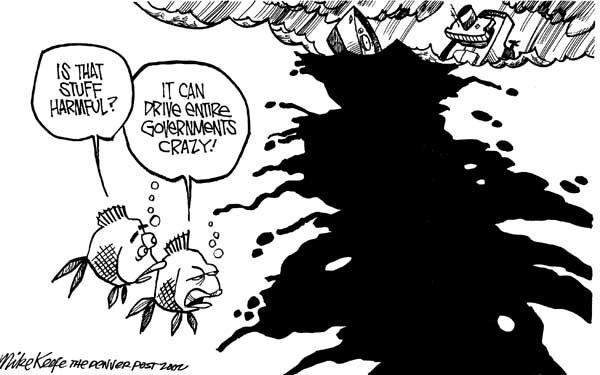


The recent oil spill at the BP rig in the Gulf of Mexico should give everyone pause about any plans to expand offshore oil drilling.
It's a proven fact that an oil spill in the Gulf of Mexico would risk all of Florida's beaches, with oil coming to St. Augustine from the Gulf Stream.
City Manager WILLIAM B. HARRISS, who unduly influenced Commissioners against Commissioner Leeanna Freeman's resolution, was exposed by her as a charlatan at a City Commission meeting.
HARRISS may have (again) engaged in illegal polling in violation of the Sunshine law, while pressuring Commissioners not to support anything "controversial" Of course, HARRISS is the most controversial thing in town and we're glad he's going.
ST. AUGUSTINE CITY MANAGER WILLIAM B. HARRISS (a/k/a "WILL HARASS")
Photo credit: J.D. Pleasant (and a cast of thousands)
Now HARRISS is retiring. Could Freeman's blowing the whistle be a contributing factor?
In any event, the St. Augustine Record didn't cover the Commission debate accurately or thoroughly, in a story so bad the reporter may have asked that his name be removed from it. Here's the strange story the St. Augustine Record ran on it:
COMMISSION DUMPS DRILLING RESOLUTION
A city resolution Monday night to add St. Augustine to a long list of cities and counties opposing offshore oil drilling failed for lack of support.
Commissioner Leanna Freeman, who proposed the measure and made the motion to pass it, could not get a second and her motion died.
She cited the risk of spills and contamination of Florida waters if a hurricane struck oil pipes and rigs.
She said she knows oil drilling in Florida happens mainly in the Gulf of Mexico, and that there are no known oil deposits or oil leases off St. Augustine.
But, she said, that doesn't mean the city should ignore the issue.
"Be a leader," she said.
About 63 governmental entities have already passed similar resolutions, even East Coast cities such as Fort Lauderdale and Miami.
Freeman said she hoped to send "a message" to Tallahassee that drilling is not welcome.
Several city residents spoke in support of her initiative. One spoke against.
Some cited the need to grow less dependent on foreign oil. Others said there's only enough oil in the Gulf to last the nation a few weeks, and that would take five years to obtain.
Other commissioners said that, while they might support the measure, the city should not consider resolutions on controversial issues that don't involve St. Augustine.
(end of sappy story published in the St. Augustine Record).
ST. AUGUSTINE CITY MANAGER WILLIAM B. HARRISS (a/k/a "WILL HARASS")
Photo credit: J.D. Pleasant (and a cast of thousands)
American Bar Association Journal: The Maricopa Courthouse War: An Arizona showdown over populist politics, abuse of power and pink boxer shorts

By Terry Carter
On Dec. 21, in the afternoon sunshine that passes for winter in Phoenix, several hundred well-dressed protesters—most of them lawyers—gathered on the Maricopa County courthouse plaza.
Summoned by an e-mail from a local lawyer, they brought handmade signs that were quaint by protest standards: “Rule of Law!” “Free Judges/Free People.”
Holding handouts, they recited the oath they gave when joining the bar, their voices rising for the last section: “I will not counsel or maintain any suit or proceeding that shall appear to me to be without merit or to be unjust.”
The immediate cause of their concern was a charge of bribery filed against a local superior court judge. Announced in vague terms at a news conference some days earlier, the charge was brought without indictment by the local prosecutor, Maricopa County Attorney Andrew Thomas.
But the criminal complaint against Judge Gary Donahoe was the last straw for these Phoenix-area lawyers, who had watched hardball politics overpower Maricopa’s courts.
The day after the protest, Yavapai County Attorney Sheila Polk, whose offices had been drawn into the mess in Maricopa, wrote in the Arizona Republic: “I can no longer sit by quietly and watch from a distance. ... I am conservative and passionately believe in limited government, not the totalitarianism that is spreading before my eyes.”
Alongside Thomas, at the center of all this, is Maricopa County Sheriff Joe Arpaio, the 77-year-old lawman whose caustic and controversial approach to crime and criminals has earned him the moniker “America’s toughest sheriff.” To the glee of Maricopa County voters, “Sheriff Joe” has become nationally famous for his “tent city” jail, chain gang labor and very public inmate marches designed to humiliate—featuring pink handcuffs and pink underwear.
But since teaming up with then-38-year-old Thomas in 2005, Arpaio’s county reign has become steeped in charges of racism, cronyism and a widespread use of law enforcement and criminal prosecution to settle increasingly bitter political intrigues. The bribery action against Donahoe—though later dropped—is but one ugly incident in a four-year history of investigation and litigation that has cost Maricopa County millions in legal fees. And a growing number of local lawyers say they’ve had enough.
“I’ve lived in New Jersey and in Washington, D.C., where politics can get nasty,” says Clint Bolick, director of the Phoenix-based Goldwater Institute’s Scharf-Norton Center for Constitutional Litigation.“But here, normal political retribution is just the starting point.”
Attempts to interview Arpaio were unavailing; Thom as’ spokesman, Barnett Lotstein, handled questions.
“This isn’t a personal thing with Thomas, like some others allege,” Lotstein says about the most recent dust-ups. “This is like in The Godfather—this is business, not personal.”
‘PERP-WALK’ POLITICS
Still, a federal grand jury in Phoenix is now investigating alleged abuses of power in Maricopa, a county that encompasses the nation’s fifth-largest metropolitan area and a population—4 million—greater than 24 states. And even a quick look at just the last few months in Maricopa County reveals a pattern of confrontation that is complicated, relentless and bizarre.
Mary Rose Wilcox
Photo by Ron Newkirk
In December, Thomas announced the indictment of two members of the county board of supervisors. Don Stapley and Mary Rose Wilcox were charged, respectively, with fraud and with failing to properly register conflicts of interest.
Stapley, a frequent critic of Arpaio and Thomas, had been indicted by prosecutors nearly two years before on 118 similar charges. When the last of those charges were dismissed in September, Arpaio’s deputies re-arrested him in the county parking lot three days later and “perp-walked” him before the media—without charges or warrant—citing probable cause.
Thomas has since been removed from the case. All charges against Wilcox and Stapley have been dropped, as well as those against Judge Donahoe. A judge from another county ruled that Thomas had conflicts of interest. And the State Bar of Arizona is apparently investigating allegations that Thomas ignored warnings that the charges against Wilcox were not legitimate, as well as an earlier warning that conflicts precluded him from investigating Stapley.
On Dec. 1, the day before the Stapley-Wilcox indictments, Thomas and Arpaio filed a federal civil suit (PDF) against the county’s board of supervisors and several judges, charging them with conspiracy and racketeering. In essence, the supervisors were accused of cutting the budgets of the sheriff and prosecutor during a countywide belt-tightening, while they continued with the long-planned construction of a new building for the county’s courts.
Public meetings have been marred by Arpaio’s deputies. In December 2008, five people were arrested after they applauded criticism of Arpaio at a meeting of the county board. The cases were dismissed last November by a county justice of the peace. The JP, Steven McMurry, noted that the deputies were “aided and abetted by the county attorney” and ordered the county to pay the defendants’ legal fees. “It has to stop,” McMurry said.
Last summer and again in mid-December, Arpaio’s deputies visited the homes of county employees, seeking information about their bosses and supervisors.
In November, a sheriff’s deputy was held in contempt for taking confidential papers from a defense lawyer’s files while she was speaking to the judge. The deputy decided he would rather be jailed than apologize, even though the incident was caught on a courtroom camera. Arpaio, whose office provides bailiffs for the courts, called his employee a “political prisoner.” His deputies staged a “sickout” and refused to bring prisoners to the courthouse. There was a bomb scare. The courts were closed for two days.
By the time of the lawyer protest, more than two dozen lawyers had filed motions seeking to move criminal cases out of Maricopa County, saying Thomas now had the judges in fear of ruling against him. That very day, Chief Justice Rebecca White Berch of the Arizona Supreme Court began triage. She issued an order appointing her predecessor, retired Chief Justice Ruth McGregor, as a special master to take control of the fast-deteriorating situation.
The various investigations, cases, motions, and allegations of conflicts and conspiracy, Berch wrote, “have the potential to impair the court’s ability to carry out its responsibilities and threaten the perception of impartial justice.” And if conflicts forced the wholesale transfer of cases away from the county, “a public safety emergency would arise.”
A LATE-NIGHT ARREST
The Arpaio-Thomas alliance was slow in developing. But it was embroiled in controversy from the start.
In their first meeting in February 2005, just a month after the prosecutor was sworn in, the sheriff asked Thomas to bring charges against a reporter at the Phoenix New Times, a local alternative newspaper—something Thomas’ predecessor, no fan of the sheriff, would have been reluctant to do.
Arpaio’s power is legend. He commands the equivalent of an Army combat brigade, with more than 3,500 employees and a $270 million budget.
An internal memo in Thomas’ office called the New Times matter stale and weak but noted that “Sheriff Joe Arpaio is demanding that this case be charged. ... Latest call indicated that there would be problems between the sheriff’s office and the county attorney’s office if this case is not charged.”
Thomas said he had a conflict, so he sent the case to his counterpart in nearby Pinal County, where it languished for two years. Later, after Arpaio and Thomas had become allies, Thomas appointed an independent prosecutor, private attorney Dennis Wilenchik.
Wilenchik, a civil litigator who made his bones in construction-defect and toxic-mold cases, had hired Thomas to work in his law office in 2003 while Thomas was preparing his run for county attorney. Once elected, Thomas sent outside work to Wilenchik that, by early 2010, amounted to $4.1 million in less than five years.
Wilenchik launched the Arpaio case by issuing a breathtakingly broad grand jury subpoena. He demanded lists of confidential sources, reporters’ notebooks and information about each of the hundreds of thousands of visitors to the newspaper’s website over the previous three years. When the paper’s owners published a story about the subpoena’s reach, Arpaio had them arrested.
Michael Manning
Photo by Ron Newkirk
“Arpaio’s deputies came to their homes and arrested them at 11 p.m. that night in plain clothes and black sedans—one of them with Mexico tags,” says Michael C. Manning, who represents the newspaper in a suit against Arpaio, “for goddamn misdemeanors.”
Backlash was so intense that Thomas dropped the charges less than 24 hours later.
It was not litigation, however, but the hot-button issue of immigration that finally forged an alliance between the seemingly mismatched public officials.
After graduating from Harvard Law School in 1991, Thomas worked briefly in private practice in Phoenix. He then entered public service, working for the attorney general, the governor and the Department of Corrections. He failed in a run for AG in 2002 and then briefly handled low-level matters as an assistant Maricopa County attorney, leaving in 2003 to begin a run for the office when the incumbent decided not to seek re-election.
Thomas fashioned himself as a conservative pundit in the mid-1990s, though his harder edges offended some in his partisan audience. In The Weekly Standard in 1997 he blamed our criminal and social ills on “the moral laissez-faire disorder of libertarianism.”
Thomas campaigned in 2004 to “stop illegal immigration.” Though federal law covers immigration, it struck a chord with Maricopa voters.
This was the moment of the Minuteman Project, launched in April 2005. The group began patrolling U.S. borders with Mexico, unnerving federal law enforcement while stirring anti-illegal-immigration sentiment.
By the end of his first year in office, Thomas had taken on the superior court judges, challenging Spanish-language probation hearings in DUI cases. Though the program was designed to help probationers understand their obligations, Thomas criticized them as “race-based courts.”
Though Thomas spent thousands of dollars on Spanish-language public service announcements bear-ing his face and name, he sued in federal court to stop the Spanish proceedings. After $498,000 in litigation fees, the 9th U.S. Circuit Court of Appeals at San Francisco ruled against Thomas last July, noting in the first sentence of its opinion that the county attorney lacked standing as a matter of “well-settled precedent.”
“Some say the county lost that case, but it’s never been ruled on the merits,” says Lotstein, Thomas’ spokesman. “It was brought for a simple reason—we don’t believe in discrimination.”
ON LOCAL AUTHORITY
Thomas also pursued his crusade against illegal immigration on another, even more controversial track. Thomas sought the lead over federal authorities in immigration enforcement within the county, and Arizona legislators gave him the tools, including a human smuggling statute known as the “coyote law” that targets those who charge fees to transport undocumented foreigners across the U.S. border.
Thomas said the illegal immigrants were as guilty as the coyotes. His novel reasoning combined the new human smuggling law with Arizona’s conspiracy statute: Both the smuggler and the person being smuggled were involved in the felony. Of Arizona’s 15 counties, only Maricopa applies that interpretation.
Robert McWhirter
Photo by Ron Newkirk
“Thomas really did want to create his own little INS,” says Phoenix public defender Robert McWhirter, immediate-past president of the Arizona Attorneys for Criminal Justice and the author of two books on immigration law published by the ABA.
Arpaio, who had close ties with the Hispanic community, was at first on a different page.
“The sheriff’s greater efforts at the time were against the Mexican Mafia, which was sending hit men into Maricopa County to carry out executions,” says super visor Wilcox, a fourth-generation Mexican-American. Those who didn’t pay for their crossing or otherwise angered the smugglers were killed. It was an epic turf battle for Arpaio. Also, she says, “he always had an af finity and a really good understanding of the Hispanic community.”
But the sheriff had a Damascene conversion in April 2005, when an Iraq war veteran held seven Mexicans at gunpoint at a rest stop on Interstate 8, suspecting they were illegal aliens. Arpaio’s deputies, however, arrested the veteran.
“You don’t go around pulling guns on people,” Arpaio told reporters. “Being illegal is not a serious crime. You can’t go to jail for being an illegal alien. ... You can only be deported.”
Arpaio suddenly found himself on unfamiliar ground, being savaged on talk radio and in letters to the editor for being soft on crime. After 11 days, Thomas dropped the charges.
“Sheriff Arpaio wanted some of the attention Thomas was getting on immigration,” says Wilcox, who with her husband owns El Portal, a popular Sonoran-style restaurant at the edge of downtown Phoenix. “At first his deputies started coming down on taco vendors and peddlers, the visible small commerce that is part of the Hispanic community.”
Both Wilcox and Stapley, her colleague on the board, publicly criticized the anti-illegal-immigration efforts, in addition to confronting Thomas and Arpaio in budget matters. Arpaio responded by publicly ratcheting up local immigration enforcement efforts.
“My message to the illegals is this: Stay out of Maricopa County, because I’m the sheriff here,” Arpaio told the Washington Post little more than a year after he had pronounced illegal immigration “not a serious crime.”
By 2008 the sheriff began sending hundreds of troops to run sweeps in mostly Hispanic neighborhoods. Heavily armed deputies, sometimes in SWAT regalia, were accompanied by civilian members of Arpaio’s posse. They stopped vehicles for minor infractions such as burned-out taillights or cracked windshields and asked for documentation of citizenship.
While Arpaio has helped carry out Thomas’ local immigration enforcement program, Thomas—and Maricopa County—have spent millions defending Arpaio.
Manning is a commercial litigator, the managing partner in Phoenix for Kansas City, Mo.-based, 330-lawyer Stinson Morrison Hecker. In the late 1990s, he took on the case of a lawyer friend whose son died of asphyxiation while tied down and unconscious in a restraint chair in county custody. The case settled for $8.25 million.
Similar cases found him. Half of the more than $40 million paid out in litigation against Arpaio over the years has gone to Manning’s clients.
Twice in 2009, Manning says, Arpaio’s deputies parked in front of his house in marked cars, watching, “just to let me know they were there.”
Since taking office, Thomas has doubled county spending on outside counsel—often with his closest political contributors, critics say. And concern over unwieldy spending and a lack of accountability have put Thomas and Arpaio at war with what seems like the rest of Maricopa County government.
“Thomas was paying out exorbitant amounts of money, and we felt that some of that work could have been done by his staff lawyers,” Wilcox says. “Our risk management people were telling us that things were not going well, and you could see it. We just kept losing cases.”
In May 2006 the board decided it would have some say in such outside hiring, as it had with Thomas’ predecessor. Thomas sued the board for encroaching on his turf.
Stapley told a columnist for the Arizona Republic that Thomas “wants to use [the contract work] as a political lever for his own campaign contributions.”
In his news release announcing his suit, Thomas switched sides in two lawsuits against the board. He said he could no longer defend the board in litigation brought by the county’s school superintendent and the medical examiner because “I believe these two complaints have merit.”
After the board threatened to take the matter to the state bar as an ethics complaint against Thomas, he and the board soon signed a memorandum of understanding. Thomas would dismiss his suit. The board could veto any new lawyers or law firms proposed for the list of those eligible for county contracts. The board agreed not to file a bar complaint against Thomas; Thomas agreed not to sue the board.
Its last item read: “This MOU terminates on Dec. 1, 2008.”
On Dec. 2, Thomas announced Stapley’s indictment.
CONFLICT ON CONFLICTS
Though Thomas and his office had advised the board on financial disclosures, Stapley was indicted on 118 counts concerning them. About half were felonies bootstrapped from underlying misdemeanors.
At the bottom of the wrangling, however, was money. Like other local governments working through tighter times, the board had slated 12 percent across-the-board budget cuts, including the offices of the county attorney and sheriff. Both bristled at the proposal, especially Arpaio.
In a letter to the board, copied to Thomas, Arpaio suggested tapping funds set aside for the county’s long-anticipated Downtown Court Tower. The $347 million project had been in planning for 12 years and the board declined to scrap it.
Shortly after Stapley was indicted, the board decided it had had enough. Board members sought outside counsel to see whether Thomas had violated their attorney-client relationship. Thomas responded with a sweeping grand jury subpoena seeking information about the courthouse project.
The board hired Tom Irvine, a Phoenix attorney, to represent members’ interests and to determine whether Thomas had ethical conflicts by serving as board adviser to the county business he had decided to investigate. When Irvine moved to quash the grand jury subpoena because of the prosecutorial conflicts, Thomas announced that Irvine, too, was part of the investigation.
Irvine says the courthouse project investigation and the litigation surrounding the board amounts to hardball politics: “[Thomas and Arpaio] said, ‘Well, if they want to investigate our ethics, we’ll go after something [board members] like.’ ”
What followed, however, was more turmoil than politics. When members of the board had their offices swept for bugs, Thomas said they were obstructing the investigation. When five people attending a board meeting cheered a speaker’s criticism of Arpaio, sheriff’s deputies arrested them. The emboldened board stripped $6 million from the county attorney’s budget to set up their own civil shop; Thomas sued.
In February 2009, in closed proceedings, Judge Donahoe—the judge later arrested—ruled that Thomas, in fact, had a conflict in his dealings with the county. His attempts to investigate a board that he represented had “the appearance of evil,” Donahoe wrote, citing an old Arizona case. In March, a former state bar official was questioned in Flagstaff by two Maricopa deputies regarding potential “intimidation” in his investigation of an ethics complaint against Thomas.
The courthouse conflict roiled through the summer, spawning a series of accusations, lawsuits and court hearings. Arpaio’s office intensified its investigations of county employees and supervisors, as Thomas continued to battle the board in the courts while also fighting the courts.
As the conflicts escalated, Maricopa courts began to assign visiting judges, retired judges and even a special master to sort out the various cases. Through an assistant, Lisa Auberchon, Thomas filed a flurry of requests to the Arizona Court of Appeals asking for intervention, suggesting that his office was faced with “a coordinated attempt by senior Maricopa County Superior Court officials to undermine the prosecution ... and shut down related criminal investigations.”
Last August, after losing several court battles over access to judicial branch e-mails, 12 armed deputies seized the county computer room—“just intimidating the employees working there and trying to show the [county] board that they could take over a resource that wasn’t theirs,” said County Manager David Smith, according to press reports.
About that time, half the charges against Stapley were dismissed by a visiting judge, and prosecutors were forced to drop the rest. Thomas’ attempt to hire Joseph diGenova and his wife, Victoria Toensing—two former prosecutors, now television celebrities—to conduct the courthouse investigation gained no traction under county procurement rules.
Arpaio’s office has long been dogged by questions relating to elections and budgets—including his use of proceeds from the sale of pink box ers to fans. Last year, the county’s chief procurement officer alerted the prosecutor to the sheriff’s purchase of a bus for $456,000—more than twice what the county usually pays for buses—without open bidding and outside official channels, a potential criminal violation. There is no evidence that Thomas did anything but ignore the letter, and the bus has remained parked without tags since its delivery last May.
But resistance against Thomas and Arpaio—once thought to be unassailable—is mounting.
When the county elections director asked Thomas last summer to investigate what he believed to be a secret election slush fund—some of it from Arpaio’s top depu ties—Thomas balked. The state attorney general later opened an investigation.
In March 2009, the U.S. Justice Department notified Arpaio that it was investigating “alleged ... discriminatory police practices and unconstitutional searches and seizures.”
“Sheriff Arpaio has been entertaining for voters through five elections, but the show has become a dangerous reality,” says attorney David Bodney. “Particularly for brown-skinned persons in vehicles during his sweeps.”
Bodney is a longtime partner in the Phoenix office of Washington, D.C.’s Steptoe & Johnson. He represents the American Civil Liberties Union of Arizona in a suit against Arpaio.
THE FINAL STRAW
In February, U.S. District Judge Murray Snow sanctioned the sheriff’s department for shredding significant documents that should have been turned over in discovery.
Even the conservative Goldwater Institute has expressed concern that Arpaio’s department has been ignoring serious and violent crimes—often clearing them without investigation—in favor of chasing illegal immigrants. When the institute took its concerns to Thomas they were ignored, says Bolick. “Andrew Thomas told me he didn’t want to further inflame the political problems in the county.”
In November, on behalf of the county board and its members, Smith filed a formal complaint with the state bar against Thomas and several of his prosecutors, complaining that members of Thomas’ staff had been waging their own campaign against county officials through the courts and on the Internet.
On Dec. 9, the fray over the courthouse project, the costly cross-litigation and the raw racial tension generated by Arpaio’s immigration sweeps brought Maricopa past the boiling point.
That afternoon, Judge Donahoe was scheduled to conduct a hearing on Thomas’ plan to hire diGenova and Toensing as special prosecutors in the courthouse case.
Complaining that the hearing itself would harm his grand jury investigation, Thomas instead announced that he had filed bribery charges against Donahoe.
At a press conference that afternoon—with Arpaio at his side—Thomas attempted to explain that under Arizona’s very broad bribery laws, the new courthouse project could be considered an inducement to judges who, like Donahoe, were hampering his investigation.
“If I’m not explaining this well, I hope you’ll help me,” he told stunned reporters.
Many lawyers in Phoenix say that single, embarrassing moment—perhaps more than anything—has gal vanized and energized opposition to Thomas and Arpaio. Inexplicable criminal charges against a well-respected judge brought lawyers of all persuasions to protest on the county’s courthouse steps. It also gave more than good reason for state and federal authorities to dig deeper in their ongoing probes.
In January, the Justice Department launched a new grand jury probe into the alleged abuses of power against political foes. Among the panel’s first witnesses were several county officials: the county manager, the head of computer services and Arpaio’s financial officer. Ominously, witnesses were encouraged to speak to the media about their testimony—apparently to insulate them from potential harassment.
Paul Charlton, a former Republican-appointed U.S. attorney for Arizona, who has represented Stapley, says he is not surprised that a backlash has finally set in. Charlton was one of the U.S. attorneys fired in 2006 by Attorney General Alberto Gonzales, in a controversial—some say political—purge. Gonzales lost his job in the subsequent firestorm.
“That kind of arrogance has its Watergate eventually,” says Charlton. “I think here it will be the charging of Judge Donahoe.”
Web Extras:
Thursday, April 22, 2010
Professor Jason Mauro Exposes Record's 1000% Inflated Crowd Estimate on Teabagger Meeting
St. Augustine Record: Letter to the Editor
By Jason Mauro
Editor: Did you have a reporter at the Tea Party rally last Saturday? I attended the rally with my 15-year-old daughter, at various times throughout the day, because I want to encourage her to investigate perspectives for herself, and not rely on media representations of such events. And what a lesson she got, not only about the Tea Party itself, but about the media.
First, there were never more than 400 people on that field, and that was the peak. Yet the Record's headline on Sunday proclaims that the rally was "Serving Tea for 5,000." Buried within the story was that this 5,000 figure was an estimate by one of the organizers. How could you use that figure in your headline, as though it were objectively derived?
Secondly, there was one black person at the event that I saw, Lloyd Marcus. And he was part of the traveling show, leading line dances of white people, and leading them in satiric songs mocking President Barack Obama.
Yet your reporter interviews him, a performer obviously brought in by the organizers, to suggest that the Tea Party is diverse.
Finally, you accept at face value the organizer's claim that any extreme racist or offensive behavior must be the work of "infiltrators," and yet what I heard on that stage, and saw on those signs, was deeply offensive, including a song about Obama called "The Great Reneger." I trust I don't need to spell out the pun involved in that song.
Please report such events in a detailed and objective way, check your facts, and don't allow editorial cheer-leading to be confused with journalism.
By Jason Mauro
Editor: Did you have a reporter at the Tea Party rally last Saturday? I attended the rally with my 15-year-old daughter, at various times throughout the day, because I want to encourage her to investigate perspectives for herself, and not rely on media representations of such events. And what a lesson she got, not only about the Tea Party itself, but about the media.
First, there were never more than 400 people on that field, and that was the peak. Yet the Record's headline on Sunday proclaims that the rally was "Serving Tea for 5,000." Buried within the story was that this 5,000 figure was an estimate by one of the organizers. How could you use that figure in your headline, as though it were objectively derived?
Secondly, there was one black person at the event that I saw, Lloyd Marcus. And he was part of the traveling show, leading line dances of white people, and leading them in satiric songs mocking President Barack Obama.
Yet your reporter interviews him, a performer obviously brought in by the organizers, to suggest that the Tea Party is diverse.
Finally, you accept at face value the organizer's claim that any extreme racist or offensive behavior must be the work of "infiltrators," and yet what I heard on that stage, and saw on those signs, was deeply offensive, including a song about Obama called "The Great Reneger." I trust I don't need to spell out the pun involved in that song.
Please report such events in a detailed and objective way, check your facts, and don't allow editorial cheer-leading to be confused with journalism.
Mosquito Board Works to Save Money, Stop Waste
Unlike other local government boards, there's a majority on the Mosquito Control Board in favor of saving money and stopping waste.
Three Commissioners effectively voted yesterday to stop the new building.
Five Commissioners voted in 2007 to halt the helicopter. Commissioners Jeanne Moeller and John Sundeman have for nearly four years been like Horatio at the Bridge, protecting tax dollars and stopping ill-advised ideas.
Commissioner Janice Bequette, elected in 2008, joined with them yesterday in halting the staff's plans to have contractors prequalified for a building we don't need.
There will now be more research and answers to pertinent questions before anyone talks of a new building.
Last night, AMCD Commissioners voted unanimously to seek a refund of some $15,000 paid to the lobbying firm of the former Chair and Executive Director of the Republican Party of Florida for lobbying to get a FEMA grant for the new building. AMCD does not qualify, which is something that the DUTKO firm should have told AMCD before taking its money.
Again, COmmissioners Moeller and Sundeman voted against the lobbying conract in the first place.
We need more public servants like Jeanne Moeller and John Sundeman and Janice Bequette.
We don't need any more arrogant, condescending know-it-alls (like City Manager WILLIAM B. HARRISS).
Commissioners also voted last night to investigate the situation with SJC Road & Bridge Department not removing obstructions in ditches.
Unlike other government boards, Mosquito Control listens to public concerns and heeds them.
Three Commissioners effectively voted yesterday to stop the new building.
Five Commissioners voted in 2007 to halt the helicopter. Commissioners Jeanne Moeller and John Sundeman have for nearly four years been like Horatio at the Bridge, protecting tax dollars and stopping ill-advised ideas.
Commissioner Janice Bequette, elected in 2008, joined with them yesterday in halting the staff's plans to have contractors prequalified for a building we don't need.
There will now be more research and answers to pertinent questions before anyone talks of a new building.
Last night, AMCD Commissioners voted unanimously to seek a refund of some $15,000 paid to the lobbying firm of the former Chair and Executive Director of the Republican Party of Florida for lobbying to get a FEMA grant for the new building. AMCD does not qualify, which is something that the DUTKO firm should have told AMCD before taking its money.
Again, COmmissioners Moeller and Sundeman voted against the lobbying conract in the first place.
We need more public servants like Jeanne Moeller and John Sundeman and Janice Bequette.
We don't need any more arrogant, condescending know-it-alls (like City Manager WILLIAM B. HARRISS).
Commissioners also voted last night to investigate the situation with SJC Road & Bridge Department not removing obstructions in ditches.
Unlike other government boards, Mosquito Control listens to public concerns and heeds them.
St. Augustine Record: Mosquito board stalls SR16 expansion
By Peter Guinta
ST. AUGUSTINE BEACH -- Apparently unable to make a decision and stick with it, Anastasia Mosquito Control District board members on Wednesday chose not to finalize the project cost of a proposed new headquarters on nine acres it owns at Interstate 95 and Agricultural Drive.
A motion to hear an architect discuss that cost went down 3-2, with board members Ron Radford and Vivian Browning dissenting.
After the vote, Radford said, "It makes no sense to cancel something we already said we'd do. We're deciding now not to do anything. We're down in the weeds."
Browning said, "Our purpose was to protect St. Johns County citizens as best we can. We need to see this through."
The board has discussed moving inland to a new, approximately $3 million headquarters since 2005, partly to escape the potentially poisonous effect that a future hurricane would have on a beach side compound loaded with barrels of pesticides.
Board member John Sundeman, who has opposed the relocation from the beginning, tried to get an item on the agenda that would have canceled the project outright.
He brought up the same point he's repeated for five years: "Why has there never been a needs-cost analysis?"
Also, he dismissed the hurricane threat as low and said the district would be forced to operate in deficit spending if it spent its reserves on the building.
"Why are we going forward with this when there's absolutely nothing wrong with (the beach compound)?" he said.
Sundeman, joined by Chairwoman Jeanne Moeller and board member Janice Bequette, effectively killed the motion.
"Estimates are $3 million to $3.5 million," Sundeman said. "What do we really need out there? We need to know all the variables and what they will cost."
Moeller, once a supporter of the project, is now waffling.
"I'm not telling you I won't vote for a new building," she said. "(But) we don't have the information we need to make a vote."
At one point, she added, "It's beyond my ability to understand."
She said 50 percent of people she asks think the district should move; the other 50 percent doesn't.
"We're attempting to build a building to fit a budget, not a building to fit a need. We have our cart before the horse," she said.
Radford said their job is the public health of this community.
"None of us would have proceeded on the basis that it wouldn't make financial sense," he said. "We ought to continue the effort we have under way. I don't know where we go from here."
Moeller also opposed asking for bids from local businesses when the district may never buy.
Browning condemned "political jousting" on the board for the deadlock, adding that some board members are too concerned with process and not with purpose.
The St. Johns County Commission has intentionally held up passage of a zoning approval it promised the district after AMCD gave it seven acres the county desperately needed to build its new Emergency Operations Center.
This action raised suspicions of a county desire to absorb AMCD. That began sometime in 2005 and 2006, when former St. Johns County Chairman Tom Manuel -- now heading to prison on an official corruption conviction -- said he'd take over the district and merge it with county operations.
On Wednesday night, Moeller said an e-mail from an assistant county administrator said county and district officials can meet and go over an outside efficiency report next week, "then find a way to alter the report if necessary."
That sent her off.
"The county spent $25,000 for a study on an independent agency," she said. "Then they put in writing that they'll alter the report. I do not think we need to defend ourselves."
Sundeman then scolded her for censuring him months ago for reading a personal letter to the County Commission, when she did that last week, making it sound like the letter came from the AMCD board.
"You got caught, ma'am," he said. "You didn't have the right to censure me."
Moeller said she represented the district as its chairwoman.
The board then decided to meet with the county in May but did not set a date.
Browning said, "We need to be talking to them and pointing out our concerns. (But) I have seen no effort by the county to embrace our input. What is their agenda? We feel like this 60-year-old special district can do a better job of killing mosquitoes."
ST. AUGUSTINE BEACH -- Apparently unable to make a decision and stick with it, Anastasia Mosquito Control District board members on Wednesday chose not to finalize the project cost of a proposed new headquarters on nine acres it owns at Interstate 95 and Agricultural Drive.
A motion to hear an architect discuss that cost went down 3-2, with board members Ron Radford and Vivian Browning dissenting.
After the vote, Radford said, "It makes no sense to cancel something we already said we'd do. We're deciding now not to do anything. We're down in the weeds."
Browning said, "Our purpose was to protect St. Johns County citizens as best we can. We need to see this through."
The board has discussed moving inland to a new, approximately $3 million headquarters since 2005, partly to escape the potentially poisonous effect that a future hurricane would have on a beach side compound loaded with barrels of pesticides.
Board member John Sundeman, who has opposed the relocation from the beginning, tried to get an item on the agenda that would have canceled the project outright.
He brought up the same point he's repeated for five years: "Why has there never been a needs-cost analysis?"
Also, he dismissed the hurricane threat as low and said the district would be forced to operate in deficit spending if it spent its reserves on the building.
"Why are we going forward with this when there's absolutely nothing wrong with (the beach compound)?" he said.
Sundeman, joined by Chairwoman Jeanne Moeller and board member Janice Bequette, effectively killed the motion.
"Estimates are $3 million to $3.5 million," Sundeman said. "What do we really need out there? We need to know all the variables and what they will cost."
Moeller, once a supporter of the project, is now waffling.
"I'm not telling you I won't vote for a new building," she said. "(But) we don't have the information we need to make a vote."
At one point, she added, "It's beyond my ability to understand."
She said 50 percent of people she asks think the district should move; the other 50 percent doesn't.
"We're attempting to build a building to fit a budget, not a building to fit a need. We have our cart before the horse," she said.
Radford said their job is the public health of this community.
"None of us would have proceeded on the basis that it wouldn't make financial sense," he said. "We ought to continue the effort we have under way. I don't know where we go from here."
Moeller also opposed asking for bids from local businesses when the district may never buy.
Browning condemned "political jousting" on the board for the deadlock, adding that some board members are too concerned with process and not with purpose.
The St. Johns County Commission has intentionally held up passage of a zoning approval it promised the district after AMCD gave it seven acres the county desperately needed to build its new Emergency Operations Center.
This action raised suspicions of a county desire to absorb AMCD. That began sometime in 2005 and 2006, when former St. Johns County Chairman Tom Manuel -- now heading to prison on an official corruption conviction -- said he'd take over the district and merge it with county operations.
On Wednesday night, Moeller said an e-mail from an assistant county administrator said county and district officials can meet and go over an outside efficiency report next week, "then find a way to alter the report if necessary."
That sent her off.
"The county spent $25,000 for a study on an independent agency," she said. "Then they put in writing that they'll alter the report. I do not think we need to defend ourselves."
Sundeman then scolded her for censuring him months ago for reading a personal letter to the County Commission, when she did that last week, making it sound like the letter came from the AMCD board.
"You got caught, ma'am," he said. "You didn't have the right to censure me."
Moeller said she represented the district as its chairwoman.
The board then decided to meet with the county in May but did not set a date.
Browning said, "We need to be talking to them and pointing out our concerns. (But) I have seen no effort by the county to embrace our input. What is their agenda? We feel like this 60-year-old special district can do a better job of killing mosquitoes."
U.S. Trustee Seeks to Block Final Decree in Morris Publishing Bankruptcy Case, Then Changes His Mind Without Giving the Court a Reason
The grand old Duke of York,
He had ten thousand men;
He marched them up to the top of the hill,
And he marched them down again.
And when they were up, they were up,
And when they were down, they were down,
And when they were only half-way up,
They were neither up nor down.
--- British nursery rhyme
Yesterday, the United States Trustee for the Southern District of Georgia, through Justice Department lawyer, Mr. Joel Paschke, Esquire, agreed with two local St. Augustine residents and filed an Objection to Morris Publishing's Motion for Entry of Final Decree, stating that our appeal on standing is pending and that "Where appeals of bankruptcy court orders are being actively litigated, the bankruptcy case is not fully administered and should not be closed." In re 1095 Commonwealth Avenue Corp., 213 B.R. 794, 795 (Bankr. D. Mass. 1997).
Today, without giving the Bankruptcy Court a reason, the U.S. Trustee withdrew the Objection. What do you reckon? Is the U.S. Trustee under pressure from the high-priced Chicago lawyers representing the influential Morris family of Augusta, Georgia? We have filed a Privacy Act and FOIA request to find out.
He had ten thousand men;
He marched them up to the top of the hill,
And he marched them down again.
And when they were up, they were up,
And when they were down, they were down,
And when they were only half-way up,
They were neither up nor down.
--- British nursery rhyme
Yesterday, the United States Trustee for the Southern District of Georgia, through Justice Department lawyer, Mr. Joel Paschke, Esquire, agreed with two local St. Augustine residents and filed an Objection to Morris Publishing's Motion for Entry of Final Decree, stating that our appeal on standing is pending and that "Where appeals of bankruptcy court orders are being actively litigated, the bankruptcy case is not fully administered and should not be closed." In re 1095 Commonwealth Avenue Corp., 213 B.R. 794, 795 (Bankr. D. Mass. 1997).
Today, without giving the Bankruptcy Court a reason, the U.S. Trustee withdrew the Objection. What do you reckon? Is the U.S. Trustee under pressure from the high-priced Chicago lawyers representing the influential Morris family of Augusta, Georgia? We have filed a Privacy Act and FOIA request to find out.
Wednesday, April 21, 2010
IN HAEC VERBAL Mosquito Control Commission Should Sue County for Public Nuisance
Dear County Commissioners:
1. At 6 PM tonight, I will ask the Anastasia Mosquito Control Commission of St. Johns County tonight to file a public nuisance lawsuit against St. Johns County, seeking a court order requiring the County to start removing obstructions that prevent water from moving in ditches and canals full of stagnant water.
2. SJC is unable to provide any legal citations, after Road and Bridge Department Supervisor JOSEPH STEPHENSON told Commissioners April 6th that some unspecified "environmental law" is at fault. No such law has been cited. STEPHENSON must be held accountable for his custom, usage, practice and procedure of not cleaning ditches and canals of stagnant water containing disease-breeding mosquitoes. STEPHESON's inaction is willful, violating public nuisance and civil rights laws.
3. As a landowner, SJC is breaching its duty to the people of SJC, putting them in harm's way.
4. If anyone has anything to say in defense of SJC's Road and Bridge Department's public nuisance creation -- its willful wanton recklessness on mosquito control -- I invite them to come to the AMCD meeting tonight at 6 PM.
5. You have the right to remain silent but we wish you wouldn't.
Sincerely,
Ed Slavin
Clean Up City of St. Augustine, Florida
829-3877
1. At 6 PM tonight, I will ask the Anastasia Mosquito Control Commission of St. Johns County tonight to file a public nuisance lawsuit against St. Johns County, seeking a court order requiring the County to start removing obstructions that prevent water from moving in ditches and canals full of stagnant water.
2. SJC is unable to provide any legal citations, after Road and Bridge Department Supervisor JOSEPH STEPHENSON told Commissioners April 6th that some unspecified "environmental law" is at fault. No such law has been cited. STEPHENSON must be held accountable for his custom, usage, practice and procedure of not cleaning ditches and canals of stagnant water containing disease-breeding mosquitoes. STEPHESON's inaction is willful, violating public nuisance and civil rights laws.
3. As a landowner, SJC is breaching its duty to the people of SJC, putting them in harm's way.
4. If anyone has anything to say in defense of SJC's Road and Bridge Department's public nuisance creation -- its willful wanton recklessness on mosquito control -- I invite them to come to the AMCD meeting tonight at 6 PM.
5. You have the right to remain silent but we wish you wouldn't.
Sincerely,
Ed Slavin
Clean Up City of St. Augustine, Florida
829-3877
Tuesday, April 20, 2010

IN HAEC VERBA: St. Johns County Must Adopt An Environmental Justice Policy; Mosquito-breeding County Property is a Public Nuisance
Dear Chairman Sanchez, Vice Chairman Bryan and Commissioners:
1. Will you please adopt an Environmental Justice (EJ) Policy for St. Johns County?
2. Prompt adoption of such a policy -- and vigorous and rigorous enforcement against the Road and Bridge Department -- might obviate the need for me to file an EJ complaint against SJC over the refusal to clean out the ditches for mosquito control purposes. Please let me hear from you individually.
3. As of 4:44 PM, no one has provided any legal citations -- to federal, state, county or other law -- supporting, directly or indirectly, Road and Bridge Department mgr. JOSEPH STEPHENSON's refusal to clean out the County-owned ditches and canals containing disease-causing mosquitoes.
4. No such citations apparently ever existed.
5. You should closely question STEPHENSON about his misleading you and ask whether SJC will do its part in the effort to prevent mosquito-borne diseases in SJC..
Thank you.
Sincerely,
Ed Slavin
Clean Up City of St. Augustine, Florida
829-3877
-----Original Message-----
From: Bill Sheroke
To: easlavin@aol.com
Sent: Tue, Apr 20, 2010 4:10 pm
Subject: RE:
There is no environmental justice policy that has been adopted by sjc bcc
1. Will you please adopt an Environmental Justice (EJ) Policy for St. Johns County?
2. Prompt adoption of such a policy -- and vigorous and rigorous enforcement against the Road and Bridge Department -- might obviate the need for me to file an EJ complaint against SJC over the refusal to clean out the ditches for mosquito control purposes. Please let me hear from you individually.
3. As of 4:44 PM, no one has provided any legal citations -- to federal, state, county or other law -- supporting, directly or indirectly, Road and Bridge Department mgr. JOSEPH STEPHENSON's refusal to clean out the County-owned ditches and canals containing disease-causing mosquitoes.
4. No such citations apparently ever existed.
5. You should closely question STEPHENSON about his misleading you and ask whether SJC will do its part in the effort to prevent mosquito-borne diseases in SJC..
Thank you.
Sincerely,
Ed Slavin
Clean Up City of St. Augustine, Florida
829-3877
-----Original Message-----
From: Bill Sheroke
To: easlavin@aol.com
Sent: Tue, Apr 20, 2010 4:10 pm
Subject: RE:
There is no environmental justice policy that has been adopted by sjc bcc
National EEO Search Required for Next St. Augustine, Florida City Manager
Photo credit: J.D. Pleasant (and a cast of thousands)
St. Augustine's next City Manager must be chosen based on a national search. Diverse people with management abilities and decent respect for human rights and the environment must be considered.
Mayor Gardner's Newsletter Suggests There May Be No Flags on Bridge of Lions
Flags on our bridge now history?
American flag on Bridge of Lions The light posts on our rehabilitated Bridge of Lions have two eyelets spaced above the lamps - perhaps for flying flags?
Doesn't matter. While city commissioners decided several years ago that only government or American flags would be flown on the bridge, City Attorney Ron Brown has found court rulings that the American flag "is not content neutral."
Translation: Old Glory is classified with any other flags, so permitting it to be flown allows the flying of any other flags.
All of which is moot because the Florida Department of Transportation owns the bridge, and may not continue an agreement with our city to use the light posts. Bridge project spokes -person Laurie Sanderson says that while elements of the bridge were thoroughly researched for historic accuracy, nothing was found to explain the purpose of those eyelets on the light posts.
American flag on Bridge of Lions The light posts on our rehabilitated Bridge of Lions have two eyelets spaced above the lamps - perhaps for flying flags?
Doesn't matter. While city commissioners decided several years ago that only government or American flags would be flown on the bridge, City Attorney Ron Brown has found court rulings that the American flag "is not content neutral."
Translation: Old Glory is classified with any other flags, so permitting it to be flown allows the flying of any other flags.
All of which is moot because the Florida Department of Transportation owns the bridge, and may not continue an agreement with our city to use the light posts. Bridge project spokes -person Laurie Sanderson says that while elements of the bridge were thoroughly researched for historic accuracy, nothing was found to explain the purpose of those eyelets on the light posts.
St. Augustine Record's Predictable Fluff on City Manager WILLIAM B. HARRISS' "Retirement"
Photo credit: J.D. Pleasant (and a cast of thousands)
By Peter Guinta
St. Augustine City Manager Bill Harriss announced his approaching retirement Monday, saying that when he leaves in June, he will have served 25 years as a city employee and 13 as city manager.
Harriss, who turns 60 in June, has a reputation as a strong-willed, sometimes blunt, administrator, but his softer side comes out talking about retirement.
"This decision has been emotional for me. You don't just say, 'Bye. See you' and walk away," he said Monday. "It's like your kids going off to college. They're not under your protection any more.
"You know they'll be successful, but it's a hard thing to let them go."
Harriss said one of his proudest achievements was improving the city's credit rating from junk bonds to the highest possible rating by "living within our means, spending money wisely and saving when we could."
There's no better way to understand how something works than by understanding how it is financed, he said.
"How do we deliver the same or higher quality service to all our constituents without having the cost of those services becoming a burden?" he said. "That's the everyday, every hour question a city manager has to ask himself, staff and, ultimately, the City Commission."
Other contributions include his execution of projects such as expansion of the water system, construction of city facilities such as a new fleet maintenance facility, central warehouse, solid waste facility, main fire station, new financial services center, rehabilitated Visitor Information Center and construction of a new downtown parking garage.
He is a Florida native who earned his accounting and finance degrees from the University of West Florida, coming to St. Johns County in 1985. That year, he began his career as financial services director, then served as general services director and assistant city manager under Joe Pomar.
He was chosen as city manager in 1998.
Former City Commissioner Bill Lennon, who served on the board for 10 years, nominated Harriss at the time.
"He's accomplished a lot," Lennon said Monday. "He pretty much filled (Joe Pomar's) shoes. There were many times when he was under severe stress.
"But he weathered the storm and did a good job."
Mayor Joe Boles agreed.
"St. Augustine is in as good a financial shape as it is because of Bill Harriss watching the dollars and cents," Boles said. "Having a bean counter as city manager goes a long way towards keeping us in good shape."
He said Harriss pushed for the city saving more in reserves.
"Having a reserve means we can spend $250,000 to replaces the lights in the parking garage with LEDs, saving us $100,000 a year in electricity costs," he said. "That's his personality permeating the entire staff. He guides them and challenges them to do better."
Harriss said Monday that he had long ago decided that he would retire after his 60th birthday and 25th year of city employment and that both those milestones will be reached in June.
But he added that he may help the new manager chosen by the commission with the transition and could stay until September.
When two new pipelines were being dug under the Matanzas River, Harriss loved to take visitors out and explain how the directional drill cut 25 feet below the river and came up on the other bank to the inch of where it was aimed.
He was known for being out of the office and on the scene.
"I was always taking things apart to see how they work," he said, adding that his father was an engineer. "He taught me a lot. Learning all the things that run a city is exciting."
However, one of his most important duties -- managing the city's budget -- required him to be in the office.
"There's not just one budget time. It's all the time," he said. "It's important to verify if something is a want or a need.
"On everything from big construction projects to office supplies, we try to look at what the function is and what it's worth to city residents."
Vice Mayor Errol Jones said Harriss has run the city well.
"We don't always agree on some issues. But I listened to him and respected his opinion even when I differed with it," Jones said. "His management style is different from a lot of others, but he's always sincere in what he's doing. He's been good for the city."
Harriss often receives angry and accusatory letters, phone calls and comments from the public. Any news story that mentions him always draws anonymous snipers.
But -- at least on the surface -- it seems not to bother him.
"People always want their way, and if they don't get it, they don't like it," he said. "I try to carry out the commission's philosophical wishes. Sometimes that doesn't sit well with people."
Jones said Harriss could be gruff sometimes.
"But he also has a gentle side," Jones said. "He knew who he worked for, and the ultimate decision was the commission's."
Harriss has also served occasionally as a reserve deputy for the St. Johns County Sheriff's Office. He and his wife, Scarlett, a teacher at Webster School, have two daughters, ages 35 and 28.
"I'll continue to work as a reserve deputy," Harriss said of his plans after retirement. "But bringing down or fighting a bad guy is not in my repertoire now that I'm 60. I don't participate in everyday law enforcement any more."
The City Commission has not yet decided how it will search for Harriss' replacement.
But whoever they choose, Harriss will be watching to make sure his beloved city is running smoothly.
He said, "I tell my staff, 'You have the baton. Don't drop it.'"
Boles said that anywhere he travels, he sees small towns in trouble.
"They've laid people off, fired people. We didn't lay anybody off. We didn't fire anybody." he said. "City staff is a close-knit, like a family. And Bill's paternal."
Subscribe to:
Posts (Atom)