In secret, behind locked gates, our Nation's Oldest City dumped a landfill in a lake (Old City Reservoir), while emitting sewage in our rivers and salt marsh. Organized citizens exposed and defeated pollution, racism and cronyism. We elected a new Mayor. We're transforming our City -- advanced citizenship. Ask questions. Make disclosures. Demand answers. Be involved. Expect democracy. Report and expose corruption. Smile! Help enact a St. Augustine National Park and Seashore. We shall overcome!
I love the creativity and resourcefulness of our National Archives -- adaptive re-use of goverment "red tape," on sale in the National Archives gift shop.
Three cheers!
From The Washington Post Style Section:
STYLE
They’re getting rid of ‘red tape’ in Washington. Literally.
The National Archives is selling the storied ‘tape’ — actually woven cotton — once used to bind government documents
By Danny Freedman
January 16, 2023 at 5:00 a.m. EST
(iStock/Washington Post illustration)
Listen
6 min
Comment
70
Gift Article
Share
For 25 years, the National Archives has been working to rid itself of government red tape — through its gift shop.
We’re talking about actual, physical tape:the red-dyed lengths of fabric that were used from the 1780s to the 1980s to bundle many of the nation’s documents, and that, according to the Archives, gave rise to “red tape” as shorthand for bureaucratic entanglements.
The “tape” the agency is selling off isn’t adhesive tape; it’s a soft, flat and narrow woven cotton that’s snipped from a spool. Red tape eventually was abandoned for white or undyed tape because of its tendency to bleed, but in its heyday, the government used vast amounts of the red stuff. For instance, in 1864, the War Department headquarters purchased 154 miles of red tape, according to the Archives. And even in 1943, the Treasury Department bought nearly 123 miles, a Washington Post article from the time noted.Quite a bit of that mileage landed at the National Archives among its billions of paper records.
“I’m not sure how much we have,” Jessie Kratz, the Archives’ agency historian, says of the red tape. “I don’t know if anyone knows. We have a lot.”
And it’s probably a familiar sight at other institutions preserving documents from the 18th and 19th centuries, she says. Before the advent of fasteners such as staples and paper clips, red tape and similar materials were used to bind together pages, to keep rolled documents from unfurling, to bundle papers and to buttress old books.
At the Archives, one common place to find it is knotted around stacks of tri-folded military records, Kratz says, which is how red tape ended up in the gift shop. A volunteer in the 1990s, Robert E. Denney, was unbundling Civil War service records to be microfilmed when he saw an opportunity with a curio that had outlasted its usefulness. In 1997, the store began selling clippings for $5, and its red-tape business is bigger than ever. It has expanded into a line of items, such as shadow boxes with tape tied around a Confederate war bond, as well as inches of fabric encased in acrylic paperweights and pieces bottled in jewelry, including earrings, cuff links and pendants.
All of the items, except the paperweight, are made by Kevin Clarke, an artist in Petaluma, Calif., who landed the gig on the strength of his work with another metaphorical nuisance: bugs. Trained in conservation biology and archival preparations, he combines art and entomology with his appreciative anatomical displays, as well as his butterfly-wing jewelry and dioramas, like the tiny motorcycle-riding “Weevil Knievel.”
Clarke says he was approached about designing red-tape items in 2015 and was intrigued. Tape arrived in a box “like a big ball of old red shoelaces,” he says. “It looked like shoelaces that had gone through the wash a hundred times.”
They span a spectrum of reds and conditions and lengths; some are knotted, some are stained. There was a learning curve to working with the tape; it requires ironing, for instance, and at first it would discolor or burn when he soldered the jewelry. “But I just love working with something that’s an old piece of history that somebody else has touched and utilized,” he says. “It was just kind of cool to think about the past that it had.”
Jim Doumas, deputy executive director of the National Archives Foundation, the nonprofit that operates the store, says visitors are often struck by those goods, having heard the expression “red tape” countless times but probably never probing its origins. “And then, son of a gun, if I’m not standing in front of red tape that was actually part of an official government document,” he says. “I think folks are just floored by that.”
Even for some who are well-acquainted with red tape, its proximity to history makes it something of an artifact in its own right. Biographer T.J. Stiles, who has won two Pulitzer prizes and a National Book Award, has encountered quite a bit of red tape in the course of his research. He says that, although the presence of the fabric raises the possibility that a document hasn’t been opened in a long time, if ever, the moment is bittersweet. “Often over time it dries up and turns fragile,” Stiles says in an email. “If you try to untie the knot, it crumbles, so the only way to remove it and access the document is to destroy the tape. That’s painful, even though the tape itself preserves no information.”
William J. Hansard bought a few red-tape charms online last year. A digital collections specialist at the Theodore Roosevelt Center in Dickinson, N.D., who has a doctorate in history, Hansard knew all about red tape. He’s delighted that it has been turned into a keepsake. “This thing that once was the bane of our existence,” for archivists, for citizens, “ … now we look upon fondly as an amusing charm — as ‘charming,’ quite literally.”
Red tape has been repurposed before; the Archives’ Philadelphia outpost has at least twice, most recently in 2014, collected red tape (among other flotsam) and turned it over to artists.
Sally Willowbee, an artist who participated in the 2014 exhibition by the found-object artist group Philadelphia Dumpster Divers, says she “just fell in love” with the red tape once she learned what it was. For one work, she appended pieces of tape with lines from “The New Colossus,” the poem at the base of the Statue of Liberty, and with restrictive language from U.S. immigration laws. She arranged the long, knotted lengths so they hung over a walkway like a beaded curtain.
After the show, Willowbee, of Deptford, N.J., had some red and white tape left over and found another use for it, something of a return to its utilitarian origin: Combining it with other fabric, she crocheted herself a circular bathroom rug.
Two feculent Florida gammons having a catfight. Did DeSANTIS sign paperwork when he sold his soul for a DONALD JOHN TRUMP endorsement in 2018? Does DeSANTIS have the fortitude to endure DJT's withering attacks, or does he fold like a cheap suit?
From The Hill:
Trump says DeSantis running for president would be ‘a great act of disloyalty’
Former President Donald Trump (left) listens during a campaign event at the South Carolina Statehouse, Saturday, Jan. 28, 2023, in Columbia, S.C. He also criticized Florida Gov. Ron DeSantis (right) for potentially launching a 2024 bid for president. (AP Photo/MarAlex Brandon/Marta Lavandier)
Former President Trump said Florida Gov. Ron DeSantis (R) running for president would be “a great act of disloyalty” as he kicked off his first two major campaign events as part of his own 2024 presidential run.
Trump visited New Hampshire and South Carolina, two of the first states to vote in the primary calendar, on Saturday after a quieter-than-normal beginning to his reelection campaign. He launched his campaign in mid-November, but has yet to hold any major rallies that were consistent during his 2016 and 2020 runs.
Trump announced the leaders of his New Hampshire and South Carolina campaigns during his speeches. After his South Carolina speech, he sat for an interview with The Associated Press and criticized DeSantis, who is rumored to be considering his own presidential run and who has consistently placed second in hypothetical Republican primary polls.
Trump emphasized his own status leading in many of those polls and took credit for DeSantis’s first election as governor of Florida.
“If he runs, that’s fine. I’m way up in the polls. He’s going to have to do what he wants to do, but he may run,” Trump said. “I do think it would be a great act of disloyalty because, you know, I got him in. He had no chance. His political life was over.”
Trump endorsed DeSantis ahead of the Republican primary for the gubernatorial race in 2018.
Trump faced criticism from many in his own party following the November midterm elections, in which Republicans underperformed their hopes and expectations. The president’s party has historically lost seats in Congress during the midterms, but Democrats were able to grow their majority in the Senate and only narrowly lost in the House.
Many, including some allies of Trump, blamed the former president for endorsing GOP candidates in the primaries who were seen as less likely to win a general election but more loyal to him than their other challengers.
Many of these candidates lost in key congressional and gubernatorial races.
Polls began showing DeSantis, who has not publicly confirmed he a 2024 run, closing the gap with Trump or in some cases leading in hypothetical polls. But Trump led DeSantis by 17 points in a Morning Consult poll earlier this month.
Trump told AP that he has not spoken to DeSantis in a long time. He expressedconfidence about his own prospects with the possibility of DeSantis running in an interview with David Brody on “The Water Cooler” earlier this week, saying, “We’ll handle that the way I handle things.”
Trump is the only major candidate who has officially launched their candidacy in the 2024 race, but many Republicans have indicated they are considering running, including former Vice President Mike Pence, former U.S. Ambassador to the United Nations Nikki Haley and former Secretary of State Mike Pompeo.
Waiting for our local, state and federal elected officials to be more proactive on our wintertime neighbors, who have their babies off our shores. Pro-life? Show me. What the heck is St. Johns County doing to help protect our endangered North Atlantic Right Whales (some 340 remain alive)?
You tell me.
From WJXT:
Marine biologists disentangle right whale off the coast of Georgia
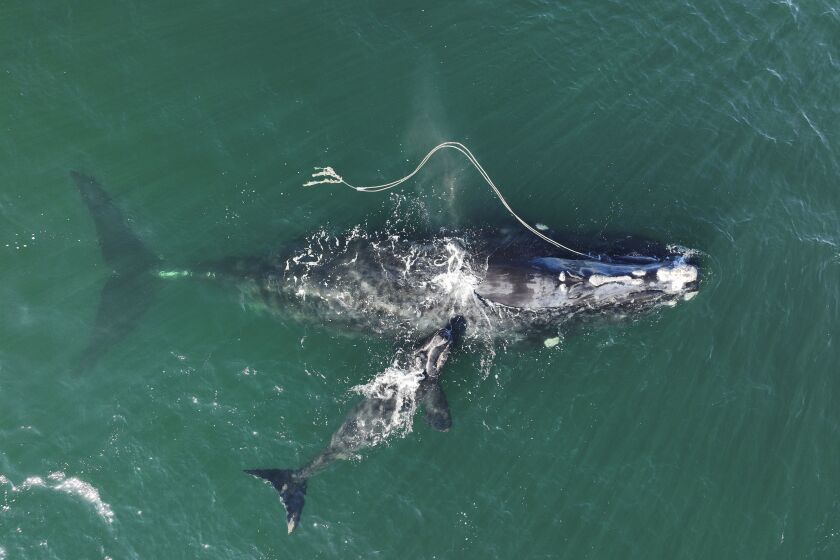
CUMBERLAND ISLAND, Ga. – A 15-year-old right whale named Nimbus is now free from being entangled in a fishing rope. Nimbus was spotted by a Florida Fish and Wildlife Conservation Commission whale survey aircraft entangled 13 miles east of Jekyll Island, Georgia.
Trained responders working from boats used special tools to remove 375 feet of 11/16 inch diameter synthetic rope that was passing through the whale’s mouth, dragging hundreds of feet behind its flukes. Responders were unable to remove a short segment of rope that was passing through the whale’s mouth, but the whale should be able to shed the remaining rope on his own in time.
Nimbus was last seen swimming south, 9 miles east of Cumberland Island, Georgia. Fishing rope entanglements are the leading cause of North Atlantic right whale deaths and injury. It’s one of the biggest challenges facing the species’ survival.
Investigators with NOAA will work to determine the fishery rope’s origin. The Georgia Department of Natural Resources along with the Clearwater Marine Aquarium Research Institute, Florida Fish and Wildlife Conservation Commission, NOAA Fisheries and Song of the Whale all worked to respond to the disentanglement.
Nimbus is a male Atlantic right whale, named for the cloud-like scars on his lips that predate this entanglement.
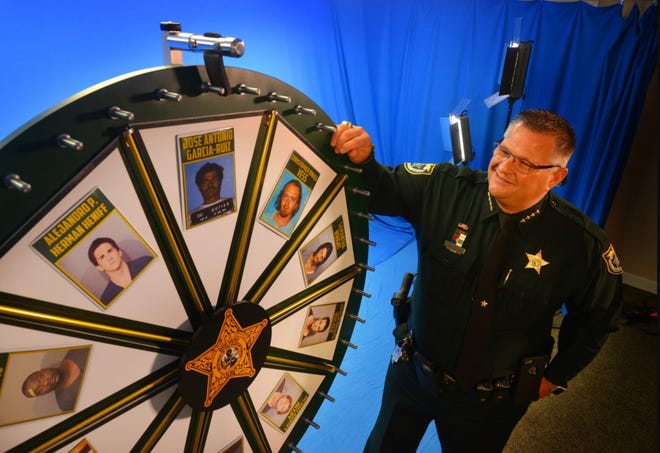
Some 60 times, Broward County Sheriff WAYNE IVEY used his TV studio to commit defamation: falsely stating that some people were "fugitives" when they were not fugitives.
Feculent Flori-DUH Sheriffs need to be watched.
I reject the false narratives that "cops [don't] need to be watched, in the words of disgraced former St. Johns County Sheriff DAVID SHOAR, who legally changed his name from "HOAR" in 1994.
From Florida Today:
Man falsely featured on 'Wheel of Fugitive' sues Sheriff Ivey for defamation
A man falsely included in several episodes of Brevard County Sheriff Wayne Ivey's popular "Wheel of Fugitive" social media 'gameshow' is suing the sheriff and the Brevard County Sheriff's Office for defamation, saying the experience cost him a job and impacted his mental health.
David Austin Gay was not a fugitive when his picture appeared in four episodes of the show between January and February 2021. Instead, he was either sitting in jail after turning himself in on a probation violation or, in one case, already legally released.
A 2021 investigation by FLORIDA TODAY found Gay was one of 60 'fugitives' the sheriff had featured on the wheel across 45 episodes between February 2020 and February 2021 who were either in jail at the time the episode aired, already free or had no active arrest warrant.
In a court filing in Brevard Wednesday, an attorney for Gay argued he was fired from a new job after his boss saw an episode of the show featuring Gay's picture.
"As he drove to his first day of work, his new employer informed him by phone to not bother showing up as he had seen Mr. GAY in IVEY and/or BCSO's 'Wheel of Fugitive' videos," Brevard attorney Jessica Travis wrote in the complaint.
"As he drove to his first day of work, his new employer informed him by phone to not bother showing up as he had seen Mr. GAY in IVEY and/or BCSO's 'Wheel of Fugitive' videos," Brevard attorney Jessica Travis wrote in the complaint.
Travis argued in the filing the incident also harmed Gay's mental health, causing depression and anxiety, and did damage to his reputation "that has caused him to be regarded with scorn, contempt, ridicule and disrespect which will continue in the foreseeable future," according to the complaint.
Gay is seeking unspecified damages in the case, including for loss of income and for pain and suffering.
“The lawsuit was filed because right is right and wrong is wrong,” Travis said in a statement Friday morning. "No one has the right to cause compliant citizens to lose their jobs or live in fear of confrontation or arrest; not even the Sheriff.”
A spokesman for Ivey did not immediately return a request for comment.
Gay spoke to reporters back in 2021 for the original FLORIDA TODAY investigation, calling the experience "humiliating."
"Something needs to be done about it," Gay said at the time. "(The sheriff) should probably fact-check everything before he goes showing the whole world talking, telling everybody people's fugitives when they're not."
On three of the dates when episodes featuring Gay's picture aired, Gay was in custody after voluntarily turning himself in for violating probation on a prior felony battery charge from 2018. Adjudication was withheld in the case. A separate charge of misdemeanor domestic violence that led to the violation in December 2020 was dismissed.
Ivey's "Wheel of Fugitive" has been lauded by supporters as a creative and entertaining way to engage the community. It's also had its share of critics, who have argued the show's format is dehumanizing, a waste of taxpayer funds and a distraction from genuine law enforcement efforts.
The show brought Ivey national attention, drawing headlines across the country and ridicule from late night talk show hosts including the Daily Show's Trevor Noah, who lampooned the show in a December 2016 episode of the Comedy Central program.
Eric Rogers is a watchdog reporter for FLORIDA TODAY. Contact Rogers at 321-242-3717 or esrogers@floridatoday.com. Follow him on Twitter: @EricRogersFT.
Wondering why St. Johns County still doesn't have police body-worn cameras and dashboard cameras?
Ask DAVID SHOAR, disgraced former Sheriff, who legally changed his name from "HOAR" in 1994.
Due to pervasive corruption here, St. Johns County is one of the last jurisdictions on this planet to implement dashboard cameras and body-worn cameras.
One of Sheriff DAVID SHOAR's first acts as Sheriff in 2005 was to remove the dashboard cameras from a couple of Sheriff's vehicles. SHOAR blocked their reinstallation, lied to me about it, and persistently said he "rejected the false narrative that cops need to be watched."
Our unsophisticated news media monopoly empowered SHOAR's corruption.
Meanwhile, SHOAR's hand-picked replacement as Sheriff, ROBERT HARDWICK, slow-walks the body-worn cameras and dashboard cameras he told publicly promised me to acquire and implement at County Commission in September 2022. HARDWICK is everywhere, doing PR events. He's everywhere, "even at the opening of an envelope," as the late David Brian Wallace said of a former St. Augustine Mayor, BUT providing information in response to records requests seems to be beneath him.
So is this another case of "The new boss is the same as the old boss"?
From The New York Times:
After Tyre Nichols Death, Officials’ Moves Reflect a Shift in Handling Police Violence
With cameras nearly everywhere, and residents wary, the authorities are moving faster and speaking critically when officers are accused of beatings.
Video
2:12Video Shows Memphis Police Officers Beating Tyre Nichols
On Jan. 7 Memphis police pulled over Tyre Nichols, a 29-year-old Black man. During the traffic stop, the officers beat Mr. Nichols. Three days later he died.CreditCredit...via City of Memphis
CHICAGO — It took 13 months and an order from a judge for the authorities in Chicago to release video showing a police officer firing 16 bullets into Laquan McDonald, a Black teenager, on a busy roadway in 2014.
Before that order, Chicago officials followed what was, at the time, a familiar law-enforcement playbook: Issue a vague, even inaccurate, initial statement. Fight the release of videos and other evidence for months on end. Use a drawn-out investigation as cover for silence.
Over the last few weeks in Memphis, it became clear how much has changed, as officials responded to the police beating and death of Tyre Nichols, a Black 29-year-old.
The Memphis Police Department’s first statement, issued just hours after the arrest, was misleading, omitting details of the beating, but said state investigators had been called in. The messaging grew more urgent after Mr. Nichols died, residents protested and his family pressed the authorities for answers.
Within two weeks, five officers involved in the arrest had been fired. Within three weeks, all five had been charged with second-degree murder, and the city’s police chief, Cerelyn Davis, had condemned their actions as “a failing of basic humanity.” On Friday, Memphis released videos that showed police officers stopping Mr. Nichols and beating him as he repeatedly screamed, “Mom!”
Across the country, even as fatal police encounters have continued apace, many cities have revisited how they investigate and talk about those cases, reflecting the reality that cameras are everywhere and that episode after episode of police violence, often involving Black people, has led to distrust of official accounts. Charging decisions that once took months or longer now sometimes happen within days or weeks. City leaders more freely call out police misbehavior when they see it. Body camera footage is more routinely made public, whether it exonerates the officers or raises questions.
“I think we are seeing a whole new world,” said Quinton Lucas, the mayor of Kansas City, Mo. While the default not long ago was to keep video private, he said, “I think people are understanding slowly but surely — particularly police chiefs — that this is not the sort of thing that can stay secret.”
Ben Crump, a lawyer representing Mr. Nichols’s family, praised the swift timeline, but he suggested that race may have played a role. The five accused police officers are Black. Credit...Desiree Rios/The New York Times
In Memphis, the release of videos came after grief-stricken statements from Mr. Nichols’s family, who had pushed for them to be made public. The family also commissioned an independent autopsy and shared a photo of Mr. Nichols in the hospital, his face swollen and bruised.
Ben Crump, a lawyer representing Mr. Nichols’s family, praised the swift timeline but suggested that race may have played a role. The five accused police officers are Black. “We want to proclaim that this is the blueprint going forward for any time any officers, whether they be Black or white, will be held accountable,” Mr. Crump said. “No longer can you tell us we got to wait six months to a year.”
Chris Magnus, who previously led the police department in Tucson, Ariz., said there used to be “an attitude that the less that was shared about various incidents — and certainly those that reflected on the shortcomings or misconduct of the police — the better.”
“I think that contributed to a climate that built of mistrust in the police and a lack of confidence because people felt like they were only being fed information when it was good news,” said Mr. Magnus, now a senior adviser at New York University School of Law’s Policing Project.
In recent years, some police departments have avoided a case-by-case debate on releasing footage and started routinely posting videos of police shootings. Officials in Milwaukee and Phoenix, for instance, release YouTube presentations, which often include footage from body cameras, sometimes clipped and narrated. Some agencies now allow family members of the deceased to watch the videos before they are released to the public.
Kristen Ziman, who retired in 2021 as police chief in Aurora, Ill., said that early in her career, she was told not to comment on police shootings. Doing so, the thinking went, risked compromising criminal or internal investigations.
But in recent years, she said, that strategy became untenable. As high-profile deaths at the hands of the police stoked nationwide protests and as more departments adopted body cameras, expectations shifted. She said the murder of George Floyd by a Minneapolis police officer in 2020, which touched off protests and unrest across the country, including Aurora, was a turning point.
In Minneapolis, people celebrated when Derek Chauvin was convicted in 2021 of murdering George Floyd. That case was a turning point for many officials in handling police violence.Credit...Joshua Rashaad McFadden for The New York Times
“I don’t think the public is going to tolerate any more of us saying, ‘This is under investigation and we’ll look at it and we’ll let you know what we decide,’” Ms. Ziman said.
“Now, it’s not just, ‘No comment,’” she added. “It’s, ‘We’re going to get ahead of this incident. We’re going to brace you for what you’re about to see, and it’s not going to be pretty.’”
In Chicago, the fatal police shooting of Mr. McDonald was a footnote in the local news when it happened in October 2014. But as word spread that there was video — and that it did not match the initial descriptions by the Police Department or officers’ union — questions grew about the city’s handling of the case.
In November 2015, hours before the video was released under court order, prosecutors filed charges against the officer who fired the shots, Jason Van Dyke. He was later convicted of second-degree murder and has been released from prison.
The case reshaped Chicago. Garry McCarthy, the police superintendent, was forced out. Mayor Rahm Emanuel, weakened by repeated protests, announced just before Mr. Van Dyke’s trial that he would not run for re-election. The Chicago Police Department was placed under a consent decree.
But Chief McCarthy, who now leads the police force in Willow Springs, Ill., population 5,800, said posting the footage of the McDonald shooting was not his decision to make. Local policies and litigation, he added, can limit a city’s options in deciding when to release video. And he said a broader conversation was needed about when and how such footage should be made public.
“Nobody’s considering the consequence of releasing a video,” Chief McCarthy said, noting the civil unrest and rioting that have previously spread in cities. “Everybody’s saying transparency, transparency, transparency. I’m not sure this is a method that’s functional right now.”
Ja’Mal Green, a Chicago mayoral candidate who in 2015 was one of the most visible protesters of Mr. McDonald’s death, said he saw in Memphis a concerted attempt to learn from mistakes in other cities.
“They’re definitely trying to make sure that they don’t see a blowup,” Mr. Green said.
Image
In 2015, demonstrators stood in response to the killing of Laquan McDonald in Chicago. It took 13 months and an order from a judge for the authorities to release a video showing a police officer shooting him.Credit...Joshua Lott for The New York Times
But while officials’ responses have changed, the underlying issue has remained. Washington Post data of fatal police shootings dating back to 2015 shows little year-to-year variance in the number of Americans dying at the hands of officers. The number of deadly police shootings recorded in 2022 — 1,096 — was the highest since the database started.
Political leaders risk alienating the police rank-and-file when they criticize officers’ actions. But long delays in releasing footage can create the appearance of obfuscation, said Phil Walzak, a onetime press secretary to former Mayor Bill de Blasio of New York City, who had a strained relationship with the police.
Mr. Walzak, also the former spokesman for the city’s Police Department, said official messaging must balance demands for transparency with preserving the integrity of an investigation. That includes ensuring a video release will not compromise the case or the personal security of anyone in the footage. But the process also has to move quickly, he said.
“If you don’t, people will think that you’re either incompetent, or you’re corrupt,” he added. “Even the perception of that can be really devastating. It’s easy to shatter trust, and it’s very hard to put it back together.”
Mr. Lucas, the Kansas City mayor, said releasing evidence and engaging with residents also allow officials to stamp out rumors about officers acting inappropriately.
In Kansas City last year, a witness account of a nonfatal police shooting suggested the wounded woman was pregnant and unarmed. The case became nationalnews, with outrage building until the local prosecutor’s office released a still image from a body camera that showed the woman, later reported to not be pregnant, had been clutching a gun.
“If you don’t share information,” including visuals, Mr. Lucas said, “public imagination will take on its own element and you’ll be dealing with the wrath of that.”
Remy Tumin contributed reporting.
Mitch Smith covers the Midwest and the Great Plains. Since joining The Times in 2014, he has written extensively about gun violence, oil pipelines, state-level politics and the national debate over police tactics. He is based in Chicago. @mitchksmith
Julie Bosman is the Chicago bureau chief. She has reported for The Times on the coronavirus pandemic, education, politics, law enforcement and literature. She joined The Times in 2002 as a news assistant in the Washington bureau. @juliebosman•Facebook
Chelsia Rose Marcius covers breaking news and criminal justice for the Metro desk, with a focus on the New York City Police Department.
A version of this article appears in print on Jan. 29, 2023, Section A, Page 1 of the New York edition with the headline: For Police, Body Cameras Break Old Code of Silence. Order Reprints | Today’s Paper | Subscribe


 Eric Rogers