Friday, December 31, 2021

Supreme Court Rebuffs Virginia School Board Appeal on Transgender Bathroom Rights (National Law Journal)

Perceptive article from National Law Review, noting emerging consensus on transgender bathroom rights, describes how Supreme Court refused to review a decision of the Fourth Circuit upholding gransgender bathroom rights, in Grimm v. Gloucester County, Virginia: 

The Supreme Court's Transgender Bathroom Case Rebuff, What Direction Should School Districts Take?

On June 28, 2021, the Supreme Court denied the Gloucester County School Board’s petition for a writ of certiorari or stated another way denied to hear an appeal from the School Board from a Federal Appellate court.  So at this juncture,  it appears the Justices don’t seem inclined to intervene in disputes over transgender rights and bathrooms.  So what are the implications of the Court’s action or more accurately inaction in Grimm v. Gloucester County School Board?

The Background and Twisting Litigation in Grimm v. Gloucester

Prior to appeal to the Supreme Court, the United States District Court for the Eastern District of Virginia denied a motion by the Gloucester County school board to dismiss the Title IX and Equal protection lawsuit brought by student Gavin Grimm.

In Grimm v. Gloucester County School Board the Plaintiff Gavin Grimm, a transgender student, challenged a school board resolution that required him—and other transgender students—to use the bathroom associated with his “biological gender.” G.G. ex rel. Grimm v. Gloucester Cty. Sch. Bd., 822 F.3d 709, 716 (4th Cir. 2016), cert. granted in part, No. 16-273, 2016 WL 4565643 (U.S. Oct. 28, 2016). Grimm sued the school board, alleging that the policy violated Title IX as well as the equal protection clause of the Constitution.

What does Title IX Protect?

Title IX of the Education Amendments of 1972 (Title IX) is a federal law that states in part: 

"No person in the United States shall, on the basis of sex, be excluded from participation in, be denied the benefits of, or be subjected to discrimination under any education program or activity receiving Federal financial assistance."

What does the Equal Protection Clause of the Constitution Protect?

The Equal Protection Clause is part of the Fourteenth Amendment to the U.S. Constitution and the part most frequently litigated reads: 

“No state shall make or enforce any law which shall abridge the privileges or immunities of citizens of the United States; nor shall any state deprive any person of life, liberty, or property, without due process of law; nor deny to any person within its jurisdiction the equal protection of the laws.”

Specifically, the phrase "equal protection of the laws" has been used by the Supreme Court to find constitutional protection in a number of gender and public education related situations. 

What Does the Due Process Clause of the 14th Amendment Protect?

The Due Process clause of the 14th Amendment which explicitly applies to the states,   essentially mirroring the protections of the 5th Amendment, which only applies to the Federal Government , thereby adding additional protections for individual rights from intrusion by the states.  The Due Process clause guarantees the following rights from interference by the states:

In addition to his Title IX and equal protection clause claims, the plaintiff in Grimm v. Gloucester relied heavily on a Department of Education (DOE) /  Office of Civil Rights Letter (OCR) known as a “Dear Colleague Letter” interpreting Section 106.33 (34 CFR 106.33 Comparable Facilities)  to require schools to “treat transgender students consistent with their gender identity.” G.G., 822 F.3d at 718.

In response to the Fourth Circuit Court of Appeals decision in Grimm v. Gloucester County School Board, 2016 WL 1567467 (4th Cir. April 19, 2016), on May 13, 2016, the Department of Labor (DOL) and the Department of Education under the Trump Administration issued a joint directive to school districts summarizing “a school’s Title IX obligations regarding transgender students and explains how the [DOE] and the [DOL] evaluate a school’s compliance with these obligations” or another a “Dear Colleague Letter.”

The Fourth Circuit’s majority opinion in Grimm (2106) relied heavily, if not exclusively, on the Obama Era’s DOE’s interpretation of Title IX and that requiring transgender students to use the restroom associated with their biological sex equated to discrimination on the basis of sex.  

The school district in Grimm, along with several state attorney generals, petitioned the Fourth Circuit for a hearing before the full panel.  The Fourth Circuit denied the and School District appealed to the United States Supreme Court for review and the Supreme Court granted certiorari in 2016, but after the change of administration the Department of Education withdrew the “Dear Colleague Letter”, the Supreme Court opted to not to hear the case and vacated and remanded the case back to the Fourth Circuit.

Grimm then filed an amended complaint, and in 2020, the Fourth Circuit affirmed the district court’s ruling in favor of Grimm.  The Fourth Circuit, in its 2020 ruling relied on 2020 landmark Supreme Court case, Bostock v. Clayton County, which held that Title VII’s prohibition of discrimination on the basis of sex necessarily includes discrimination on the basis of sexual orientation and gender identity. The Fourth Circuit extended the Supreme Court’s reasoning in Bostock  to Title IX’s analogous prohibition of discrimination on the basis of sex.

The School District once again appealed and the Supreme Court refused to grant certiorari on June 28, 2021, so the underlying 2020 Fourth Circuit opinion stays intact. 

What Impact will Grimm v. Gloucester Actually Have?

According to Shannon Farmer a Labor & Employment partner in the Philadelphia office of Ballard Spahr, with extensive litigation experience related to civil rights:

"As the Fourth Circuit’s decision and the Supreme Court’s denial of certiorari makes clear, the Court’s landmark ruling in Bostock changed the legal landscape surrounding LGBTQ+ discrimination. When Grimm was before the Court in 2016, the underlying Fourth Circuit decision was based on administrative guidance with limited authority. The Fourth Circuit’s most recent ruling, however, was grounded in the Court’s reading of statutory language. Although the Supreme Court explicitly stated that the Bostock opinion did “not purport to address bathrooms, locker rooms, or anything else of the kind,” its decision not to hear the Grimm case allowed Bostock to be extended to provide exactly those protections. In addition, the Biden Administration's March 8 Executive Order and a subsequent memorandum from the DOJ have extended Bostock to the educational context."

Although many institutions have created or are beginning to create policies for transgender students, the long and winding road of the Grimm case shows there are still challenges ahead and changes in direction from the DOL, DOE and OCR  with different administrations, can make keeping up with the rules a moving target. As it stands today, revisions to existing policies will call for more clearly-defined inclusivity provisions for the LGBTQ community. 

According to Nikki Hatza, an associate in the Philadelphia office of Ballard Spahr with previous experience with the Employment Litigation Section of the U.S. Department of Justice's Civil Rights Division:

"Given the Biden Administration’s guidance and the existing appellate court decisions interpreting Title IX and the Equal Protection Clause to prohibit discrimination on the basis of gender identity, schools should review and adjust their policies as needed to comply."

Per Art Coleman, of EducationCounsel and past Deputy Assistant Secretary for Civil Rights, U.S. Department of Education, who along with his team, last year filed an amicus brief in the U.S. Court of Appeals for the Fourth Circuit on behalf of Gavin Grimm: 

"The U.S. Supreme Court’s decision not to consider the appeal in the Grimm case is not surprising in light of the unbroken string of recent federal appellate decisions that affirm that the protections of Title IX extend to transgender students.  Coupled with recent U.S. Departments of Justice and Education actions that align with those rulings, clear consensus has emerged under federal law.”

The federal court rulings that affirm the extension of Title IX protections to transgender students have continued to affirm the reality of consequential harm to transgender students that occurs when they are denied from full participation and opportunities in education.  In the end, the cases really are about the indisputable harm to students that results from lack of equal opportunity—medically, psychologically and educationally.  The federal courts—and the Biden administration—have recognized that reality, and won’t countenance it.  Because the law doesn’t.

Jessica Clarke, a professor of law and co-director of the George Barrett Social Justice Program at Vanderbilt University believes that Grimm v. Gloucester will cause groups with concerns related to LGBTQ rights to shift their attention from the bathroom issue and served as the impetus for school districts to adopt more trans-friendly bathroom policies. 

“The decision not to grant certiorari is important because it did not disrupt the emerging consensus among federal courts--not just the Fourth Circuit--that schools may not forbid transgender students from using restrooms consistent with their gender identities. One factor that has been important in this development is that school districts around the country have adopted trans-inclusive restroom policies without experiencing any of the disruption that was feared. As a result, we are likely to see conservative advocacy groups shift the focus of their attacks on the LGBTQ community from restrooms to other issues.”

Tuesday, December 28, 2021

‘Unlike anything I’ve seen at the FTC’: Biden’s chair makes her public debut. (Politico, July 1, 2021; two FTC press releases)

Wonderful news about Federal Trade Commission, under new management of FTC Chair Lina Khan! 

New Chairman, and new Directors of FTC Bureau of Competition and Bureau of Consumer Protection. 

See below.

I am pondering filing several FTC complaints.

I am inspired by Chair Lina Khan and her 3-2 Democratic majority.  

In 1890 and 1914, Congress enacted the Sherman Antitrust Act, Clayton Antitrust Act and Federal Trade Commission Act, making "every contract, combination and conspiracy in restraint of trade" illegal, and a felony, and providing for FTC to investigate and adjudicate antitrust and unfair trade practice issues.  

Former Senate Judiciary Committee Chairman Joseph Robinette Biden, Jr. swore to "preserve, protect and defend" our Constitution and laws, as did his appointees.  

President Joe Biden meant it. 

So do his appointees.

It shows,

"Fiat justitia, rust ceaelum."  ("Let justice be done though the heavens fall." 

Evocative photo below is of a Dublin, Ireland police station, adjoining an Irish court, Photo credit: from website of McGarr Solicitors.


From Politico: 


TECHNOLOGY

‘Unlike anything I’ve seen at the FTC’: Biden’s chair makes her public debut

Under Biden nominee Lina Khan, the agency met in public for the first time in decades — and split along party lines on an aggressive enforcement agenda.

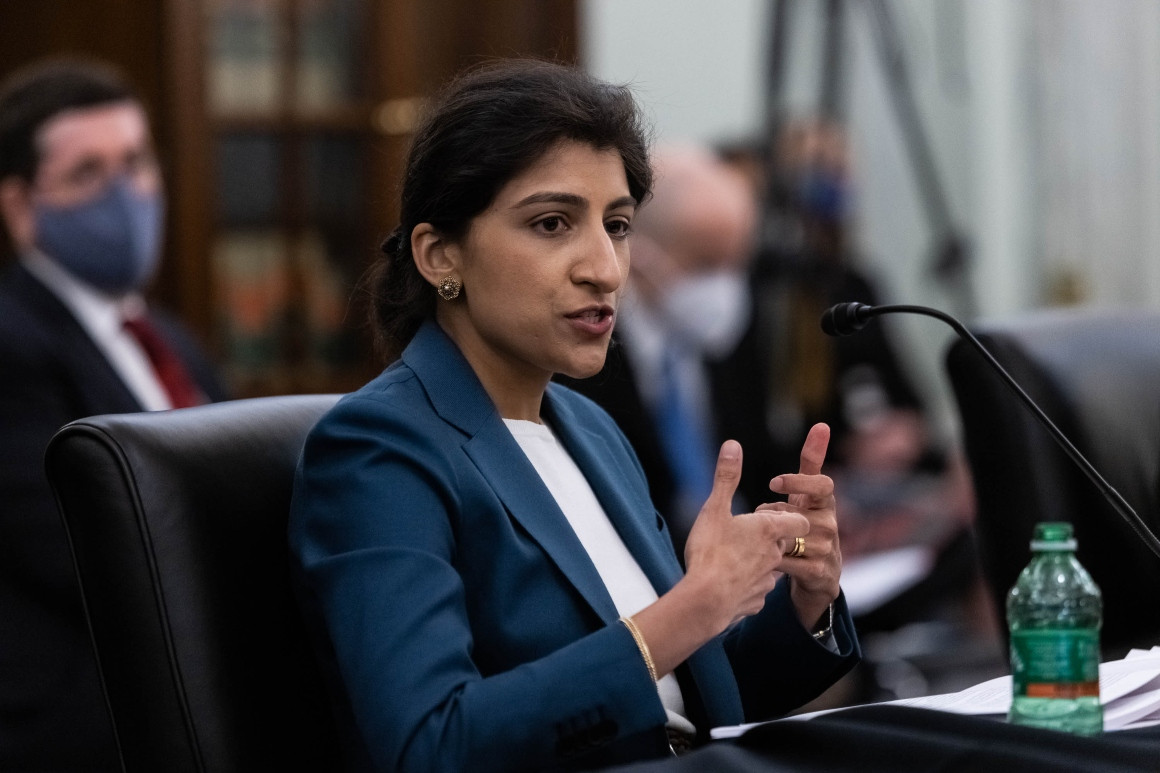
FTC Commissioner nominee Lina M. Khan testifies.

 FTC Commissioner nominee Lina M. Khan testifies.  

The Federal Trade Commission's first meeting under new Chair Lina Khan broke decades of precedent by taking place in public. | Graeme Jennings-Pool/Getty Images

By LEAH NYLEN

07/01/2021 08:49 PM EDT

The Federal Trade Commission's first meeting under new Chair Lina Khan broke decades of precedent Thursday by taking place in public — something unheard-of for the notably secretive antitrust and consumer protection agency.


Then it pushed through a series of actions on progressive Democrats' wish list: Fines for companies that lie about products being "Made in America." Greater latitude for launching antitrust probes and lawsuits. And a wider door to writing new regulations — something else the FTC hasn't done much of in decades.


All this came despite fierce objections from the commission's two Republicans, in a sign that partisan rancor is also back in vogue at the Biden-era FTC.


Thursday's videoconferenced session was the first public glimpse of what may lie in store for the 106-year-old agency under its youngest-ever chair, a former Columbia University law professor who made her reputation as a critic of tech giants like Amazon. And fellow tech critics were particularly thrilled.


“More progress was made today than in the last quarter-century,” said Jeff Chester, of the watchdog group Center for Digital Democracy, who has done work before the FTC since the 1990s. "Its very, very important and it’s unlike anything I’ve seen at the FTC."


Here are POLITICO's takeaways from Khan's debut:


Partisanship is back


The FTC has long touted itself as a bipartisan agency, less prone to the party-line votes that characterize much of the business at bodies like the Federal Communications Commission and the Securities and Exchange Commission.


“The FTC has a long history of bipartisanship, and we work hard to maintain that tradition,” then-Chair Joe Simons, a Republican, told a Senate panel in 2018.

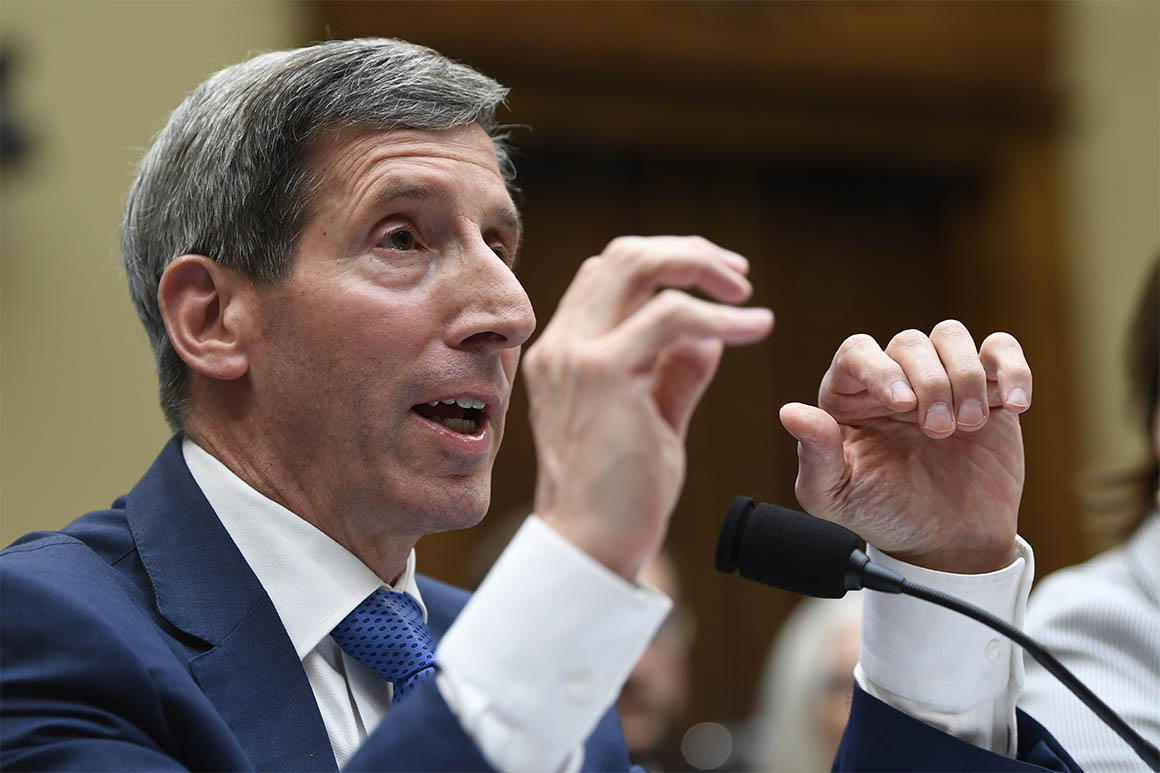
FTC Chair Joe Simons testifies.


 Then FTC Chair Joe Simons testifies during a House Energy and Commerce subcommittee hearing on Capitol Hill. | Susan Walsh/AP Photo

That spirit was absent Thursday, however, as every item on the agenda passed in a 3-2 party line vote. Republicans Noah Phillips and Christine Wilson repeatedly decried the new approach, accusing the Democrats of risking a congressional backlash by overstepping decades of precedent and the agency's legal authority.


The split was notably different from the agency's usual partisan divides, even though Democrats have typically been more likely than Republicans to favor enforcement in high-profile antitrust cases. As recently as December, Simons joined with the FTC's two Democratic commissioners to approve a major antitrust suit against Facebook.


In her first public comments as chair, Khan also voiced a much different set of priorities from the commission's Republicans, emphasizing that the FTC has a mandate to protect “consumers, workers and honest business owners” and “to promote a fair and thriving economy that is representative of all Americans.”


Previous chairs and commissioners have defined the agency’s primary focus as promoting consumer welfare. That standard look at how businesses' conduct affects the ways people purchase goods and services, often translated as its influence on price. But progressives say it undervalues other considerations such as fairness and privacy.


Back to the '70s … or '80s


“If we don't acknowledge the mistakes of the past, we are doomed to repeat them,” Wilson warned while arguing against one of the Democratic-led action items.


She was referring to the 1970s, when the FTC under then-Chair Michael Pertschuk sought to create rules on TV advertising directed at children, in what came to be known as the KidVid controversy. The Washington Post's editorial board accused the FTC of trying to be the “national nanny,” and Congress, under pressure from advertisers and business groups, passed legislation to significantly curtail the FTC’s rulemaking authority.


Since then, the FTC has shied away from rulemaking, even where the agency’s founding statute expressly calls for the commission to make regulations. (More on that below).


The FTC also suffered a series of court losses in the early 1980s when it tried to bring cases under its statutory authority to police “unfair methods of competition,” Wilson pointed out.


The FTC “needs to acknowledge the commission's losses in those cases,” she said. The response “should not be a new concerted effort by the commission to exceed the FTC’s authority.”

Khan and her supporters, though, argue that Republicans are paying attention to the wrong decade in antitrust and the FTC’s history. When Ronald Reagan became president in 1981, he brought to federal agencies a young, enthusiastic and highly ideological cadre who remade antitrust into the corporate-friendly policy realm it is today. That's the legacy the Democrats are now trying to undo, calling it a return to the principles behind the FTC's creation in 1914.


“Lawmakers created the FTC to police unlawful business practices with greater expertise and democratic accountability than courts provided,” she said.


Rules are coming


One of the most important actions Thursday — a project of Democratic Commissioner Rebecca Kelly Slaughter — sets the stage for a return to active rulemaking.


After Congress passed legislation in 1980 to cut back on the FTC’s rulemaking, the agency adopted procedures that Slaughter said even further curtailed the agency’s ability to propose rules. A proposal adopted Thursday aims to eliminate those “self-imposed” requirements while still allowing “ample transparency and opportunity for public participation,” said Slaughter, the agency's former acting chair.


One key change would eliminate the role of the FTC’s administrative law judge in presiding over rulemakings. Instead, the FTC’s chair or a person of her choosing can act as the presiding officer, overseeing public hearings and determining the factual record behind the rule.


Republicans opposed the change, on the grounds that someone selected by the chair would be less neutral than the agency’s in-house judge.


Slaughter suggested that online ticket sales and data collection are two potential areas for possible rules. Khan also said the FTC would probably consider writing its own definition of what conduct amounts to an “unfair method of competition” — an idea that could allow the agency to sue businesses for bad behavior not covered by traditional antitrust law.


So are more investigations


The commission also lowered the threshold for the FTC's staff to launch antitrust probes, a move that could have huge implications.


For years, the agency has required its antitrust attorneys to get the full commission's approval to begin investigations. In contrast, attorneys from the agency's consumer branch often have had wider latitude to send out subpoenas and document requests to companies or ask for interviews with business employees, under so-called “omnibus” resolutions.


Slaughter said the disparity "has never made sense.” But the FTC’s Republicans assailed the move to give antitrust lawyers a freer hand.


“I cannot understand why the commission would abrogate so much of its authority at such a critical time,” Wilson said.


Now, antitrust staff will need only one commissioner's approval to subpoena information for certain kinds of investigations, including those that involve repeat offenders, technology companies or digital platforms and pharmaceutical companies or hospitals. Cases where staff are seeking information on the Covid-19 pandemic or harms to labor or small businesses will also only need one commissioner’s approval.


While Khan and her allies styled the resolutions as “streamlining” investigations, they actually have a more strategic value for the Democrats.


Democratic Commissioner Rohit Chopra is likely to leave in the coming months because President Joe Biden has nominated him to head the Consumer Financial Protection Bureau. Once he departs, the FTC will be equally split between Republicans and Democrats until Biden nominates and the Senate confirms a fifth member. Thursday's change ensures that the Republican commissioners can’t block investigations the Democrats want to open.


More transparency, but only so much


Thursday’s meeting was the first of its kind — the first time the FTC’s commissioners have met publicly to vote in decades, and among the first times ever they have accepted public comments. (The FTC often holds workshops and hearings on various topics, but the five commissioners rarely attend.)


Khan heralded the meeting as bringing needed transparency to the FTC’s work by “establishing a regular public forum.”


The Republicans were less enthused, with Wilson noting that while the FTC released the meeting’s agenda a week in advance, Khan’s office didn’t provide the text of the items under consideration until Friday.


“With sufficient notice, advanced planning, input from our knowledgeable staff and a robust dialogue among my fellow commissioners, open commission meetings could facilitate” transparency, she said. “Today's meeting falls short on all accounts.”


The public comment period was also scheduled for the end of the meeting, which meant the commissioners were voting on items before anyone got a chance to speak about them, Phillips said.


“Transparency is important, but I don't think the commission is living up to that ideal with this,” he said.


Both Phillips and Wilson offered proposals that would have seen the FTC publish its proposals in the Federal Register for public comment before the commissioners voted on them. (Those motions failed on party-line votes.)


After Thursday’s meeting, the agency issued news releases heralding each of the proposals — though not the actual text of what the FTC adopted in at least one of the motions.


FILED UNDER: FTC, ANTITRUST, CONSUMER FINANCIAL PROTECTION BUREAU, JOE BIDEN,


----

FTC Chair Lina M. Khan Appoints Directors of Bureau of Competition and Bureau of Consumer Protection

Holly Vedova will serve as Director of Bureau of Competition; Samuel A.A. Levine will serve as Director of Bureau of Consumer Protection 

SHARE THIS PAGE

 
FOR RELEASE

Federal Trade Commission Chair Lina M. Khan announced that she has appointed Holly Vedova as Director of the agency’s Bureau of Competition and Samuel A.A. Levine as Director of the Bureau of Consumer Protection. Ms. Vedova and Mr. Levine have been serving in their roles in an acting capacity since June of this year.

“Already in their roles as Acting Directors of the Bureau of Competition and Bureau of Consumer Protection, Holly Vedova and Sam Levine have taken important steps to ensure the FTC is working vigorously on behalf of the people we serve,” said Chair Khan. “Now as permanent directors of the FTC’s enforcement bureaus, their mission will be to guide this agency as we work to safeguard fair competition and check unfair or deceptive practices. I look forward to continuing our work together.”

Vedova joined the FTC in 1990 and served most recently as an attorney advisor to Commissioner Rohit Chopra. She has been an attorney advisor to four other FTC commissioners, and also served as counsel to the Director of the Bureau of Competition. Prior to joining Commissioner Chopra’s office, Vedova was a staff attorney in the FTC’s Bureau of Competition, Mergers III Division, where she investigated mergers in various industries. She also spent two years in private practice as in-house antitrust counsel to a large pharmaceutical corporation. Vedova holds a J.D. from George Mason University School of Law and a B.A. from Earlham College.

Levine moves to lead the Bureau of Consumer Protection following work first in the FTC’s Midwest Regional office and then as an attorney advisor to Commissioner Rohit Chopra in the Washington, DC office. Before joining the FTC, Levine worked for the Illinois Attorney General, where he prosecuted predatory for-profit colleges and participated in rulemaking to expand income-driven repayment options for student borrowers. Levine also clerked with The Honorable Milton I. Shadur in the U.S. District Court for the Northern District of Illinois. He holds a J.D. from Harvard Law School and a B.A. from Washington University in St. Louis. Levine received the 2012 Gary Bellow Public Service Award in recognition of his commitment to social justice.

The Commission votes approving the appointments of Vedova and Levine were 5-0.

CONTACT INFORMATION

MEDIA CONTACT: 
Office of Public Affairs


------

FTC press reelease:

FTC Chair Lina M. Khan Announces New Appointments in Agency Leadership Positions

SHARE THIS PAGE

 
FOR RELEASE

Federal Trade Commission Chair Lina M. Khan announced several new additions to the FTC’s Office of Policy Planning. Olivier Sylvain, Meredith Whittaker, Amba Kak, and Sarah Myers West will be working with the agency’s Chief Technology Officer and technologists as part of an informal AI Strategy Group and in partnership with policy experts across the agency to provide insight and advice on emerging technology issues. John Kwoka will be working with competition economists and attorneys on an updated approach to merger review policies.

“At this critical time for the agency, I’m thrilled to welcome to the FTC several new additions: Amba Kak, John Kwoka, Sarah Myers West, Olivier Sylvain, and Meredith Whittaker,” said Chair Lina M. Khan. “Tackling unlawful conduct requires that we ensure our law enforcement and policy work are keeping pace with new market realities. These leaders in tech and economic policy will work alongside experts within the FTC and my office to help us realize that goal.”

Olivier Sylvain will serve as Senior Advisor on Technology to the Chair. Sylvain joins the FTC from Fordham University where he has served as Professor of Law. An expert on Section 230 of the Communications Decency Act, his areas of scholarship include administrative law, information law, U.S. data protection and privacy law, and other information-economy related matters. At Fordham, he has been the Director of the McGannon Center for Communications Research, the Academic Director of the Center for Law and Information Policy, and a research affiliate at the Center on Race, Law, and Justice. Sylvain was also a Karpatkin Fellow in the National Legal Office of the American Civil Liberties Union and a litigation associate at Jenner & Block, LLC. He is a graduate of Williams College, holds a JD from the Georgetown University Law Center, and earned a Ph.D. from Columbia University. 

John Kwoka will serve as Chief Economist to the Chair. John joins us from Northeastern University where he is the Neal F. Finnegan Distinguished Professor of Economics. Kwoka has published widely, with his recent scholarship focusing on ways to update and strengthen merger policy and other aspects of antitrust. Kwoka has previously taught at the University of North Carolina at Chapel Hill and George Washington University, and has had visiting positions at Northwestern University and Harvard University. He has lectured and consulted widely in the areas of industrial and competition policy and has published more than 85 research and policy papers on economic issues. Kwoka has previously served at the Federal Trade Commission, the Antitrust Division of the Justice Department, and the Federal Communications Commission. He holds a Ph.D. in Economics, University of Pennsylvania, and an A.B. in Economics from Brown University. 

Meredith Whittaker will serve as Senior Advisor on Artificial Intelligence to the Chair. Whittaker joins the FTC from NYU’s Tandon School of Engineering where she has served as Faculty Director of the AI Now Institute and the Minderoo Research Professor. Her work has focused on critically examining the intersection of technology and policy, including the political economy of artificial intelligence and companies that develop and profit from it. She founded Google’s Open Research Group, and co-founded M-Lab, a globally distributed network measurement platform that provides the world’s largest source of open data on internet performance. She has over 15 years of experience in tech, and has advised the White House, the Federal Communications Commission, the City of New York, and many other governments on artificial intelligence and related issues. She holds an A.B. in Rhetoric and English Literature from Berkeley. 

Amba Kak will serve as a Senior Advisor on Artificial Intelligence. Kak joins the FTC from NYU’s Tandon School of Engineering where she has served as the Director of Global Policy at the AI Now Institute. Having worked in multiple jurisdictions, Amba brings comparative global expertise to policy issues. Her recent research has focused on algorithmic accountability and biometric regulation. Previously, she was the Global Policy Advisor at Mozilla where she helped develop the organization’s policy positions on network neutrality and data privacy regulation, among others. Amba has a Master’s in Law (BCL) and an MSc in the Social Science of the Internet from the University of Oxford, which she attended as a Rhodes Scholar. 

Sarah Myers West will serve as an Advisor on Artificial Intelligence. Myers West joins the FTC from NYU’s Tandon School of Engineering where she has served as Research Scholar at the AI Now Institute. Her research examines the intersection of technology, labor, and platform accountability, as well as the history and political economy of the tech industry. She has testified before the NYC City Council and has been invited to present her research at venues such as the National Science Policy Network, Internet Governance Forum, and National Human Genome Research Institute, among others. Myers West received her doctoral degree from the Annenberg School for Communication and Journalism at the University of Southern California and holds Master’s Degrees in Communication and Public Diplomacy.

Colorado's first lawmaker to use a wheelchair will finally get to wield the gavel. (NPR)

Good news about disability rights in Colorado legislature! Congress enacted the Americans with Disabilities Act unanimously in 1990. Yet governments are some of the cruelest refuseniks. During the maladministration of corrupt St. Augustine City Mnnager WILLIAM BARRY HARRISS and the late Robert Jones and current County Commission candidate Merrill Paul Roland had to sue the City of St. Augustine in federal court to make the City provide curb cuts and other reasonable accomodations. 

St. Augustine has more progress to make.  For example, there is no reasonable accommodations for persons who cannot attend meetings in person.  School Board allows remote participation and so should everyone else.  And the overpriced $30,000 podium for speakers at the City of St. Augustine is unadorned by any lift or device to allow participation by persons in a wheelchair, like the Colorado state representative. 

Asserting "state's rights," several hateful states refused to comply with ADA.  Some courthouses made court reporters and litigants crawl upstairs rather than providing elevators. 

In the landmark 2004 case of Tennessee v. Lane, the Supreme Court ruled against this Jim Crow era cruelty against persons with disabilities in several Tennessee state courthouses.

Colorado Democratic State Rep. David Ortiz was paralyzed from the waist down in a helicopter accident in Afghanistan. God bless him for his service to our Nation, then and now, and thanks for standing up for peoples' rights.

Let freedom ring!

From NPR: 


Colorado's first lawmaker to use a wheelchair will finally get to wield the gavel


When Colorado elected Rep. David Ortiz, the state's first lawmaker to use a wheelchair, staff at the 130-year-old capitol building in Denver quickly got to work making changes. 

Wooden ramps were added, doorways were widened and Ortiz's desk was modified so that he could get to work unassisted. But for his first session in office, the Democrat still couldn't reach the most prominent place in the House chamber: the speaker's podium. 

In 2022, that changes.

"It looks amazing," says Ortiz, checking out the newly installed lift that will give him the same access to the podium his colleagues enjoy every day. "I really think it goes with the aesthetic of the building." The gold-colored rectangular box, which sits adjacent to the steps leading up to the platform, was designed to blend in with the capitol's ornate decor. 

"It looks amazing," says Ortiz looking at the new lift that he'll take to the podium to address the his fellow House members starting in the 2022 legislative session.

Bente Birkeland/Colorado Public Radio

Legislative staff say that they believe this is the first podium lift of its kind installed inside a state capitol anywhere in the U.S.

"I love the misted glass, that way I don't feel like I'm being stared at," Ortiz says, pointing to a subtle screen that surrounds the lift. "Although I feel like someone should be playing The Final Countdown as it's lifted up."

With the lift in place, Ortiz will now be able to take a turn presiding over the full chamber, wielding the gavel during debates and determining the winners and losers of voice votes. 

"This is pretty much where the power lies with the majority party versus the minority party," says Speaker of the House Alec Garnett, also a Democrat.

Over the course of a session, every member of the majority party gets a chance to preside over the chamber. Garnett says he's glad Ortiz will now join that rotation.

"You can do it with humor, you can do it with fairness. Everyone has their own style, and I'm really excited to watch Rep. Ortiz as he gets this opportunity."

For the 2021 session, legislative staff trained to physically carry Ortiz up to the podium in his wheelchair. Ultimately, though, Ortiz says he didn't want to take that approach.

"There were a whole host of reasons. I didn't want to get dropped, imagine what that could have looked like?" But mostly, he says, "I wanted them to do things the right way."

During his first test of the lift, Ortiz rolled his wheelchair onto it as the staff who oversaw the project looked on. In 15 seconds, he was out on the dais. 

"Who's ready?" he laughed as he grabbed the large wooden gavel used to manage the floor and gave it a sharp bang on the desk.

"That is loud up here." 

As Ortiz thanked staff for making the lift a reality, his manner changed from joking to emotional for a moment.

The 39-year-old survived a helicopter crash while serving with the Army in Afghanistan and was left paralyzed from the waist down. Since then, Ortiz has worked to highlight issues people living with disabilities face. For him, making Colorado's capitol building more accessible is about a lot more than his own ability to do his job. 

"It's also symbolic to be able to see somebody with a disability up there now; whereas before we couldn't," he says. "Any little boy or girl that lives with a disability [and] sees that, maybe they will consider running for office. And I would encourage them to because being a caucus-of-one can get pretty lonely."

The podium lift cost $22,000 and is likely not the last modification for the House chamber — other areas still need changes before Ortiz can go everywhere his fellow lawmakers already have access to.