From The New York Times:
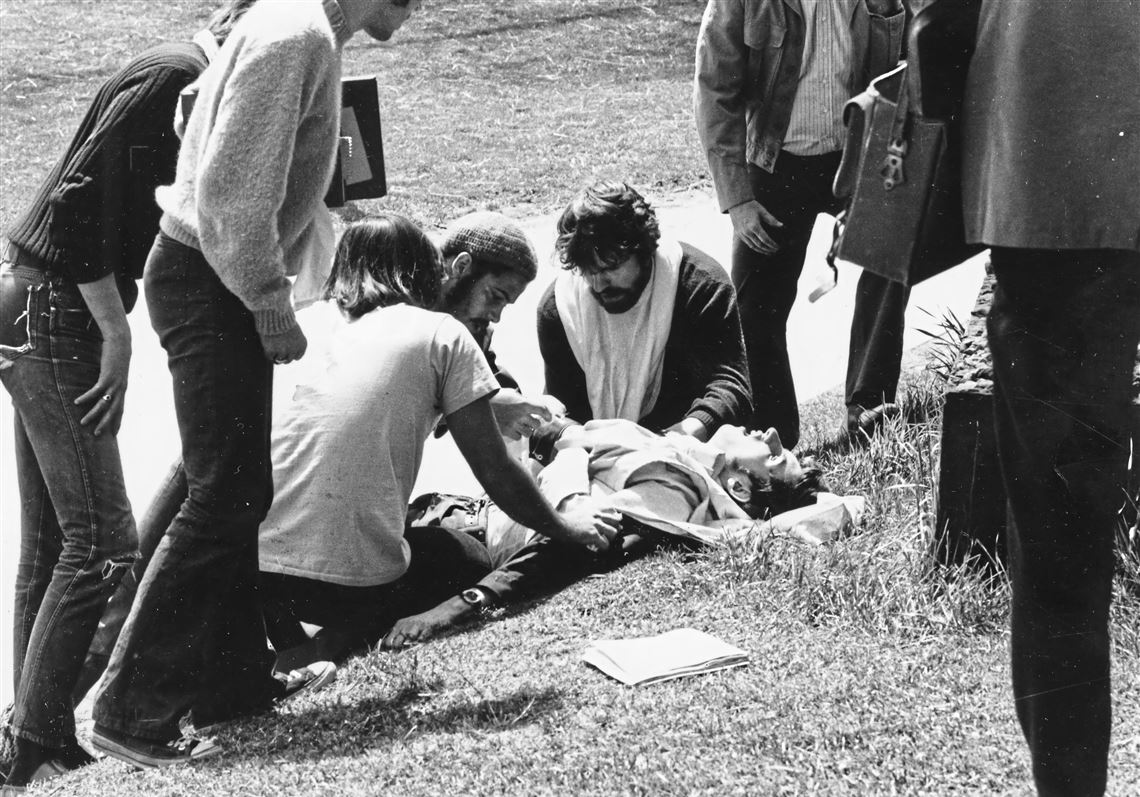
John Cleary, Wounded in Kent State Shooting, Dies at 74
He was shot in 1970 by the National Guard during a student protest over the Vietnam War that left four dead in Ohio. A photo of him lying on the ground and bleeding made the cover of Life magazine.

John Cleary, who was shot in the chest by Ohio National Guard troops during an antiwar protest at Kent State University in 1970, a chilling moment in American history that was captured in a Life magazine cover photo, died on Oct. 25 at his home in Gibsonia, Pa., near Pittsburgh. He was 74.
His death was announced by Kent State. Mr. Cleary was diagnosed with pancreatic cancer in 2019.
Apolitical and more interested in watching “Bonanza” than the nightly news, Mr. Cleary was a 19-year-old freshman architecture major at Kent State when protests against the Vietnam War turned violent on campus.
“Most of the people in my major, we were basically just concentrating on getting our homework done and helping one another study for tests or kind of bantering back and forth about design issues,” Mr. Cleary said in an oral history conducted by the university in 2010. “To be honest, politics really didn’t come up.”
In early May 1970, after President Richard M. Nixon announced that American forces had expanded the war into Cambodia, an R.O.T.C. building at Kent State was set on fire. Gov. James A. Rhodes, a Republican, ordered more than 100 members of the National Guard — armed with M1 military rifles and other tactical gear — to patrol the campus.

“There was a lot of tension that was created from the fact that there were military vehicles, jeeps, trucks and personnel kind of almost setting up camp on the campus,” Mr. Cleary said. “That created a tension between the students and the guardsmen.”
On May 4, a Monday, a large protest was scheduled for noon on the university commons. After attending his morning classes, Mr. Cleary borrowed a camera from a classmate and headed over.
“I went to kind of just see what was going on and observe the protesters,” he said.
After students ignored an order to disperse, the guardsmen launched canisters of tear gas. Mr. Cleary snapped some photos, then decided to head to a nearby building for his next class.
The guardsmen moved in.
“I wanted to get one last picture of them before they went over the crest of the hill, so I was kind of getting my camera, I was winding it, getting ready to take another shot and suddenly, they just turned and fired,” he said. “It was like this volley of gunshots.”
A bullet struck him in the chest.
“I guess the best way I can describe it is like getting hit in the chest with a sledgehammer,” Mr. Cleary said. “It just really knocked me down.”
How The Times decides who gets an obituary. There is no formula, scoring system or checklist in determining the news value of a life. We investigate, research and ask around before settling on our subjects. If you know of someone who might be a candidate for a Times obituary, please suggest it here.
Four students were killed. Nine others, including Mr. Cleary, were wounded.
As he lay on the ground bleeding, several students rendered first aid. Howard Ruffner, a Kent State student working that day as a freelance photographer for Life, snapped an image of the moment.
“I was shocked like everyone else that the Guard opened fire,” Mr. Ruffner said in an interview. “I just kind of instinctually kept taking photographs of things that I thought showed emotion and care.”

Mr. Ruffner’s photo ran on the cover of Life. A photo taken by another student, John Filo, showed Mary Ann Vecchio screaming as she knelt alongside Jeffrey Miller, a student who was lying facedown and dead. It ran on the front page of The New York Times, and Mr. Filo won the Pulitzer Prize for spot news photography.
While both photos became defining images of the Vietnam era, Mr. Ruffner’s had a more widespread and immediate impact illustrating the country’s violent political divisions, because it had appeared on the cover of one of the most widely read magazines in America.
After seeing the Life photos, Neil Young of Crosby, Stills, Nash & Young wrote the song “Ohio," with the lyrics “Tin soldiers and Nixon coming/We’re finally on our own/This summer I hear the drumming /Four dead in Ohio.” The band quickly recorded and released the song, and it became an essential anthem of the protest movement.
“People today just don’t grasp the power that Life magazine had back then,” Brian VanDeMark, a former U.S. Naval Academy historian and author of “Kent State: An American Tragedy” (2024), said in an interview. “I think it intensified the impact of what happened to John Cleary in terms of people’s perception and understanding of the tragedy.”

John Robert Cleary was born on Feb. 28, 1951, in Glenville, N.Y., a town near Schenectady, to Robert and Doris (Miller) Cleary. His father was an engineer at General Electric.
Living in a rural area, John grew up fishing, camping and skiing. His parents were conservative, but there wasn’t a lot of political talk during dinner. The family had one television, and it was usually tuned to a western or a Disney program.
“I was just kind of cruising along,” he said in an oral history interview conducted in 2022 by Binghamton University in New York. “It really was not until I went to Kent that I really began to be exposed to anything going on outside our little community.”
Following the shooting, Mr. Cleary spent weeks in a hospital and then moved back home. He returned to Kent State the following year to resume his studies. After graduating in 1974, he married his college sweetheart, Kathy Bashaw, and they settled near Pittsburgh.
For the next decade, he barely mentioned the shooting and declined to take part in reunions or commemorations. He estimated that 90 percent of his friends and colleagues didn’t know he was the wounded student on the cover of Life.
“I was starting out in my career, and work was tough,” Mr. Cleary said. “And I had a family to support.”
There was another reason.
“In the aftermath of the shooting, his conservative family and neighbors in upstate New York pressured him to say nothing critical about the guardsmen who had shot him and 12 others,” Mr. VanDeMark wrote in his book. “He began not just hiding his involvement but denying it.”
That changed in 1981, when his son Andrew was born — on May 4.
“I felt like God was telling me something,” he said. “You cannot bury this. You cannot pretend it did not happen to you. You cannot put it behind you. It is something that you need to confront.”


Mr. Cleary began attending anniversary events at Kent State. He agreed to be interviewed by reporters. And slowly, he became a quiet yet powerful voice in warning about the dangers of poisonous political discourse and the suppression of free speech. The lesson, he said, was to de-escalate.
“John became the public face of the price of protest without even having been a protester himself,” Thomas Grace, another Kent State student who was shot that day, said in an interview. “It shows how complicated and complex the past can be.”
Mr. Cleary is survived by his wife and son; a daughter, Elizabeth Dove; and four grandchildren.
The nine shooting survivors called themselves the Blood Brothers. After Mr. Cleary’s death, five remain.
“One by one, these voices are going away,” Roseann Canfora, a Kent State journalism professor whose brother Alan Canfora was wounded in the shooting, said in an interview. “John’s experience — and especially his voice — remind us about how precious our democracy is and the courage that it takes to defend it.”
Mr. Cleary, frail and weak from illness, returned to Kent State this past May for anniversary events. A student organization chose him to ring a campus bell to honor the victims.
“It was an unforgettable moment,” Professor Canfora said. “There were tears everywhere.”
An earlier version of this obituary referred incorrectly to the shooting of Alan Canfora at Kent State University. He was wounded in the incident, not killed.
When we learn of a mistake, we acknowledge it with a correction. If you spot an error, please let us know at nytnews@nytimes.com.Learn more


No comments:
Post a Comment