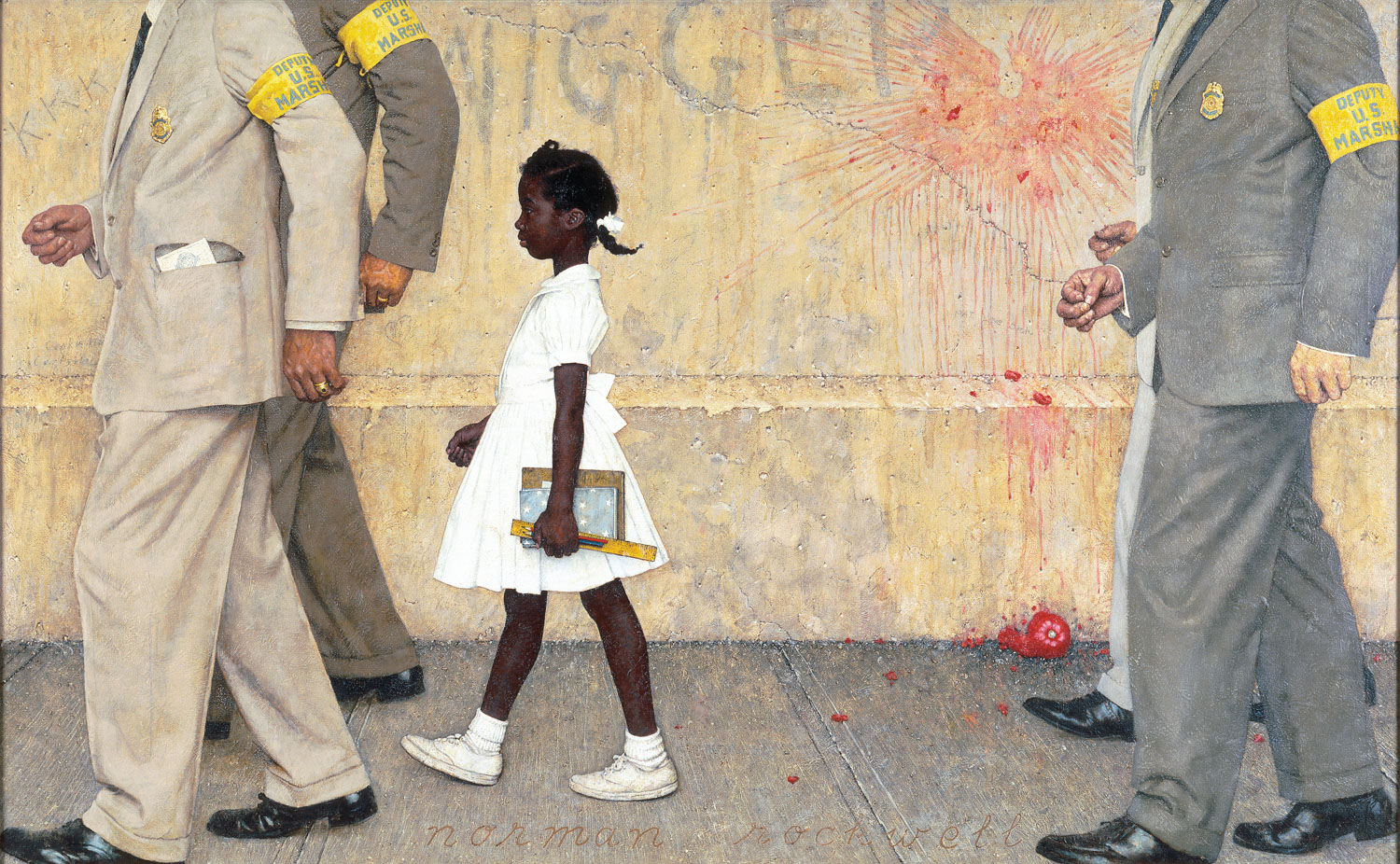
The Problem We All Live With
| The Problem We All Live With | |
|---|---|
 | |
| Artist | Norman Rockwell |
| Year | 1964 |
| Dimensions | 91 cm × 150 cm (36 in × 58 in) |
| Location | Norman Rockwell Museum[1] |
The Problem We All Live With is a 1964 painting by Norman Rockwell that is considered an iconic image of the Civil Rights Movement in the United States.[2] It depicts Ruby Bridges, a six-year-old African-American girl, on her way to William Frantz Elementary School, an all-white public school, on November 14, 1960, during the New Orleans school desegregation crisis. Because of threats of violence against her, she is escorted by four deputy U.S. marshals; the painting is framed so that the marshals' heads are cropped at the shoulders, making Bridges the only person fully visible.[3][4] On the wall behind her are written the racial slur "nigger" and the letters "KKK"; a smashed and splattered tomato thrown against the wall is also visible. The white protesters are not visible, as the viewer is looking at the scene from their point of view.[3] The painting is oil on canvas and measures 36 inches (91 cm) high by 58 inches (150 cm) wide.[5]
History

The painting was originally published as a centerfold in the January 14, 1964, issue of Look.[5] Rockwell had ended his contract with the Saturday Evening Post the previous year due to frustration with the limits the magazine placed on his expression of political themes, and Look offered him a forum for his social interests, including civil rights and racial integration.[3] Rockwell explored similar themes in Murder in Mississippi and New Kids in the Neighborhood;[6] unlike his previous works for the Post, The Problem We All Live With and these others place black people as featured protagonists, instead of as observers, part of group scenes, or in servile roles.[7][8] Like New Kids in the Neighborhood, The Problem We All Live With depicts a black child protagonist;[7] like Southern Justice, it uses strong light-dark contrasts to further its racial theme.[9]
While the subject of the painting was inspired by Ruby Bridges, Rockwell used a local girl, Lynda Gunn, as the model for his painting;[10] her cousin, Anita Gunn, was also used.[11] One of the marshals was modelled by William Obanhein.[11]
- Paintings by Norman Rockwell
- School segregation in the United States
- Art based on actual events
- Paintings of African-Americans
- Works originally published in Look (American magazine)
- 1964 paintings
- Civil rights movement in popular culture
- Art in the White House
- Paintings of children
- Paintings in the Norman Rockwell Museum


No comments:
Post a Comment