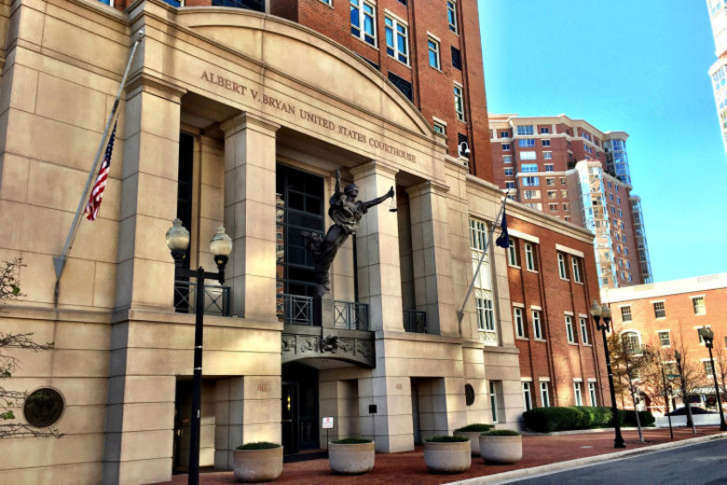
IN THE UNITED STATES DISTRICT COURT FOR THE
EASTERN DISTRICT OF VIRGINIA
Alexandria Division
UNITED STATES OF AMERICA,
v.
JAMES B. COMEY, JR.,
Criminal No. 1:25-cr-272-MSN-WEF
Defendant.
MEMORANDUM OPINION
This matter is before the Court to address the narrow issue of whether there are
particularized and factually based grounds to justify the disclosure of grand jury materials to the
defense pursuant to Federal Rule of Criminal Procedure 6(e)(3)(E)(ii). For the reasons set forth
below, the Court finds the record in this case requires the full disclosure of grand jury materials.
In so finding, the Court recognizes this is an extraordinary remedy, but given the factually based
challenges the defense has raised to the government’s conduct and the prospect that government
misconduct may have tainted the grand jury proceedings, disclosure of grand jury materials under
these unique circumstances is necessary to fully protect the rights of the accused.
I. Relevant Procedural History
On October 13, 2025, the government moved for implementation of a filter protocol to
govern its handling and disclosure of potentially privileged material. ECF 38. The material was
seized in 2019 and 2020 pursuant to court authorized warrants in a different district and as part of
a separate investigation. Id. at 2. The defense opposed the motion, in part, on the grounds that the
information the government sought to review was improperly retained after the conclusion of the
prior investigation, improperly used in this investigation and the government had already accessedCase 1:25-cr-00272-MSN-WEF Document 191 Filed 11/17/25 Page 2 of 24 PageID#
2631
potentially privileged information. ECF 71. Rather than institute a filter protocol, the defense
asked the Court to direct the government to disclose information related to the acquisition and
prior use of the material it sought to review. Id. The defense argued that its “concerns with the
government’s respect for—and ability to safeguard—the defendant’s attorney-client privileged
materials are not merely hypothetical” because the lead case agents “may have been exposed to
attorney-client privileged materials.” Id. at 6.
On October 29, 2025, United States District Judge Michael S. Nachmanoff entered an
Order finding that “briefing on the government’s proposed filter protocol raises several legal
questions that must be resolved before any protocol is authorized.” ECF 102 at 2. Citing the
government’s motion and Mr. Comey’s response, ECF Nos. 38 and 71, the Court appointed the
undersigned “to preside over all proceedings related to the potential review of privileged materials
in this case.” ECF 102 at 1–2.
On November 5, 2025, the undersigned held a hearing on the government’s motion for a
filter protocol. Following the hearing, the Court ordered the government to provide the materials
subject to the filter review to the defense to give the defense an opportunity to assert any claims
of privilege. ECF 161. The Court further ordered the government not to review any of the
materials at issue until any privilege disputes have been resolved by the Court. Id. The Court then
ordered the government to provide additional information to the defense about the circumstances
surrounding the search and prior use of the materials at issue, including, at the defense’s request,
to produce all grand jury materials. Id.
The government appealed the Court’s order challenging, in part, whether the Court made
sufficient particularized findings to support the disclosure of the grand jury materials. ECF 164.
District Judge Nachmanoff then remanded the matter to the undersigned to conduct “further
2Case 1:25-cr-00272-MSN-WEF Document 191 Filed 11/17/25 Page 3 of 24 PageID#
2632
proceedings to analyze whether there are particularized and factually based grounds for disclosure”
of the grand jury material. ECF 167 at 2.
On November 10, 2025, the parties filed briefs addressing the disclosure of grand jury
materials. ECF Nos. 171 and 172. In its brief, the government proposed the Court review the
grand jury materials in camera to aid its analysis. ECF 172. The same day, November 10, 2025,
the Court held a telephonic hearing during which it granted the government’s request to provide
the grand jury materials to the Court for review. ECF 177. The Court, having considered the
briefs of the parties, the oral argument of counsel, and the grand jury materials provided by the
government, now sets forth, as the government requested, particularized and factually based
grounds supporting the disclosure of the grand jury materials.1
II. Legal Standard for Disclosure of Grand Jury Materials
The “long-established policy of maintaining the secrecy of grand jury proceedings” is
codified in Federal Rule of Criminal Procedure 6(e). United States v. Penrod, 609 F.2d 1092,
1096 (4th Cir. 1979). However, Rule 6(e) provides several exceptions under which a court may
authorize disclosure of grand jury materials. See Gallop v. United States, 2012 WL 13081725, at
*9 (E.D. Va. Jan. 9, 2012) (“The decision whether to order the disclosure of grand jury testimony
is within the court’s discretion.”) (citing United States v. Foggo, 595 F. Supp. 2d. 672, 674 (E.D.
Va. 2009)). In this case, Mr. Comey seeks access to such materials in order to move for dismissal
of the indictment based on alleged irregularities in the grand jury proceedings. ECF 171 at 2.
Accordingly, the relevant exception is Rule 6(e)(3)(E)(ii), which permits a court to authorize
disclosure “at a time, in a manner, and subject to any other conditions that it directs . . . at the
1 Relatedly, the defense filed a separate motion seeking access to the grand jury materials. ECF 106. The
government filed its opposition to that motion on November 13, 2025. ECF 184.
3Case 1:25-cr-00272-MSN-WEF Document 191 Filed 11/17/25 Page 4 of 24 PageID#
2633
request of a defendant who shows that a ground may exist to dismiss the indictment because of a
matter that occurred before the grand jury[.]”
A majority of courts have held that the appropriate standard that a defendant must meet to
gain disclosure of grand jury materials under Rule 6(e)(3)(E)(ii) is that of “‘particularized need,’
borrowed from the standard under the case law applying Rule 6(e)(3)(E)(i).” See United States v.
Naegele, 474 F. Supp. 2d 9, 10 (D.D.C. 2007) (citing Ridings v. Department of Justice, 38 Fed.
Appx. 20, 21, (D.C. Cir. 2002) (per curiam) (unpublished) (“Even assuming appellant could invoke
Rule 6(e)(3)(C)(ii), his claim nonetheless fails because appellant did not make a ‘showing of
particularized need’ for disclosure of the grand jury transcripts ... The district court properly held
that appellant’s unsupported assertion that a grand jury did not indict him does not constitute the
showing of particularized need required under Fed. R. Crim. P. 6(e)(3)(C)(ii).”) (citations omitted);
United States v. Nguyen, 314 F. Supp. 2d 612, 616 (E.D. Va. 2004) (defendant must show that
“particularized and factually based grounds exist . . . [that] may create a basis for dismissal of the
indictment.”); United States v. Labate, 2001 WL 533714 at *20 (S.D.N.Y. May 18, 2001) (“To be
entitled to disclosure of grand jury minutes, defendant must make a showing of ‘particularized
need’ that outweighs the strong interest in maintaining the secrecy of grand jury proceedings.”);
United States v. Abcasis, 785 F. Supp. 1113, 1119 (E.D.N.Y. 1992) (defendant “has the burden of
asserting that particularized and factually based grounds exist to support the proposition that
irregularities in the grand jury proceedings may create a basis for dismissal of the indictment”);
United States v. Broyles, 37 F.3d 1314, 1318 (8th Cir.1994) (using particularized need standard);
United States v. Puglia, 8 F.3d 478, 480 (7th Cir.1993) (same); United States v. Lisinski, 728 F.2d
887, 893 (7th Cir.1984) (same); United States v. Dunn, 2005 WL 1705303 at *1 (S.D.N.Y. July
19, 2005) (same); United States v. Mazzola, 183 F. Supp. 2d 195, 197-98 (D. Mass. 2001) (same)).
4Case 1:25-cr-00272-MSN-WEF Document 191 Filed 11/17/25 Page 5 of 24 PageID#
2634
The Fourth Circuit has held that this “particularized need” inquiry requires the trial court
to “balance the petitioner’s need for release against the traditional public interest reasons for grand
jury secrecy and ‘only in those cases where the need for [disclosure] outweighs the public interest
in secrecy’ will the requirement of ‘particularized need’ for release be found to exist.” In re Grand
Jury Proc. GJ-76-4 & GJ-75-3, 800 F.2d 1293, 1298 (4th Cir. 1986) (quoting Douglas Oil Co. v.
Petrol Stops Northwest, 441 U.S. 211, 222 (1979)); United States v. Sells Engineering, Inc., 463
U.S. 418 (1983)); see also United States v. Foggo, 595 F. Supp. 2d 672, 675 (E.D. Va. 2009);
Gallop v. United States, No. 2:08CR217, 2012 WL 13081725, at *9 (E.D. Va. Jan. 9, 2012).
Courts in this district have made clear that Rule 6(e)(3)(E)(ii) “is not an invitation to engage
in a fishing expedition to search for grand jury wrongdoing and abuse when there are no grounds
to believe that any wrongdoing or abuse has occurred.” Loc Tien Nguyen, 314 F. Supp. 2d at 616.
Because “grand jury proceedings are entitled to a strong presumption of regularity,” a defendant
seeking disclosure under Rule 6(e)(3)(E)(ii) bears a “heavy burden” of showing that
“particularized and factually based grounds exist to support the proposition that irregularities in
the grand jury proceedings may create a basis for dismissal of the indictment.” Id. (citing Abcasis,
785 F. Supp. at 1119; United States v. Breitkreutz, 977 F.2d 214, 217 (6th Cir. 1992); United States
v. McKie, 831 F.2d 819, 821 (8th Cir. 1987); Lisinski, 728 F.2d at 893)). “Nor can this burden be
satisfied with conclusory or speculative allegations of misconduct.” Id. (citing United States v.
Morgan, 845 F. Supp. 934, 941 (D. Conn. 1994); Abcasis, 785 F. Supp. at 1119).
III. Factual Background
In 2017, the U.S. Attorney’s Office for the District of Columbia (“USAO-DDC”) initiated
an investigation, referred to by the Federal Bureau of Investigation (“FBI”) as Arctic Haze. ECF
71 at 2. This investigation concerned an allegation of unauthorized disclosure of classified
5Case 1:25-cr-00272-MSN-WEF Document 191 Filed 11/17/25 Page 6 of 24 PageID#
2635
information to a New York Times reporter, which appeared in an April 22, 2017 article titled
“Comey Tried to Shield the FBI from Politics. Then He Shaped an Election.” Id. The investigation
focused on the article’s inclusion of classified information related to one of the factors that
influenced Mr. Comey’s decision, as then-FBI director, to unilaterally announce the closure of the
FBI’s investigation into then-Presidential Candidate Hillary Clinton’s handling of classified
material while she was serving as Secretary of State. Id. Daniel Richman, a Columbia Law School
professor, personal friend of Mr. Comey, and former Special Government Employee at the FBI
during Mr. Comey’s tenure as FBI Director, was quoted by name in the article and was the subject
of USAO-DDC’s investigation. Id.
The Richman Search Warrants
In 2019 and 2020, the FBI obtained four warrants authorizing agents to search a hard drive,
an iCloud account, an iPad and iPhone belonging to Mr. Richman, as well as two Columbia
University email accounts used by Mr. Richman (collectively referred to as “the Richman
Warrants”).
2 ECF Nos. 89-1 to 89-4. The Richman Warrants authorized agents to search for and
seize information created or stored between March 1, 2016 and May 30, 2017 that constituted
evidence of violations of 18 U.S.C. § 641 (Theft and Conversion of Stolen Government Property)
and 18 U.S.C. § 793 (Unlawful Gathering or Transmission of National Defense Information). Id.
2 Search warrant 19-sw-182 was issued on August 27, 2019, and authorized the search of Mr. Richman’s hard
drive from February 1, 2017 to April 30, 2017. ECF 89-1.
Search warrant 19-sc-2097 was issued on October 22, 2019, and authorized the search of Mr. Richman’s
Columbia University and Law School email accounts from March 1, 2016 to May 30, 2017. ECF 89-2.
Search warrant 20-sw-200 was issued on January 31, 2020, and authorized the search of Mr. Richman’s
iCloud account from March 1, 2016 to May 30, 2017. ECF 89-3. Attachment B to the warrant specifically limits the
information to be seized to “non-privileged communications.” Id.
Search warrant 20-sw-143 was issued on June 4, 2020, and authorized the search of the backup files for Mr.
Richman’s iPad and iPhone from March 1, 2016 to May 30, 2017. ECF 89-4. Attachment B to the warrant specifically
limits the information to be seized to “non-privileged communications.” Id.
6Case 1:25-cr-00272-MSN-WEF Document 191 Filed 11/17/25 Page 7 of 24 PageID#
2636
The information seized pursuant to the Richman Warrants during the Arctic Haze investigation is
at the center of the current dispute between the parties in this case.
The 2019 and 2020 Searches of the Richman Devices as Part of the Arctic Haze
Investigation
The record reflects that in 2019 and 2020, the government took modest–and as it turned
out ineffective–steps to identify and isolate potentially privileged information contained in the
materials seized pursuant to the Richman Warrants. For example, the government permitted
Columbia University to review the emails seized from Mr. Richman’s Columbia email accounts
and withhold private or otherwise sensitive communications. ECF 181 (Defense’s Ex Parte Under
Seal Notice Regarding Grand Jury Materials). The government also provided Mr. Richman and
his counsel with an opportunity to review the materials seized from his devices and to assert a
privilege over those materials. ECF 38 at 2. The government claims that the documents and
communications identified by Columbia University and Mr. Richman as privileged were never
reviewed as part of the Arctic Haze investigation. ECF 165 at 11–12.
However, the government never engaged Mr. Comey in this process even though it knew
that Mr. Richman represented Mr. Comey as his attorney as of May 9, 2017, and three of the four
Richman Warrants authorized the government to search Mr. Richman’s devices through May 30,
2017, 21 days after an attorney-client relationship had been formed. ECF Nos. 38 at 2 and 138-11
at 33 (Aug. 2019 Office of the Inspector General Report) (noting that Mr. Comey informed the
Office of Inspector General that “the day after his removal, or ‘very shortly thereafter,’ he retained
attorneys Patrick Fitzgerald, David Kelley, and Daniel Richman.”).
According to an April 29, 2020 letter from Mr. Richman’s then-attorney to the
government–produced to the Court ex parte by the defense–the Department of Justice informed
Mr. Richman that the data it obtained from his iCloud account extended to August 13, 2019, well
7Case 1:25-cr-00272-MSN-WEF Document 191 Filed 11/17/25 Page 8 of 24 PageID#
2637
outside the scope of the warrant and well past the date on which Mr. Richman was retained as Mr.
Comey’s attorney. ECF 181-6 at 20. The same letter further states that the Department of Justice
informed Mr. Richman that it had seized data from Mr. Richman’s hard drive that extended to June
10, 2017–again well into the period during which Mr. Richman represented Mr. Comey–despite
the warrant (19-sw-182) imposing a temporal limit of April 30, 2017. Id.
At the time the Richman Warrants were executed, the government was aware not only that
Mr. Richman represented Mr. Comey, but also that he maintained ongoing attorney-client
relationships with other individuals, as the FBI materials regarding his resignation from Special
Government Employee status noted his intention to represent a defendant in a federal criminal
prosecution. Id. As a result, when the government obtained the first Richman Warrant in 2019, it
was clearly foreseeable that Mr. Richman’s devices contained potentially privileged
communications with numerous third parties, including Mr. Comey. Nevertheless, in 2019 and
2020, the government made a conscious decision to exclude Mr. Comey from the filter process,
even though Mr. Comey, as the client, is the privilege holder, not Mr. Richman. The government’s
claim at the November 5, 2025 hearing that Mr. Richman, at the time himself the subject of a
criminal investigation and represented by separate counsel, was in a position to effectively assert
Mr. Comey’s privilege is entirely unreasonable.
Of equal concern is whether the government complied with a fundamental requirement of
the Fourth Amendment and with the plain language of the warrants that it may seize only those
materials specifically authorized by the Court. Under long-standing Fourth Amendment
precedent, the government may search for and seize only those materials expressly authorized by
the terms of a search warrant issued in connection with specific predicate offenses. See United
States v. Williams, 592 F.3d 511, 519 (4th Cir. 2010) (“At its core, the Fourth Amendment protects
8Case 1:25-cr-00272-MSN-WEF Document 191 Filed 11/17/25 Page 9 of 24 PageID#
2638
against general warrants that authorize ‘exploratory rummaging in a person’s belongings . . . by
requiring a particular description of the things to be seized.’” (citing Andresen v. Maryland, 427
U.S. 463, 480 (1976); United States v. Nasher-Alneam, 399 F. Supp. 3d 579, 595 (S.D.W. Va.
2019) (“Given the heightened potential for government abuse of stored electronic data, it is
imperative that courts ensure that law enforcement scrupulously contain their searches to the scope
of the search warrant which permitted the search in the first place.”); United States v. Schlingloff,
901 F. Supp. 2d 1101, 1106 (C.D. Ill. 2012) (suppressing evidence where search exceeded scope
of warrant because “[a]ny other outcome would be contrary to the intent of the Fourth Amendment
that search warrants must describe with particularity the things to be seized, so that a search for
specified evidence does not devolve into a generalized search for something entirely different”).
This principle, referred to as the Fourth Amendment’s particularity requirement, is fulfilled when
“the warrant identifies the items to be seized by their relation to designated crimes and when the
description of the items leaves nothing to the discretion of the officer executing the warrant.”
Williams, 592 F.3d at 519.
Here, the government was permitted to search all of the Richman materials but authorized
to seize only evidence related to violations of 18 U.S.C. § 641 (Theft and Conversion of Stolen
Government Property) and 18 U.S.C. § 793 (Unlawful Gathering or Transmission of National
Defense Information), both markedly different offenses than those with which Mr. Comey is
currently charged.3
3 On September 25, 2025, Mr. Comey was indicted by a federal Grand Jury in the Eastern District of Virginia
for making a false statement in violation of 18 U.S.C. § 1001 (Count One) and obstruction of justice in violation of
18 U.S.C. § 1505 (Count Two). The indictment is based on Mr. Comey’s testimony to the Senate Judiciary Committee
on September 30, 2020, which referenced his testimony to the Senate Judiciary Committee on May 3, 2017. ECF 1.
9Case 1:25-cr-00272-MSN-WEF Document 191 Filed 11/17/25 Page 10 of 24 PageID#
2639
There is nothing in the record to suggest the government made any attempt to identify what
documents, communications or other materials seized from Mr. Richman constituted evidence of
violations of 18 U.S.C. § 641 and § 793. To be clear, ensuring that agents and prosecutors seize
only those things which a court has authorized is a critical early step in the execution of any warrant
and an elemental responsibility of all government agents.
When the undersigned questioned the Assistant United States Attorney currently assigned
to this case at the November 5, 2025 hearing, as to how and whether a set of materials responsive
to the Richman Warrants was identified and separated from non-responsive materials, he simply
said he did not know.4 ECF 165 at 19–20. Following the hearing, on November 5, 2025, the
Court ordered the government to produce to the defense all material seized pursuant to the
Richman Warrants “in whatever form it is currently maintained” by 5:00 p.m. on November 6,
2025. ECF 161. Pursuant to that Order, the government provided to the defense the materials
seized from the Richman Warrants, but, according to the defense, the manner and format in which
the government provided the information did not reflect that the government had seized, reviewed
and used only the information responsive to the warrants. ECF 171 at 7 n.4.
This potential failure by the government is even more concerning because the warrant
issued on August 27, 2019 (19-sw-182) specifically directed the government to identify what
information was responsive to the warrant and instructed “[l]aw enforcement personnel [to] then
seal any information that does not fall within the scope of [the warrant] and … not [to] further
review the information absent an order of the Court.”5 ECF 89-1.
4 To be clear, the two assistant United States attorneys currently assigned to this case entered their appearances
post-indictment and were not a part of the Arctic Haze investigative team.
5 This provision is not repeated in the other Richman warrants submitted by the government, but the approach
is nevertheless plainly required on the face of each warrant and as discussed supra, in accordance with well-established
Fourth Amendment precedent.
10Case 1:25-cr-00272-MSN-WEF Document 191 Filed 11/17/25 Page 11 of 24 PageID#
2640
The government appears to have conflated its obligation to protect privileged
information–an obligation it approached casually at best in this case–with its duty to seize only
those materials authorized by the Court. This cavalier attitude towards a basic tenet of the Fourth
Amendment and multiple court orders left the government unchecked to rummage through all of
the information seized from Mr. Richman, and apparently, in the government’s eyes, to do so
again anytime they chose.6 The Arctic Haze investigation was closed in September 2021, with no
charges filed. The Richman materials sat dormant with the FBI until the summer of 2025, when
the Bureau chose to rummage through them again.
The 2025 Search of the Richman Materials as Part of the Investigation into Mr. Comey
By the summer of 2025, the FBI and the United States Attorney’s Office for the Eastern
District of Virginia (USAO-EDVA) had initiated a criminal investigation into Mr. Comey. ECF
Nos. 172-1 and 172-2. As part of the investigation, on September 12, 2025, an FBI agent assigned
to the Director’s Advisory Team was instructed, apparently with the concurrence of the USAO-
EDVA,
7 to review “a Blu-ray disc that contained a full Cellebrite extraction and Reader reports of
[Mr. Richman’s] iPhone and iPad backups.” ECF 172-1.
Inexplicably, the government elected not to seek a new warrant for the 2025 search, even
though the 2025 investigation was focused on a different person, was exploring a fundamentally
different legal theory, and was predicated on an entirely different set of criminal offenses. The
Court recognizes that a failure to seek a new warrant under these circumstances is highly unusual.
6 The Fourth Circuit has held that the government’s prolonged retention and continued access to materials that
are non-responsive to a search warrant may violate the Fourth Amendment. See United States v. Zelaya-Veliz, 94 F.4th
321 (4th Cir. 2024) (holding that district courts “retain[] the authority to determine that prolonged retention of non-
responsive data by the government violated the Fourth Amendment.”).
7 It is important to note that the USAO-EDVA prosecutors were not involved in the 2019 and 2020 searches
of the Richman materials and may have reasonably assumed the agents in 2019 and 2020 seized and preserved only
those materials responsive to the warrants.
11Case 1:25-cr-00272-MSN-WEF Document 191 Filed 11/17/25 Page 12 of 24 PageID#
2641
The Court also recognizes that seeking a new warrant under these circumstances would have
required a fresh legal analysis and likely resulted in some delay, a delay the investigative team
could not afford given that the statute of limitations would expire in a mere 18 days. See 18 U.S.C.
§ 3282(a).
If a new warrant had been sought by the government and issued by the Court, the Fourth
Amendment would have required it to be narrowly tailored, authorizing access only to materials
within a limited time frame and relevant to the new offenses under investigation. See Williams,
592 F.3d at 519. In addition, any new warrant would have imposed strict procedural safeguards
to ensure privileged information was not reviewed by the prosecution team. As a result, the
parameters of the 2025 search would inevitably have had a different and much narrower scope
than the Richman Warrants. Faced with this prospect, the government chose to unilaterally search
materials that were (1) seized five years earlier; (2) seized in a separate and since closed
investigation; (3) that were never reviewed to determine whether the seized information was
responsive to the original warrants; (4) that were likely improperly held by the government for a
prolonged period of time; (5) that included potentially privileged communications; (6) did so
without ever engaging the privilege holders; and (7) did so without seeking any new judicial
authority.
Having decided to forge ahead under these highly unusual circumstances, the FBI agent
conducting the September 12, 2025 search of the disc containing information from Mr. Richman’s
iPhone and iPad was specifically instructed to seize “conversations between [Mr.] Richman and
[Mr.] Comey.” ECF 172-1. There appeared to be no precautions in place to avoid the collection
of privileged communications. Id. The agent conducted the review and printed “the relevant
pages,” which included multiple conversations involving Mr. Comey and Mr. Richman. Id. The
12Case 1:25-cr-00272-MSN-WEF Document 191 Filed 11/17/25 Page 13 of 24 PageID#
2642
reviewing agent then transferred the disc and “the relevant [printed] pages” to a second FBI agent
(hereinafter referred to as Agent-2). Id. Sometime between September 12, 2025 and September
25, 2025, Agent-2 reviewed the newly seized materials and, not surprisingly, identified
communications involving Mr. Comey and Mr. Richman as potentially privileged. ECF 172-2.
The government presented this case to the grand jury on September 25, 2025. ECF 1. The
same day, prior to the grand jury presentment, Agent-2 alerted the lead case agent (hereinafter
referred to as Agent-3) and an attorney with the FBI’s Office of General Counsel that “evidence
obtained in the Government’s investigation of James Comey may constitute attorney-client
privileged or attorney-client confidential information. It is also possible that [the agents] may have
obtained evidence that constitutes attorney work-product information.”8 ECF 89-5. Agent-2 gave
Agent-3 and the FBI attorney “a limited overview of the [privileged] communications.” ECF 172-
2.9 Agent-3, rather than remove himself from the investigative team until the taint issue was
resolved, proceeded into the grand jury undeterred and testified in support of the pending
indictment. ECF 179. In fact, Agent-3 was the only witness to testify before the grand jury in
support of the pending indictment. Id. The government’s decision to allow an agent who was
exposed to potentially privileged information to testify before a grand jury is highly irregular and
a radical departure from past DOJ practice.
Only after the government had reviewed the materials seized pursuant to the 2019 and 2020
search warrants, only after FBI agents had personally identified potentially privileged materials,
and only after the government obtained an indictment on September 25, 2025, did it seek court
8 This is the language used by an FBI attorney to characterize their September 25, 2025 phone conversation
with Agent-3. A second agent, possibly Agent-2, was also on the call but that that person’s identity has been shielded
from the Court. ECF 89-5.
9 The government provided no further detail about what, in its view, constitutes a “limited overview.”
13Case 1:25-cr-00272-MSN-WEF Document 191 Filed 11/17/25 Page 14 of 24 PageID#
2643
approval of a filter protocol for materials the FBI had already reviewed. ECF 38. For reasons that
remain unclear, the government waited 31 days from September 12, 2025, the date the FBI began
reviewing the materials, and 18 days from September 25, 2025, the date the FBI informed its Office
of General Counsel about having been exposed to potentially privileged materials, before seeking
court approval of a filter protocol on October 13, 2025. Id.
IV. The Court’s in Camera Review of the Grand Jury Materials10
The Court has now reviewed the grand jury transcript, the audio recording of the grand
jury proceedings, as well as the exhibits presented to the grand jurors. Only one witness, Agent-
3, testified before the grand jury, and only one prosecutor appeared on behalf of the government.
ECF 179-1 (Full Grand Jury Indictment Transcript).
The Search and Use of the Richman Materials
The government’s position is that the grand jury materials “confirm the baselessness of the
defendant’s claim that privileged information may have been shared with the grand jury.” ECF
172. While it is true that the undersigned did not immediately recognize any overtly privileged
communications, it is equally true that the materials seized from the Richman Warrants were the
cornerstone of the government’s grand jury presentation. The government substantially relied on
statements involving Mr. Comey and Mr. Richman in support of its proposed indictment. Agent-
3 referred to these statements in response to multiple questions from the prosecutor and from grand
jurors and did so shortly after being given a limited overview of privileged communications
between the same parties. The government’s position that privileged materials were not directly
shared with the grand jurors ignores the equally unacceptable prospect that privileged materials
10 Specific statements made before the grand jury are redacted. The Court’s analysis of those statements is not.
14Case 1:25-cr-00272-MSN-WEF Document 191 Filed 11/17/25 Page 15 of 24 PageID#
2644Case 1:25-cr-00272-MSN-WEF Document 191 Filed 11/17/25 Page 16 of 24 PageID#
2645
Process Clause “requires the government to prove a criminal defendant’s guilt beyond a reasonable
doubt”). In addition, the statement by the prosecutor was made in response to challenging
questions from grand jurors, the context of which suggests the grand jurors may have reasonably
understood the prosecutor to mean that if she could not satisfactorily answer their questions, then
Mr. Comey would “ ” answer these questions at trial.
Second, the prosecutor told the grand jury that there was
ECF 178-1 at 106. That statement
clearly suggested to the grand jury that they did not have to rely only on the record before them to
determine probable cause but could be assured the government had more evidence–perhaps better
evidence–that would be presented at trial.
Issues Regarding the Completeness of the Grand Jury Transcript and Audio Recording,
and the Manner in Which the Second Indictment was Presented to the Grand Jury
Finally, the record is well established that the grand jury was originally presented with a
three-count indictment, signed by the prosecutor. ECF 3, 10. The grand jury, however, rejected
Count 1 of the original indictment and found probable cause as to the two remaining counts. Id.
At some point, the prosecutor prepared and signed a second indictment that removed Count 1 of
the original indictment. ECF 10, 188-1. At the return of the indictment, the government presented
both the first and second indictments to the magistrate judge. ECF 10. The first indictment
indicated that the grand jury failed to find probable cause as to any count. ECF 3, 10. The second
indictment indicated that the grand jury found probable cause as to two counts. ECF 1, 10. Both
indictments were fully executed by grand jury foreperson and the prosecutor. ECF 1, 3, 10.
Presented with two facially inconsistent indictments, the magistrate judge questioned the grand
jury foreperson and the prosecutor to unwind this procedural knot. Id. The magistrate judge then
16Case 1:25-cr-00272-MSN-WEF Document 191 Filed 11/17/25 Page 17 of 24 PageID#
2646
accepted the return of the second signed indictment. Id. The second indictment was a new
indictment and therefore the undersigned concluded after reviewing the grand jury transcript that
the prosecutor would have presented the second indictment to the grand jury for consideration
before it was returned in open court. It now appears that may not have happened.
On November 14, 2025, the prosecutor filed a declaration with the Court attempting to
address the issue of whether the transcript of the grand jury proceedings filed with the Court was
the full and complete transcript. ECF 187-1. The prosecutor stated that after the grand jury was
left to deliberate on the first indictment at approximately 4:28 p.m., she had no further contact with
the grand jury. The prosecutor further stated that at approximately 6:40 p.m. she was notified by
the then-First Assistant United States Attorney that the grand jury returned a true bill on only two
of the three counts presented by the government.
11 Id. The prosecutor, according to her declaration,
then proceeded to the courtroom for the return of the indictment. Id. The hearing on the return of
the indictment began at approximately 6:47 p.m. ECF 10.
The short time span between the moment the prosecutor learned that the grand jury rejected
one count in the original indictment and the time the prosecutor appeared in court to return the
second indictment could not have been sufficient to draft the second indictment, sign the second
indictment, present it to the grand jury, provide legal instructions to the grand jury, and give them
an opportunity to deliberate and render a decision on the new indictment. If the prosecutor is
mistaken about the time she received notification of the grand jury’s vote on the original
indictment, and this procedure did take place, then the transcript and audio recording provided to
11 If the Court is to read the prosecutor’s declaration as suggesting there was no contact between any
government official and the grand jury after 4:28 p.m., then it begs the question of how the then-First Assistant learned
that the grand jury had refused to indict on one count, and how the First Assistant knew which count had been rejected
by the grand jury, all before the indictment was returned in open court.
17Case 1:25-cr-00272-MSN-WEF Document 191 Filed 11/17/25 Page 18 of 24 PageID#
2647
the Court are incomplete.12 If this procedure did not take place, then the Court is in uncharted
legal territory in that the indictment returned in open court was not the same charging document
presented to and deliberated upon by the grand jury. Either way, this unusual series of events, still
not fully explained by the prosecutor’s declaration, calls into question the presumption of
regularity generally associated with grand jury proceedings, and provides another genuine issue
the defense may raise to challenge the manner in which the government obtained the indictment.
V. Authority That May Support a Defense Motion to Dismiss
To secure the disclosure of grand jury materials under Rule 6(e)(3)(E)(ii), a defendant must
show that “a ground may exist to dismiss the indictment because of a matter that occurred before
the grand jury.” The government argues that the defense has failed to meet its heavy burden to
satisfy this standard and even assuming there was a Fourth Amendment violation (or a series of
Fourth Amendment violations) or that privileged information was compromised, the most severe
remedy available to the defense would be the exclusion of evidence rather than dismissal of the
indictment. ECF 172. Indeed, “the validity of an indictment is not affected by the character of the
evidence considered.” United States v. Calandra, 414 U.S. 338, 344–45 (1974); see also Bracy v.
United States, 435 U.S. 1301, 1302 (1978) (Rehnquist, J., denying stay application) (“[A]n
indictment is not invalidated by the grand jury’s consideration of . . . evidence obtained in violation
of the Fourth Amendment.”). Courts have likewise held that the grand jury’s consideration of
evidence obtained in violation of the attorney–client privilege, on its own, does not constitute
grounds for dismissal of an indictment. See United States v. Colasurdo, 453 F.2d 585, 596 (2d
Cir. 1971); United States v. Rodolitz, 648 F. Supp. 430, 432 (S.D.N.Y. 1986) (holding that a motion
12 jury proceedings.
It is the responsibility of the United States Attorney’s Office to record and, if required, transcribe all grand
18Case 1:25-cr-00272-MSN-WEF Document 191 Filed 11/17/25 Page 19 of 24 PageID#
2648
to dismiss the indictment “based on an alleged violation of . . . the attorney-client privilege before
the grand jury must be denied.”).
However, the government’s claim that this is, at worst, a conventional Fourth Amendment
violation and an excusable slippage of privileged communications is unpersuasive, particularly
considering the central role this information played in the government’s grand jury presentation.
It is well established that courts may, and indeed on occasion must, use their supervisory authority
to “safeguard the integrity of the grand jury process.” See United States v. Strouse, 286 F.3d 767,
771 (5th Cir. 2002). The Supreme Court has recognized that a district court may use its supervisory
power “to dismiss an indictment because of misconduct before the grand jury, at least where that
misconduct amounts to a violation of one of those ‘few, clear rules which were carefully drafted
and approved by this Court and by Congress to ensure the integrity of the grand jury’s functions.’”
See United States v. Williams, 504 U.S. 36, 46 (1992) (quoting United States v. Mechanik, 475
U.S. 66, 74 (1986) (O’Connor, J., concurring in the judgment)). The Supreme Court has also
recognized that this supervisory power of federal district courts should be used “to implement a
remedy for violation[s] of recognized rights, to preserve judicial integrity by ensuring that a
conviction rests on appropriate considerations validly before the jury, and finally, as a remedy
designed to deter illegal conduct.” United States v. Hasting, 461 U.S. 499, 505
(1983) (citations omitted).
Accordingly, when prosecutorial misconduct before the grand jury prejudices a defendant
and threatens the defendant’s right to fundamental fairness in the criminal process, a district court
may exercise its supervisory authority to dismiss the indictment. See United States v. Derrick, 163
F.3d 799, 807 (4th Cir. 1998) (explaining that the Fourth Circuit has “consistently recognized that
an indictment may not be dismissed for prosecutorial misconduct absent a showing that the
19Case 1:25-cr-00272-MSN-WEF Document 191 Filed 11/17/25 Page 20 of 24 PageID#
2649
misconduct prejudiced the defendant). The Supreme Court has held that a defendant who seeks to
have an indictment dismissed because of misconduct before the grand jury must show actual
prejudice and “establish[ ] that the violation substantially influenced the grand jury’s decision to
indict’ or [that] there is ‘grave doubt’ that the decision to indict was free from the substantial
influence of such violations.’” Bank of Nova Scotia v. United States, 487 U.S. 250, 256 (1988);
see also United States v. Feurtado, 191 F.3d 420, 425 (4th Cir. 1999) (applying the standard
established by Bank of Nova Scotia v. United States and affirming a district court’s dismissal of
the indictment without prejudice, where the court found that, although the defendants had not
shown that improper testimony substantially influenced the grand jury, there remained “some
doubt that the grand jury’s decision to indict was free from the influence of that testimony”). Here,
the procedural and substantive irregularities that occurred before the grand jury, and the manner
in which evidence presented to the grand jury was collected and used, may rise to the level of
government misconduct resulting in prejudice to Mr. Comey.
VI. Findings by the Court
Based on the foregoing, the Court makes the following findings:
First, the facts establish a reasonable basis for the defense to challenge whether the
Richman Warrants were executed in a manner consistent with the Fourth Amendment and the
orders of the issuing court.
Second, the facts establish a reasonable basis for the defense to challenge whether the
government exceeded the scope of the Richman Warrants in 2019 and 2020 by seizing and
preserving information that was beyond the scope of the warrants, that is, information that did not
constitute evidence of violations of either 18 U.S.C. § 641 or § 793.
20Case 1:25-cr-00272-MSN-WEF Document 191 Filed 11/17/25 Page 21 of 24 PageID#
2650
Third, the facts establish a reasonable basis for the defense to challenge whether the
government had the lawful authority to search the Richman materials anew in 2025.
Fourth, the facts establish a reasonable basis for the defense to challenge whether the
government’s 2025 seizure of the Richman materials included information beyond the scope of
the original warrants.
Fifth, the nature and circumstances surrounding the government’s potential violations of
the Fourth Amendment and court orders establish a reasonable basis to question whether the
government’s conduct was willful or in reckless disregard of the law.
Sixth, the facts provide a reasonable basis for the defense to show that they were prejudiced
by the government’s use of the Richman materials in the grand jury, particularly if the
government’s conduct was willful or reckless, given the centrality of these materials to the
government’s presentation.
Seventh, the facts establish a reasonable basis for the defense to challenge whether the
government took sufficient steps to avoid the collection and review of privileged materials,
including the reasons why Mr. Comey was never afforded the opportunity to assert a privilege
over his communications until after the indictment was obtained.
Eighth, the facts establish a reasonable basis for the defense to challenge whether
privileged information was used, directly or indirectly, by the government to prepare and present
its grand jury presentation. This is particularly troublesome because the government’s sole witness
before the grand jury was exposed to a “limited overview” of privileged material shortly before he
testified.
Ninth, the nature and circumstances surrounding the disclosure of potentially privileged
information establish a reasonable basis to question whether the government’s conduct was willful
21Case 1:25-cr-00272-MSN-WEF Document 191 Filed 11/17/25 Page 22 of 24 PageID#
2651
or in reckless disregard of the law. This is particularly significant because Agent-3, after having
been exposed to potentially privileged information, chose to testify before the grand jury rather
than separate himself from the investigation to contain any further exposure to privileged
information and limit any prejudice to Mr. Comey.
Tenth, as discussed in Section IV above the prosecutor made statements to the grand jurors
that could reasonably form the basis for the defense to challenge whether the grand jury
proceedings were infected with constitutional error.
Eleventh, the grand jury transcript and recording likely do not reflect the full proceedings
because, although it is clear that a second indictment was prepared and presented to the grand jury
(ECF 3), the transcript and audio recording of the proceedings do not reflect any further
communications after the grand jury began deliberating on the first indictment.
Collectively, the facts set forth herein and the particularized findings of the Court establish
that “ground[s] may exist to dismiss the indictment because of a matter that occurred before the
grand jury[.]” Rule 6(e)(3)(E)(ii). The Court need not now determine whether any facts herein
have been proven, or whether there is merit to any motion yet to be filed. That task may lie ahead.
Rather, the Court is finding that the government’s actions in this case–whether purposeful,
reckless, or negligent–raise genuine issues of misconduct, are inextricably linked to the
government’s grand jury presentation, and deserve to be fully explored by the defense.
VII. Balancing Grand Jury Secrecy and Disclosure to the Defense
Lastly, before ordering disclosure of grand jury materials the Court must balance the
secrecy requirements of Rule 6(e) against Mr. Comey’s Due Process rights. See In re Grand Jury
Proc. GJ-76-4 & GJ-75-3, 800 F.2d at 1298. In United States v. Procter & Gamble Co., the
Supreme Court listed the traditional reasons underlying grand jury secrecy: “(1) To prevent the
22Case 1:25-cr-00272-MSN-WEF Document 191 Filed 11/17/25 Page 23 of 24 PageID#
2652
escape of those whose indictment may be contemplated; (2) to insure the utmost freedom to the
grand jury in its deliberations, and to prevent persons subject to indictment or their friends from
importuning the grand jurors; (3) to prevent subornation of perjury or tampering with the witnesses
who may testify before grand jury and later appear at the trial of those indicted by it; (4) to
encourage free and untrammeled disclosures by persons who have information with respect to the
commission of crimes; (5) to protect innocent accused who is exonerated from disclosure of the
fact that he has been under investigation, and from the expense of standing trial where there was
no probability of guilt.” 356 U.S. at 681 n. 6 (quoting United States v. Rose, 215 F.2d 617, 628–
29 (3d Cir.1954)).
The traditional policies underlying grand jury secrecy are only moderately applicable to
this case. Here, the grand jury’s role in this case is over and the statute of limitations has expired
so there is no danger that release of grand jury materials could impact future grand jury
proceedings. The only person to testify before the grand jury was a single federal agent. There
are no other “persons who have information with respect to the commission of crimes” who
testified before the grand jury, either voluntarily or pursuant to a subpoena. The government has
offered no particularized reason why grand jury materials should be kept from the person the grand
jury indicted. Mr. Comey was the only person who was the subject of this grand jury proceeding,
and Mr. Comey is the only person who is receiving the grand jury information. On the other hand,
as the Court has found, these materials are essential if Mr. Comey is to fully and fairly defend
himself in the face of the irregularities that have characterized this investigation from its inception.
It is also important to note that the grand jury materials are not being made public, at least
not yet. The grand jury materials are being provided to the defense under the terms of a Protective
23Case 1:25-cr-00272-MSN-WEF Document 191 Filed 11/17/25 Page 24 of 24 PageID#
2653
Order (ECF 40) and for the limited purpose of defending this criminal action brought by the
government.13
For these reasons, the Court finds that the institutional concerns for grand jury secrecy are
greatly outweighed by Mr. Comey’s right to Due Process.
VIII. Conclusion
The Court recognizes that the relief sought by the defense is rarely granted. However, the
record points to a disturbing pattern of profound investigative missteps, missteps that led an FBI
agent and a prosecutor to potentially undermine the integrity of the grand jury proceeding.
Therefore, in this case, “the Court has before it a rare example of a criminal defendant who can
actually make a ‘particularized and factually based’ showing that grounds exist to support the
proposition that irregularities may have occurred in the grand jury proceedings and may justify the
dismissal of one or more counts of the indictment.” See Naegele, 474 F. Supp. 2d at 10 (citations
omitted).
Accordingly, the defense request for all grand jury materials is granted.
ENTERED this 17th day of November 2025.
____________________________________
WILLIAM E. FITZPATRICK
UNITED STATES MAGISTRATE JUDGE
13 It is also worth noting that those charged with criminal offenses routinely receive at least partial transcripts
of grand jury proceedings prior to trial. The government is oftentimes required to provide testimony given before a
grand jury to defendants to comply with its discovery obligations under Rule 16 and the Jencks Act, 18 U.S.C. § 3500,
or to comply with its constitutional responsibilities in accordance with Brady v. Maryland, 373 U.S. 83 (1963) or
United States v. Giglio, 450 U.S. 150 (1972).
24


No comments:
Post a Comment