Faster than a speeding dump truck, our St. Augustine and St. Johns County history and nature are being demolished.
Entire forests.
Whole ecosystems.
Our precious environmental and cultural ecosystems here in what we call "God's country."
Historic buildings.
Our history and nature are worth saving.
We, the People, are saving it on a daily basis.
It takes a village.
Yes we can.
Yes we do.
Most recent example -- the historic 1953 St. Johns County Jail. More than 1000 people were illegally arrested in St. Augustine here for First Amendment protected activity, supporting Civil Rights. Their courage helped bring about the 1964 Civil Rights Act. Their criminal cases were removed to federal court by William Moses Kuntsler, (credited with almost single-handedly reviving federal removal jurisdiction), and other civil rights lawyers. After removal to federal court, the 1000+ cases were dismissed by United States District Court Judge John Milton Bryan Simpson, for whom the Federal Courthouse in Jacksonville is now named. In some of his orders, Judge Bryan Simpson found that the civil rights protesters were "tortured" in the 1953 St. Johns County Jail. It will NOT be demolished. No, my friends, we will NOT demolish the 1953 St. Johns County Jail for a parking lot.
It happened in America during 1963-1964.
The Jim Crow regime in St. Augustine, Florida arrested and jailed more than 1000 people in that jail.
They were arrested illegally in retaliation for their First Amendment protected activity -- demonstrations supporting civil rights for African-Americans.
They included Rev. Dr. Martin Luther King, Jr.,, the Rev. Ralph David Abernathy, Sr., the Rev. Cordy Tindell Vivian, Rev. Freddie Lee Shuttlesworth, Rev. Hosea Lorenzo Williams, Mrs. Mary Elizabeth Peabody (mother of Endicott Howard Peabody, then-Governor of Massachusetts, also mother of Marietta Tree and gransmother of Frances Fitzgerald); Audrey Nell Edwards and the St. Augustine Four, Black school children arrested for protesting, Dr. Robert Bagner Hayling, D.D.S., and the Rev. Andrew Jackson Young, Jr. (later President Jimmy Carter's United Nations Ambassador, a Congressman and Mayor of Atlanta).
The arrested included sixteen (16) Rabbis and one administrator. It was the largest mass arrest ofRabbis in American history. Illegally incarcerated in the 1953 Jail our County wanted to demolish, the Rabbis wrote an eloquent statement by the light of one dim bulb -- "why we went." It is read every year on June 18 by the St. Augustine Jewish Historical Society.
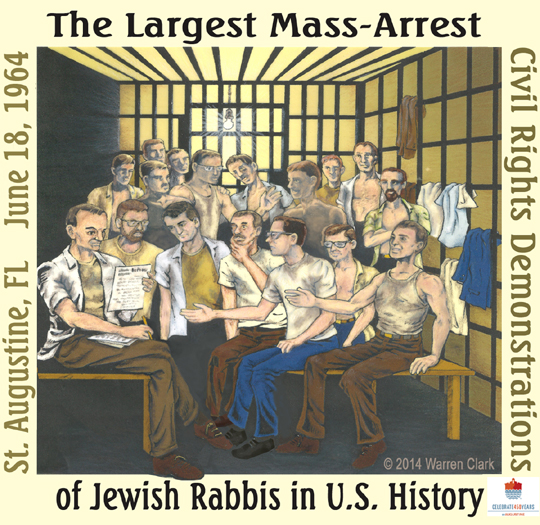
Art Copyright (c) 2023 by the Rev. Dr. Warren Clark.
The Rabbis' letter states:
June 19, 1964
Dear Friend:
St. Augustine is the oldest city in the United States. It was here on St. Augustine’s Day, August 28, 1565, that Pedro Menendez de Aviles first sighted land. In 1965 it will celebrate its 400th anniversary – indeed it has requested federal funds to enhance this historic observance. St. Augustine has other distinguishing characteristics. In American history books yet to be written, this small, neatly kept Florida community will long be remembered as a symbol of a harsh, rigidly segregated, Klan- dominated, backward-looking city which mocked the spirit of the doughty African-born, dark- pigmented priest for whom it was named.
St. Augustine is a tourist town. By far the highest percentage of its income comes from the visitors who walk through its quaint streets staring at “excavations” from the 18th century only now being restored. Most visitors stop at the Slave Market, supposedly only a relic of bygone days. True, they no longer sell slaves in that market, but let no one be deceived into thinking that there no longer exists among this town’s white residents the mental attitude and the psychology which first put slaves on those trading blocks. The spirit of racial arrogance persists and is reinforced by the sway of terror long exerted by hooded and unhooded mobsters.
We went to St. Augustine in response to the appeal of Martin Luther King addressed to the CCAR Conference, in which he asked us to join with him in a creative witness to our joint convictions of equality and racial justice.
We came because we realized that injustice in St. Augustine, as anywhere else, diminishes the humanity of each of us. If St. Augustine is to be not only an ancient city but also a great-hearted city, it will not happen until the raw hate, the ignorant prejudices, the unrecognized fears which now grip so many of its citizens are exorcised from its soul. We came then, not as tourists, but as ones who, perhaps quixotically, thought we could add a bit to the healing process of America.
We were arrested on Thursday, June 18, 1964. Fifteen of us were arrested while praying in an integrated group in front of Monson’s Restaurant. Two of us were arrested for sitting down at a table with three Negro youngsters in the Chimes Restaurant. We pleaded not guilty to the charges against us.
Shortly after our confinement in the St. John’s County Jail, we shared with one another our real, inner motives. They are, as might be expected, mixed. We have tried to be honest with one another about the wrong, as well as the right, motives which have prompted us. These hours have been filled with a sense of surprise and discovery, of fear and affirmation, of self-doubt and belief in God.
We came to St. Augustine mainly because we could not stay away. We could not say no to Martin Luther King, whom we always respected and admired and whose loyal friends we hope we shall be in the days to come. We could not pass by the opportunity to achieve a moral goal by moral means – a rare modern privilege – which has been the glory of the non-violent struggle for civil rights.
We came because we could not stand quietly by our brother’s blood. We had done that too many times before. We have been vocal in our exhortation of others but the idleness of our hands too often revealed an inner silence; silence at a time when silence has become the unpardonable sin of our time. We came in the hope that the God of us all would accept our small involvement as partial atonement for the many things we wish we had done before and often.
We came as Jews who remember t he millions of faceless people who stood quietly, watching the smoke rise from Hitler’s crematoria. We came because we know that, second only to silence, the greatest danger to man is loss of faith in man’s capacity to act.
Here in St. Augustine we have seen the depths of anger, resentment and fury; we have seen faces that expressed a deep implacable hatred. What disturbs us more deeply is the large number of decent citizens who have stood aside, unable to bring themselves to act, yet knowing in their hearts that t his cause is right and that it must inevitably triumph.
We believe, though we could not count on it in advance, that our presence and actions here have been of practical effect. They have reminded the embattled Negroes here that they are not isolated and alone. The conscience of the wicked has been troubled, while that of the righteous has gained new strength. We are more certain than before that this cause is invincible, but we also have a sharpened awareness of the great effort and sacrifice which will be required. We pray that what we have done may lead us on to further actions and persuade others who still stand hesitantly to take the stand they know is just.
We came from different backgrounds and with different degrees of involvement. Some of us have had intimate experience with the struggle of minority groups to achieve full and equal rights in our widely scattered home communities. Others of us have had less direct contact with the underprivileged and the socially oppressed. And yet for all of us these brief, tension-packed hours of openness and communication turned an abstract social issue into something personal and immediate.
We shall not forget the people with whom we drove, prayed, marched, slept, ate, demonstrated and were arrested. How little we know of these people and their struggle. What we have learned has changed us and our attitudes. We are grateful for the rare experience of sharing with this courageous community in their life, their suffering, their effort. We pray that we may remain more sensitive and more alive as a result.
We shall not soon forget the stirring and heartfelt excitement with which the Negro community greeted us with full-throated hymns and hallelujahs, which pulsated and resounded through the church; nor the bond of affectionate solidarity which joined us hand in hand during our marches through town; nor the exaltation which lifted our voices and hearts in unison; nor the common purpose which transcended our fears as well as all the boundaries of race, geography and circumstance. We hope we have strengthened the morale of St. Augustine Negroes as they strive to claim their dignity and humanity; we know they have strengthened ours. Each of us has in this experience become a little more the person, a bit more the rabbi he always hoped to be (but has not yet been able to become). We believe in man’s ability to fulfill God’s commands with God’s help. We make no messianic estimate of man’s power and certainly not of what we did here. But it has reaffirmed our faith in the significance of the deed. So we must confess in all humility that we did this as much in fulfillment of our faith and in response to inner need as in service to our Negro brothers. We came to stand with our brothers and in the process have learned more about ourselves and our God. In obeying Him, we become ourselves; in following His will we fulfill ourselves. He has guided, sustained and strengthened us in a way we could not manage on our own. We are deeply grateful to the good influences which have sustained us in our moments of trial and friendship. Often we thought of parents, wives, children, congregants, particularly our teen-age youth, and of our teachers and our students. How many a Torah reading, Passover celebration, prayer book text, and sermonic effort has come to mind in these hours. And how meaningful has been our worship, morning and evening, as we recited the ancient texts in this new, yet Jewishly familiar, setting. We are particularly grateful for what we have received from our comrades in this visit. We have been sustained by the understanding, thoughtfulness, consideration and good humor we have received from each other. Never have the bonds of Judaism and the fellowship of the rabbinate been more clearly expressed to us all or more deeply felt by each of us.
These words were first written at 3:00 a.m. in the sweltering heat of a sleepless night, by the light of the one naked bulb hanging in the corridor outside our small cell. They were, ironically, scratched on the back of the pages of a mimeographed report of the bloody assaults of the Ku Klux Klan in St. Augustine. At daybreak we revisited the contents of the letter and prayed together for a new dawn of justice and mercy for all the children of God.
We do not underestimate what yet remains to be done, in the north as well as the south. In the battle against racism, we have participated here in only a skirmish. But the total effect of all such demonstrations has created a Revolution; and the conscience of the nation has been aroused as never before. The Civil Rights Bill will become law and much more progress will be attained because this national conscience has been touched in this and other places in the struggle.
We praise and bless God for His mighty acts on our behalf.
Baruch ata adonai matir asurim. Blessed art Thou, O Lord, who freest the captives.
Rabbi Eugene Borowitz
Rabbi Balfour Brickner
Rabbi Israel "Sy" Dresner
Rabbi Daniel Fogel
Rabbi Jerrold Goldstein
Rabbi Joel Goor
Rabbi Joseph Herzog
Rabbi Norman Hirsh
Rabbi Leon Jick
Rabbi Richard Levy
Rabbi Eugene Lipman
Rabbi Michael Robinson
Rabbi B. T. Rubenstein
Rabbi Murray Saltzman
Rabbi Allen Secher
Rabbi Clyde T. Sills
Mr. Albert Vorspan
https://rac.org/why-we-went-joint-letter-rabbis-arrested-st-augustine
Scene of "torture" as found by U.S. District Court Judge Bryan Simpson, the historic 1953 Old St. Johns County Jail housed prisoners until circa 2017.
Sheriff Robert Hardwick stated at a County Commission meeting in 2024 there were plans to demolish the 1953 Old Jail. During a recess, I advised Sheriff to take his plans to the Cultural Resources Review Board (CRRB). He did not do so. Instead, some "dim bulb" arachnid apparatchiks, led by dour St. Johns County Administrator "JOY" ANDREWS & Co., who earned her law degree in China, applied for a demolition permit.
"JOY" ANDREWS & Co. falsely argued the building wasn't historically significant, that only the cell doors and a few other objects were important. They hired PAUL M. WEAVER, III, an historic preservation expert, to help support their sophistry with a shallow report that reflects poorly on him and the County,
Bumptious County burghers were wrong. We stopped them.
Thanks to several reform County Commissioners and some of our friends, including fired former St. Johns County Cultural Resources Director, Mr. Trey Alexander Asner, to Rabbi Merrill Shapiro, to the St. Augustine Jewish Historical Society and the families and friends of the surviving Rabbis who were arrested
UPDATED: With a public CRRB meeting now scheduled in the County Auditorium for June 30 St. Johns County Administrator "JOY" ANDREWS on May 7, 2025 at 3:45 announced that our County has halted its demolition demand. Good career move. She avoided an international incident.
On May 7, 2025, at 3:45 PM, County Administrator "JOY" ANDREWS announced that there would be no demolition, and that the space would be utilized after plans are made for adaptive reuse.
On June 30, 2025 at 1:30 PM, our St. Johns County Cultural Resources Review Board will meet in the County Auditorium. While Ms. Andrews archly told Commissioners that there was no need for people to speak out on preservation of the Old Jail because the proposed demolition won't be on the agenda, that is at best facetious.
Thanks to reform Commissioners Ann Taylor and Krista Keating-Josephr, for getting the CRRB meeting moved to the County Auditorium. For years I have asked the County to hold CRRB meetings in the County Auditorium.
For years, those CRRB. meetings were held in a tiny conference room at the County Growth Management (sic) Building.
Such a bad scene.
Citizens treated disrespectfully and disdainfully by pro-developer staff.
At the April 14, 2025 CRRB meetings, five Jacksonville TV news crews got to see how rude they were.
Crammed into a too-small room by small-minded County staff, led by gross Growth Management (sic) Director MICHAEL ROBERSON, who fired Cultural Resources Coordinator Trey Alexander Asner for doing his job too well.
No class.
No podium.
No public address system.
No Government TV live streaming video.
Putative minutes taken by County Growth Management (sic) staff, not Clerk of Courts staff.
Unfriendly "STAFF ONLY signs on the windows of the doors to the room.
Citizens not allowed in the room before the meetings commenced.
Citizens interrupted mid-sentence.
CRRB Chair Leslee Keys demanding that citizens "stand" to speak, when County staff refused to provide a podium. How gauche and louche. (I declined the Chair's unctuous, ungracious demand, citing ADA/504).
No class.
June 9, 2025 meeting will now be in County Auditorium. Citizens should no longer be treated like jail prisoners and tortured by County staff and CRRB Chair.
What's next: Local Landmark Designation for the Old Jail, to protect it from demolition?
To be continued.....
UPDATE MAY 9, 2025, 10:42 PM:
MALADROIT ST. JOHNS COUNTY STAFF IS ATTEMPTING TO CHANGE THE DATE OF THE MEETING TO JUNE 4, KNOWING THAT AT LEAST TWO CRRB MEMBERS CANNOT ATTEND ON THAT DAY.
I WROTE CRRB:
|


3 comments:
According to the county website, the meeting has been moved to June 4. Majority of the CRRB members can’t make it that date. What’s going on?
I have notified three Commissioners, the County Administrator and County Attorney's office and voiced my objections. Writing e-mail to CRRB.
Thanks for alerting me to the County's attempted gaslighting. Please see my e-mail to Chair Leslee Keys and the other CRRB members, at the end of the article. above. Looks like SJC is still lawless, after all these years.
Post a Comment