Who authorized this press release? Who wrote it? Why is it unsigned? Why is it unadorned by the name of an author or lawyer? Does this curious document read like a Russian czar's ukase? Who's in charge here?
No case law is cited.
No State Attorney Generals opinion is cited.
No legislative history is cited.
No legal analysis.
No proof of danger.
No proof of nonconforming structure.
Wonder why?
This press release stinks.
It "stinks on ice, as my mother would say,
It reeks to high Heaven, my friends,
Our United States Supreme Court held in 1892, in Holy Trinity Church v. United States, 143 U.S. 457 (1892) "It is a familiar rule, that a thing may be within the letter of the statute and yet not within the statute, because not within its spirit, nor within the intention of its makers."
The landmark Holy Trinity Church case involved the federal government's attempted overreach, under the February 26, 1886 alien contract labor law, to prosecute an Anglican minister. That government overreach was reversed. The result was a landmark Supreme Court decision requiring rational interpretation of statutes and defending religious freedom.
In the Magic Beach case, there's no assertion that our Florida House and Senate wanted to wipe out historic structures like the legally protected Magic Beach Motel.
As FBI Deputy Director Mark Felt (played by Hal Holbrook) told Bob Woodward (played by Robert Redford) in the Watergate movie, All the President's Men, "I hate shallowness.
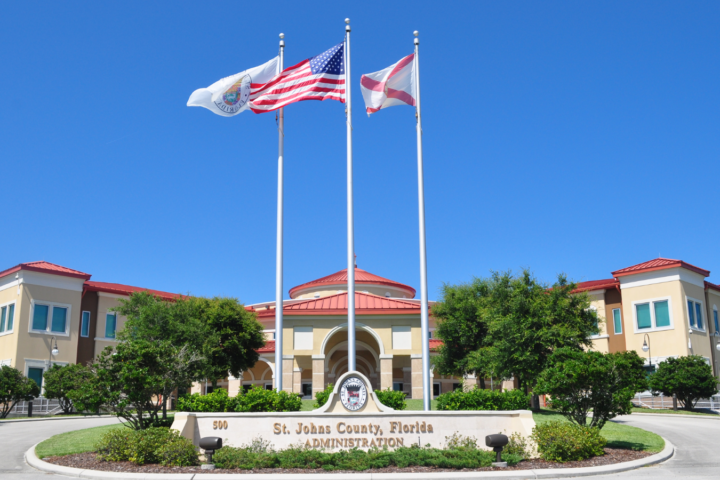
Enough flummery, dupery and nincompoopery from our one-party rulers in St. Johns County.
Let's save the Magic Beach Motel, my friends.
A speculator-lawyer spoke to our the St. Johns County Commission on Monday, August 4, 2025, which resulted in this one-sided pro-developer press release on August 5, 2025:
St. Johns County Provides Update on Proposed Magic Beach Motel Demolition
The County is legally prohibited from denying or conditioning demolition.
St. Johns County will issue a demolition permit for the Magic Beach Motel, located at 50 Vilano Road, in accordance with state law and following review by County staff.
The property, constructed in 1951, and designated in 2021 as a Significant Cultural Resource under Section 3.01.04 of the County’s Land Development Code, is partially located seaward of the Coastal Construction Control Line. As such, the demolition falls under the Resiliency and Safe Structures Act provisions, enacted by the Florida Legislature as Chapter 2024‑21, Laws of Florida, and codified in Section 553.8991, Florida Statutes.
Under this state law, local governments are prohibited from restricting or preventing the demolition of qualifying structures—including those located seaward of the Coastal Construction Control Line—unless such demolition is necessary for public safety. The statute further limits local review to matters strictly related to compliance with the Florida Building Code, Fire Prevention Code, and other life safety standards.
While the County recognizes the Magic Beach Motel’s significance to the Vilano Beach community, it is legally prohibited from denying or conditioning demolition if the requested permit complies with state requirements under Chapter 2024‑21.
The property owner submitted the required documentation in compliance with applicable state and local codes, including a voluntary Cultural Resource Management Plan. Although not required, the property owner has committed to implementing certain elements of the plan, which include documenting, salvaging, and commemorating key architectural and cultural elements of the motel.
Under Section 553.8991(4), Florida Statutes, “A local government may not prohibit, restrict, or prevent the demolition of any structure or building identified in paragraph (3)(a) for any reason other than public safety.” Section 553.8991(8) also preempts and voids any conflicting local law, ordinance, or process.
Demolition activities are anticipated to begin later this year. The County will ensure that all work proceeds in compliance with applicable safety, environmental, and building standards.
----
What does the statute say?
SECTION 8991Resiliency and Safe Structures Act.
553.8991 Resiliency and Safe Structures Act.—(1) SHORT TITLE.—This section may be cited as the “Resiliency and Safe Structures Act.”
(2) DEFINITIONS.—As used in this section, the term:(a) “Coastal construction control line” means the boundary established under s. 161.053. (b) “Law” means any statute, ordinance, rule, regulation, policy, resolution, code enforcement order, agreement, or other governmental act.
(c) “Local government” means a municipality, county, special district, or any other political subdivision of the state.
(d) “Nonconforming structure” means a structure or building that does not conform to the base flood elevation requirements for new construction issued by the National Flood Insurance Program for the applicable flood zone.
(e) “Replacement structure” means a new structure or building built on a property where a structure or building was demolished or will be demolished in accordance with this section.
(3) QUALIFYING STRUCTURES AND BUILDINGS.—(a) Subject to paragraph (b), this section applies to any structure or building on a property in which all or a portion of such property is seaward of the coastal construction control line and the structure or building is:1. A nonconforming structure;
2. A structure or building determined to be unsafe by a local building official; or
3. A structure or building ordered to be demolished by a local government that has proper jurisdiction.
(b) This section does not apply to any of the following structures or buildings:1. A structure or building individually listed in the National Register of Historic Places.
2. A single-family home.
3. A contributing structure or building within a historic district which was listed in the National Register of Historic Places before January 1, 2000.
4. A structure or building located on a barrier island in a municipality with a population of less than 10,000 according to the most recent decennial census and which has at least six city blocks that are not located in zones V, VE, AO, or AE, as identified in the Flood Insurance Rate Map issued by the Federal Emergency Management Agency.
(4) RESTRICTIONS ON DEMOLITION PROHIBITED.—A local government may not prohibit, restrict, or prevent the demolition of any structure or building identified in paragraph (3)(a) for any reason other than public safety. A local government may only administratively review an application for a demolition permit sought under this section for compliance with the Florida Building Code, the Florida Fire Prevention Code, and the Life Safety Code, or local amendments thereto, and any regulation applicable to a similarly situated parcel. The local government may not impose additional local land development regulations or public hearings on an applicant for a permit under this section.
(5) RESTRICTIONS ON REDEVELOPMENT PROHIBITED.—A local government shall authorize replacement structures for qualifying buildings identified in paragraph (3)(a) to be developed to the maximum height and overall building size authorized by local development regulations for a similarly situated parcel within the same zoning district. A local government may not do any of the following:(a) Limit, for any reason, the development potential of replacement structures below the maximum development potential allowed by local development regulations for a similarly situated parcel within the same zoning district.
(b) Require replication of a demolished structure.
(c) Require the preservation of any elements of a demolished structure.
(d) Impose additional regulatory or building requirements on replacement structures which would not otherwise be applicable to a similarly situated vacant parcel located in the same zoning district.
(e) Impose additional public hearings or administrative processes that would not otherwise be applicable to a similarly situated vacant parcel within the same zoning district.
(6) DEVELOPMENT APPLICATIONS.—Development applications submitted for replacement structures for qualifying buildings identified in paragraph (3)(a) must be processed in accordance with the process outlined in local land development regulations including any required public hearings in front of the local historic board. However, a local government may not impose additional public hearings or administrative processes that would not otherwise be applicable to a similarly situated vacant parcel within the same zoning district.
(7) APPLICATION AND CONSTRUCTION.—This section applies retroactively to any law adopted contrary to this section or its intent and must be liberally construed to effectuate its intent. This section does not apply to or affect s. 553.79(26). (8) PREEMPTION.—A local government may not adopt or enforce a law that in any way limits the demolition of a structure identified in paragraph (3)(a) or that limits the development of a replacement structure in violation of subsection (5). A local government may not penalize an owner or a developer of a replacement structure for a demolition pursuant to this section or otherwise enact laws that defeat the intent of this section. Any local government law contrary to this section is void.


No comments:
Post a Comment