
. Thanks to Trey Alexander Asner for preparing the recommendation. Read it here: https://cleanupcityofstaugustine.blogspot.com/2025/05/recommendation-to-nominate-historic-st.html

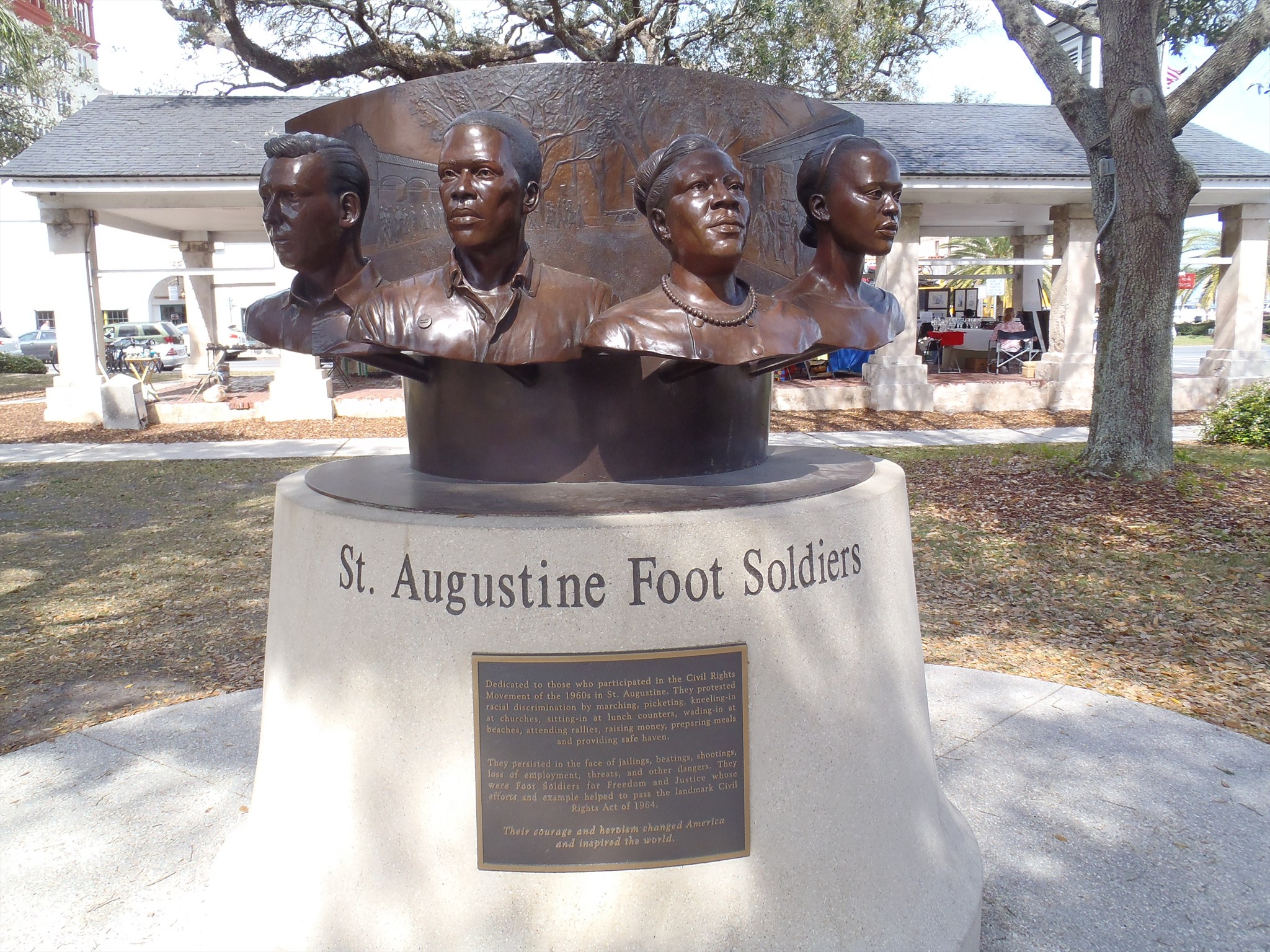

Come speak to St. Johns County Commission, June 3 & June 17, 2025 in non-agenda public comment.
County Auditorium, 500 Sebastian View,
Come speak to the St. Johns County Cultural Resources Review Board,
June 30, 2025,1:30 PM
County Auditorium, 500 Sebastian View,
Like any good diplomats, we will not take "no" as if it were an answer.
Read up on applicable law here:
https://cleanupcityofstaugustine.blogspot.com/2025/05/st-johns-county-land-development-code.html
https://cleanupcityofstaugustine.blogspot.com/2025/05/st-johns-county-development-review.html.
Recommendation to Nominate the Historic St. Johns County Jail
For Landmark Status
Prepared by Trey Alexander Asner, MS Historic Preservation
Recommendation to Nominate the Historic St. Johns County Jail
For Landmark Status
Prepared by Trey Alexander Asner, MS Historic Preservation
“Dr. Martin Luther King Jr., Ralph Abernathy (front, right) and other Activists on the Steps of the SJC Jail after Release.” 1964.
Photo source: Historic SJC 1845-1995. SAHS.
11. Name of Property
Historic name: St. Johns County Jail
Other names: St. Johns County Detention Center and Annex, “The Annex”
2. Location
Street and number:4025 Lewis Speedway, St. Johns County, Florida 32084
The structure is in a county owned government complex operated by the St. Johns
County Sheriff’s office (fig. 1).
Figure 1. “Aerial showing jail in relationship to more recent structures.” Photo credit:
Google Maps.
3. Architectural Description
The jail is two stories with a basement in the Art Moderne style. There is a central
block with curved corners flanked by two wings that are “stepped down” from the
central block. The structure was built in 1953 with a rectangular shaped plan and has a
flat roof (fig. 2). It is constructed of concrete block and has a stucco exterior fabric.
2Figure 2. “Façade of SJC jail.” Photo credit: Google Maps
The main entryway is located on the front (south) elevation in the center of the
facade below a flat projecting curvilinear roof that may have been visibly accented with
polished metal before being painted over during a renovation. The entryway is located
within a vestibule that was enclosed in the original design. The main entry door consists
of a modern metal commercial style door with a rectangular lancet window. The
secondary entry in the vestibule is located along the northern wall of the vestibule and
features a modern metal commercial style door. In its original construction, the
vestibule was enclosed with a commercial door flanked by glass block sidelights.
Concrete steps with rails lead up to the entry.
To the left of the entrance on the central block is what at first appears to be a blind
window that had been filled in. However, this was part of the original design and is
where the name of the building has been placed. Currently, it reads “DETENTION
CENTER ANNEX.” In between the entrance and the sign is a plaque that was placed by
ACCORD recognizing the significance of the jail to the Civil Rights Movement. To the
right of the entrance is another entry where an original window has been partially filled
in and replaced with a modern commercial door which is surrounded by a concrete
block wall. In between that entry and the main entrance is a builder’s plaque and a
rectangular clerestory window which is a modification from the original design.
The second level of the central block features contemporary fixed windows. The
middle window arrangement consists of a ribbon of three plate glass lights and is
3flanked by two windows, each featuring two lights. Originally, the fenestration of the jail
consisted of all awning style windows. Along the parapet is a simple frieze that runs the
entire length of the facade. Both wings feature original downspouts and a flat shallow
projecting roof with curved ends over the first and second levels. The surrounds of each
window were modified after the original construction.
The first floor of the east wing facade features contemporary windows. On the
second level are two one over one style fixed windows in the center flanked by two large
plate glass windows separated by a mullion. The first level has been modified with a
blind window, two windows that have been filled and replaced with clerestory windows,
and another entry with a low wall.
The first floor of the west wing façade displays two one over one windows
separated by a mullion, a small one over one, another one over one, and another pair of
one over one windows separated by a mullion. The second story features two plate glass
windows flanked by two pairs of plate glass windows separated by a mullion.
The first story of the east elevation has had two windows that have been partially
filled in and replaced with clerestory ones. A metal staircase leads to a second story
entrance covered by a pent roof. To the left of the door are two one over one windows
separated by a mullion. To the right is a single one over one and another two one over
one windows separated by a mullion. The first story of the west elevation possesses a
hyphen that connects the annex to a more modern structure and another A metal
staircase that leads to a second story entrance covered by a pent roof. This entry is
flanked by two pairs of windows separated by a mullion. The rear (north) elevation is
obscured. The foundation consists of a basement.
In the 1980s, the building underwent a renovation where the interior was
extensively modified and the exterior was altered. Exterior alterations included the
removal of the original windows, window openings filled in, and new entries. Despite
these alterations, the exterior retains most of its original integrity.
4Criteria for Landmark Designation
4. 50 years or older
Structure was built in 1953.
5. Meets at least three of the following attributes of Integrity: location,
design, setting, materials, workmanship, feeling and association.
• LOCATION
The structure is located at its original site.
• DESIGN
The jail is in the Art Moderne style and was designed by local architect
F.A. Hollingsworth. Significant design elements remain overall intact. The
structure has a symmetrical and austere appearance with embellishments
such as a decorative frieze along the parapet, curved corners, and a
projecting flat roof over the entry.
• Materials
The body of the structure is constructed of concrete block with a stucco
exterior fabric and features a concrete roof.
• Feeling
The jail serves as a place of reflection into the emotions of activists of the
Civil Rights Movement which include feelings of courage, fear, resilience,
and determination.
• Association
The jail has strong associations with the Civil Rights Movement at both the
local and national level. It has a direct connection to significant persons,
events of the movement, and the passage of the Civil Rights Act of 1964
itself. Additionally, there are strong associations with Black history and
Jewish American history.
6. Applicable Criteria for Landmark Status
A. Exemplifies an historic, cultural, political, economic, or social trend of St. Johns
County, the State of Florida, or the nation.
The jail exemplifies cultural, political, economic and social trends of the County,
State, and Nation. This is represented in its use as an instrument to punish
5B. C. demonstrators and local “Foot Soldiers” during the St. Augustine Movement who
fought against the culturally and politically enforced Jim Crow laws that
discriminated against Black Americans. The structure represents an important
historic moment in the Civil Rights Movement within the context of both Black
and Jewish American history.
The jail is where Dr. Martin Luther King was held when he called upon
supporters from across the country to come to St. Augustine to fight against
segregation. It is also where the rabbis who answered his call were held when
they wrote a letter explaining why they came in support of King.
Embodies distinguishing characteristics of an architectural style, period or
method of Construction.
The structure is in the Art Moderne style and embodies conventions that were
popular in the mid to late half of the twentieth century.
Is the work of an architect or builder whose work has significantly influenced the
development of St. Johns County, the State of Florida, or the nation.
The structure was designed by prominent local architect F.A. Hollingsworth who
designed other historically significant structures such as the Mediterranean
Revival First National Bank (1926), and the oldest synagogue in St. Augustine
(1923) (pgs. 6-7).
1
Additionally, Hollingsworth oversaw the adaptive reuse of the Waterworks
Building (originally built 1898 and rehabilitated 1927), and the addition on the
original Record Building (1924).
Hollingsworth was also likely the city’s first preservation architect (pg. 7).
2
Hollingsworth worked on the restoration of the St. Francis Barracks after the
1 Weaver, Paul, and Robert O. Jones. National Register of Historic Places Registration Form (Record Building).
2006, chrome-extension://efaidnbmnnnibpcajpcglclefindmkaj/npgallery.nps.gov/NRHP/GetAsset/cd8b2608-
9cd7-4de8-b777-5181f021384a/. Accessed 28 Apr. 2025.
2 Weaver, Paul, and Robert O. Jones. National Register of Historic Places Registration Form (Record Building).
2006, chrome-extension://efaidnbmnnnibpcajpcglclefindmkaj/npgallery.nps.gov/NRHP/GetAsset/cd8b2608-
9cd7-4de8-b777-5181f021384a/. Accessed 28 Apr. 2025.
61916 fire, was part of the Carnegie Restoration Commission of the 1930s, and was
employed by the St. Augustine Historical Society in the 1950s (pg. 7).
3
D. Contains elements of design, detail, materials or craftsmanship of outstanding
quality or represents a significant innovation or adaptation to the Florida
environment.
E. Has value as a Building that is recognized for the quality of its architecture and
that retains sufficient features showing its architectural significance.
F. Has yielded, or is likely to yield, archaeological information or artifacts important
in prehistory or history.
G. Is a geographically definable area or neighborhood united by culture,
architectural styles or physical development, which has historic or cultural
significance in the community.
7. Historic Context
Jail Construction and Accommodations
In 1951, a local bill was passed by the Florida Legislature that gave the St. Johns
County Board of County Commissioners the authority to construct or acquire a county
jail and courthouse.
4 The old county jail on Williams street had been condemned by
state prison inspectors and the County needed a modern facility (fig. 3) to meet the
needs of the County.
5 The bill gave the commission permission “to levy up to five mills,
if necessary, over a period of 15 years to finance the building.6”
3 Weaver, Paul, and Robert O. Jones. National Register of Historic Places Registration Form (Record Building).
2006, chrome-extension://efaidnbmnnnibpcajpcglclefindmkaj/npgallery.nps.gov/NRHP/GetAsset/cd8b2608-
9cd7-4de8-b777-5181f021384a/. Accessed 28 Apr. 2025.
4 “PROPOSED NEW ST. JOHNS COUNTY JAIL....” St. Augustine Record, 17 June 1951.
5 “PROPOSED NEW ST. JOHNS COUNTY JAIL....” St. Augustine Record, 17 June 1951.
6 “PROPOSED NEW ST. JOHNS COUNTY JAIL....” St. Augustine Record, 17 June 1951.
7Local architect F.A. Hollingsworth was selected to design the structure which was
to be two stories, 121 by 50 feet, made concrete block, and features concrete floors and
roof to be rendered “fireproof.”7 The jail was to be used for the “retention” of those
awaiting court arraignment or trial” while the “County Stockade” building was to serve
criminals who had been sentenced to serve time.8 It was completed in 1953.
The jail was to be constructed with room for 104 prisoners and complete with
“jailer quarters and office, waiting room and radio equipment space.9” The first floor
was advertised as going to feature cells for 8 white women, 12 “colored” women, juvenile
cells for 4 white and four “colored” girls, plus a kitchen and laundry facilities.10
Figure 3. “Illustration of Proposed New SJC Jail by F.A. Hollingsworth.” Photo credit:
St. Augustine Historic Society.
The second floor of the jail was advertised as going to have “cells for 20 white and
28 colored men; quarters for four white and four colored juvenile boys; six wen men and
six colored men dormitory cells and two hospital cells with beds for white prisoners and
one colored prisoner.
11” A room where lawyers could talk with their clients was also to be
located on the second floor.12 The windows were advertised as going to be the “latest
resisting steel, awning design…13”
7 “PROPOSED NEW ST. JOHNS COUNTY JAIL....” St. Augustine Record, 17 June 1951.
8 “PROPOSED NEW ST. JOHNS COUNTY JAIL....” St. Augustine Record, 17 June 1951.
9 “PROPOSED NEW ST. JOHNS COUNTY JAIL....” St. Augustine Record, 17 June 1951.
10 “PROPOSED NEW ST. JOHNS COUNTY JAIL....” St. Augustine Record, 17 June 1951.
11 “PROPOSED NEW ST. JOHNS COUNTY JAIL....” St. Augustine Record, 17 June 1951.
12 “PROPOSED NEW ST. JOHNS COUNTY JAIL....” St. Augustine Record, 17 June 1951.
13 “PROPOSED NEW ST. JOHNS COUNTY JAIL....” St. Augustine Record, 17 June 1951.
8The Civil Rights Movement and the SJC JAIL
When Pedro Menendez de Avilez founded St. Augustine in 1565, he brought with
him both enslaved and free Africans, establishing a black presence in modern day St.
Johns County that would see itself through multiple flags such as the Spanish, British,
and American.14 Each with their own unique institutions on how blacks were to be
perceived. From the Spanish Siete Partidas which believed that slavery was a condition
not based on color, to the “peculiar institution” of the British and American periods
which was inextricably tied servitude to the color of one’s skin.15
In present day St. Johns County, the first free Black settlement in North America
was founded by the Spanish in 1738 called Fort Mose. As early as 1687, the Spanish
promised freedom to enslaved person fleeing the British colonies.16 The Southern
Railroad led south before north.
The “peculiar institution” of slavery that based solely on race began with the
British Period (1763-1784) and was continued by the Americans when they took
possession of Florida in 1821 and established St. Johns County. At the conclusion of the
Civil War, the Black citizens of St. Johns County were technically free, but were
repressed by Jim Crow (1877 to c. 1965) law and etiquette that restricted them to second
class citizenry.
In Plessy v. Ferguson (1896), the Supreme Court upheld Jim Crow’s
segregationist “separate but equal” laws that would become the center of the Civil Rights
Movement.17 In 1954, the Modern Civil Rights Movement began when Brown V. Board
14 “African Americans in St. Augustine 1565-1821 - Castillo de San Marcos National Monument (U.S. National
Park Service).” Www.nps.gov, National Park Service, 22 Oct. 2023,
www.nps.gov/casa/learn/historyculture/african-americans-in-st-augustine-1565-1821.htm. Accessed 30 Apr.
2025.
15 “African Americans in St. Augustine 1565-1821 - Castillo de San Marcos National Monument (U.S. National
Park Service).” Www.nps.gov, National Park Service, 22 Oct. 2023,
www.nps.gov/casa/learn/historyculture/african-americans-in-st-augustine-1565-1821.htm. Accessed 30 Apr.
2025.
16 “African Americans in St. Augustine 1565-1821 - Castillo de San Marcos National Monument (U.S. National
Park Service).” Www.nps.gov, National Park Service, 22 Oct. 2023,
www.nps.gov/casa/learn/historyculture/african-americans-in-st-augustine-1565-1821.htm. Accessed 30 Apr.
2025.
17 “Research Guides: Plessy v. Ferguson (Jim Crow Laws): Topics in Chronicling America: Introduction.”
Guides.loc.gov, guides.loc.gov/chronicling-america-plessy-ferguson. Accessed 8 May 2025.
9of Education ended segregation in schools and set off an organized effort across the
country for the next two decades to extend equality to all.18
From 1963 to 1964, St. Johns County and St. Augustine served as the setting for
the final battle for the Civil Rights Act of 1964 and witnessed some of the tensest
moments of the movement as activists and the local KKK clashed.
In St. Johns County, local dentist Dr. Robert B. Hayling led what became known
as the “St. Augustine Movement” on the eve of the city of St. Augustine’s 400th
Anniversary.19 He organized a youth council of the National Association for the
Advancement of Colored People (NAACP) to engage in sit ins, marches, and boycotts.20
In June of 1963, these juvenile demonstrators protested outside the local Woolworths
carrying signs that read “If We Spend Money Here Why Can’t we Eat Here?21”
In July of 1963, 16 young blacks, which included 7 juveniles, were arrested after
requesting service at the local Woolworths.22 Local judge Charles Mathis told the
parents of the juveniles that he would only release them into their custody if they no
longer participated in any demonstrations.
23 Four of the juveniles refused and were sent
to reform school for 6 months. They became known as the “St. Augustine Four” and
were likely some of the first civil rights activists who were incarcerated at the St. Johns
County Jail. 24
In September, activists staged a protest in response to the treatment of the “St.
Augustine Four” and the city commission’s refusal to create a biracial commission to
18 Brown v. Board of Education (1954). The U.S. National Archives and Records Administration, 18 Mar. 2024,
www.archives.gov/milestone-documents/brown-v-board-of-education. Accessed 30 Apr. 2025.
19 Duncan, Gwendolyn. “Dr. Robert B. Hayling.” Accordfreedomtrail.org,
www.accordfreedomtrail.org/hayling.html. Accessed 30 Apr. 2025.
20 “ACCORD Freedom Trail | St. Augustine, Florida | Historic Civil Rights Movement.” Accordfreedomtrail.org,
2025, accordfreedomtrail.org/timeline.html.
21 “ACCORD Freedom Trail | St. Augustine, Florida | Historic Civil Rights Movement.” Accordfreedomtrail.org,
2025, accordfreedomtrail.org/timeline.html.
22 “ACCORD Freedom Trail | St. Augustine, Florida | Historic Civil Rights Movement.” Accordfreedomtrail.org,
2025, accordfreedomtrail.org/timeline.html.
23 “ACCORD Freedom Trail | St. Augustine, Florida | Historic Civil Rights Movement.” Accordfreedomtrail.org,
2025, accordfreedomtrail.org/timeline.html.
24 “ACCORD Freedom Trail | St. Augustine, Florida | Historic Civil Rights Movement.” Accordfreedomtrail.org,
2025, accordfreedomtrail.org/timeline.html.
10address the longstanding race issues in the “Ancient City.25” Activists were met with
violence, harassment, and unfairly jailed. The KKK and segregationists attempted to
intimidate them through marches of their own, rallies, and attacking the homes of
protestors (fig. 4).
Figure 4. Cross Burning by the KKK North of the Dobbs Brothers Book Bindery.
Photo source: Flagler College Civil Rights Library.
In September of 1963, in response to local civil rights activism, a public Ku Klux
rally and cross burning was held. At this rally, the main speaker, “Brother Connie Lee,”
called for violence against the Black community. He then went on to say that the
“fellows” responsible for the Birmingham Church bombing deserved medals for killing
black children that he argued were just “animals” ridden with “venereal diseases.26” He
25 “ACCORD Freedom Trail | St. Augustine, Florida | Historic Civil Rights Movement.” Accordfreedomtrail.org,
2025, accordfreedomtrail.org/timeline.html.
26 “Account of a Meeting of the Ku Klux Klan near St. Augustine by Rev. Benjamin Irvin Cheney, Jr., 1964.”
Florida Memory, 2020, www.floridamemory.com/items/show/346349?id=4. Accessed 2 Apr. 2025.
11then called for the murder of Hayling and Black people in general to roaring approval
from the crowed.27
The racially charged crowd became violent when it was revealed that members of
the Klan had actually kidnapped Hayling and three others. They proceeded to beat
them, break their bones, and almost succeeded in lynching them by setting them on
fire.
28 At the last moment, due to the intervention of Rev. Irv Cheney, they were saved
from certain death.29 Hayling was later convicted and fined $100 and the four whites
who were initially arrested were acquitted.30
In February, Hayling’s home was attacked.31 One bullet narrowly missed his
pregnant wife while another fatally wounded the family dog.32 Activist Cynthia Mitchell
Clarke stated that if they kept their lights on at night there was “risk of our house being
fire bombed” so they had to study in the closet. There was great fear that “we were going
to be shot and the house is going to be burnt down.”
Hayling reached out to Martin Luther King’s Southern Christian Leadership
Conference for support and all eyes fell on St. Augustine as it became the epicenter for
the national Civil Rights Movement. One reporter called the city a “segregated
superbomb.”33 In Spring of 1964, Hosea Williams, a SCLC leader from Savannah, came
to St. Augustine to meet with Dr. Hayling.34
27 “Account of a Meeting of the Ku Klux Klan near St. Augustine by Rev. Benjamin Irvin Cheney, Jr., 1964.”
Florida Memory, 2020, www.floridamemory.com/items/show/346349?id=4. Accessed 2 Apr. 2025.
28 “Dr. Robert B. Hayling.” Accordfreedomtrail.org, 2025, www.accordfreedomtrail.org/hayling.html. Accessed
2 Apr. 2025.
29 “Dr. Robert B. Hayling.” Accordfreedomtrail.org, 2025, www.accordfreedomtrail.org/hayling.html. Accessed
2 Apr. 2025.
30 On October 16, 1963, Dr. Hayling was convicted and fined $100. On November 4, the four whites were
acquitted.
31 Dr. Robert B. Hayling.” Accordfreedomtrail.org, www.accordfreedomtrail.org/hayling.html. Accessed 30
Apr. 2025.
32 Duncan, Gwendolyn. “Dr. Robert B. Hayling.” Accordfreedomtrail.org,
www.accordfreedomtrail.org/hayling.html. Accessed 30 Apr. 2025.
33 33 Goodwyn, Larry. “Anarchy in St. Augustine, by Larry Goodwyn.” Harper’s Magazine, c. 1965,
harpers.org/archive/1965/01/anarchy-in-st-augustine/. Accessed 1 May 2025.
34 Goodwyn, Larry. “Anarchy in St. Augustine, by Larry Goodwyn.” Harper’s Magazine, c. 1965,
harpers.org/archive/1965/01/anarchy-in-st-augustine/. Accessed 1 May 2025.
12In April of 1964, King’s Southern Christian Leadership Conference (SCLC) came
to St. Augustine as the Civil Rights Bill was threatened by a filibuster in the Senate.
35
The House had passed the Civil Rights Bill on February 10, 1964.
36 However, a small
group of southern senators began a filibuster to stop the bill from being voted on and
the future of the act became uncertain.37 King decided that St. Augustine and St. Johns
County would be made to demonstrate the need for anti-discrimination legislation and
put public pressure on the senators.
King rallied supporters and his SCLC field secretaries conducted workshops to
teach about nonviolence and mass demonstrations.
38 The majority of activists were
locals, “Foot Soldiers,” who decided to risk their lives engaging in demonstrations,
marches, wade ins at the county beaches, and standing up against Jim Crow. Local
segregationists responded violently with beatings, harassment, firebombing, and
shootings.39 Rev. Andrew Young was quoted as saying that St. Augustine was “really
worse than Birmingham. It’s the worst I’ve ever seen.”40
A beach house (MLK House/ Canright House) that was used by SCLC staff was
attacked by segregationists who were looking to assassinate King after directions to the
house were published by the local newspaper.41 They shot up the house, broke out the
windows, sprayed racist graffiti on the walls, destroyed the interior, and attempted to
firebomb it.42 A picture of King pointing to a bullet hole in the rear sliding glass window
was shown in newspapers all around the world (fig. 5).
35 “ACCORD Freedom Trail | St. Augustine, Florida | Historic Civil Rights Movement.” Accordfreedomtrail.org,
2025, accordfreedomtrail.org/timeline.html.
36 “St. Augustine’s Civil Rights Movement Local and National Background.” Accordfreedomtrail.org, 2024,
accordfreedomtrail.org/background.html. Accessed 1 May 2025.
37 “St. Augustine’s Civil Rights Movement Local and National Background.” Accordfreedomtrail.org, 2024,
accordfreedomtrail.org/background.html. Accessed 1 May 2025.
38 “ACCORD Freedom Trail | St. Augustine, Florida | Historic Civil Rights Movement.” Accordfreedomtrail.org,
2025, accordfreedomtrail.org/timeline.html.
39 Goodwyn, Larry. “Anarchy in St. Augustine, by Larry Goodwyn.” Harper’s Magazine, c. 1965,
harpers.org/archive/1965/01/anarchy-in-st-augustine/. Accessed 1 May 2025.
40 Goodwyn, Larry. “Anarchy in St. Augustine, by Larry Goodwyn.” Harper’s Magazine, c. 1965,
harpers.org/archive/1965/01/anarchy-in-st-augustine/. Accessed 1 May 2025.
41 “5480 Atlantic View.” Accordfreedomtrail.org, 2025, accordfreedomtrail.org/5480atlantic.html. Accessed
12 May 2025.
42 “5480 Atlantic View.” Accordfreedomtrail.org, 2025, accordfreedomtrail.org/5480atlantic.html. Accessed
12 May 2025.
13Hundreds of these activists would wake up knowing that by the days end, they
would be likely imprisoned at the St. Johns County Jail for fighting against segregation.
The jail which was run by St. Johns County Sheriff L. O. Davis who was a “tough
minded” segregationist and Klansman “judged by even the strictest Deep South
criterion.”43 Davis deputized a local “Klan oriented leader” named “Hoss” Manucy of a
group locally known as “Manucy’s Raider’s,” but formally known as the Ancient City
Gun Club.44 Along with other deputized members of his well-organized militia like
group, he roamed the beaches during the day and plaza at night looking to fight against
integrationists.
45 The Florida Advisory Committee to the U.S. Commission on Civil
Rights described St. Augustine as a “segregated superbomb….46”
43 Goodwyn, Larry. “Anarchy in St. Augustine, by Larry Goodwyn.” Harper’s Magazine, c. 1965,
harpers.org/archive/1965/01/anarchy-in-st-augustine/. Accessed 1 May 2025.
44 Goodwyn, Larry. “Anarchy in St. Augustine, by Larry Goodwyn.” Harper’s Magazine, c. 1965,
harpers.org/archive/1965/01/anarchy-in-st-augustine/. Accessed 1 May 2025.
45 Goodwyn, Larry. “Anarchy in St. Augustine, by Larry Goodwyn.” Harper’s Magazine, c. 1965,
harpers.org/archive/1965/01/anarchy-in-st-augustine/. Accessed 1 May 2025.
46 Goodwyn, Larry. “Anarchy in St. Augustine, by Larry Goodwyn.” Harper’s Magazine, c. 1965,
harpers.org/archive/1965/01/anarchy-in-st-augustine/. Accessed 1 May 2025.
14Figure 5. Martin Luther King Points to Bullet Hole in Window of Safe House.
Source: Flagler College Civil Rights Library.
President Johnson was told that if “he wanted to keep an eye on the leaders of the
civil rights movement, he should just look at the St. Johns County Jail” because that's
where they all were incarcerated.47 The building served as a witness to the hundreds of
both white and black civil “Foot Soldiers” that were imprisoned for fighting segregation
which included King, Rev. Ralph Abernathy, Hosea Williams, Andrew Young, Dr.
Hayling, Mary Peabody (fig. 6), the St. Augustine Four, the sixteen rabbis and one lay
person, and many more brave individuals.48
Figure 6. “Mother of Massachusetts Governor Endicott Peabody speaking to
reporters on the steps of the jail.” 1964. Photo source: St. Augustine Historic Society and
Research Library.
The civil rights activists knew that beyond the verbal and physical assaults that
they faced by segregationists, their resilience to the institution of Jim Crow would be
further tested by their fate at the St. Johns County Jail where they were likely to be
inhumanely treated (fig. 7).
47 “St. Johns County Jail Annex.” Accordfreedomtrail.org, 2025, www.accordfreedomtrail.org/jail.html.
Accessed 30 Mar. 2025.
48 “St. Johns County Jail Annex.” Accordfreedomtrail.org, 2025, www.accordfreedomtrail.org/jail.html.
Accessed 30 Mar. 2025.
15Figure 7. Singing Demonstrators. Photo credit: Associated Press. Photo Source:
Jeremy-dean.com
Judge Bryan Simpson, who overturned the injunction on demonstrator’s night
marches, lambasted the County’s use of concrete sweatboxes, miniature cells, and
chicken coops that were designed to torture activists at the jail (Gary Dorrien, pg.
366).49 “Here is exposed, in its raw ugliness, studied and cynical brutality, deliberately
contrived to break men physically and mentally” he wrote (Dorrien, pg. 366).50 In
defiance against their incarceration, activists sang “freedom songs,” clapped hands, and
rattled the jail’s dishes against wire screened cages (pg. 16).51
Mrs. Katherine Twine who became known as the “Rosa Parks of St. Augustine”
was arrested so many times that she began to carry with her a large brimmed hat which
she named her “freedom hat” to protect her from the sun when she was placed in the
49 Dorrien, Gary. BREAKING WHITE SUPREMACY: Martin Luther King Jr. And the Black Social Gospel. Yale
University Press, 2019, chrome-extension://efaidnbmnnnibpcajpcglclefindmkaj/eddierockerz.com/wp-
content/uploads/2021/03/breaking-white-supremacy-martin-luther-king-jr.-and-the-black-social-gospel-
pdfdrive-.pdf. Accessed 30 Mar. 2025.
50 Dorrien, Gary. BREAKING WHITE SUPREMACY: Martin Luther King Jr. And the Black Social Gospel. Yale
University Press, 2019, chrome-extension://efaidnbmnnnibpcajpcglclefindmkaj/eddierockerz.com/wp-
content/uploads/2021/03/breaking-white-supremacy-martin-luther-king-jr.-and-the-black-social-gospel-
pdfdrive-.pdf. Accessed 30 Mar. 2025.
51 Bootleggers, Busts, and Badges. St. Augustine Historic Society and Research Library.
16chicken coop at the jail.52 Furthermore, large bonds would be placed of $1,500 to
$3,000 dollars to intimidate activists and to hurt them economically as well as
physically.53
Fig 8. “MLK and his ‘perennial jail mate’ Ralph Abernathy in the SJC Jail.” Photo
credit: Associated Press. Photo Source: Jeremy-dean.com
After King was arrested in St. Augustine on June 11, 1964 (fig. 8), he contacted
religious leaders and activists from across the country to come to St. Augustine. One of
these religious leaders was his friend and civil rights activist Rabbi Israel Dresner (fig. 9)
who King asked to bring together other rabbis to stand together in solidarity with him in
52 “ACCORD Freedom Trail | St. Augustine, Florida | Historic Civil Rights Movement.” Accordfreedomtrail.org,
2025, accordfreedomtrail.org/timeline.html.
53 “ACCORD Freedom Trail | St. Augustine, Florida | Historic Civil Rights Movement.” Accordfreedomtrail.org,
2025, accordfreedomtrail.org/timeline.html.
17the fight for civil rights.
54 King had first met Dresner when the rabbi visited him in a
Georgia cell.55
Figure 9. “Martin Luther King Jr. and Rabbi Israel Dresner.” Photo source: Avi Dresner
On June 18, 1964, Dresner arrived in St. Augustine with 16 other rabbis and one
lay person to attempt to integrate the whites only pool and restaurant at the Monson
Motor Lodge.56 While the rabbis engaged in prayer, a group of activists (both white and
black) jumped in the Monson’s pool. The motor lodge’s owner, James Brock, poured
acid into the pool to force the activists out.57 The image that was captured of Brock
pouring acid in the pool (fig.10) as activists tried to swim away became one of the most
important and recognized moments of the Civil Rights Movement. An image that may
not have been possible without the rabbis who distracted the authorities long enough
54 Nichols, Annemarie. “Rabbis Return to St. Augustine in Anniversary of the Largest Mass Arrest of Rabbis in
U.S. History.” Samuel Proctor Oral History Program, 20 June 2014, oral.history.ufl.edu/rabbis-return-to-st-
augustine/. Accessed 8 May 2025.
55 “Most Arrested Rabbi” Israel Dresner Dies at Age 92.” Cbsnews.com, CBS New York, 14 Jan. 2022,
www.cbsnews.com/newyork/news/rabbi-israel-dresner-dies/. Accessed 8 May 2025.
56 Nichols, Annemarie. “Rabbis Return to St. Augustine in Anniversary of the Largest Mass Arrest of Rabbis in
U.S. History.” Samuel Proctor Oral History Program, 20 June 2014, oral.history.ufl.edu/rabbis-return-to-st-
augustine/. Accessed 8 May 2025.
57 Nichols, Annemarie. “Rabbis Return to St. Augustine in Anniversary of the Largest Mass Arrest of Rabbis in
U.S. History.” Samuel Proctor Oral History Program, 20 June 2014, oral.history.ufl.edu/rabbis-return-to-st-
augustine/. Accessed 8 May 2025.
18with their demonstration to allow the other activists to enter the pool and engage in a
“swim in.”
Figure 10. James Brock Pours Acid into the Monson Pool. 1964. Photo source:
Flagler College Civil Rights Library.
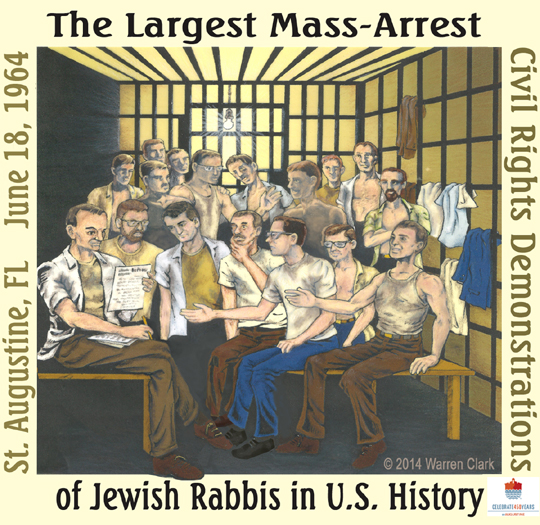
Their arrest was the largest arrest of rabbis in U.S. history.58 From their crammed
cell at the jail (fig. 11) which was illuminated by a single bulb, the 16 rabbis (and lay
person) wrote a group letter, “Why We Went,” declaring that they came because they
"realized that injustice in St. Augustine, as anywhere else, diminishes the humanity of
each of us.”59 They called upon the memories of the Holocaust where millions of people
58 Rozner, Lisa. ““Most Arrested Rabbi” Israel Dresner Reflects on Life of Activism after Being Diagnosed with
Stage 4 Colon Cancer.” Cbsnews.com, CBS New York, 29 Dec. 2021,
www.cbsnews.com/newyork/news/rabbi-israel-dresner/. Accessed 8 May 2025.
59 “Why We Went: A Joint Letter from the Rabbis Arrested in St. Augustine | Religious Action Center of Reform
Judaism.” Rac.org, June 1964, rac.org/why-we-went-joint-letter-rabbis-arrested-st-augustine. Accessed 30
Mar. 2025.
19had remained passive against the persecution of the Jews and compared the situation to
how many remained indifferent to Jim Crow.60
American Jews have had a long history in supporting civil rights through funding,
founding civil rights organizations, and activism.61 They were involved in the creation of
important organizations such as the NAACP, the Leadership Conference on Civil and
Human Rights, the SCLC, and the Student Nonviolent Coordinating Committee
(SNCC).
62
Figure 11. “Painting depicting the arrest of the rabbis in the SJC jail by Warren
Clark.” 2014. Courtesy of Warren Clark.
Jewish activists also represented a large number of white activists who
participated in demonstrations during the Civil Rights Movement. Both the Civil Rights
60 “Why We Went: A Joint Letter from the Rabbis Arrested in St. Augustine | Religious Action Center of Reform
Judaism.” Rac.org, June 1964, rac.org/why-we-went-joint-letter-rabbis-arrested-st-augustine. Accessed 30
Mar. 2025.
61 Religious Action Center of Reform Judaism. “A Brief History of Jews and the Civil Rights Movement of the
1960s.” Religious Action Center of Reform Judaism, rac.org/issues/civil-rights-voting-rights/brief-history-jews-
and-civil-rights-movement-1960s. Accessed 13 May 2025.
62 Religious Action Center of Reform Judaism. “A Brief History of Jews and the Civil Rights Movement of the
1960s.” Religious Action Center of Reform Judaism, rac.org/issues/civil-rights-voting-rights/brief-history-jews-
and-civil-rights-movement-1960s. Accessed 13 May 2025.
20Act of 1964 and the Voting Rights Act of 1965 were drafted in the conference room of the
Religious Action Center of Reform Judaism.63
People across the world saw the violence and hate that was waged against Civil
Rights activists in St. Augustine as the image of the incident was broadcasted all over the
world and into the into the international spotlight. The day after Monson protest and
the arrest of the rabbis, June 19, 1964, Senator Everett Dirksen of Illinois broke the
Senate’s filibuster on the Civil Rights Act of 1964, guaranteeing its passage.64
8. Statement of Significance
The old St. Johns County Jail (Annex) is a socially historic significant structure that
possesses strong associations with the local and national Civil Rights Movement with a
period of significance between 1963 to 1964. It is not only a significant site in terms of
Black history, but Jewish American history as well, and a tangible connection to St.
Johns County’s civil rights past.
Figure 12. Mary Peabody with Robert Hayling After Her Release from Prison.
Photo source: Flagler College Civil Rights Library of St. Augustine
63 Religious Action Center of Reform Judaism. “A Brief History of Jews and the Civil Rights Movement of the
1960s.” Religious Action Center of Reform Judaism, rac.org/issues/civil-rights-voting-rights/brief-history-jews-
and-civil-rights-movement-1960s. Accessed 13 May 2025.
64 Dorrien, Gary. BREAKING WHITE SUPREMACY: Martin Luther King Jr. And the Black Social Gospel. Yale
University Press, 2019, chrome-extension://efaidnbmnnnibpcajpcglclefindmkaj/eddierockerz.com/wp-
content/uploads/2021/03/breaking-white-supremacy-martin-luther-king-jr.-and-the-black-social-gospel-
pdfdrive-.pdf. Accessed 30 Mar. 2025.
21Many important local and national figures of the Civil Rights Movement were
interred at the jail for their participation in local demonstrations such as the Rev. Dr.
Martin Luther King, Dr. Robert B. Hayling (fig. 12), Mary Peabody (fig. 13), and Rabbi
Israel Dresner. The local demonstrations for which they were arrested and jailed for
captured international attention and helped to break the senate filibuster which paved
the way for the Civil Rights Act of 1964.
Figure 13. Civil Rights Battler. Photo source: Flagler College Civil Rights Library.
From within the walls of the jail, King called out for the support of religious
leaders and activists from across the country to fight segregation and rally support for
the Civil Rights Act. This decision had a profound impact on the success of the
Movement. Rabbi Israel Dresner answered King’s call and led a demonstration at the
Monson Motor Lodge which resulted in the largest arrest of rabbis in U.S. history. From
their cramped cell, the sixteen rabbis and one lay person penned a letter, “Why We
Went,” outlining their moral responsibility to fight prejudice. The jail is symbolic of the
22longstanding support of the Jewish community for civil rights issues, especially during
the Post War era, and within the shadow of the Holocaust.
The jail served as a place of convergence for people of different races, faiths, and
classes, who were united in the fight against prejudice and segregation. Together, they
experienced the systematic and social framework of the Jim Crow South that is
represented by the structure.
9. Justification
The jail is eligible for a significant cultural resource with landmark designation on
the grounds that it represents an important historic trend (LDC Criteria A) as it related
to the events and persons of the Civil Rights Movement on both the local and national
level.
10. Recommendations for Preservation
It is recommended that upon designation that a plan is drafted that adheres to
the Secretary Standards for Preservation for restoration, rehabilitation, or a
combination thereof. That all significant features, materials, and finishes are preserved
or reconstructed on the exterior.
Considering that the interior was modified dramatically in the 1980s, has limited
integrity, and is projected to be renovated to meet the modern needs of the St. Johns
County sheriff’s office, preservation efforts should be focused on the exterior which still
retains a substantial level of integrity.
It is recommended that the appearance of the exterior of the jail should be
restored to its period of significance of 1963-1964 and all significant features preserved.
• Stucco exterior fabric is recommended to be preserved and restored.
• Flat projecting roofs and their metal fascia embellishments are
recommended to be preserved and restored.
• The fenestration should be restored. This would include the return of
original openings that have been filled in, the removal of added entries,
stairways, and the removal of modified window surrounds. It is
recommended that replacement windows have a resemblance to the
original awning style windows with the appearance of horizontal
rectangular lights.
23• The original entry is recommended to be restored with an appropriate
styled door and the return of the glass block sidelights. The facade, with
emphasis on the entry, served as an important backdrop to historic photos
that document the important individuals associated with the structure.
24LIST OF REFERENCES
Dorrien, Gary. BREAKING WHITE SUPREMACY: Martin Luther King Jr. And the
Black Social Gospel. Yale University Press, 2019, chrome-
extension://efaidnbmnnnibpcajpcglclefindmkaj/eddierockerz.com/wp-
content/uploads/2021/03/breaking-white-supremacy-martin-luther-king-jr.-
and-the-black-social-gospel-pdfdrive-.pdf. Accessed 30 Mar. 2025.
Duncan, Gwendolyn. “Dr. Robert B. Hayling.” Accordfreedomtrail.org,
www.accordfreedomtrail.org/hayling.html. Accessed 30 Apr. 2025.
Nichols, Annemarie. “Rabbis Return to St. Augustine in Anniversary of the Largest Mass
Arrest of Rabbis in U.S. History.” Samuel Proctor Oral History Program, 20
June 2014, oral.history.ufl.edu/rabbis-return-to-st-augustine/. Accessed 8 May
2025.
Rozner, Lisa. “Most Arrested Rabbi” Israel Dresner Reflects on Life of Activism after
Being Diagnosed with Stage 4 Colon Cancer.” Cbsnews.com, CBS New York, 29 Dec.
2021, www.cbsnews.com/newyork/news/rabbi-israel-dresner/. Accessed 8 May
2025.
Viti, Lucia. 2025. “Could St. Johns County’s Old Jail, Where MLK and Several Rabbis
Were Jailed in 1964, Be Demolished?” St. Augustine Record. February 10, 2025.
https://www.staugustine.com/story/news/local/2025/02/10/st-johns-
considers-demolishing-old-jail-where-mlk-was-once-jailed/78375763007/.
Weaver, Paul. Mitigation Plan, St. Johns County Jail. Feb. 2025.
Weaver, Paul, and Robert O. Jones. National Register of Historic Places Registration
25Form (Record Building). 2006, chrome
extension://efaidnbmnnnibpcajpcglclefindmkaj/npgallery.nps.gov/NRHP/GetAs
set/cd8b2608-9cd7-4de8-b777-5181f021384a/. Accessed 28 Apr. 2025.
“ACCORD Freedom Trail | St. Augustine, Florida | Historic Civil Rights Movement.”
Accordfreedomtrail.org, 2025, accordfreedomtrail.org/timeline.html.
“Account of a Meeting of the Ku Klux Klan near St. Augustine by Rev. Benjamin Irvin
Cheney, Jr., 1964.” Florida Memory, 2020,
www.floridamemory.com/items/show/346349?id=4. Accessed 2 Apr. 2025.
“African Americans in St. Augustine 1565-1821 - Castillo de San Marcos National
Monument (U.S. National Park Service).” Www.nps.gov, National Park Service,
22 Oct. 2023, www.nps.gov/casa/learn/historyculture/african-americans-in-st-
augustine-1565-1821.htm. Accessed 30 Apr. 2025.
Bootleggers, Busts, and Badges. St. Augustine Historic Society and Research Library.
Brown v. Board of Education (1954). The U.S. National Archives and Records
Administration, 18 Mar. 2024, www.archives.gov/milestone-documents/brown-
v-board-of-education. Accessed 30 Apr. 2025.
“Most Arrested Rabbi” Israel Dresner Dies at Age 92.” Cbsnews.com, CBS New York, 14
Jan. 2022, www.cbsnews.com/newyork/news/rabbi-israel-dresner-dies/.
Accessed 8 May 2025.
“PROPOSED NEW ST. JOHNS COUNTY JAIL....” St. Augustine Record, 17 June 1951.
SAHS.
26Religious Action Center of Reform Judaism. “A Brief History of Jews and the Civil
Rights Movement of the 1960s.” Religious Action Center of Reform Judaism,
rac.org/issues/civil-rights-voting-rights/brief-history-jews-and-civil-rights-
movement-1960s. Accessed 13 May 2025.
“Research Guides: Plessy v. Ferguson (Jim Crow Laws): Topics in Chronicling America:
Introduction.” Guides.loc.gov, guides.loc.gov/chronicling-america-plessy-
ferguson. Accessed 8 May 2025.
“St. Augustine’s Civil Rights Movement Local and National Background.”
Accordfreedomtrail.org, 2024, accordfreedomtrail.org/background.html.
Accessed 1 May 2025.
“St. Johns County Jail Annex.” Accordfreedomtrail.org, 2025,
www.accordfreedomtrail.org/jail.html. Accessed 30 Mar. 2025.
“The St. Augustine Four.” n.d. Www.accordfreedomtrail.org. Accessed March 17, 2025.
https://www.accordfreedomtrail.org/four.htm.
“Why We Went: A Joint Letter from the Rabbis Arrested in St. Augustine | Religious
Action Center of Reform Judaism.” Rac.org, June 1964, rac.org/why-we-went-
joint-letter-rabbis-arrested-st-augustine. Accessed 30 Mar. 2025.
“5480 Atlantic View.” Accordfreedomtrail.org, 2025,
accordfreedomtrail.org/5480

26“5480 Atlantic View.” Accordfreedomtrail.org, 2025,
accordfreedomtrail.org/5480atlantic.html. Accessed 12 May 2025.



2 comments:
It is said that Atheist Pizza is a huge Ed Slavin fan... an that Ed Slavin is is huge Atheist Pizza fan. Perhaps the two can meet for a bite to eat and exchange ideas. Ed Slavin gets a lot of news from Atheist Pizza.🍕
SJC...big city Atlanta prices and nothing more. Republicans have turned Florida into the biggest ripoff in human history. Whole generation probably going nowhere if they're working class.
Post a Comment