In secret, behind locked gates, our Nation's Oldest City dumped a landfill in a lake (Old City Reservoir), while emitting sewage in our rivers and salt marsh. Organized citizens exposed and defeated pollution, racism and cronyism. We elected a new Mayor. We're transforming our City -- advanced citizenship. Ask questions. Make disclosures. Demand answers. Be involved. Expect democracy. Report and expose corruption. Smile! Help enact a St. Augustine National Park and Seashore. We shall overcome!
Both sides had planned to wrap up the impeachment debate in the House Judiciary Committee by about 5 p.m., allowing Republicans to attend a White House Christmas party. Lisa Collins, wife of ranking Republican member Doug Collins (Ga.), wore sequined red holiday finery to the hearing.
But mid-afternoon, Collins had a brief private word with his wife and made an announcement to the committee Democrats: “We’re going to be here a long time tonight,” he said. “There’s plenty of balls we can go to, so if anybody thinks that might be in our plans, don’t worry about it … because if we have to fact-check you all night, we will.”
AD
ADVERTISING
He wasn’t kidding. Republicans floated amendments and assaulted the process — for 14 hours. Democrats deduced that Republicans were delaying so they could say the committee approved impeachment articles “in the middle of the night” — much like they complained that the Intelligence Committee held hearings in a “basement” (neglecting to mention that’s where the committee’s hearing room is).
Hostility, insults and theatrics: Articles of impeachment are approved | Impeachment This Week
Attacks on both sides got heated and personal as the House Judiciary Committee approved two articles of impeachment against President Trump. (The Washington Post)
So Judiciary Chairman Jerry Nadler (D-N.Y.) answered the GOP stunt with one of his own. “It is now very late at night,” he said at 11:15 p.m., then summarily announced the committee would recess for the night so members could “search their consciences” and vote at 10 a.m. — in broad daylight.
Republicans erupted.
“Stalinesque,” hollered Rep. Louie Gohmert (Tex.). “Let’s have a dictator.”
“Chairman Nadler’s integrity is zero!” said Collins.“Kangaroo court… I have never seen anyone want to get in front of these cameras more than this group right here.”
AD
And with that, Collins went — you guessed it — in front of the cameras, to deliver some more epithets: “Bush league! … Runshodding the rules!”
Fox News’s Chad Pergram pointed out that Rep. James Sensenbrenner (R-Wisc.) had hours earlier congratulated Nadler on his handling of proceedings.
No longer, Collins said. “We have members who have flights! We have members who are getting on trains!”
Impeach the president, sure. But don’t mess with lawmakers’ travel plans. Collins kept shouting: “Lack of taste!” “Ludicrous!” “Crap!” Midway in this extraordinary stream of invective, he announced: “I’m just beyond words.”
Opinion | Impeachment: Why so much is at stake
The impeachment inquiry into President Trump has exposed troubling cracks in the political system. (Video: Joy Sharon Yi, Kate Woodsome/Photo: Danielle Kunitz/The Washington Post)
This impeachment is historic, in the sense that it is rare, only the third in the nation’s history. But it seems more like an extension of politics as usual. Republicans aimed for this: If they could turn the proceedings into a circus, they could discredit President Trump’s impeachment. Maybe they succeeded, because the Fox News-viewing public remains steadfastly opposed. But in the process they have bludgeoned not just this impeachment but impeachment itself, the powers of Congress, the legitimacy of government, the law and any sense of objective truth. What’s historic about this moment is the near-complete dysfunction of, and loss of confidence in, American democracy.
AD
Heckuva job, Putin.
In between Fox News appearances, Republicans in the hearing room Thursday vied for the most-Trumpian insults — “Y’all are an EPA hazardous waste site,” Collins offered, and Rep. Matt Gaetz of Florida mocked Hunter Biden’s drug use — and some Democrats responded in kind. Rep. Cedric Richmond (La.) likened Republicans to Judas, betraying Americans “for 30 positive tweets.”
Overnight, Republicans produced a new poster for the dais, with red horror-movie letters over a graveyard scene saying “It’s Friday the 13th….Chairman Nadler’s Impeachment Nightmare.” For the impeachment vote itself, Republicans marched silently from their cloakroom Friday morning and maintained solemnity (except for Gohmert, who after voting insisted on having his vote read back to him because “I want to make sure”) as each voted against the two articles, and each Democrat voted for. After just seven minutes, both articles had been approved. The clocks in the Ways & Means hearing room displayed 10:09 am.
Mike Johnson (La.): “Charade … Rigged … Ambush … Radical left.”
Gaetz, fresh from his derision of Biden for drug addiction, said: “For Democrats, impeachment is their drug.”
Asked about the behavior of Trump, who just used the power of the presidency to attack a teenager on the autism spectrum as having an “anger-management problem,” Republicans’ epithets suddenly ran dry.
Johnson excused Trump’s latest disgrace as “unorthodox.” By contrast, he said, the Democrats would pay “a huge political price” for impeaching Trump.
AD
If only Republicans cared about the huge price we will all pay for their decision to defend a president’s wrongdoing with a Trumpian campaign of reckless invective.
The City of St. Augustine and other local polluters repeatedly were let off Scot-free on pollution crimes by successive waves of Florida Department of Environmental Protection (FDEP) political appointees. As our late friend and mentor, David Thundershield Queen put it best, DEP means "Don't Expect Protection." From Florida Today:
Florida environmental fines dip by half in a decade
Jim Waymer, Florida TodayPublished 3:43 p.m. ET Dec. 12, 2019 | Updated 3:56 p.m. ET Dec. 12, 2019
Florida's environmental cops fine fewer than half as many polluters today less than half as much thanthey did a decade ago, before former Gov. Rick Scott took office and shifted state regulators to a more pro-business posture, state data shows.
Through the first week of December, the Florida Department of Environmental Protection assessed352 penalties this year, totaling $4.4 million in fines for violating air, water, sewer, petroleum tank and other state environmental regulations.
By comparison, in 2010 DEP assessed 1,249 environmental penalties in Florida, totaling $10.2 million — more than 3 ½-times as many penalties and double thefines assessed this year.
DEP holds that the lower figures prove the success of the agency's mission to help businesses, utilities and other polluters to clean up their acts. But the agency's critics say the steep drop in fines reflects an ever-softening stance on environmental enforcement and permitting in Florida. In the meantime, critics add, the state's sensitive waters, air and other natural resources suffer, with unknown risks and consequences for public health.
"The short answer is the reason it's plummeted is that's what Rick Scott wanted," said Jerry Phillips, executive director with Florida Public Employees for Environmental Responsibility, a nonprofit DEP watchdog group in Tallahassee.
Phillips, a former enforcement attorney for DEP, has asserted for years that the agency is lax on violators. He put out a report earlier this year countering DEP's claim that more than 95% of Florida facilities are compliant. His analysis, for example, found fewer than 42% of the potable water facilities and 52 percent of domestic wastewater facilities in compliance with rules to protect drinking water. In 2011, the agency changed the way it calculates compliance, Phillips says, making the numbers look better. The agency only counts what it deems “significant noncompliance” while omitting other violations, such as failure to report emissions and discharges.
Before Scott took office in 2011, when a utility or business failed an inspection, DEP issued warning letters, ordering them to comply or face potential fines. If they ignored the warning, the agency would send a "notice of violation," and then pursue civil penalties if that notice also failed to bring a facility into compliance.
Under Scott's directive to create a more business-friendly state, DEP began issuing "compliance assistance letters" and reduced environmental permit reviews to just a few days. Not much has changed under Gov. Ron DeSantis, Phillips said.
"It gives you the impression that the department doesn't take this stuff seriously, so why should the permittees?" Phillips asked. "It's anything that they can do to avoid having these facilities identified as not complying with their permits."
Potential penalties that start out big routinely also wind up much smaller, as DEP allows violators to negotiate down fine amounts or put the money back into their operations or pollution prevention projects that likely would have had to be done anyway. The same pattern plays out statewide.
According to DEP data and documents obtained by FLORIDA TODAY:
Only four violators in Brevard were assessed a combined $12,600 in 2019, with one air pollution violator allowed to offset $3,600 in penalties by putting that amount toward energy efficiency improvements at its facilities. By comparison, 21 violators in Brevard were assessed $73,476 in fines in 2011, and even that was a more than a 50 percent drop in fines and amount levied from 2010.
Sarasota County Utilities had the largest fine assessed in Florida this year: $624,800, for 35 spills involving several million gallons of treated and untreated sewage. As DEP routinely allows, the utility was given the option of spending 1-½-times the fine amount — $937,200 — on improvements to its facilities, instead of paying the fine.
Statewide, DEPcollected just over $1 million for 329 civil penalties in 2019. Yearly collected and assessed fine amounts differ because fines aren't always collected the same year they are assessed. By comparison, DEP collected only 265 civil penalties totaling $900,484 last year; 231 fines totaling $705,891 in 2017; and 293 fines totaling $2.2 million in 2016.
Brevard's top 2019 fines
The top DEP fine in Brevard County this year was $4,100 in penalties levied against Space Coast Crushers (SCC), in Rockledge for failing to do required yearly air pollution tests. The fine included $2,000 in estimated economic benefit the company gained by failing to do required annual visible emissions tests for five years in a row, according to DEP enforcement documents.
In a Feb. 5 letter to the agency, SCC's consultant, Beatty Environmental Services, Inc., said the incident could have been prevented and blamed DEP for failing to provide "proper guidance and assistance that is expected of the Department. Because of this failure, SCC is paying the price," the letter says. DEP inspectors deemed the site in compliance and didn't bring up the required air testing during a 2012 inspection, the letter notes.
Beach Funeral Home & Cremation Service faced $3,600 in penalties or failing to conduct required yearly emissions tests at its Melbourne funeral home, according to DEP documents. The agency sought $ 2,000 in civil penalties and $1,600 for the economic benefit the company gained by not doing the testing. Instead of paying the fine, DEP allowed the funeral home to put that amount toward installing some energy saving solar attic exhaust fans.
Brevard's third steepest environmental fine this year hit a Sunshine Food Mart on 4570 Dixie Highway in Palm Bay, assessed $3,000 for failing to make repairs, which may have led to a discharge, and other violations.
The only city in Brevard that DEP fined this year was Cocoa Beach. The agency fined the city $2,000 for unauthorized discharges of up to 500,000 gallons of treated sewage effluent to the Banana River on Jan. 17, and up to 300,000 gallons to the Banana River on April 28, DEP records show.
DEP officials say fines are only one tool to bring facilities into compliance. Others includesolid permitting, inspection and compliance resolution processes.
"Depending on the nature of the violation and circumstances surrounding the event, DEP will determine which measure is best-suited," Dee Ann Miller, a DEP spokeswoman, said via email.
DEP hired 61 additional staff in its regulatory district offices to help inspect sewer plants and other facilities that discharge to rivers and other waters, Miller noted. By year's end, the agency will have completed 2,000 additional inspections, above and beyond its routine compliance inspections, focusing on sewer plants and other facilities with the most potential to pollute waters.
"This will be the first time all of the wastewater and stormwater facilities throughout the state have been inspected in a single year," Miller said.
Miller also points to DeSantis' proposal for a 50% increase over existing fines and increased daily fines until spills are remediated or a state consent order is in place that addresses the violation. Currently, polluters are only fined for the days the spill is happening.
State law outlines more than 75 different penalty categories across multiple environmental programs, with fines ranging from $50 to $50,000, Miller added.
"Governor DeSantis is proposing to raise every single one," she said. "The Governor’s proposal calls for an increase in penalties to improve the deterrent effect of these penalties and incentivize resolving environmental concerns in a timely fashion."
Education instead of fines
DEP administrators say their mission is partly education andnot just punishment for violators. That solves pollution problems more quickly than takingoffenders to court, they said. And lower enforcement numbers can mean the agency's other tactics are preventing violations in the first place.
"Civil penalties are intended to be a deterrent and ensure immediate and continued compliance with environmental regulations," Miller said. "The Legislature prescribes the fines applicable to specific violations in statute, many of which have not changed since 2001. For a similar deterrent effect to occur today, the prescribed penalty amounts must be adjusted for inflation to meet 2001 dollar values."
A 2001 state law allowed DEP to calculate most fines based on a list of pre-set penalties for common violations. The agency can then whittle the fine down further based on whether the violator shows good faith, the violation was beyond their control, the violator'sability to pay, their compliance history, and whether they gained an economic benefit from the violation.
For cases expected to be less than $10,000, DEP officials say the outcomes are more efficient, consistent and swifter than civil litigation.
Such cases often make up most of the agency's workload, which DEP critics like Phillips see as a system soft on violators. DEP allows businesses to pump money into pollution preventions that should have been there in the first place, criticsargue. Meanwhile, water quality and public safety problems remain uncorrected for months while DEP negotiates with violators.
Fines that kick in years after a violation occurs also can obscure whether Florida is getting tougher or softer on environmental crime. Phillips says the number of cases opened — whicha decade ago hovered between 1,300 and 2,000 a year for two decades — should have grown as the state's population ballooned. Now DEP only opens a few hundred cases per year, and while the state's population increased, the agency's manpower lagged.
Phillips has long criticized what he sees at DEP as a "traffic ticket" approach.
The agency issues more thorough consent orders, but often even those don't solve the problem, he says.
"It's amazing. There is very little environmental protection here nowadays," Phillips said.
Florida Department of Environmental Protection fines
In 2010, the Florida Department of Environmental Protection assessed 1,249 environmental fines in Florida, totaling $10.2 million.
In 2019, the agency assessed 352 fines, totaling $4.4 million.
Assessed DEP environmental fines in Florida (2015 to Dec. 5, 2019):
2019 - 352 fines = $4,424,529.15
2018 - 302 fines = $2,801,482.78
2017 - 157 fines = $3,698,644.56
2016 - 209 fines = $3,990,487.75
Assessed DEP fines in Florida (2008-2011):
2011: 881 fines = $8,306,945
2010: 1,249 fines = $10,171,471
2009: 1,264 fines = $7,100,725
2008: 1,332 fines = $7,286,745
Collected DEP fines in Florida (2015 to Dec. 3, 2019):
Source: Florida Department of Environmental Protection
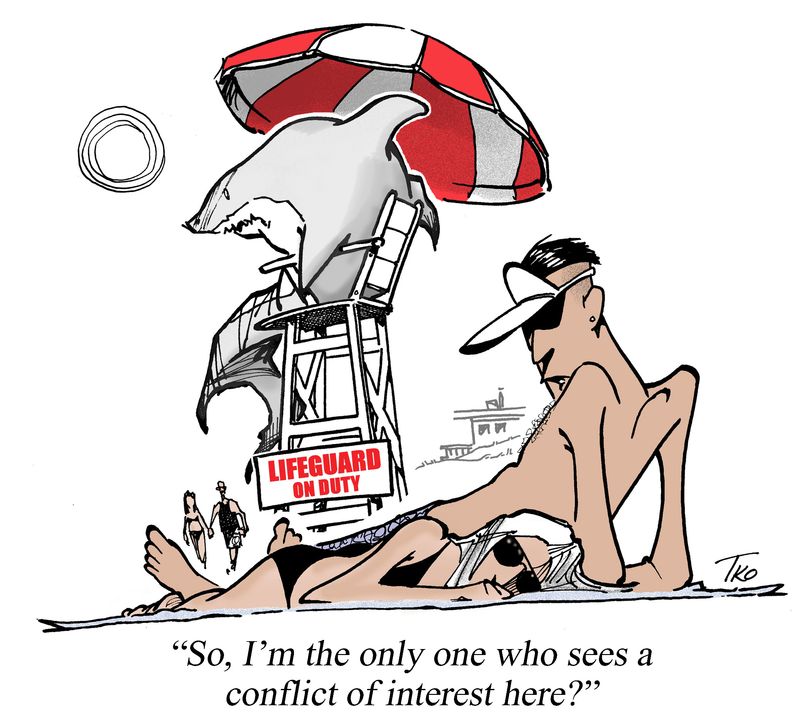
Controversial St. Johns County Clerk of Courts and Comptroller HUNTER C. CONRAD has not responded to calls to withdraw his name from consideration to be St. Johns County Administrator Ad Interim. Wonder why?
-----Original Message----- From: Ed Slavin To: coc ; pmccormack ; rross ; bcc1jjohns ; bcc2jsmith ; bcc3pwaldron ; bcc4jblocker ; bcc5hdean Sent: Sat, Dec 7, 2019 7:24 pm Subject: CONFLICT OF INTEREST: Kindly withdraw HUNTER S. CONRAD employment offer, respect First Amendment and avoid organizational conflict of interest
Good evening:
No draft contract has yet been provided. Why?
Conflicts of interests are to be scrupulously guarded against. See, e.g., United States v. Mississippi Valley Generating Co., 364 U.S. 520, 548 (1961)("the 'Dixon-Yates' case," involving TVA rivals' conflicts of interest in a proposed Memphis coal-fired powerplant), citing Matthew 6:24 -- "no [person] can serve two masters," holding that laws and rules preventing conflicts of interest are aimed "not only at dishonor but at conduct that tempts dishonor." All conflict of interest laws are based upon Matthew 6:24 ("A man cannot serve two masters"), which the unanimous Supreme Court decision by Chief Justice Earl Warren deemed to be both a "moral "moral principle" and a "maxim which is especially pertinent if one of the masters happens to be economic self-interest."
Please reconsider and kindly withdraw the inchoate, ill-advised job offer to HUNTER S. CONRAD, a partisan politician who is the only person considered for a nonpartisan position as St. Johns County Administrator Ad Interim.
Former County Commissioner Mary Kohncke documented in an open letter the Commission's illegal preference for all-Republican appointees.
This is viewpoint discrimination in violation of the First and Fourteenth Amendments.
Our First Amendment deserves "breathing space." NAACP v. Button, 371 U.S. 415, 433 (1963) New York Times. v. Sullivan, 3766 U.S. 254 (1974); Gasparinetti v. Kerr, 568 F.2d 311, 314-17 (3d Cir. 1977)(illegal restrictions on policemen’s First Amendment rights); Philadelphia Newspapers, Inc. v. Hepps, 479 767, 772, 777 (1986)(O’Connor, J.)(newspaper entitled to breathing space in defamation case); Hustler Magazine v. Falwell, 485 U.S. 46, 52, 56 (1988) (Rehnquist, J.) (magazine parody of TV preacher entitled to breathing space); Keefe v. Ganeakos, 418 F.2d 359, 362 (1st Cir. 1969)(Aldrich, C.J.)(chilling effect on First Amendment illegal suspension of teacher over Atlantic Monthly article on Vietnam War); Parducci v. Rutland, 316 F.Supp. 352, 355, 357 (M.D. Ala 1970)(Johnson, C.J.)(chilling effect in illegal firing of English teacher over Kurt Vonnegut’s Welcome to the Monkey House.
Despite constitutional law demanding that the First Amendment deserves "breathing space," the all-Republican St. Johns County Commission is about to use the position of County Administrator to reward a Republican friend.
As Justice Robert Houghwot Jackson wrote for the Supreme Court, "If there is any fixed star in our constitutional constellation, it is that no official, high or petty, can prescribe what shall be orthodox in politics, nationalism, religion, or other matters of opinion, or force citizens to confess by word or act their faith therein." West Virginia Board of Education v. Barnette, 319 U.S. 624 (1943).
If HUNTER S. CONRAD becomes Interim County Administrator and then returns to be Clerk of Courts and Comptroller, he will occupy a revolving door of dozens of ethics violations: (a) Recommending his own Clerk of Courts FY 2021 budget to Commissioners as County Administrator; (b) Running the County for multiple months; then (c) Returning as Clerk of Courts and Comptroller to supervise the putative Inspector General and Comptroller, ruling on any allegations of maladministration by himself as County Administrator
Does this revolving door violate create untenable conflicts of interest? Yes.
It is a blatant conflict of interest, illegal, immoral and unseemly, a stench in the nostrils of our Nation for HUNTER CONRAD to stand astride these two offices in a revolving door.
James Madison wrote in The Federalist No. 10: "No [person] is allowed to be a judge in [his/her] own cause, because his interest would certainly bias his judgment, and, not improbably, corrupt his integrity. With equal, nay with greater reason, a body of men are unfit to be both judges and parties at the same time . . . .".
The Supreme Court held in In re Murchison, 349 U.S. 133, 136 (1955) (Black, J.), "[O]ur system of law has always endeavored to prevent even the probability of unfairness. To this end no man can be a judge in his own case and no man is permitted to try cases where he has an interest in the outcome."See also TWA v. Civil Aeronautics Board, 102 U.S. App. D.C. 391, 392, 254 F.2d 90, 91 (1958). Spencer v. Lapsley, 20 How. 264, 266 (1858); Publius Syrus, Moral Sayings 51 (D. Lyman transl. 1856) ("No one should be judge in his own cause."); Blaise Pascal, Thoughts, Letters and Opuscules 182 (Wight transl. 1859) ("It is not permitted to the most equitable of men to be a judge in his own cause.").
As William Blackstone wrote, "[I]t is unreasonable that any man should determine his own quarrel," 1 W. Blackstone, Commentaries on the Laws of England 91citingDr. Bonham's Case, 8 Rep. 114a (C.P. 1610); see also City of London v. Wood, 12 Mod. 669, 687 (1701)(Lord Holt)(invalidating fine for refusal to serve as sheriff recovered by the city in its own court of Mayor and Aldermen). See also Aetna Life Ins. Co. v. Lavoie, 475 U.S. 813 (1986)(overruling case where Chief Justice of Alabama Supreme Court sat in judgment of case that would set precedent for his own pending case); Ward v. Village of Monroeville, 409 U.S. 57 (1972); Gibson v. Berryhill, 411 U.S. 564 (1973); Withrowv. Larkin, 421 U.S. 35 (1975); Cinderella Career and Finishing Schools, Inc. v. FTC, 425 F.2d 583 (D.C. Cir. 1970); American Cyanamid Co. v. FTC, 363 F.2d 757 (6th Cir. 1966); SCA Services, Inc. v. Morgan, 557 F.2d 110 (7th Cir.1977).
HUNTER S. CONRAD's proposed blatantconflict of interest, an admittedly revolving door relationship involving two (2) lucrative offices, one elected and one appointed -- Clerk of Courts and County Administrator -- is the sort that that Anglo-American courts have been protecting us against for some 409 years. since at least 1610. Dr. Bonham's case, supra;Tumey v. Ohio, 273 U.S. 510, 522-24 (1927) (Taft, C.J.). See also Laird v. Tatum, 409 U.S. 824, 828 (1972) (Rehnquist, J.), holding that it is well-settled that a government official is disqualified from ruling on a case "if [s]he either signs a pleading or brief" or "if he actively participated in any case even though he did not sign a pleading or brief."
Don't take my word for it -- what will HUD or FEMA or their respective Inspector General criminal investigators say?
Please stop, look and listen.
Please heed our Founders' wisdom, supra.
Please don't vote to name conflicted HUNTER S. CONRAD Interim County Administrator.
CONRAD's selection doesn't withstand scrutiny, taken: (a) in possible violation of Sunshine laws, (b) without a background investigation, (c) without posting or advertising, (d) outside the ordinary course of business, and (e) in violation of civil rights and conflict of interest laws and principles.
Please call me to discuss this weekend.
Thank you.
With kindest regards, I am,
Sincerely yours,
Ed Slavin
904-377-4998
www.cleanupcityofstaugustine.blogspot.com
www.edslavin.com
-----Original Message----- From: Ed Slavin To: coc ; pmccormack ; rross ; coc ; bcc1jjohns ; bcc2jsmith ; bcc3pwaldron ; bcc4jblocker ; bcc5hdean Sent: Fri, Dec 6, 2019 4:43 pm Subject: Request No. 2019-684: Draft HUNTER S. CONRAD employment contract, including OCI clause/research
Good afternoon: 1. Please send and post today the draft HUNTER S. CONRAD employment contract as St.Johns County Administrator Ad Interim for presentation at the December 9, 2019 special meeting, including any provisions on organizational conflict of interest and ethics.
2. Does Mr. CONRAD have a prohibited conflict of interest, if he returns to Clerk of Courts and Comptroller, on ANY Inspector General complaint about his own maladministration during his suzerainty as the County Administrator Ad Interim?
3. How can Commissioners possibly justify not posting or advertising the position before they voted to do it on November 19, 2019?
Trump impeachment articles must focus, like a laser-beam, on one word: “bribery” — one of two specific crimes in our Constitution, Article II, Section 4, before the words “high crimes and misdemeanors.” (The other specifically-named impeachment-crime is “treason,” defined as “levying War against [the United States], or in adhering to their Enemies, giving them Aid and Comfort.”)
Does holding up $391,000,000 in Congressionally-appropriated Ukraine military/foreign aid constitute “bribery?” Does accepting foreign help constitute accepting a bribe?
Trump abused his office to attempt to bribe Ukraine’s President. Why? To bolster Trump’s re-election campaign. How many Ukrainian soldiers and civilians died because of Trump’s arrogant, illegal, unconstitutional aid delays?
Enough dupery. Enough Trumpery.
It’s time for Trump to go. Have faith. Our system will work once again.https://cleanupcityofstaugustine.blogspot.com/2019/12/ed-slavin-column-time-to-dethrone-king.html
Here's my impeachment column from the Sunday, December 8, 2019 St. Augustine Record.
By Ed Slavin, St. Augustine
Posted Dec 6, 2019 at 11:30 AM St. Augustine Record
A Tennessee Department of Environmental Conservation air pollution regulatory manager once told his subordinate, a supervisor, that the State of Tennessee owned his “mind” for “7 1/2 hours a day,” and that if told by management to “jump off a roof,” he must “jump off a roof.” The supervisor was fired for doing his job, e.g., citing landowners for setting massive tire fires.
Americans’ fundamental rights to speak our minds must be protected and not neglected. But President Donald John Trump treats everyone — even Generals and Ambassadors — like hired hands, as if he were King Donald I.
Exhibit A: Trump firing our Ambassador to Ukraine, based on defamation from Rudolf Giuliani’s Russian-American associates.
Prediction: Trump will be impeached by our House of Representatives. Trial will be in the Senate, which Gladstone once called “the world’s greatest deliberative body.”
As a teenager, I watched in awe as Congress investigated President Richard Milhous Nixon. Our system worked.
As it unfolded, heroic Senate Watergate Committee Chair Samuel James Ervin Jr. (D-N.C.), said, “I love my country.... I think that Watergate is the greatest tragedy this country has ever suffered. I used to think that the Civil War was our country’s greatest tragedy, but I do remember some redeeming features in the Civil War in that there was some spirit of sacrifice and heroism displayed on both sides. I see no redeeming features in Watergate.”
Watergate-conspiracy tapes were ordered released by the Supreme Court. Nixon resigned rather than be impeached, after he was told by Sen. Barry Goldwater, et al, that he had perhaps 15 Senate votes left.
Will Trump profit from Nixon’s example?
Let us hope so.
115 years ago, U.S. District Judge Charles H. Swayne of St. Augustine, Florida and Wilmington, Delaware, was impeached by the House of Representatives on a party-line vote, accused of:
‒ Expense account padding;
‒ Abusing powers as railway bankruptcy-receiver to twice order up —for his, his family’s and friends’ use — a private railway car, porter and accoutrements from the bankrupt Jacksonville, Tampa and Key West Railway (riding in style to Delaware and California);
‒ Jailing/disbarring two attorneys who requested his recusal (in property case re: land owned by his wife);
‒ Living outside his district boundaries (changed after his appointment), delaying for nine years moving his residence to Pensacola.
Would anyone convict Judge Swayne for alleged foot-dragging, hebetude or reluctance to move to Pensacola?
But who doubts it might constitute a “high crime and misdemeanor” to treat a private railway car as his own — twice — or to refuse to recuse himself in his wife’s case?
Swayne was acquitted Feb. 27, 1905, by Republican-controlled Senate (another party-line vote).
Did the Democratic-controlled House over-try/overstate its case? What If it brought a concise case, instead of hiding its light under a bushel-basket? (12-count, 3,217-word charges, 34-day trial). Some allegations were perhaps overwrought or over-stated, but some were undisputed. Swayne contended some actions were “inadvertent.” Swayne remained a federal judge until his death in 1907.
Trump impeachment articles must focus, like a laser-beam, on one word: “bribery” — one of two specific crimes in our Constitution, Article II, Section 4, before the words “high crimes and misdemeanors.” (The other specifically-named impeachment-crime is “treason,” defined as “levying War against [the United States], or in adhering to their Enemies, giving them Aid and Comfort.”)
Does holding up $391,000,000 in Congressionally-appropriated Ukraine military/foreign aid constitute “bribery?” Does accepting foreign help constitute accepting a bribe?
Trump abused his office to attempt to bribe Ukraine’s President. Why? To bolster Trump’s re-election campaign. How many Ukrainian soldiers and civilians died because of Trump’s arrogant, illegal, unconstitutional aid delays?
Enough dupery. Enough Trumpery.
It’s time for Trump to go. Have faith. Our system will work once again.
Another great column by retiring St. Augustine Record Opinion Editor Jim Sutton, with more on his Flagler College years under racist segregationist former St. Augustine Record Publisher A.H. "Hoppy" Tebeault, and Flagler College President (later state representative and now Chancellor) WILLIAM LEE PROCTOR, a/k/a "MASSA PROCTOR."
By Jim Sutton
Posted Dec 6, 2019 at 2:07 PM
St. Augustine may be the best place on earth.
My first day here was a trip to Flagler College in the early 1970s. I was 17. Seems they were short on boys and long on girls — and were looking to even things out. It was a spectacular recruiting tool.
Halfway through my college years I spent some time on what might be termed a forced sabbatical. A year later, Dr. Bill Proctor was my salvation, allowing me back in when no one else was interested. And since that time, he has become a kind of mentor by proxy. He didn’t have to lecture me other than that one dressing down. He gave me closet support. I needed only to watch him to set my moral compass.
It was former The Record Publisher Hoop Tebault, who bullied me into the newspaper business. We’d been like Batman and the Joker (he was Batman) for years: I on the college newspaper staff, he the boss of it all. The battles were epic. Few mortals ever won one with him.
But after succumbing to a providential graduation, Mr. Tebault pushed me to a publisher buddy of his in Madison, Florida. I got a job. When I showed up at the White Springs Leader for my first day as a reporter, the secretary, Kaci, told me breathlessly the editor had pilfered the petty cash box and disappeared over the weekend. I drove back to tell my boss, Tommy Greene, the situation. He stuck out a hand the size of a catcher’s mitt and said, “Congratulations, boy, you’re the editor.”
At a newspaper banquet a year later, I discovered I was the youngest editor in the history of the Florida Press Association. For two years I ran The White Springs Leader and the Mayo Free Press — both nestled in the bosom of the Suwannee River — and where the big news was flue cured tobacco, hail, churches, deer season and especially who cooked-down the best cane syrup. One secret was never cutting it before the first frost.
I came home to St. Augustine and The Record in the fall of 1980. It was coincidence that my then-hometown Mayo High School faced my now-hometown Hastings High in the state Class B football playoffs that year.
Tom King was the editor here at the time; a fine man who figured out quickly that whatever my future in journalism, it might best be practiced outside.
So my beat included covering Corky Ringspot (a pesky nematode) on tri-county potatoes, the spots on the tails of redfish and the Hastings Town Council. I did anonymous restaurant reviews on the side for a time, as well as covering the downtown nightlife — and there was some wicked good licks going down at Scarlett’s and the White Lion in those days.
Every slice of St. Augustine was mine for the writing. Too many of the people I admired and who helped “learn me” the rules and the ropes are passed and gone. But I always hoped something of them was left in copy I turned in.
And there are so many city and county folks I owe so much to still around.
I’ve always loathed the term “journalist.” That’s something somebody made up to make reporters believe they’re worth more than they are.
No. A good reporter is worth three journalists. Get the facts, and get your philosophical baggage out of the way.
Taking sides is the job of the Opinion page. The newsroom and the opinion desk are kept as separate as the newsroom and the advertising department in any good newspaper.
Funny story. Maybe 20 years ago, we had hired a female ad director who was a member of the Mormon Church. On her first day in a department head meeting, I had no idea of her religious grounding, and in polite conversation mentioned that New York Times Editor Howell Raines once referred to the sales staff there as “whores in the temple of journalism.”
I left the room before it got awkward.
The Opinion desk is a great job if you like to think about things and have a thickish epidermis. It’s an old newspaper joke that the Opinion job is a good one because you don’t have to let facts get in the way of a good story.
The one duty I never looked forward to was endorsement meetings every two years. That’s when candidates come in for a talk and you later have to tell readers who you believe can do the best job — and generally why. You hurt feeling. You step on aspirations.
Among the more memorable was the gentleman that was Gov. Lawton Chiles — who’d also served in the Senate with my dad. He always had his longtime bodyguard with him at the old Record building on Cordova. And you could see he was thinking when he answered you.
Among the more colorful was U.S. Rep. Corrine Brown who always scheduled her meetings first thing in the morning and asked me every two years if I’d have a Hardee’s sausage biscuit ready, with grape jelly. I did. Hardee’s is gone, and she’s doing a nickel in the Coleman Federal Correctional Complex near Wildwood.
From the perspective of two opposing candidates, the newspaper is always wrong exactly half the time in its endorsements. And many readers want to believe an editorial board has some hidden agenda one way or the other in its selection.
The bare truth is a newspaper never “gets” anything out of a political endorsement other than several enemies and one ingrate.
But all along the way I have enjoyed being so close to the triumphs and tragedies of our county. I have become friends with folks whom I’ve never met other than on phone calls or in Letters to the Editor.
Wednesday will be my last day here at The Record.
I’ll continue doing the fishing column from home; for a while, anyway. You can reach me with reports or photos at creekratstaug@gmail.com. I’ll now have time to do more about fishing than talking about it. If you think that’s a hint, you’re right.
Letters and complaints send to letters@staugustine.com.
I don’t know how to thank you all for your cussedness and/or support over these years (and those Christmas cookies, Clara).
Don’t give up the good fights. We have much to fight for, and way too much to lose if we don’t.