Friday, August 21, 2026

ANNALS OF DeSANTISTAN: Incitatus and incredible shrinking lame duck's dupey St. Johns County Commission endorsements

In 2023 DeSANTI$ appointed SARAH SALLEY ARNOLD to St. Johns County Commission to replace beloved Commissioner Jeb Smith.  A modest, self-described "farmer from Hastings," Mr. Smith resigned to run the Florida Farm Bureau Federation.  Mr. Smith was often a voice of reason and a fierce opponent of wasteful government spending.  Honorable man.  Good person. We miss him.

DeSANTI$ replaced honorable Jeb Smith with a conceited cynical snollygoster.  SARAH SALLEY ARNOLD is facing state law criminal charges for a fraudulent GQP ballot endorsement scheme, in which she allegedly used her minor children to stuff envelopes with  false GQP ballot. Trial is set for late November before a a St Johns County jury with an Alachua County prosecutor and Alachuaa County' Circuit Court Chief Judge, William Elbridge Davis.

Now, DeSANTI$ is wreaking himself upon St. Johns County with two more County Commission endorsements.  The endorsement to end all endorsements? Four days before Universal Primary?

Why?  As Henry Kissinger once asked about a bad Redskins football call, "On vot theory?"

Like putting Dractula in charge of the Blood Bank, DeSANTIS appointed ARNOLD' to St. Johns County Commission.  Her appointment was a feculent favor to otiose overdeveloper TRAVIS JAMES HUTSON, then a smarmy State Senator, now a $75k/year lobbyist for SJC Clerk of Courts BRANDON JAMES PATTY, once a Congressional candidate (until DeSANTIS decided not to run for Senator, after Senator MARCO ANTONIO RUBIO decided to run again).

Corrupt Flori-DUH Governor DeSANTIS, St. Johns County's former Congressman (2013-2018) is now a "lame duck." https://en.wikipedia.org/wiki/Lame_duck  The lamest of "lame ducks."  How cool is that?

It shows. 

Dim demagogic "lame duck" Governor DeSANTIS emits gibberish in  a dubious "endorsements" of two putative "conservatives," actually louche lapdogs for the rich, reckless and feckless.  Mark Twain said "the only permanent criminal class is Congress.  Add devious "developers" to the list. 

DeSANTI$ evidently wants what estate lawyers call "dead hand control." 

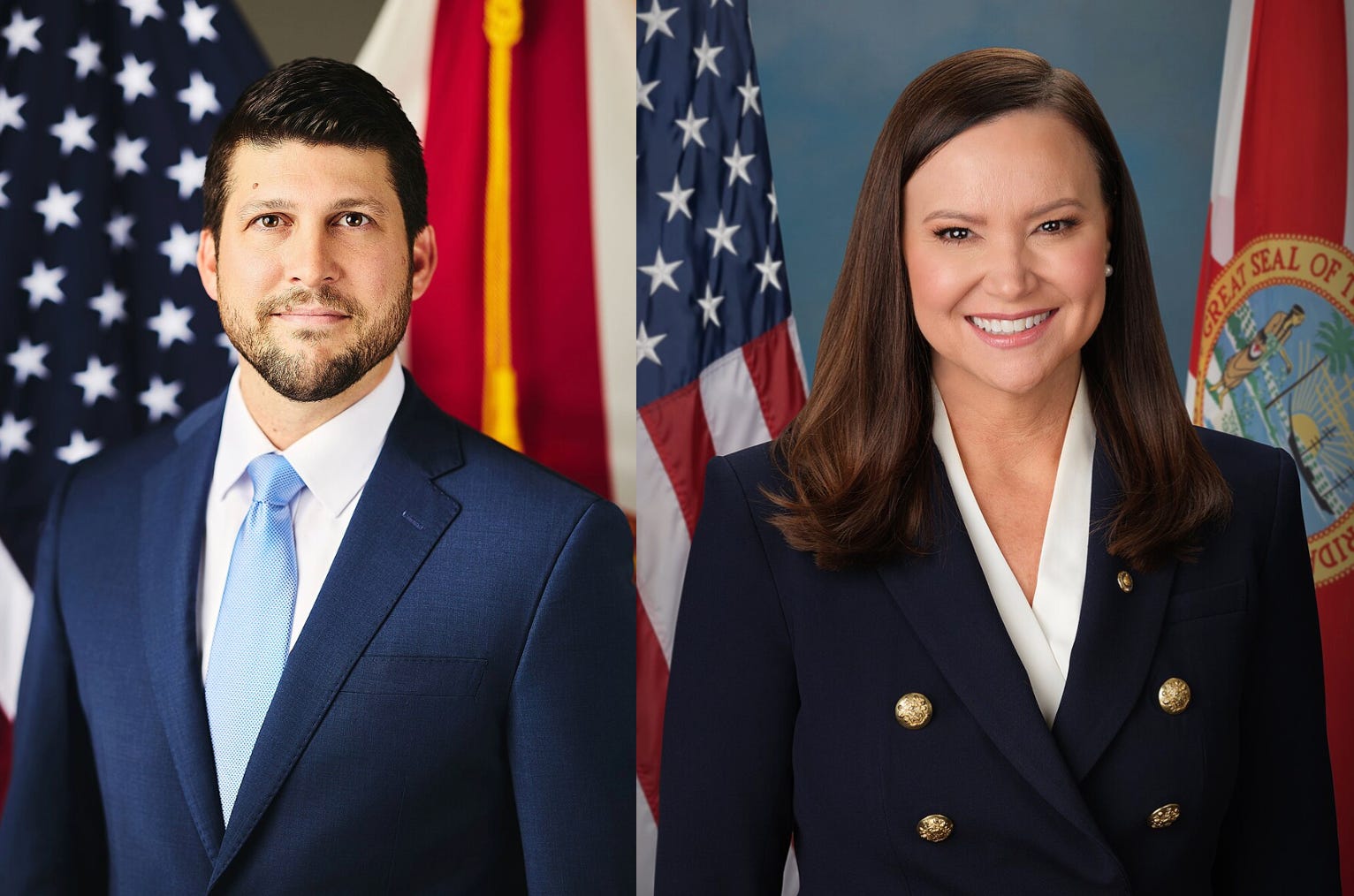
At the last minute before the August 18 Universal Primary, bumptious Boy Governor RONALD DION DeSANTIS on August 14 endorsed two developer-funded St. Johns County Commission candidates.  

One DeSANTIS endorsee/donee-beneficiary is a former jailer.  Running against a popular government reformer who is a Gold Star Mother of a Navy SEAL who died in the Middle East. 

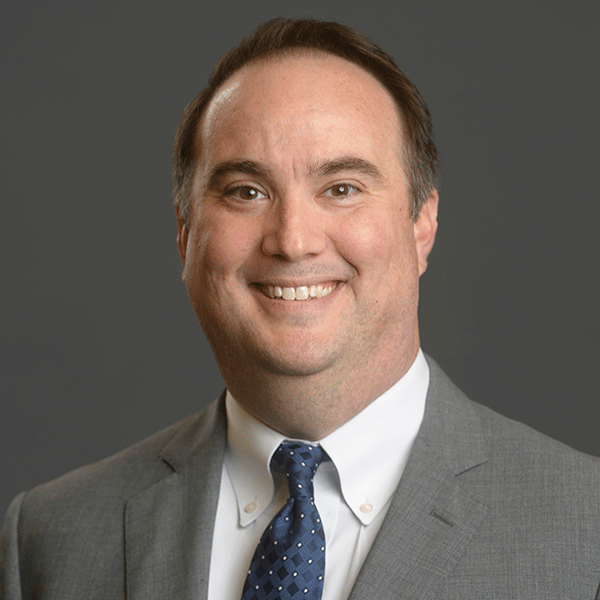
The other DeSANTI$ endorsee is a current junior CITIBANK executive.   Running against a former FBI Special Agent who investigated white collar crime and corruption and organized crime.

Third-raters aspiring to preserve and protect a sixth-rate County government, where corruption reigns.

Colorless. 

Dull spear-carriers in DeSANTIS's comic opera buffa. 

DeSANTI$'s "endorsement" claimed that the pair of ringers were "conservatives.'  

Nope. 

Dupes?

Developer dupes? 

Ringers.  Wikipedia defines the term: "Ringer, in sports idiom, an impostor, especially one whose pretense is intended to gain an advantage in a competition."

DeSANTI$ is the former Yale University Baseball Team Captain, as well as a rather inarticulate and whiny Harvard Law School graduate. But DeSANTI$ knows a thing or two about "ringers."

DeSANTI$ is underhanded in his abuse of power, allegedly providing a list of favors tied to money when he first took office, including $25,000 fees for golfing with the Governor. 

https://www.tampabay.com/florida-politics/buzz/2019/09/12/ron-desantis-political-team-planned-25k-golf-games-250k-intimate-gatherings-memos-say/

Let me ask you to assume that coin-operated conman RON DeSANTI$ endorsed both Commission candidates at the behest of louche land-raping, clear-cutting sinister scalawags whose activities run to money-laundering and deforestation.   As New Orleans DA Jim Garrison would say "what do you expect from a pig but a grunt?"

Shakespeare wrote, "what is past is prologue."


Quo vobis videtor? (What do y'all reckon?")

Shakespeare used the phrase "what is past is prologue" in his play The Tempest. Wikipedia writes:  "In contemporary use, the phrase stands for the idea that history sets the context for the present. The quotation is engraved on the National Archives Building in Washington, DC,[1] and is commonly used by the military when discussing the similarities between war throughout history....The phrase was originally used in The Tempest, Act 2, Scene I. Antonio uses it to suggest that all that has happened before that time, the "past," has led Sebastian and him to this opportunity to do what they are about to do: commit murder. In the context of the preceding and next lines, "(And by that destiny) to perform an act, Whereof what's past is prologue; what to come, In yours and my discharge," Antonio is in essence rationalising to Sebastian and the audience that he and Sebastian are fated to act by all that has led up to that moment, the past has set the stage for their next act, as a prologue does in a play. It can also be taken to mean that everything up until now has merely set the stage...."

The Roman Emperor Caligula allegedly appointed his horse, Incitatus, to be a Roman consul.

https://en.wikipedia.org/wiki/Incitatus

I'm not saying yet that DeSANTI$ is quite as crazy as Caligula. 

But....

Remember that DeSANTIS proved to be an improvident horse's ass as a Congress-critter and Boy Governor.

As a Congressman, this mediocrity who once stiffed one of our County Commission Chairs for a scheduled meeting on beach "renourishment."  

Our tourism economy was suffering, but rebarbative reprobate DeSANTI$ was too busy appearing on faux Fox "News" some 42 times to do the job of a Congressman.

Donald R. Matthews and other government or "political science scholars write that members of Congress are of two types-- "workhorses" and "showhorses."

DeSANTIS mounted an ill-fated campaign for President, in which he failed to carry so much as one (1) Iowa County in the 2020 closed Republican Primary.  Iowans rejected DeSANTIS.

Thinking voters will reject corrupt Governor DeSANTIS's works and pomps and  "endorsements" of developer shills.  As retired St. Augustin lawyer Thomas Elihah Cushman once told me, "There's no shortage of shills in St. Johns County."

But this year, there were no takers for the job of shill to file to run as a write-in candidate to close the Republican Primary.

This for the first time in ten (10) years, we have a "Universal Primary."  Democrats can vote.  So can No Party Affiliation voters. So can veterans, vegetarians.  Everyone can vote.  Though supporters of one-party rule succeeded in narrowing the interpretation of the 1998 voter choice to have Universal Primaries where 

DeSANTI$ was always "showhorse," never a workhorse."

"What is past is prologue."

An "endorsement" by DeSANTIS is no honor. 

It was apparently presented as an afterthought, like a parting gift to devious developers, his funders. 


The controversial St. Augustine Airport Authority was rejected on August 12, 2026 at 8 AM the first pf some dodgy actions involving Commissioner ARNOLD's husband, corporate lawyer CASEY WILLIAM ARNOLD  (center), who is the son of a retired Circuit Court Judge C. Jeffery Arnold of Orange County judge (right) whose family was from Lake County and owned vast land holdings and a sawmill (right, swearing in SARAH SALLEY ARNOLD as a new St. Johns County Commissioner on December 21, 2021, appointed by Governor RONALD DION DeSANTI4, who declines to remove her, declining without explanation of his "law and order" maladministration's failure to exercise its removal power under Article IV, section 7 of our Florida Constitution to suspend malfeasant Commissioners ARNOLD and WHITEHURST.

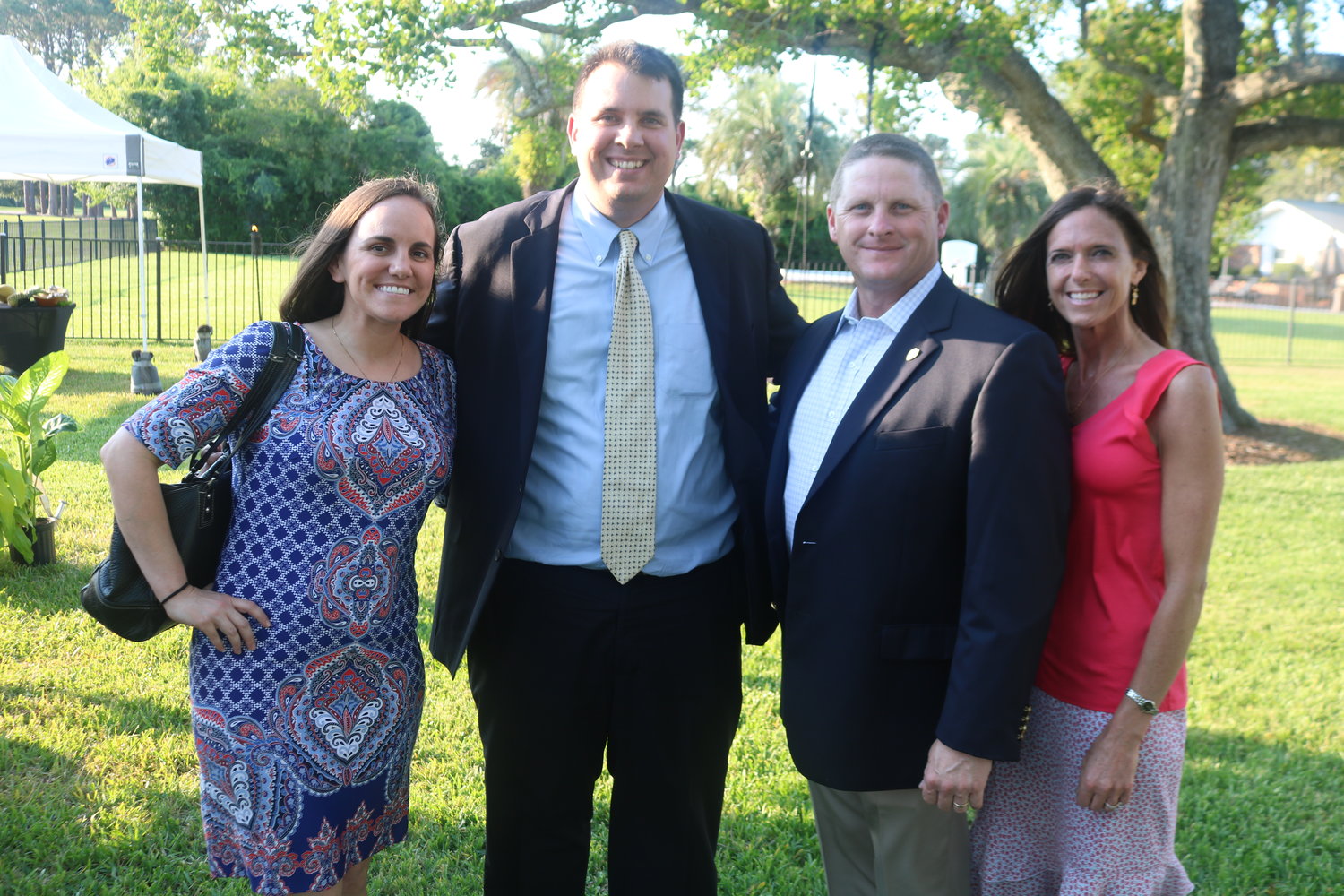
Photo credit: Ponte Vedra Recorder, election night on the night of cynical snollygoster CHRISTIAN GREGORY WHITEHURST's election to St. Johns County Commission.  WHITEHURST, not unlike a Manchurian Candidate, is surrounded by developer, then-Senator TRAVIS JAMES HUTSON (left) and Clerk of Courts BRANDON JAMES PATTY (right).

After a lengthy investigation by the Florida Department of Law Enforcement,  Commissioners WHITEHURST and ARNOLD face misdemeanor criminal charges of election fraud involving allegedly fraudulent GQP endorsements, with the trial set before 8th Circuit Court Chief Judge Davis in late November 2026.  

Two of ARNOLD's own kids and WHITEHURST's  own mother allegedly helped stuff envelopes with phony "endorsements" from the Republican Executive Committee.

The fraudfeasors deceived voters and helped narrowly re-elect WHITEHURST over lawyer Ann-Marie Evans.

Evans was the far more qualified candidate in the closed 2024 Republican Primary, who asked questions, demanded answers and expected democracy about matters of "development," waste, fraud, abuse, flummery, dupery and nincompoopery in corrupt St. Johns County.

Believe it or Not! Apparently neither CHRISTIAN WHITEHURST nor  SARAH ARNOLD ever matriculated. The pair of matched alleged GQP election guide fraudfeasors personify the GQP recruiting rule laid down by the late GQP campaign organizer Tom Slade, who told young Republican apparatchiks not to recruit college graduates, but to go for "Joe Sixpack."

SAVIN' WITH SLAVIN. MOSQUITO CONTROL BOARD, SEAT 2. CELEBRATE INDEPENDENCE.

Clean Up City of St. Augustine, Florida: Ed Slavin for Mosquito Control ...

SAVIN' WITH SLAVIN.

My late mentor, Chief Judge Nahum Litt, taught me that any government budget can be cut by 10%. 

Our Florida governments need to work harder. 

Smarter.  

Ethically. 

I am running for independent Mosquito Control Board to help save your tax dollars.  

I am for wise spending.

I am against wasteful spending.

Against what Abraham Lincoln would call "flubdubs."

ED SLAVIN FOR ANASTASIA MOSQUITO CONTROL DISTRICT OF ST. JOHNS COUNTY, SEAT 2. VOTE ON OR BEFORE NOVEMBER 3, 2026. CELEBRATE INDEPENDENCE.

Clean Up City of St. Augustine, Florida: Ed Slavin for Mosquito Control ...

Feast of Saint Augustine, August 28, 1974:"Fast Eddie" Recalls His First Days in Senator Kennedy's Office and Georgetown University


It was August 28, 1974, the Feast of Saint Augustine), I heard Ralph Nader speak at Gaston Hall at Georgetown University:
The next day, on August 29, 1974), I went to work for the office of U.S. Senator Ted Kennedy, on the morning before my first class at Georgetown University.


Thanks to the Navy SEAL Terrence McShane, Georgetown University Resident Assistant, Vietnam, veteran, son of a Philadelphia Inquirer classified ad department workplace friend of my Aunt Helen, I was in like the proverbial Flynn

Like the character played by Robert Morse in the musical comedy "How to Succeed in Business Without Really Trying," I started in the mailroom.

It was around the corner from Senator Kennedy's main office. In fact, it was formerly and formally one of five rooms assigned to progressive Democratic Senator "Fritz" Hollings of S.C., which he had lent (permanently, it turns out) to Senator Kennedy after RFK was murdered, to handle the overflow of mail, which never abated.

For 2.5 days/week, as a freshman and sophomore (Tuesday, Thursday and Friday afternoon), I worked as an intern, first free, then paid ($53/week for up to 30 hours of work).

I opened and stapled mail, read mail, assigned mail to other people to read, auto-pennned and stuffed response letters, ran errands, did research, helped with casework, and quickly earned a mafia-sounding nickname.  My widely-used nickname in Senator Ted Kennedy's office was "Fast Eddie."

Because if you needed to send something somewhere quickly (this was 1974), there was no Internet, no E-mail and only slow cumbersome fax machines, which took 4-6 minutes per page (and emitted fumes that could make you dizzy).

You put it in an envelope, you called the mailroom, and you asked for an intern. Any intern.

Or, if it was Tuesday, Thursday or Friday afternoon, you would say, "Is Fast Eddie there?"
Fast Eddie (the EMK staff gave me that nickname) had survived rheumatic fever and arthritis. I was (and still am) a klutz. I did not drive (still don't and you should be glad I don't).

But Fast Eddie moved swiftly, got things done quickly, and did not tarry, unlike your typical undergraduate interns, who moved like molasses going uphill in Vermont in January.

I got to meet and talk and laugh with phenomenal staffers and superlative secretaries, including legislative director Carey W. Parker (a Rhodes scholar, one of several in that big room, and his secretary Shannon McDonald), Mary Murtagh and Melody Miller, and people who went on to be Ambassador to NATO (Robert Hunter), first Jewish director of the Peace Corps (Marc Schneider), and be appointed on EMK's death to the U.S. Senate (Paul Kirk). I learned how to answer a telephone, how to solve problems, how to use the telephone, and how to persuade government officials to do their jobs.

I would walk several times a day and take the subway (a/k/a the Toonerville trolley in Tom Wicker's novel, Facing the Lions) from the Richard Brevard Russell, Jr. U.S. Senate Office Building (a/k/a "OLD S.O.B.) to the Capitol, dropping freshly mimeographed speeches and press releases to the three Senate press galleries (newspaper, tv and periodical), sometimes to eye-rolling from journalists who were amazed to see so many EMK press releases.

I read the press releases and speeches, and learned from the scholarly style of Carey Parker, et al.

On November 21, 1974, by vote of 65-27, the United States Senate overrode President Ford's veto of the Freedom of Information Act -- urged by then-youthful Dick Cheney, Donald Rumsfeld and Antonin Scalia. After the historic veto override, I carried the triumphant Ted Kennedy speech and press release to the press galleries.  To get there, I took the subway to the Capitol Building, took the elevator to the second floor, walking up the marble steps to the third floor, past this venerable painting of Lincoln signing the Emancipation Proclamation:

Less than nine years later, I became the "pest who never rests," using FOIA to win declassification of the largest mercury pollution event in Earth history, in Oak Ridge, Tennessee on May 17, 1983, as Appalachian Observer editor.

We also helped empower Sheriff's deputies to blow the whistle.  Result: the FBI arrested and incarcerate a corrupt Anderson County Sheriff (two-time Tennessee Sheriff of the Year Dennis O. Trotter).

We also helped run off a corrupt school superintendent, Paul Eugene Bostic, Jr., a "school dictator" of the sort documented by Harry Caudill in Night Comes to the Cumberlands.

After spending much of eighth, ninth and tenth grades on my back, my health became more robust as I walked several times a day, learning the corridors of power on Capitol Hill, walking by beautiful U.S. Capitol Hill artwork, paintings, sculptures and frescoes, and through secret corridors and hidden basement corridors, to obscure places like the Capitol basement, the Senate Folding and Stapling Room, the Senate Carpentry Shop, and the Russell Building Attic.

I would watch committee hearings and Senate sessions, pre-CSPAN. I would watch the legislative assistants in the Dance of Legislation (as Eric Redman called it), and the warp and woof of constituent correspondence and casework.

I would hang out with the likes of Mary Murtagh, press secretary Dick Drayne and the case workers, and by sophomore year even had a tiny 2x3 table-desk between press and case operations, complete with tiny chair and, of course, a telephone.

I found that saying "This is Ed Slavin in Ted Kennedy's office" got your calls returned, and that we could perform minor miracles.

It's like Harris Wofford said on January 20, 1961: "You can do anything with these phones!" (After calling to desegregate the Coast Guard, after JFK complained there were no blacks in the Coast Guard contingent at his Inaugural Parade.

In Senator Kennedy's office, I learned the power of positive thinking, knowing that with a keyboard, a telephone and a democracy, we could do anything to make the world a better place.  EMK staffer
Mary Murtagh and I helped to end sperm whaling with our research on jojoba, an oil seed that is an exact chemical duplicate for the oil of the endangered sperm whale, of which there were 20,000 killed in the world back then -- 2/3 of all the world's whales murdered then, saved by the wonders of the market system and a replacement product that nature created and we promoted. Google® jojoba and see what happened!

I was inspired by hearing Ralph Nader speak in Gaston Hall at Georgetown University the evening of August 28, 1974 (Feast of St. Augustine).  (It was also the eleventh anniversary of the "I have a dream speech" by Rev. Dr. Martin Luther King, Jr. at the 1963 Civil Rights March on Washington, at Lincoln Memorial, and also the anniversary of the 1955 kidnapping and murder of Emmett Till.)

In 2008, Folio Weekly (Anne Schindler, editor, now with First Coast News) would call me an "environmental hero" for detecting and remedying the City of St. Augustine's dumping a landfill in a lake.  There have been threats, but nevertheless I have persisted. 

Be not afraid.

My political theory professor, Jose Sorzano, said "Ideas have consequences." (He was later Deputy UN Ambassador under President Reagan, working under Ambassador Jeanne Kirkpatrick, another GU professor whose class on "Personality & Politics" I never took, only  because it was only offered on Tuesdays and Thursdays, my work days).

Yes, hearing Ralph Nader's speech in 1974 had consequences.


It led to life in, around and surrounded by, investigative reporting, government service and working to improve the lot of others.

It led to work for EMK and in two other Senate offices (Gary Hart and Jim Sasser), investigative reporting, two judicial clerkships at the Department of Labor (Charles P. Rippey and Chief Judge Nahum Litt), work at the AFL-CIO Occupational Safety and Health Legal Rights Foundation and the Government Accountability Project and privately, representing whistleblowers around America.

It led me to stand up for equal rights and honest government here, in the City of St. Augustine, where for years, we band of brothers and sisters have worked to transform our City government, from one of the worst to one of the first in North Florida on human rights, winning Rainbow flags on the Bridge of Lions, respect for GLBT rights, respect for Environmental Justice, and transforming our town (electing the incomparable Nancy Shaver, the first woman Mayor elected by vote of all of the people as such, on November 4, 2014)(see Folio Weekly article here).

We enjoyed beating numerous demolition permits before the Historic Architectural Review Board and watching as yet another federal court victory in Bates v. City of St. Augustine (Bates II), by U.S. District Judge Brian J. Davis (fine visual artists harassed by 32 years of Jim Crow law ordinances and oppression by City).  

In 2016, votes were counted in four fixed county races, including the fixed Sheriff's election, one of four illegally closed primaries, with two shills (one of them the Sheriff's own massage therapist, a former jailer) claiming "write-in" status, violating the Fifteenth Amendment to the U.S. Constitution and Article VI, Section 5(b) of Florida's Constitution, denying us the universal primary to which we're legally entitled.  I asked the Justice Department Civil Rights Division to bring a lawsuit.  A resolution was passed by the St. Augustine City Commission, calling for an end to such illegally closed primary shenanigans.

In 2017, activists and tourism business owners and managers united, with eight of us convincing the St. Johns County Visitors and Convention Bureau, Inc. to reverse the illegal firing of CEO Richard Goldman.  In all my years of labor law, I'd never won reinstatement of a CEO before, or any victory nearly that quickly.  

We won.

People are uniting and listening, and we're making St. Augustine a better place.  No longer do developers and millionaires and billionaires and racists throw their weight around here quite like they did in 2005, when I first spoke at a City meeting, or in 2006, when the City Manager WILLIAM BARRY HARRISS dumped a landfill in a lake, and thought it was cute.

In 2022, developer puppet County Commissioner JEREMIAH RAY BLOCKER lost his bid for re-election to Gold Star Mother Krista Keating-Joseph, who opposes overdevelopment.  BLOCKER was exposed as receiving a 100% exemption of his Ponte Vedra mason from property taxes, supposedly because VA considers him 100% permanently and totally disabled, yet he's a $81,000+/year County Commissioner, paid $110,000/year to be Executive Director of a dodgy non-profit, while working as a law firm partner, and (drum roll), a Major with the Florida National Guard J.A.G. Corps, which could not possibly consider him deployable if it knew of his 100% disability rating. 

Ms. Keating-Joseph defeated BLOCKER by 175 votes.  prodigal developer puppet JEREMIAH RAY BLOCKER's campaign spent fifteen times as much money, spending $15.64 for every vote he got. BLOCKER lost.  The people won. 

As Alexander Hamilton said, "Here, sir, the people govern."

Activists helped save The Outpost and Fish Island, which has remains of eight slave cabins, slave graves and the mansion and graves of Jesse Fish, Florida's first crooked realtor, and founder of the citrus agricultural industry here.  We've stopped a proposed Planned Unit Development by developer DONALD R. HORTON and look forward to buying the land for a park -- part of a future St. Augustine National Historical Park and National Seashore.

We need more archaeology and greater National Park Service status here.   We need more history commemoration, not less, here in St. Augustine, including:
  1. Enactment of the St. Augustine National Historical Park and National Seashore, first proposed by Mayor Walter Fraser, Senator Claude Pepper, et al. in 1939.   
  2. Monument at Emancipation Park (where locals heard the Emancipation Proclamation read in January 1863);
  3. Monuments to documented local lynching sites; 
  4. Monument to St. Augustine's Union Civil War veterans; 
  5. Seated sculpture honoring slavery victims, showing a family being split for auction; 
  6. Seated sculpture of civil rights heroes and sheroes Dr. Robert S. Hayling, D.D.S., Stetson Kennedy and Barbara Vickers, engaged in conversation, perhaps looking at the slavery sculpture and one of the other Civil War monuments (like the one honoring General William Wing Loring);
  7. A large civil rights and African-American history museum honoring St. Augustine's pivotal role in adoption of the 1964 Civil Rights Act, not unlike the ones in Memphis, Atlanta and elsewhere, putting everything in perspective; 
  8. A new Florida law requiring K-12 civil rights education, like in Mississippi;
  9. Florida fourth graders trekking to St. Augustine to learn history and empathy, with National Park Service rangers explaining to them and millions of other visitors the places here where Rev. Dr. Martin Luther King, Jr, Andrew Young, Ralph David Abernathy, Dr. Robert Hayling, et al. helped change history for the better, making America truly a shining "City on a Hill" for the world.
Yes we can!

My parents, both union organizers, were my first teachers. It took them twelve years to have their only child -- the result of my father having malaria in Sicily and my mother being subjected to unethical x-ray experiments at age 11. They taught me about right and wrong and standing up to power and oppression, something they were both adept at doing during most of their lives.

My aunt Bunny was a Franciscan nun in South Korea -- I did not meet her until I was ten, and I was impressed with her dedication to human rights. She said if she said anything against the South Korean dictator on a bus, she'd be overheard and bounced out of the country as persona non grata in 48 hours. South Korea is now a democracy.

History is complicated, I've learned.  One of my professors, Holocaust hero Jan Karski, is memorialized with this monument on the Georgetown campus, NYC, Israel and three places in Poland:


True to the standards of my first boss, Senator Edward M. Kennedy and his two murdered brothers, remember EMK's words at the 1980 Democratic National Convention:
may it be said of us, both in dark passages and in bright days, in the words of Tennyson that my brothers quoted and loved, and that have special meaning for me now:
"I am a part of all that I have met
To [Tho] much is taken, much abides
That which we are, we are --
One equal temper of heroic hearts
Strong in will
To strive, to seek, to find, and not to yield."

.... For all those whose cares have been our concern, the work goes on, the cause endures, the hope still lives, and the dream shall never die.


Let freedom ring!


Alumnus Jon Ossoff (SFS’09) Wins Historic Georgia Senate Race, Says SFS Training Has Been “Indispensable” (Valeria De La Vega, Georgetown School of Foreign Service Alumni Assn, January 8, 2021)

My undergraduate  alma mater, GU SFS, graduated both Jon Ossoff and Bill Clinton. From GU SFS Alumni:


Alumnus Jon Ossoff (SFS’09) Wins Historic Georgia Senate Race, Says SFS Training Has Been “Indispensable”

On the morning of January 6, the eyes of the country were on SFS alumnus Jon Ossoff (SFS’09) as he thanked voters for electing him in a U.S. Senate runoff election in Georgia that will change the balance of power in the United States.

Ossoff and fellow Democratic candidate Rev. Raphael Warnock defeated Republican incumbents Sen. David Perdue and Sen. Kelly Loefler, respectively, splitting the Senate fifty-fifty between the two parties and handing Democrats control of the chamber through the tie-breaking vote of Vice President-elect Kamala Harris. 

When he takes his seat, Ossoff will become the youngest Democrat to serve in the Senate since President-elect Joe Biden in 1973.

Senator Jon Ossoff standing, wearing a light blue shirt. Behind him green trees

Ossoff is one of 16 SFS alumni who ran for office in the 2020 Election, but it is his race that may have the greatest impact on the future direction of the United States. The runoff was fought amid a rancorous period in U.S. politics as President Trump and his allies publicly contested Joe Biden’s victory in the presidential election, protesters demanded action on racism and police violence and a deadly spike in coronavirus cases impacted communities across the country.

Ossoff graduated from Georgetown just over a decade ago, but soon the former Culture and Politics major will be working on legislation that will shape the domestic and global events SFS students will study in their classrooms. Ahead of election day, Ossoff and some of those who knew him best at Georgetown reflected on his time on the Hilltop and discussed how his SFS experience influenced his decision to forge a career in public service.

A Passion for Education

Like many of his counterparts, Ossoff was drawn to the School of Foreign Service because he harbored an interest in pursuing a career in diplomacy. 

“I planned to enter the Foreign Service, so I had dreamed of attending Georgetown,” he says.

However, once he arrived on the Hilltop, a number of new fields and opportunities opened up for him. “I wound up engaging policy and foreign affairs in a different way,” he explains. 

Ossoff’s intellectual curiosity and his enthusiasm for exploring different concepts and subjects stood out to his professors. 

Dr. Daniel Porterfield, who currently serves as President and CEO of the Aspen Institute, taught Ossoff in his Human Rights: A Culture in Crisis class. He remembers Ossoff as an intellectually curious student with a deep passion for education, which Porterfield says was a family trait. 

“I remember his very close relationship with his father, who attended two class meetings and was clearly so proud of his son,” Porterfield recalls. “It was clear to me how much Jon and his family value education.”

Senator Jon Ossoff standing next to his wife Alisha Kramer. He is wearing a suit, she is wearing a labcoat.

Alumna Brendan Thompson (SFS’12, MBA’18) also has fond memories of Ossoff as an academically engaged student who loved to explore ideas both inside and outside the classroom. A close personal friend of Ossoff’s wife, Alisha Kramer (C’12), Thompson says that their group of friends would have long discussions about policy and international affairs.

“Jon and Alisha have always shared the values and ideals of a just and equitable society,” she says. “The conversations we had late at night around a Burleith dining room table ten years ago — about access to affordable healthcare, social justice, education — are centerpieces of his platform today.”

Jay Troop (SFS’09), another of Ossoff’s friends from Georgetown, attests that these discussions continue to resonate with him today. He says, “Our conversations have always challenged my perspective and led me to a deeper understanding of whatever big idea we were trying to unpack.” 

Even in Ossoff’s undergraduate days, he was interested in pursuing a career in public service, says Porterfield.

He recalls, “I remember that he expressed a strong interest in making a difference through public service in whatever professional roles he would go on to play.”

Pursuing DC Opportunities

These public service aspirations were reflected in Ossoff’s extracurricular activities. Justin Douds (SFS’07, L’10), who met Ossoff when they sang together in the Georgetown a cappella group The Georgetown Chimes, remembers his dedication to the internships he completed in the offices of Georgia congressmen Rep. John Lewis and Rep. Hank Johnson, as well as his keen interest in government. “Besides Chimes, schoolwork and Alisha, Jon’s main interests in college were his internships,” Douds says. 

Another fellow Chimes graduate, Richard Matsui (SFS’07), also remembers Ossoff as having a keen interest in politics.

A group of 12 young men wearing navy jackets, and khaki pants, posing for a photograph.

“On the Hilltop, it was obvious to all of us that Jon would be tremendously successful at whatever he pursued, but his love for the American political system really stood out,” he says. “He spent his ‘free’ time helping to get Hank Johnson elected to the House, and then worked hard for Hank after he was elected.”

After graduating, Ossoff worked as a national security staffer for Johnson for five years before moving to the United Kingdom to earn a master’s degree at the London School of Economics. He remained in the country for a number of years, becoming the managing director and CEO of Insight TWI, a London-based production company specializing in television documentaries exposing foreign corruption, work which enabled him to put his SFS education into practice.

“The training I got at SFS has been indispensable throughout my career,” Ossoff stresses. “My business produces investigations of war crimes, organized crime and corruption, as well as reporting on sensitive and complex issues in international affairs. Georgetown’s SFS equipped me well to do that work, and to manage productions where our teams are often working in hostile and politically volatile environments.”

An Enduring Georgetown Connection

Ossoff’s college friends say that the influence of his Georgetown experience can be seen in his later political career, too.

Douds explains that the university’s DC location was a major draw for the aspiring public servant. “I believe he chose Georgetown in large part because it gave him the ability to work in national politics while a student. It also allowed him to easily remain in the District after college,” he says.

Thompson believes that Georgetown’s campus culture also created the perfect environment for Ossoff to develop the ideas and principles that would later underpin his political values. 

“Georgetown attracts students determined to make the world a better place,” she explains. “When you’re surrounded by like-minded, passionate classmates, you’re motivated to pursue careers that create a positive impact in your community, field or industry.”

Jon Ossoff shaking hands with SFS student

Even after graduating, Ossoff maintained a deep connection with the Hilltop, continuing to give back to the Hoya community years later. When working in Johnson’s congressional office, he returned to campus numerous times to share his insights into careers on Capitol Hill at workshops and panels for current students.

When he ran for Congress in Georgia’s 6th district, in a 2017 special election that marked him as a rising star of the Democratic Party, Ossoff welcomed students from the Georgetown Institute of Politics and Public Service to observe his campaign as part of their three-day field trip to study the election.

Ossoff not only built a professional network at Georgetown, he also found a supportive community. Douds remembers that when Kramer, who was then Ossoff’s girlfriend, came up from Atlanta to visit him, Ossoff organized his fellow Chimes members to join him in singing for her as she arrived on campus. 

However, while Ossoff found a home away from home in DC, his friends say he never forgot his Georgia roots. Both Matsui and Douds fondly recall a trip The Chimes made to Atlanta for a performance Ossoff had organized at his high school. They say that Ossoff’s love for his hometown was apparent during the visit.

“During winter break one year, his family hosted The Chimes for a few days and he was an eager tour guide for his city,” says Douds. “As long as I’ve known Jon, he has always, always been a proud Georgian.”

Inspiring a New Generation of Public Servants

Across Georgia and the country, Ossoff’s candidacy and the historic significance of his race galvanized supporters, including Georgetown students and alumni.

International Politics major Arash Abbas (SFS’21) worked as an Operations Associate for the Ossoff campaign, interviewing and hiring Georgians who, in turn, reached out to their local communities to get out the Democratic vote for the run-off election.

Arash Abbas stands in front of a parking lot. He is wearing a face mask, a Jon Ossoff for Senate T-shirt and is holding an Ossoff campaign leaflet.

Abbas — who hopes to work in policy and hasn’t ruled out running for office himself one day — says that engaging with voters has been inspiring and rewarding. “From an African-American man who was raised during the Jim Crow era to a teacher focused on educating her students amidst the pandemic, the perseverance of everyday Georgians has given me hope for our country’s future,” he says.

The undergraduate student sees Ossoff as a role model for his own career. “He represents the tenacity and empathy that Georgetown and SFS tend to foster within our students,” Abbas explains. “His drive inspires me to actively pursue justice in my own career rather than be a bystander in our nation’s future.”

Many of Ossoff’s former classmates also supported his run. Every Tuesday, Thompson says, she and a group of friends volunteered to phone bank for his campaign. “It has been incredible to see students, faculty and alumni without ties to Jon or Georgia share their support for him,” she remarks.

Ossoff speaking in front of a microphone. Behind him a wall with portrait of a man painted in blue, pink and orange.

“I’m so inspired by his campaign,” says Troop. “He’s attacking problems in a way that makes them feel solvable. His efforts have inspired me to make sure I’m doing what I can as an engaged citizen to make this country better.”

Matsui similarly believes that Ossoff’s campaign is an example of how SFS graduates can engage in the school’s core value of service. 

He stresses, “Jon’s articulate defense of his principles under the harsh spotlight of the national media reminds all of us alums that we have the training — and therefore, arguably, the obligation — to advocate publicly for our principles as well.”

Professor of Government and Foreign Service Anthony Clark Arend taught Ossoff’s favorite class, International Law, and has continued to stay in touch with his former student. He believes that the candidate’s run for office presents current students with a lesson in perseverance and commitment.

“The message is that one should seek to use their gifts in service to others,” he says. “He sends a message that you shouldn’t be afraid to take risks. He lost his first election but instead of giving up on electoral politics, he evaluated his skills and decided to run again — this time in one of the most consequential Senate races in recent memory.”

Arend continues, “Jon has proven himself to be a powerful advocate for democracy and for integrity in public service. I know that he will continue to be a leader in service to his fellow human beings.”

Madeleine Albright speaking in front of a podium

And Ossoff has also won the admiration of a former professor who knows a thing or two about what it takes to lead in both the domestic and international arenas. Dr. Madeleine Albright, Michael and Virginia Mortara Distinguished Professor of Diplomacy and former U.S. Secretary of State, says that he is a great example of how her students can apply the lessons of her class — including preparing for the unexpected and understanding the implications of decision-making — to the real world. 

“One of my only professional regrets is that I never ran for elected office. I’ve always admired people who are willing to undergo the grueling test of a campaign in order to serve the public, and he is no exception,” she says. “Our country depends on honest, motivated and passionate leaders who are dedicated to public service and who use their education to help others. Jon Ossoff is an example of that.”

In the wake of a campaign that has thrown him into the national spotlight, Ossoff has some advice for current students considering running for office in the future. 

“If you can, do work that you’re genuinely passionate about, that is satisfying and fulfilling, rather than making career choices to build some model resumé,” he says. “Anti-corruption journalism is an unusual background for a candidate, but it’s work I’m proud of and work that I love, and that’s the path that brought me to this campaign.”

The Senator-elect concludes, “Only run for office when you feel the real fire in your belly. Never accept that you’re too young to take the plunge. And ignore the haters!”

Feature photo: Jon Ossoff for Senate Campaign.