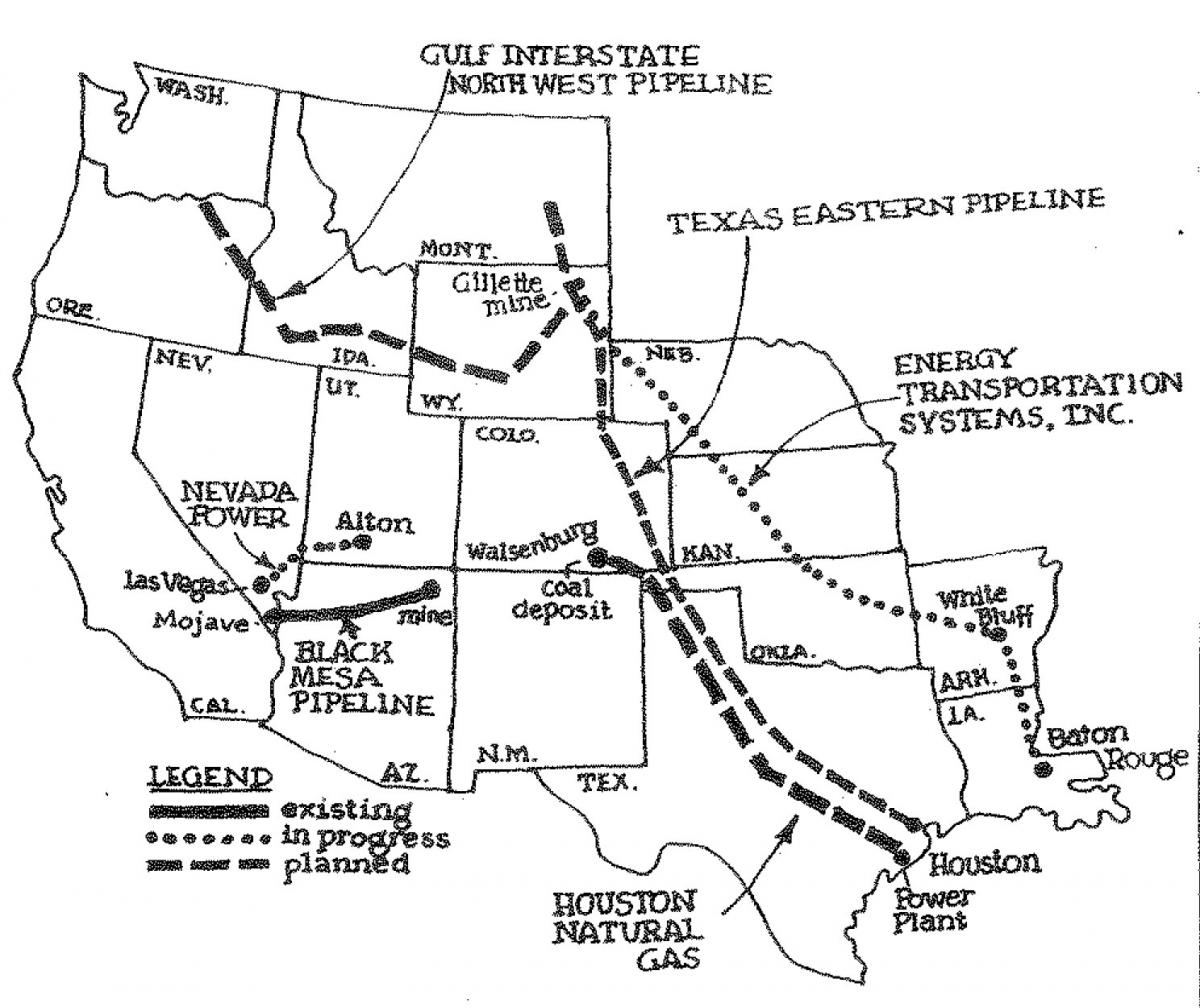
In 1978, a diverse coalition of Western farmers and ranchers, environmentalists, United Mine Workers of America, antitrust and consumer advocates and investigative journalists (including me) helped expose stunningly pro-cartel special interest legislation that would have given eminent domain legislation to Big Oil and its commercial allies, the powerful secretive corporations seeking to build coal slurry pipelines.
I was proud to be a part of that epic battle for the soul of our Nation, waged in our U.S. House of Representatives.
My late college roommate, Edward Francis McElwain, investigated the issue for Senator Gary Warren Hart.
Ed gave me the inspiration to write an 11,500 word article, my first investigative article, which was inserted into the Congressional Record by a Kansas Republican, U.S. Rep. Joe Skubitz (minus the facts on campaign finance).
Coal pipeline special interests hated me.
I was slandered and threatened. Pipeliners spread rumors on Capitol Hill that I was a "paid agent of the Burlington Northern Railway" (now BNSF).
Knowing that I was an undergraduate in the Georgetown University School of Foreign Service, a louche lobbyist for the world's largest construction company, Bechtel, threatened that if I published my 11,500 word investigative article, I would "never work for the State Department." I quietly replied, "Ma'am, I don't want to work for the State Department."
Fun Fact: By 1982, both the United States Secretary of State (George P. Schultz) and United States Secretary of Defense (Caspar Willard Weinberger), were former Bechtel executives.
Lesson learned; Be not afraid. (It's in the Bible some 106 times).
On July 20, 2026, Washington Post reporter Richard Lyons wrote, "A surprisingly controversial bill to move Western coal to Southern and Eastern markets by means of slurry pipelines was killed by the House yesterday, 246 to 161, a victim of railroad clout and environmental fears."
On July 20, 2026, Washington Post reporter Richard Lyons wrote, "A surprisingly controversial bill to move Western coal to Southern and Eastern markets by means of slurry pipelines was killed by the House yesterday, 246 to 161, a victim of railroad clout and environmental fears."
I was plum tickled to be present at the creation of U.S. government policy on coal pipelines. We, the People won, against corrupt Big Money interests.
Here are two Washington Post articles, before and after the House vote:
From The Washington Post:
Controversial Coal Slurry Bill in House
By Ward Sinclair
July 18, 1978
The Washington Post
The House yesterday took up a little-publicized but intensely controversial bill that some say is an answer to the nation's energy problem and others say will simply start a new energy cartel.
The issue is the long-debated coal slurry pipeline, a new way of moving coal from mine to electrical generating station.
The legislation, on which the House is expected to vote today, could affect jobs, the use of precious water in the West, the health of railroads, electricity costs in some regions and, inescapably, the profits of a number of major corporations.
The legislation sanctions the construction of pipelines - some more than 1,400 miles long - carry slurried coal, a mixture of pulverized coal and water, to power plants.
To call the bill controversial is understatement. It pits railroads and environmentalists against pipeline interests and utilities, labor against labor and region against region.
It also pits House committee against House committee. The Interior and Public Works committees approved versions of the pending bill: Interstate and Foreign Commerce opposed it.
A key feature of the legislation would give the pipeline companies the power of eminent domain - allowing them condemnation power for rights-of-way across the property of railroads that also haul coal.
Railroads and railway labor groups have fought the legislation since it was first proposed in the early 1960s, on the ground that pipelines would undermine them and cost jobs.
Other opponents, led by Reps. Teno Roncalio (D-Wyo.), Ron Marlenee (R-Mont.) and Joe Skubitz (R-Kan.) charge that the legislation would lead to "an unwarranted raid on water already badly needed by farmers and ranchers" in the arid Western states.
They also contend that the bill inadequately protects the states in controlling allocation of water to the slurry pipelines, which need a ton of water for every ton of coal shipped to a power plant.
But the Interior Committee, asserting that the legislation would stimulate competition with railroads and benefit consumers, argues that coal slurry "may be crucial" in meeting national energy needs.
The battle over the future of coal slurry pipelines has created an unlikely alliance between environmentalists and the Association of American Railroads, which are opposing the bill for different reasons.
"We have no great love for the railroads - their coal-carrying unit trains create a lot of problems - but we fear that if you stimulate that competition, you'll be swapping one restraint of trade for another," said John Doyle of the Environmental Policy Center.
"We feel this legislation is going to create little coal slurry cartels in some regions of the country.They will own the coal, build the pipelines and control them, build the boilers for utilities."
In response to such criticism, the Interior and Public Works committees struck a compromise - they agreed that no single company could control more than 20 percent of a slurry pipeline.
Interior originally set the limit at 5 percent: Public Works, 35 per cent.
But other critics, such as Reps. James H. Weaver (D-Ore.) and Fred B. Rooney (D-Pa.), say the compromise doesn't go far enough - that it still would allow a few companies to control the slurry business.
Critics cite the largest proposed pipeline system, a 1,000-mile span between a strip mine at Gillette, Wyo., and a new power plant at White Bluff, Ark., as an example of the cartel posibilities.
That project is the brainchild of Energy Transport Systems Inc. (ETSI), a combine made up of the Bachtel Corp. (pipeline builder), Lehman Brothers (investment house), Kansas-Nebraska Natural Gas Co., and United Energy Resources of Houston.
The pipeline they want to build would carry coal slurry from a Peabody Coal Co. operation at Gillette to a new Arkansas Power and Light Co. plant at White Bluff.
Arkansas Power is owned by Middle South Utilities Inc., a regional holding company. Peabody is partially controlled by Bechtel, the Boeing Co., the Williams companies and the Fluor Corp., each of which has interests in pipeline construction, power plant construction and hardware.
Middle South and Panhandle Eastern Pipeline Co. have entered into a long-term agreement with Peabody to produce coal at Gillette, where ETSI's pipeline would start.
Such an arrangement, the critics say, would lead away from competition. Railroads would be unable, even at lower hauling rates, to win contracts to carry Wyoming coal to the middle South, they say.


No comments:
Post a Comment