From National Catholic Reporter (NCR)
Editorial: We are in moral exile. We must resist.
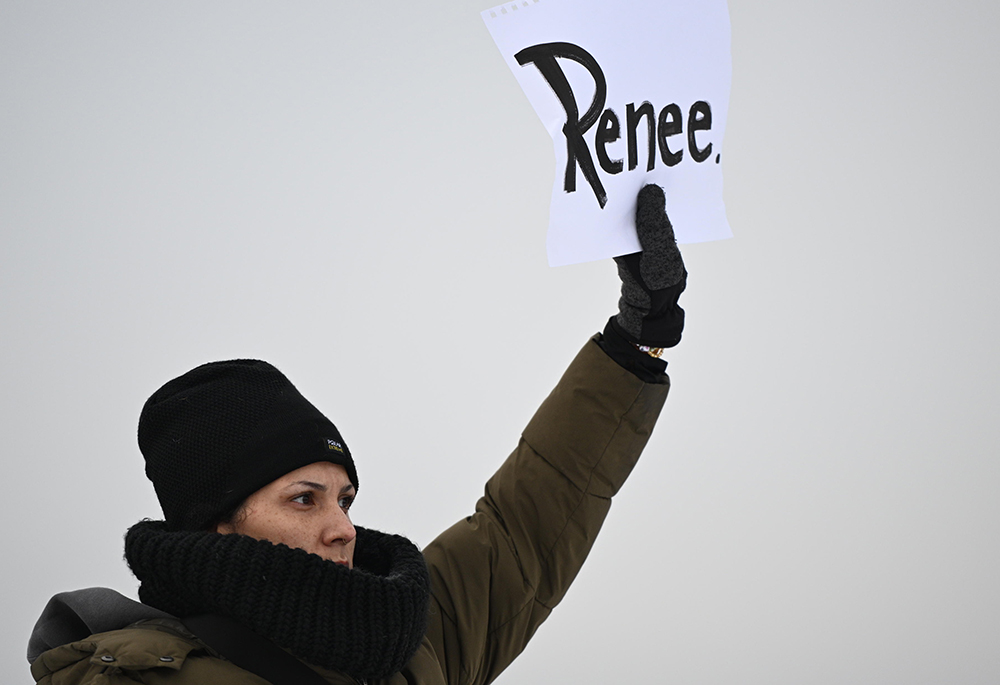
A protester holds up a sign reading "Renee", the woman shot and killed by a U.S. Immigration and Customs Enforcement officer in Minneapolis on Wednesday, outside the Bishop Henry Whipple Federal Building, Thursday, Jan. 8, 2026, in Minneapolis, Minnesota. (AP photo/Tom Baker)
There are moments in a nation's life when the future does not arrive as a surprise. It announces itself slowly, unmistakably, through patterns we learn to recognize even as we hope we are wrong. When such a moment finally arrives, it feels less like shock than like confirmation: This is where we were headed.
We are living in one of those moments now.
Another life has been taken by the power of the state. The details of what happened in Minneapolis will be argued. "Process" will be invoked. Investigations will promise clarity at some later date. We have learned this choreography well. What matters more than any single finding, however, is the broader realization that the ground beneath us has shifted — and that we are no longer sure who we are.
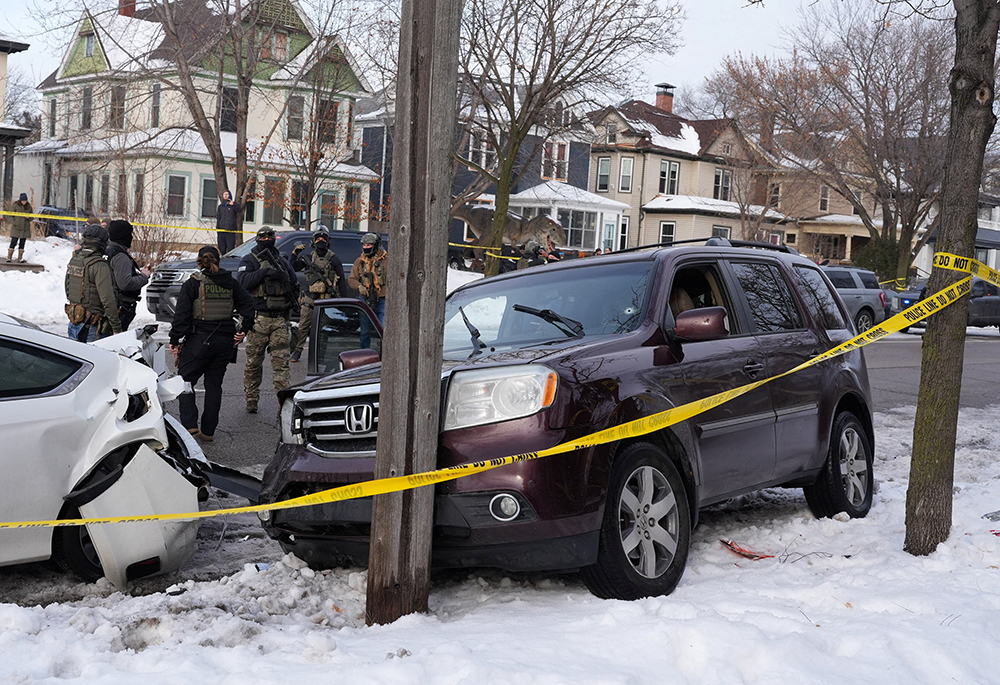
Federal agents gather next to a vehicle with a bullet hole in the windshield after its driver was shot by a U.S. immigration agent, according to local and federal officials, in Minneapolis, Jan. 7, 2026. (OSV News/Reuters/Tim Evans)
This is the question that presses upon us now, and it is not one that can be answered by courts, agencies or elections alone: Who have we become?
Not only as voters or citizens, but as a people. As communities. As moral actors living with one another in public space. What habits have we acquired that allow state violence to pass so quickly from outrage to explanation, from grief to acceptance? What has been dulled in us that once would have demanded pause, humility and restraint?
This is the question that presses upon us now, and it is not one that can be answered by courts, agencies or elections alone: Who have we become?
We have become efficient at absorbing what should disturb us. This is something the current administration keeps demanding of us, as we wrote shortly after the military action in Venezuela. "Trump dares us to take stock," we said of a moment that already seems distant but was just a few days ago. "[He] dares us to say that he's gone too far, dares us to engage in acts of resistance equal to his destructive behavior."
And now that same dare, that same demand, has hit home in Minneapolis with the killing of Renee Good. This did not happen all at once. It happened through repetition. Through the steady expansion of fear as a governing logic. Through the quiet normalization of force as a solution rather than a failure. Through the constant suggestion that safety requires submission and that dissent is a luxury we can no longer afford.
In time, these messages do more than shape policy. They shape character.
From a Christian perspective, this is the heart of the crisis. The tradition we claim does not begin with the management of fear, but with the protection of human dignity. It does not teach that order justifies violence, or that power is vindicated by its ability to dominate. It teaches that every human life bears an inviolable worth that no authority may suspend for convenience or control.
When a society begins to treat lethal force as an ordinary instrument of governance, it has already surrendered something essential — not only justice, but imagination. It can no longer envision safety without coercion, or authority without threat. Violence becomes thinkable. Then acceptable. Then routine.
We keep saying: This is not who we are. But is that true anymore?
The tradition we claim does not begin with the management of fear, but with the protection of human dignity. ... It teaches that every human life bears an inviolable worth that no authority may suspend for convenience or control.
Many Americans now describe a feeling that is hard to name but impossible to ignore: estrangement. A sense of being out of place in one's own country. Not because of disagreement or political loss, but because the moral language of the nation no longer sounds familiar.
It is as if our very souls have left us. Values once spoken aloud — restraint, accountability, the sanctity of life — now feel quaint, even suspect. Our vice president, who considers himself a committed Catholic of solid standing, calls the ICE shooting a tragedy of the victim's "own making."
That dislocation is not accidental. It is the predictable effect of a culture that treats conscience as an obstacle rather than a guide.
At moments like this, it is tempting to locate responsibility entirely "out there" — in leaders, institutions and systems that deserve scrutiny and resistance. But that is only part of the truth. The deeper danger lies closer to home: in our growing belief that nothing we do can matter, that outrage is futile, that resistance is symbolic at best.
Authoritarianism thrives not only on force, but on resignation.
This is why the most urgent task before us is not simply political opposition, but moral recovery. We must relearn what it means to be a people capable of nonviolent resistance — not as a strategy, but as a way of being human together. Nonviolence insists that we remain morally awake even when power tries to numb us. It refuses the lie that cruelty is inevitable and that dignity is expendable.
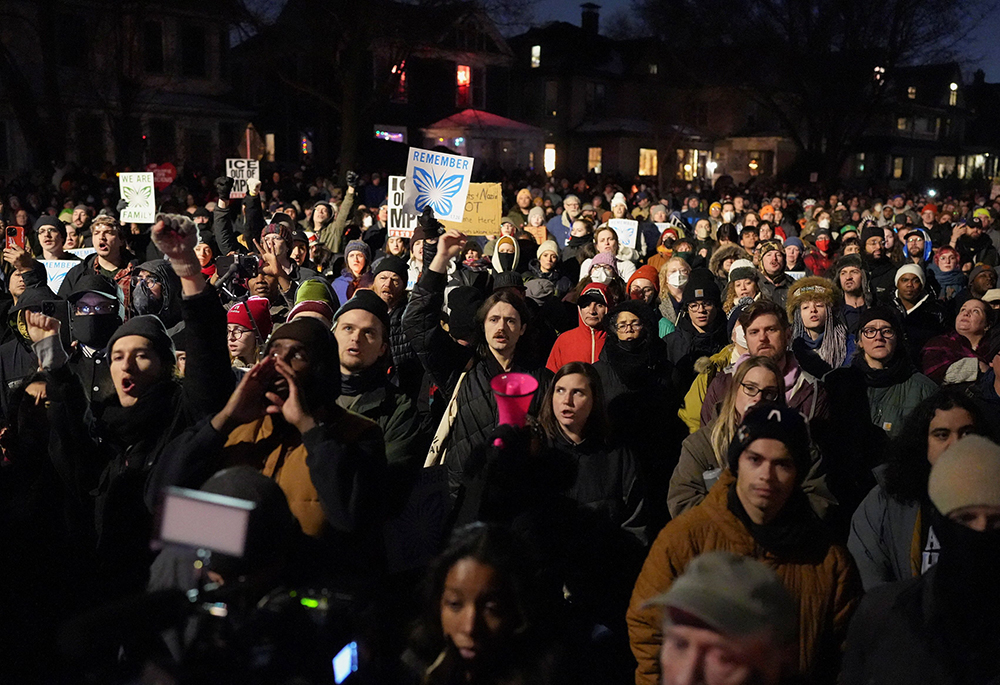
People gather during a vigil for a 37-year-old woman who was shot in her car by a U.S. immigration agent, according to local and federal officials, in Minneapolis Jan. 7, 2026. (OSV News/Tim Evans/Reuters)
Nonviolent resistance begins inwardly, with the refusal to let fear shape our vision. But it does not remain there. It takes public form — in witness, in solidarity, in bodies and voices present where silence is expected. It says, quietly and persistently, that there are lines we will not cross, even if the state does.
Nonviolent resistance begins inwardly, with the refusal to let fear shape our vision. But it does not remain there. It takes public form. … It says, quietly and persistently, that there are lines we will not cross, even if the state does.
History offers no comfort to those who wait for perfect conditions before acting. Every meaningful movement toward justice has begun with people who were uncertain, divided, and afraid — but who chose presence over withdrawal and conscience over convenience.
National Catholic Reporter has spent decades chronicling what happens when institutions place self-protection above truth, when authority demands patience instead of accountability, when violence is explained rather than confronted. The lesson has never changed: The cost of silence is always higher than the cost of witness.
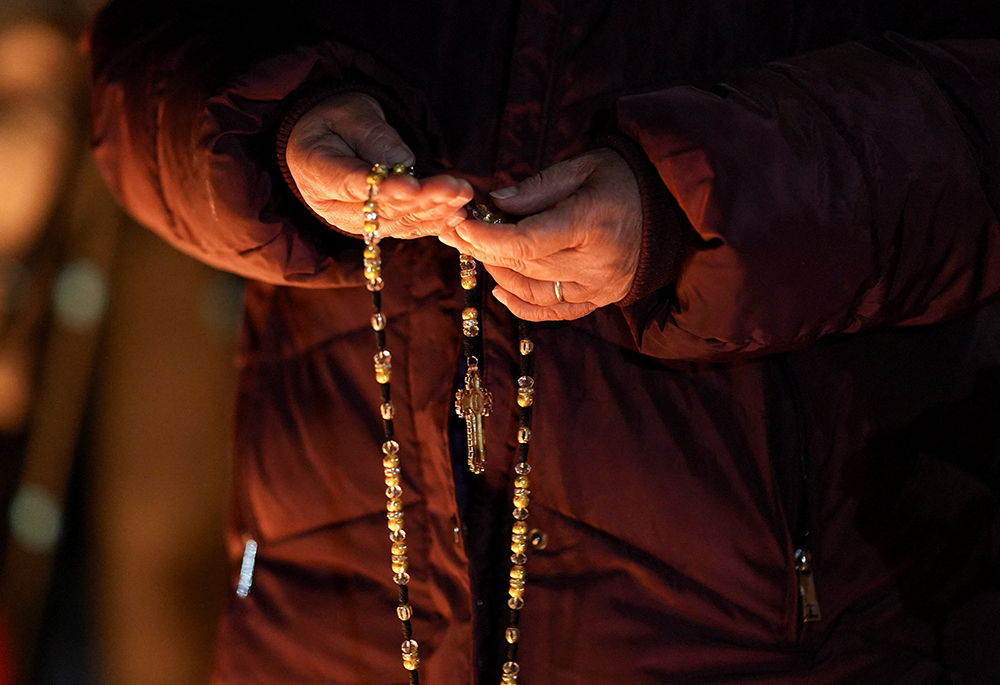
A woman holds a rosary during a vigil for a 37-year-old woman who was shot in her car by a U.S. immigration agent, according to local and federal officials, in Minneapolis Jan. 7, 2026. (OSV News/Reuters/Tim Evans)
The problem before us is real, and it is exerting itself forcefully in public life. But the solution does not begin there. It begins in the recovery of belief — belief that conscience still matters, that community still matters, that what we do together can still shape the future.
A nation does not renew itself by force. It renews itself when enough people decide that moral exile is unacceptable — and that dignity, once reclaimed, must be defended in public.
We are, finally, at the crossroads — the one we all knew was coming long before Minneapolis.
What remains unknown is which direction we will take.


No comments:
Post a Comment