Sunday, May 01, 2022

GANNETT mismanagers get Four Pinnochios for snarky comment on good Gina Burrell letter on reader letters

Good Gina Burrell letter from last Sunday's Record, but gaslighting  comment by GANNETT is insulting.  

GANNETT broke its promise to its readers.

This blog hereby award GANNETT four Pinocchios for breaking its promise.



Who the hell decided to make this change permanent, while not announcing it?

There is no longer the name of a single editor on the masthead of the Record.

Pat Rice, the Editor (also editor of the Daytona Beach News Journal) who November 21, 2022  promised restoration of our daily opinion page is gone.  

Retired. 

Who do we see about that?

Monopolistic GANNETT -- practitioner of crappy chain gang journalism -- is still charging outlandish sums for an incredible shrinking sad sack version of the St. Augustine Record.

Thank you Gina Burrell, for your latest insightful letter, printed on April 24, 2022:


The Record needs a strong opinion editor

I just finished reading the print copy of the April 19 edition of the St. Augustine Record, the Local & State Section. I was very disappointed that there was not one letter to the editor from residents/readers in this section. With St. Johns County's population of 292,000, there has to be persons writing letters.

I have lived in St. Augustine for 28 years, and have written many letters to the editor to The Record. The Record's editorial page editors never changed my letters, and always printed them, no matter the subject matter, which I am grateful. This is also true of the current editors, whoever they are.

I am hopeful that the current owners, USATodayNetwork/Gannett, will continue pursuing and hiring an editorial page editor, so that we will again have a daily editorial page, with thoughtful local letters to the editor and local guest columns. Possibly, a higher salary for the editor might bring success.

I am curious about what is going on at The Record building on SR312. I have heard that the building has been sold to someone. The building now seems to be used by the US Postal Service for county distribution of the mail. Their trucks are viewed in their parking lot. Also, the few times I have called The Record's phone number 904-819-3430, I get a live person located in a South American country. Are there no U.S. residents offered these jobs?

In the past, The Record has been a force in our community. In fact, in election years, editorial staff and the League of Women Voters sponsored candidate debates for local and state offices. The Record endorsed candidates. Will The Record be involved this election season? We locals would appreciate more Record coverage of city and county commission meetings.

Gina Burrell, St. Augustine

Editor’s note: The Record publishes an opinion page every Sunday. April 19 was a Tuesday.

In the past, The Record has been a force in our community. In fact, in election years, editorial staff and the League of Women Voters sponsored candidate debates for local and state offices. The Record endorsed candidates. Will The Record be involved this election season? We locals would appreciate more Record coverage of city and county commission meetings.

Gina Burrell, St. Augustine

Editor’s note: The Record publishes an opinion page every Sunday. April 19 was a Tuesday.

Summer Haven residents: Buyer beware

I can't believe the average St. Johns County taxpayer wants to subsidize repairs for wealthy Summer Haven homeowners (Saving Summer Haven, April 17). Nor do I think it's fair to ask them to do so.

I agree with Walter Coker when he says "It's hard to believe we're up here debating whether to spend more taxpayer money on the ongoing, insurmountable problems at Summer Haven again. It's almost like we've learned nothing from the many expensive failures over the past six years."

As for the wealthy homeowners of Summer "Haven," what ever happened to "caveat emptor?" (Caveat emptor is Latin for "Let the buyer beware.")

Peter Madaus, St. Augustine

Masks mitigate risk

Some may wonder why some of the seniors, like me, still wear masks indoors and in crowds. The answer is simple: We calculate our risk differently than our younger neighbors.

According to CDC data, even with the very high degree of vaccination among those over 70 years old, our risk of a positive COVID test resulting in hospitalization is about 4 to 5 times greater than those between 60-69 years. Compared to the 40-59 year old youngsters, the risk of hospitalization is about a factor of 10 higher.

Finally, when compared with those under 40, our risk is greater than 100 times that of the youngsters. So we are somewhat paranoid about cutting short the 10-20 years we have left on our clocks.

Charlie Judice, St. Augustine

Remembering a mentor

It was great to see an article about Fred Seely and his worldwide adventures circumnavigating the globe last week.

Fred was managing editor of the Times-Union when I was a 1977 summer intern between my junior and senior years of college. I enjoyed working with him and the entire internship program. It led me into an early career as a police and court reporter in Tennessee, and eventually to law school back in Florida.

It was great to see photos and read about a good man and a great editor from so many years ago.

Nicholas Glover, Elkton

Mental illness, a father's perspective

People are hesitant to discuss mental illness. The cruelty of stigma is real.

So, here are three excellent books by fathers who did speak out: a Pulitzer Prize winner, a New York Times best seller and a former director of the National Institute of Mental Health.

"Crazy:  A Father's Search Through America's Mental Health Madness," Pete Earley.

"If it could happen to my family, it could happen to yours. I've been a journalist for more than 30 years. I've interviewed murders and spies, judges and prosecutors, always seeking the truth. But I was always on the outside looking in. Until my son, Mike, was declared mentally ill."

"No One Cares About Crazy People," Ron Powers.

"This is the book I promised myself I would never write. I have kept that promise for a decade – since our younger son, Kevin, hanged himself in our basement, a week before his 21st birthday after struggling with schizophrenia."

"Healing, Our Path From Mental Illness to Mental Health," Thomas Insel, MD.

"I have wrestled with mental illness as a parent, a scientist and a doctor for nearly half a century. Years earlier, I had watched my son struggle with ADHD, and my daughter, addicted to dieting, nearly die of anorexia nervosa.

Their struggles were my toughest days as a parent. Because I misunderstood the problem."

My wife and I are repeating our appeal. To those experiencing this nightmare, please don't stay in the shadows. We need more in the sharing firsthand experience to dispel the ignorance of stigma.

Richard and Kathleen Marquis, St. Augustine

Animal melting pot created by climate change could lead to new disease outbreaks. (SCIENCE Magazine)


Every time a developer kills another forest with deforestation here in North Florida, the chances of another global pandemic increase.

Shady, foreign-funded developers with undisclosed investors (some Russian), are ruining our County and risking our lives.

I am running for the open Seat 2 at the Anastasia Mosquito Control District of St. Johns County,

In Sicily, with the 82nd Airborne Division in 1943,  my father suffered malaria in WWII.

The Army doctor told him he got it in North Africa. The 90-day wonder was wrong, and mosquitos on Sicily did not read his medical textbooks.  

My dad suffered for decades from the after-effects of malaria, a mosquito-borne disease, 

The next global pandemic could be a mosquito-bonre disease. 

Like incumbent Commissioner Jeanne Moeller, current chair Anastasia Mosquito Control District of St. Johns County (AMCD), I believe in public policy decisions based upon good science. 

From SCIENCE Magazine (published by the late David Brian Wallace, my BFF's longtime employer of thirteen years) the American Association for the Advancement of Science, against which we won a worker rights victory before the National Labor Relations Board and District of Columbia Human Rights Commission in 1992, vindicating worker rights there forever): 


Animal melting pot created by climate change could lead to new disease outbreaks

As habitats shift, many mammalian species will meet each other for the first time and swap viruses, modeling study predicts

28 APR 20225:00 

By JON COHEN

Earth’s warming climate is expected to change the habitat of many animal species, which a new modeling study predicts may spell trouble: Species on the move will mingle with many others they have never encountered before, allowing the various animals to exchange viruses. That could spark new disease outbreaks in many wildlife populations—and in humans as well.


By 2070, assuming the most conservative warming scenario, there will be at least 15,000 new cross-species transmissions involving more than 3000 mammalian species, according to a modeling team led by Colin Carlson, a global change biologist at Georgetown University. “Most of this pattern has probably been set in motion with the 1° of warming we’ve already experienced,” says Carlson, whose study appears online in Nature today.


It’s becoming increasingly clear that climate change will have an effect on the spread of infectious diseases, says Skylar Hopkins, a disease ecologist at North Carolina State University who specializes in parasites, and this “solid study” offers new insights. “They’ve given us a quantitative estimate of how big the risk is for viral sharing in wildlife and where it’s going to happen,” Hopkins says. “But we really don’t know what this means for human health.”


The modelers calculate there are some 21 million possible pairings of mammalian species, and only 7% of those duos currently share a geographic range, which means there’s a tremendous opportunity for new encounters. “Most species on Earth haven’t met each other yet,” Carlson says.


Carlson’s team wanted to know how that might change in the decades ahead. Their models explored four scenarios for climate change, called Representative Concentration Pathways, which range from 2°C to 4°C increases and forecast how each would alter mammalian habitats and mingling. Then, they factored in which first encounters might lead to viral exchanges—only 6% of the possible pairs harbor viruses from the same families, suggesting those could swap pathogens at a future encounter.


Carlson says several findings surprised him. “We get a completely different geography of risk than we expected,” he says. He anticipated that climate change would drive species north and south toward the poles, but the models showed intense mixing occurs earlier, because species will move to habitats at higher or lower altitudes. Bats, which make up about 20% of all mammals, will have an outsize impact on mixing because their ability to fly allows even nonmigratory species to travel hundreds of kilometers over a lifetime, far more mobility than most small animals. “Bats have the hand on the steering wheel of how bad this is,” Carlson says. And virus swapping will concentrate in high-elevation, species-rich ecosystems of Africa and Asia, not, as other models have suggested, at higher latitudes. “Models let us talk about the nuances of the future,” he says.


For a concrete example, the team did a case study of Zaire ebolavirus, which they predict has 13 possible mammalian hosts based on known susceptibility factors. Adding in dispersal limitations of species, they estimate that the least dramatic climate change scenario could cause the virus to be involved in more than 2000 first encounters between two species, of which nearly 100 might lead to a jump from one species to the other. Those leaps could cause deaths in some of these species but could also lead to Ebola infections in humans in the Horn of Africa, where the disease has never been seen.


Quantifying the impact of climate change on first encounters and new viral transmissions adds an important parameter to the modeling that’s been done earlier, says Erin Mordecai, a Stanford University ecologist who studies climate change and infectious disease dynamics. But Mordecai stresses that the study’s real strength is in the big picture, not the nitty-gritty details, which are often complicated by such factors as predicted dispersal patterns and distinctions within a genus. (Bats alone have tremendous variation.) “The specific numerical and geographic projections in the model should be taken as very coarse hypothetical estimates,” Mordecai says.


Although Carlson says there is no way to undo the species mixing that climate change has already caused, he believes we can better mitigate the risks to humans. Leaders in pandemic prevention, for example, have put great emphasis on the threats posed by wildlife markets and deforestation, which both increase encounters between humans and mammals. But that only accounts for a small percent of the actual risk, Carlson says. Surveillance efforts should also intensify whenever a species is found far from its original habitats, such as the Brazilian free-tailed bats that have greatly expanded their range in the southeastern United States over the past decade. Such long-haul travelers have lots of fresh opportunities to exchange viruses with other species.


“Plan long term around a world where we can’t put this back in the box,” Carlson says. “Wishful thinking is our enemy.”


Animal melting pot created by climate change could lead to new disease outbreaks

As habitats shift, many mammalian species will meet each other for the first time and swap viruses, modeling study predicts

Owners of tiny homes across Florida are seeking peace with local governments. (WUSF)

"Zoning is Communism," said St. Johns County Commission candidate Johnny Coe Counts, a farmer from Cracker Swamp, at the April 26, 2022 second Growth Management workshop at the County Commission Taj Mahal. 

The United Supreme Court disagrees, upholding zoning laws for a century. 

It sounds extremist, but we need to discuss and debate zoning. 

My father was as Realtor, and I know first-hand from his stories how zoning affects housing.

I agree that some local and Florida zoning law are overbearing.

I agree that Mr. Counts has a point, albeit poorly made with emotional language.. 

Let the debate on zoning begin. 

Harsh regulations on food trucks, tiny houses and duplex and aoartment homes typify the genre of misguided regulations that inflate the cost of housing, making Florida the least affordable state in our Nation.     

Let's enforce the Fair Housing Act and take a stand against "snob zoning."

If the late U.S. Department of Labor Chief Administrative Law Judge Nahum Litt (1979-1995), my sagacious mentor, were alive, he would advise me to ask St. Johns County Commissioners about our developer-written zoning laws: "Who benefits?"  ("Cui bono?)

From WUSF:


Economy / Business

Owners of tiny homes across Florida are seeking peace with local governments

Three tiny homes next to each other
Veronica Nocera
/
WUFT News
Krsna Balynas and her husband Govinda Carol of Alachua have 12 tiny homes in Alachua County listed on the Airbnb vacation rental website. Three of them are tucked away in an enclave a 10-minute drive from her house. 

It’s hard to know how many people live in tiny homes, as some choose to live under the radar to escape governmental and legal hurdles.

Krsna Balynas and her husband Govinda Carol finished building their first tiny house in Alachua in May 2020 and listed it as an Airbnb a month later – mostly just to see what would happen. Within two weeks, it was booked almost a month out.

Almost two years later, the couple’s company Simplify Further now rents 12 tiny houses across Alachua County via vacation rental websites: 11 in Alachua City – including four on their own property – and one in La Crosse. They’ve hosted over 7,500 guests.

However, big trouble has set upon them because of it. Balynas, 28, said an Alachua city codes enforcement officer came to their home on Feb. 10, and said she and Carol, 35, had one month to abide municipal regulations or get rid of about half of the houses.

“To come knock on our door, and basically give us 30 days to shut down our entire business and livelihood with no consideration — I felt it to be a little audacious,” Balynas said.

Watch below: Krsna Balynas and her husband have operated their tiny homes company for almost two years. “It actually started back when COVID started and we got our first stimulus check,” Balynas said. “We used the money to build our first tiny home.” (Veronica Nocera/WUFT News)

The couple are one of those in the region who have pursued the tiny home lifestyle or business hustle, and one of many in the state who have faced government pushback.

Tiny houses are typically under 600 square feet, which their owners say allows them to lead simplistic, environmentally friendly lives. The homes can be built on foundations or on wheels, thus offering greater to freedom to travel, and sales boosted during the pandemic.

It’s hard to know how many people across the region and the nation live in tiny homes, as some choose to live under the radar to escape governmental and legal hurdles.

However, the Florida Tiny House Enthusiasts Facebook group has over 15,000 members, and nationally tiny homes have become popular vacation options. Related Airbnb searches rose by 791% between 2019 and 2021, and the properties accounted for 17 of the year’s 100 most wish-listed homes, according to an Airbnb report on travel and living.

But owning or renting a tiny home can be far from stress-free.

Dan Fitzpatrick, 72, is president of the Tiny Home Industry Association, a trade organization founded in 2016. Because tiny homes aren’t typical dwelling units or even technically RVs, their owners struggle to comply with municipal building and zoning codes, said Fitzpatrick, a former longtime city and county administrator.

Some states, he said, are gradually becoming more supportive.

In 2021, Maine passed a law granting tiny homes the same status as single-family dwellings. However, no such statewide law exists in Florida, meaning current and prospective tiny home owners are often at the mercy of where they wish to live in or pass through.

“If you have a good working relationship with your municipal government, you can change some of the codes, rules and regulations so that they become more tiny friendly,” Fitzpatrick said.

For Balynas and Carol, cooperating with their local government has been a struggle.

Their tiny homes do not comply with the part of the International Residential Code that requires tiny homes under 400 square feet to abide by regulations for single dwelling units. The appendix was adopted into the seventh edition of the Florida Building Codein December 2020, though as are all building code appendices, it is applied jurisdiction by jurisdiction.

On Feb. 16, Balynas and Carol met with Alachua City Manager Mike DaRoza and officials from the planning and community development division to argue their case. The couple insisted that the code in question only applies to tiny homes on foundations, and because theirs are on wheels, they should abide RV code, which Balynas said is outside the city’s jurisdiction.

A week later, DaRoza sent Balynas a letter asking her to clarify the use of her structures.

“As you know, numerous names have been mentioned at various times, which have made it exceedingly different for the city to evaluate any issues regarding them,” Balynas read from the letter in a video posted to Instagram Feb. 24. “Please provide specific names for the type of units constructed and the uses for these units.”

Balynas replied that she and Carol would speak with an attorney before engaging further.

“It seems the battle was won but the war goes on,” she wrote in the Instagram caption.

The city was still seeking to resolve the matter and would have no further comment on the matter, DaRoza wrote this week in an email to WUFT News.

Other tiny home owners say they would like to seek changes to related laws.

Robin “Shorty” Robbins, 64, lives in a tiny house in St. Johns County. She’s on the national board of the Tiny Home Industry Association, which is looking to introduce legislation to the Florida Legislature next year. The proposed measure would amend the state Department of Motor Vehicles code so tiny homes on wheels won’t be considered RVs, Robbins said.

“We want to live in our tiny houses full time, so not being registered as an RV is a better thing for us,” she said. “It really is truly an industry that needs to start being looked at and being taken seriously.”

Robbins herself built her tiny home in 2014 and for three years has used it to travel. She said she understands regulations to protect tiny homes from trouble such as natural disasters. But she also hopes governments can see them as a potential solution to affordable housing. In Los Angeles, the homes have been used to combat the cities homelessness issue. 

Kurt Hunt, COO of Atlas Cottage Homes, based in Orlando, also said tiny houses can help with a lack of affordable housing, especially with people entering the workforce. His company’s homes are built on foundations, with some in Ocala and Inverness, Citrus County.

“The demand’s outstripping supply, so it’s raising all the rent, it’s raising all the house values,” Hunt said, “so we started building cottage homes … in urban areas, in particular, that lack affordable workforce housing.”

Mike Cheatham, 46, of Melbourne, owns and operates Movable Roots, a family run business that designs, builds and delivers tiny homes. The process can take up to 13 months for the specially designed houses, and he’s sold over 30 houses since beginning in early 2017, Cheatham said. Working with state, county and local governments to educate officials about how tiny houses differ from RVs has been laborious – but necessary, he said.

“The county commissioners are the ones that really make the change,” Cheatham said.

Some areas are more tiny home friendly than others. Brevard County, for example, has amended building and zoning code sections that have allowed for tiny home communities like Braveheart Properties. But with the legal fight related to tiny houses ongoing in many counties, others are helping portable home owners who need a place to park while traveling.

Maureen Murtha, 34, a communications specialist for Gainesville Regional Utilities, has cows, chickens, dogs and tiny homes on her 10 acres of land near Lake Butler in Union County.

While she doesn’t have a tiny house herself, Murtha said she saw people needing a place to park their homes on wheels. At her peak, she has had seven parked on her farm.

“I’ve had single folks, I’ve had couples, I’ve had people that are engaged, people that break up, get engaged – the whole spectrum,” Murtha said. “Lots of different walks of life, lots of different economic backgrounds.”

Watch below: Maureen Murtha allows people to park their tiny homes on her 10-acre property near Lake Butler in Union County. At her peak, she said, Murtha had seven tiny homes on her property, which is also home to cows, chickens and horses. (Meghan McGlone/WUFT News)

Jessica Tittl’s tiny house rests on wheels on Murtha’s farm.

Tittl, 34, who learned about the lifestyle from a documentary on minimalism, moved from her in Ohio to a tiny home in Lake Butler to stop “living that rat race life,” she said. This allowed her to return to school, studying coral reefs at the University of Florida.

“It was a scary thing to do,” Tittl said, “to go from what everybody tells you to do in life and just be like, ‘I’m going to build a tiny house and live on a stranger’s farm.’”

Where Murtha lives, there aren’t many code restrictions or neighbors, and she said there are loopholes for people who have farms, such as allowing multiple family housing on farms to help with work. She said she’s lucky to be able to take advantage of that.

“If you’re cool, and you want to live in nature, minimalist, and you have a tiny house and you like me and you like the property, then it works out,” Murtha said. “All the people that have lived here, for better or worse, became some of my closest friends.”

Mark Cox, 32, used to live on Murtha’s property before moving nearby to rent out his tiny home as an Airbnb. Before that, he traveled the country in his portable house, spending time along the way on a llama farm in Tennessee and on the mountains in North Carolina.

Cox had planned to stay on Murtha’s property for a month before moving on, but he stayed for four years.

“Now I see it as my duty to invite others to come and see it,” he said, “hoping that I can either open their eyes to it, or influence them if they had an idea of building a tiny house.”

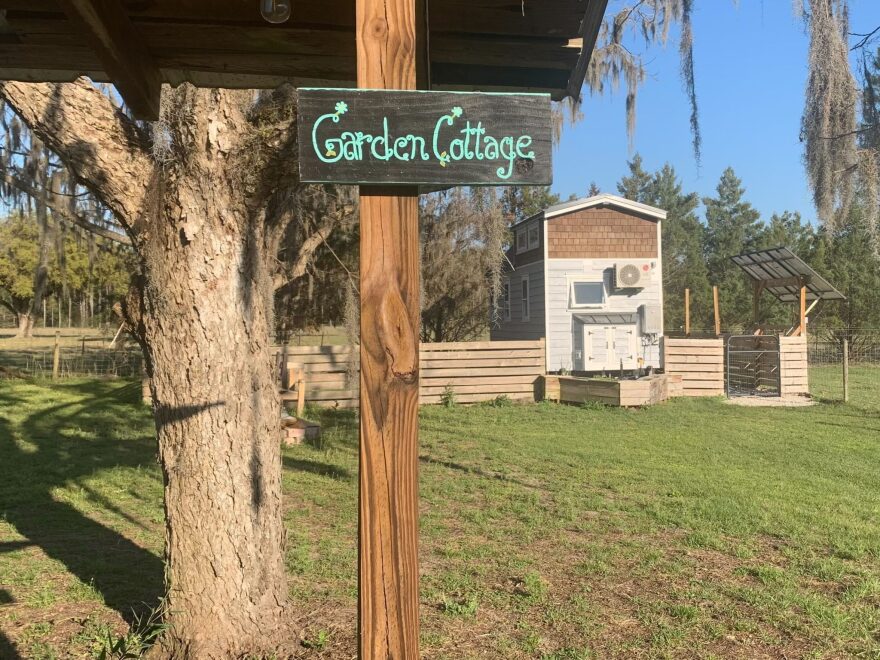
Garden Cottage sign on a post with a tiny home in the background
Meghan McGlone
/
WUFT News
Owners of tiny homes have ample space to park and can enjoy the cows, horses, dogs and chickens on Maureen Murtha’s property near Lake Butler in Union County.

Trevor Noah’s best burns at the White House correspondents’ dinner. (WaPo)

Trevor Noah's bon mots include several directed at Governor RONALD DION DeSANTIS, who began his political life as our adenoidal AWOL Congressman from St. Johns County, Florida, stiffing local elected officials on scheduled meetings while appearing on feculent fetid faux Fox News' noisome programs some 40 times. 

From The Washington Post: 


Trevor Noah’s best burns at the White House correspondents’ dinner

The 2022 White House correspondents’ dinner, in 3 minutes

Trevor Noah took aim at cable news channels and their big-name anchors during his relatively safe set at Saturday night’s White House correspondents’ dinner. Noah was the first comedian to headline the annual event since Michelle Wolf caused a stir with her roasts in 2018; writer Ron Chernow spoke the next year.

The crowd at the Washington Hilton laughed and, at times, gasped as Noah made jabs at President Biden for not being able to fulfill his promises, at CNN for investing in questionable business propositions (RIP CNN Plus) and at journalists in general for spending way too much time on social media.

Here are the best burns from Noah’s speech.

— “You guys spent the last two years telling everyone about the importance of wearing masks and avoiding large, indoor gatherings. Then the second someone offers you a free dinner, you all turn into Joe Rogan, huh?”

— “I’m not doing this just for the attention. I’m a comedian, not Kyrsten Sinema.”

— “I know a lot of you are worried and, yes, it is risky making jokes these days. We all saw what happened at the Oscars. I’ve actually been a bit worried about tonight, I won’t lie. What if I make a really mean joke about Kellyanne Conway and her husband rushes up on the stage and thanks me?”

— “What I like about Ron DeSantis is if Trump was the original Terminator, DeSantis is like the T-1000. You’re smarter than him. You’re slicker than him. You can walk down ramps. Trump said he won the election, but everyone was able to look at the numbers and see that he was wrong. That’s why Ron DeSantis is one step ahead. First you ban the math textbooks, then nobody knows how to count the votes.”

Overview: At the White House correspondents’ dinner, Biden jokes about a return to near-normal

— “The great chef José Andrés is joining us tonight. … Whenever there’s a disaster anywhere in the world, Chef José is there. Which I guess is why he’s sitting at the CNN table tonight.”

— To Biden: “I was a little confused about: Why me? But then I was told you get your highest approval ratings with a biracial African guy standing next to you.”

— “Interesting fact: Even as first lady, Dr. Biden continued her teaching career, the first time a presidential spouse has ever done so. Congratulations. You might think it’s because she loves teaching so much, but it’s actually because she’s still paying off her student debt. I’m sorry about that, Jill. Guess you should’ve voted for Bernie.”

— “As you all know, President Biden’s lack of a filter does get him into hot water sometimes. Last month, he caused a huge international scandal saying that Vladimir Putin should be removed from power. It was very, very upsetting to Russia. Until someone explained to them that none of the stuff Biden wants actually gets done.”

— “Think of all the journalists whose careers have been hurt by the Biden presidency. People like Daniel Dale. He used to be CNN’s fact-checker on TV every day but now there’s barely anything to check. Same for Glenn Kessler at The Washington Post. On the way here, I saw him offering four Pinocchios for a dollar. Mr. President, that’s on you. What about Maggie Haberman? For four years, it was exclusives. … Now look at her. She spends all day fighting with random people on Twitter like a common political reporter.”

— “Fox News is sort of like a Waffle House. It’s relatively normal in the afternoon, but as soon as the sun goes down, there’s a drunk lady named Jeanine threatening to fight every Mexican who comes in.”

Biden’s best jokes at the White House correspondents’ dinner

— “Apparently Jeff [Zucker] got fired after he tried to keep his workplace relationship a secret, which is weird because if he really didn’t want anyone to know about it, he could’ve just made a show about it on CNN Plus.”

— “They spent $300 million on CNN Plus. Three hundred million. Can I be honest, CNN? I think Stanley Tucci was playing you guys. I think that dude knew exactly where Italy was and he was just going to keep searching as long as you were paying.”

— “This is the golden era of conspiracy theories, whether it’s the right wing believing Trump can still win the 2020 election, or the left believing Joe Biden can still win the 2024 election.”

— “Thank you so much for having me. I appreciate you. Please be careful leaving tonight. We all know this administration doesn’t handle evacuations well.”


Gov. DeSantis says it’s ‘wrong’ for the feds to forgive student loan debt. (Florida Politics)

Is Florida Governor RONALD DION DeSANTIS once again showing his yapping, whiny, adenoidal, vicious, vacuous side?  (It's the only side we've seen as Governor).

Rebarbative RON DeSANTIS wants to be President.

RON DeSANTIS one of the most mentally unstable, unproductive, unkind, angry and  unhappy politician this side of Mar-a-Lago.  

DeSANTIS is always grousing about some imagined grievance.

In contrast, Democrats are upbeat and always have been, believing in the "better angels of our nature, " and believing government can help solve problems in the public interest.

DeSANTIS's anti-intellectualism is a defining feature of this double Ivy League imp.

For DeSANTIS's information, debt forgiveness is in the Bible, and it is a legitimate subject for public policy in a landscape where Dull Republican politicians subsidize billionaire developers like DONALD JOHN TRUMP and the pack of landraping scalawags that are laying waste to what we know and love here in St. Johns County (a/k/a "God's Country").

We deserve better.  Real Democrats like FDR, Truman, JFK, LBJ and Obama and Clinton inspired us with their positive vision.  FDR, like Al Smith, was a happy warrior, who famously said, "I'm an old campaigner, and I love a good fight.". (My mother saw and heard FDR say it at Franklin Field in Philadelphia in 1944). 

Republicans like Eisenhower famously supported New Deal reforms -- today misguided Republican arachnid apparatchiks would call Eisehower a RINO (Robert Welch of the John Birch Society called Ike a "Communistl."

Today's Dull Republicans even attack fictional chracters (remember Vice President J. Danforth Quayle's attack on "Murphy Brown?"  

Today's Dull Republicans are even attacking Disney, for "Crossing a line" in the words of our bullying soon-to-be ex-Governor, RON DeSANTIS.

DESANTI is the former Harvard Law School student and former Yale Basetball Team Captain, who falsely advertised himself as a Navy SEAL in his first campaign in 2012.  (Stolen valor -- he was a Navy lawyer, not a Navy SEAL)

Deceptive wannabe-dictator RON DeANTIS fancies himself an "expert" -- an "expert" on nearly everything. Mostly he just pops off, without provocation, like a carping harpy, a 24/7 unhappy one with the feculent fetid noisome Fox News noise machine at his beck and casll. 

 Is DeSANTIS a "nattering nabob of negativism," In the immortal words that William Safire wrote for President RICHARD MILHOUS NIXON's first Vice President SPIRO THEODORE AGNEW, (who later pled nolo contendere to tax invasion arising out of his taking bribes from Maryland highway construction contractors when he was Governor (the gentlemen's plea of no "contest" arranged by his talented criminal defense lawyers. 

SAFIRE's AGNEW speeches were filled with uncouth attacks on the news media, but they did not conceal the legendary dishonesty of President NIXON and his hypocritial attack dog, AGNEW.   

Is RON DeSANTIS disgraced ex-President DONALD TRUMP's vicious version of NIXON's hitman, SPIRO T. AGNEW?. 

You tell me.


From Florida Politics:


Gov. DeSantis says it’s ‘wrong’ for the feds to forgive student loan debt. (Florida Politics) 

By A.G. Gancarski April 29, 2022 '

Almost 60% of it is graduate school debt.' President Joe Biden continues to mull some form of student loan forgiveness. 

But Republicans aren’t sold, and Gov. Ron DeSantis is no exception. On Friday in Williston, DeSantis blasted the concept of debt forgiveness as a regressive measure that punished working-class people by forcing them to absorb debt incurred for advanced degrees. 

 “This student debt that’s out there, almost 60% of it is graduate school debt. These are people like doctors and lawyers, people that are getting Masters’ and Ph. D’s and all this other stuff (sic),” DeSantis said. Currently, payment deadlines for federal student loans are paused, with a moratorium in effect through August 2022. But pressure has mounted from Democrats for Biden to move forward with a plan for debt cancellation. More than $1.6 trillion is owed by 43 million people. 

As the Associated Press reported earlier this month, seven million Americans are in default. “You know, my view is why would you make a truck driver or a waitress or a construction worker pay off the debt for somebody that did a Ph.D. program in gender studies?” DeSantis said. “That’s wrong.” 

The Governor’s comments come nearly a day after President Biden shot down a question from a reporter about plans to forgive $50,000 of debt. “I am not considering $50,000 debt reduction but I am in the process of taking a hard look on whether or not there will be additional debt forgiveness. I’ll have an answer on that in the next couple weeks,” Biden said Thursday at the White House. 

White House Press Secretary Jen Psaki said Monday policy moves are imminent, and Biden “would make a decision about any cancellation of student debt before the conclusion of that pause on student loans” in August. However, any policy announcement will be razzed by Florida Republicans, who, like DeSantis, say loan forgiveness fails the equity test. Sen. Rick Scott, the richest member of the U.S. Senate, suggested this week a move to forgive or cancel student loan debt would disadvantage people who “paid their way through school” as he did. “If they’re going to run up debt, they need to have a plan to pay it back.” 

 A.G. Gancarski A.G. Gancarski has written for FloridaPolitics.com since 2014. He is based in Northeast Florida. He can be reached at AG@FloridaPolitics.com