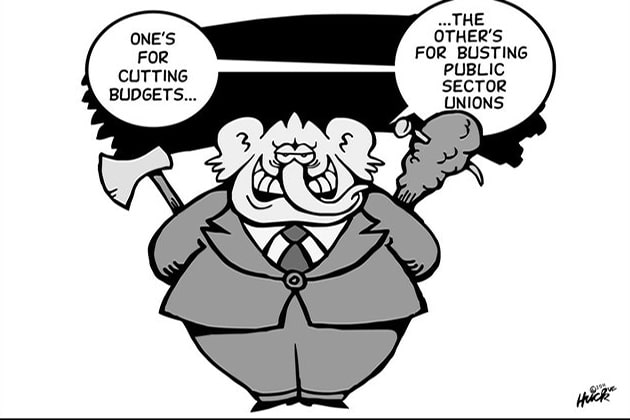
The pretender in the White House may put "Make America Great Again" hats on working men and women, but he does not give a fig about American values -- he's a billionaire developer who's all about centralizing power and depriving workers of a voice in their workplaces.
As LBJ said to Congress after Selma, :"We SHALL overcome!"



Behind a Key Anti-Labor Case, a Web of Conservative Donors
By NOAM SCHEIBER and KENNETH P. VOGEL
FEB. 25, 2018
The New York Times
In the summer of 2016, government workers in Illinois received a mailing that offered them tips on how to leave their union. By paying a so-called fair-share fee instead of standard union dues, the mailing said, they would no longer be bound by union rules and could not be punished for refusing to strike.
“To put it simply,” the document concluded, “becoming a fair-share payer means you will have more freedom.”
The mailing, sent by a group called the Illinois Policy Institute, may have seemed like disinterested advice. In fact, it was one prong of a broader campaign against public-sector unions, backed by some of the biggest donors on the right. It is an effort that will reach its apex on Monday, when the Supreme Court hears a case that could cripple public-sector unions by allowing the workers they represent to avoid paying fees.
One of the institute’s largest donors is a foundation bankrolled by Richard Uihlein, an Illinois industrialist who has spent millions backing Republican candidates in recent years, including Gov. Scott Walker of Wisconsin, Senator Ted Cruz of Texas and Gov. Bruce Rauner of Illinois.
Tax filings show that Mr. Uihlein has also been the chief financial backer in recent years of the Liberty Justice Center, which represents Mark Janus, the Illinois child support specialist who is the plaintiff in the Supreme Court case.
And Mr. Uihlein has donated well over $1 million over the years to groups like the Federalist Society that work to orient the judiciary in a more conservative direction. They have helped produce a Supreme Court that most experts expect to rule in Mr. Janus’s favor.
The case illustrates the cohesiveness with which conservative philanthropists have taken on unions in recent decades. “It’s a mistake to look at the Janus case and earlier litigation as isolated episodes,” said Alexander Hertel-Fernandez, a Columbia University political scientist who studies conservative groups. “It’s part of a multipronged, multitiered strategy.”
In doing so, these donors have not just brought labor to the brink of crisis but threatened the Democratic Party as well.
Amid changes in the campaign finance landscape and the decline of private-sector unions, the party and its candidates have increasingly relied on major public unions for funding, including hundreds of millions of dollars in direct and indirect spending during the 2016 presidential cycle. Those unions include the American Federation of State, County and Municipal Employees, whose Council 31 is the defendant in the Janus case.
A recent paper by Mr. Hertel-Fernandez and two colleagues may foretell what Democrats can expect if Mr. Uihlein and his fellow philanthropists succeed. It found that the Democratic share of the presidential vote dropped by an average of 3.5 percentage points after the passage of so-called right-to-work laws allowing employees to avoid paying union fees. That is larger than Democrats’ margin of defeat in several states that could have reversed their last three presidential losses.
And that is clearly on the mind of Republicans. In a recent interview, the Senate majority leader, Mitch McConnell of Kentucky, acknowledged the potential of the Janus case to hurt Democratic fund-raising for the coming midterm elections. “In states where they got rid of the automatic deduction and employees figured they could keep their own money, they did,” he said. “So it could have an impact.”
Conservative groups aren’t alone in locking arms to advance an ideological agenda. For decades, liberal donors and foundations, sometimes working together through coalitions like the Democracy Alliance, have promoted liberal goals in a variety of ways. Some backed groups, like the NAACP Legal Defense Fund and the GLBTQ Legal Advocates & Defenders, that used litigation to move American society leftward.
But the extent of the coordination on the right often dwarfs liberal efforts. Especially on the state level, conservative groups are “doing different things, mobilizing different constituencies,” Mr. Hertel-Fernandez said. “But they’re all working with one another. You don’t see the same thing on the left.”
As the percentage of unionized private-sector workers has collapsed in recent decades, public-sector unions, which have held steady in the mid-30s since the early 1980s, have increasingly become a target.
Conservatives chafe at the unions’ political influence, which they believe not only props up the Democratic Party but also drives up government spending and skews public policy on issues like education.
In 2011, Wisconsin rolled back the right of most public unions to bargain over anything other than wages and eliminated the requirement that nonmembers pay fees. The portion of unionized public-sector workers in the state plummeted from half to just over one-quarter within five years.
In seeking to produce similar results nationally, conservative donors have created a symbiosis between groups aiming to overturn Supreme Court precedent favorable to unions and groups that take advantage of those rulings to drain unions of members.
The Lynde and Harry Bradley Foundation of Wisconsin, which had over $800 million in assets in 2016, has funded both kinds of organizations.
In a 2014 case brought by a group that had received more than $1 million in contributions from the Bradley Foundation, the Supreme Court ruled that home-care aides and other “partial-public employees” paid through Medicaid could not be forced to pay fair-share fees if they left their unions. Unions say these fees, typically about 80 percent of standard dues, are necessary to compensate them for representing nonmembers in bargaining and grievance proceedings.
Then in 2016, the court heard a case, Friedrichs v. California Teachers Association, that could have struck down fair-share fee requirements for all public employees represented by unions in more than 20 states, including California, Illinois and New York. The case was brought by a group that has received millions of dollars from the Bradley Foundation.
During 2015 and 2016, the foundation also substantially increased its contributions, totaling well over $1 million, to groups like the Independence Institute of Colorado and the Freedom Foundation of Washington State. Those groups have used such tools as direct mail, phone calls and door knocking to persuade public-sector workers to give up union membership.
Richard Graber, the chief executive of the Bradley Foundation, said the foundation avoided short-term tactical considerations in its giving. But he acknowledged that the increase was driven partly by the recent Supreme Court developments, which promised to make such opt-out campaigns more compelling for union members. (Some conservative groups are currently raising money for even more ambitious opt-out campaigns to take advantage of a favorable ruling this year.)
Our columnist Andrew Ross Sorkin and his Times colleagues help you make sense of major business and policy headlines — and the power-brokers who shape them.
In February 2016, the month after the Supreme Court heard the Friedrichs case, Justice Antonin Scalia died, depriving conservatives of a decisive fifth vote to strike down mandatory union fees. That gave the Liberty Justice Center, backed by Mr. Uihlein, a chance to try again.
Few philanthropists have funded a more sweeping assault on labor than Mr. Uihlein, who with his wife, Elizabeth, founded a Wisconsin-based shipping supply company called Uline.
Mr. Uihlein is an ardent conservative who considers many Republican office holders too moderate on fiscal and social issues, according to those who know him.
“It’s not just politics for him,” said his friend Leonard A. Leo, the Federalist Society executive vice president, who declined to offer specifics on Mr. Uihlein’s views. “I think he is philosophically attuned to conservative ideas,” added Mr. Leo, whom the Trump White House enlisted to shepherd the Supreme Court nomination of Neil M. Gorsuch, Justice Scalia’s successor.
The Uihleins have spent tens of millions of dollars over the past decade supporting Republican candidates and committees. That includes contributions to super PACs backing the 2016 presidential campaigns of Mr. Walker and Mr. Cruz, and at least $250,000 to help Mr. Walker survive a 2012 recall election. (Mr. Uihlein did not respond to a request for comment.)
The Uihleins appear to be preoccupied with state employee pensions and the unions that negotiate them.
“Bruce is the only one in the race who isn’t beholden to public-sector unions,” Mr. Uihlein said of Mr. Rauner, the year before his 2014 election as Illinois governor, in an interview with Crain’s Business Chicago. The Uihleins gave more than $2.5 million to his campaign.
Mr. Rauner has been a major ally in the fight against public-sector unions. Shortly after taking office in 2015, he challenged the constitutionality of mandatory union fees in federal court.
By the time a judge ruled that Mr. Rauner lacked standing for his lawsuit, the Illinois Policy Institute, which drew more than one-third of its $5.8 million in revenue that year from Mr. Uihlein’s foundation, had found a viable plaintiff to replace him: Mark Janus. The Liberty Justice Center and the National Right to Work Legal Defense Foundation, which Mr. Uihlein also contributes to, represented Mr. Janus in court.
Since then, the policy institute has sought to persuade state employees to leave their union through its mailing campaign. It said it had obtained employees’ names through Freedom of Information Act requests.
Mr. Rauner’s administration has amplified the institute’s message, and vice versa. In an August 2016 email to state workers, the administration highlighted a benefit of giving up union membership and urged workers to visit a website that would help them do so. The policy institute soon promoted the same website and provided similar guidance in its mailings to state workers.
Mr. Uihlein’s foundation has supplemented these efforts by supporting a nonprofit called Think Freely Media, which uses storytelling techniques to champion free-market ideas, including right-to-work laws. The Uihlein foundation contributed more than $1.5 million to Think Freely from 2014 to 2016, the last year for which tax records are available.
At the center of this network is a longtime conservative activist named John Tillman, who serves as the chief executive of the Illinois Policy Institute as well as the chairman of the Liberty Justice Center and Think Freely Media.
In an interview, Mr. Tillman, who managed a call center earlier in his career and talked up his “marketing-centric approach” to promoting free enterprise, said the institute is fighting the enormous power of union leaders but is not anti-union per se.
“In the late 1800s, early 20th century, business owners had all the power, and workers had very little power,” he said. “Unions and collective bargaining emerged as a way to level the playing field. I think it was an amazing story of success.”
But in other contexts, Mr. Tillman has been less conciliatory.
In a fund-raising solicitation by the policy institute in December, Mr. Tillman claimed credit for helping more than 2,600 workers leave their union, resulting in a loss of $1.2 million in union revenue.
Continue reading the main story
“It’s time for Illinois to throw off the shackles of big labor and big government,” he wrote.
“When you and I look around Illinois and see the devastation the union-dominated status quo has inflicted,” he continued, “we simply have no choice.”
Jonathan Martin contributed reporting. Doris Burke contributed research.


2. County Attorney should be directed to file public nuisance lawsuit against developers and those responsible for poor draining. This is what happens when developers get their way, every day.
3. No provision in flawed impact fee proposal before County Commission to internalize the external costs of development like bad drainage?
4. We need a development moratorium.
5. We need a provision to make developers pay for ALL of their environmental impacts.
6. Our quality of life is being ruined by developers' greed.
7. Dirty water & constant flooding is a public health hazard.
8. Who was the developer? Who was its lawyer? Research, interviews, investigative reporting both desired and required.
9. Law Enforcement Assistance Administration report from circa 1978 found high correlation between high growth rate and corruption in planning and zoning.
10.In the 1990s, our County allowed an asphalt plant to be built on SR 207 near schools, homes, senior citizen housing. When I interviewed County zoning official for the Collective Press, she was arrogantly insouciant about the public health effects of asphalt on cancer mortality and suicide rates.
11. One County building inspector pled guilty to federal extortion charges in 2015 -- WILL RANDY ROGERS admitted shaking down businesses if they did not pay him money, threatening to file bogus code enforcement complaints.
12. Is the former inspector cooperating with an FBI investigation?Whatever happened to his case?
13. St. Augustine Record needs to go to the scene of development crimes and start investigating what the County Building Department does all day, every day.
St. Johns County Building Department
Address: 4040 Lewis Speedway, St. Augustine, FL 32084
Opens 7:30AM Mon
Phone: (904) 827-6800