Saturday, April 28, 2018

Do reactions to the firing of Jesuit House chaplain show anti-Catholic bias? (America)


Republicans' insistence upon non-Catholic chaplain is freighted with animus and possibly violates Article VI of the U.S. Constitution, which says: "no religious Test shall ever be required as a Qualification to any Office or public Trust under the United States.

Here's coverage from the Jesuits' America Magazine:


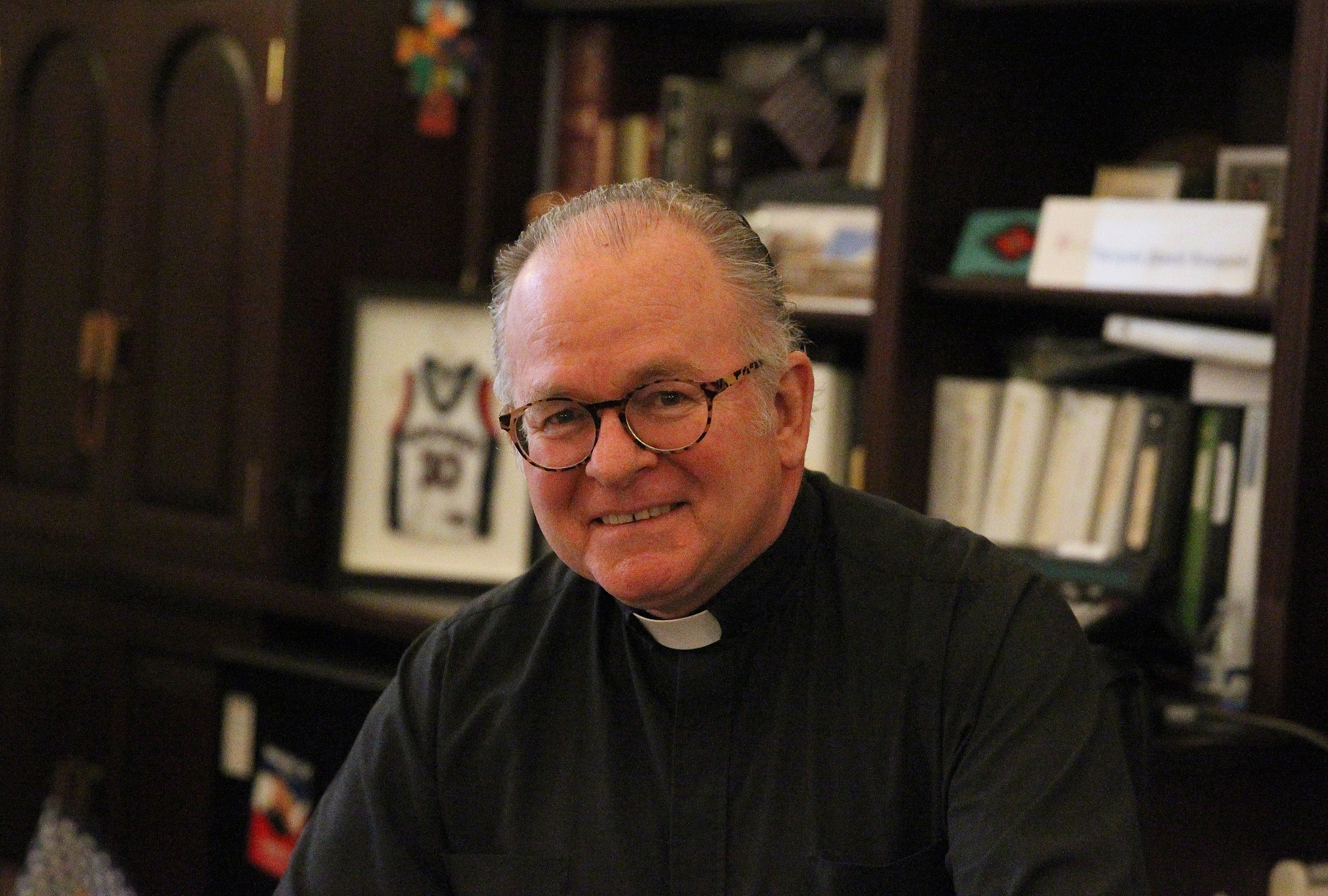
Jesuit Father Patrick J. Conroy, pictured in a May 8 photo, has been the chaplain of the U.S. House of Representatives since 2011. (CNS photo/Rhina Guidos) 
One of the Republican lawmakers tasked with finding a replacement for House chaplain Patrick Conroy, S.J., said that he believes the next chaplain should be a married person with children since she or he can provide better pastoral care, a comment some are saying smacks of anti-Catholic bias.
Representative Mark Walker of North Carolina, a Southern Baptist minister, said he wanted Father Conroy’s successor to be somebody with children, which would preclude nearly all Catholic priests and nuns.
“I’m looking for somebody who has a little age, that has adult children, that kind of can connect with the bulk of the body here,” Mr. Walker said on Thursday.
Representative Mark Walker of North Carolina said he wanted Father Conroy’s successor to be somebody with children.

While Mr. Walker said that this desire does not explicitly rule out a Catholic chaplain, he said that “when you walk the journey of having a kid back home that’s struggling or made some bad decisions, or when you have a separation situation, or your wife’s not understanding the [congressional] schedule, having somebody who’s walked in those shoes allows you to immediately relate a little bit more than others.”
John Whitney, S.J., pastor of St. Joseph Church in Seattle and a former provincial superior of the Oregon Province of the Society of Jesus, said he has known Father Conroy since 1983. He told America that he is hesitant to call Mr. Walker’s remarks “anti-Catholic” but he said they demonstrate an “ignorance” about pastoral ministry.
“The fact that we don’t have families may mean that we have less personal experience of raising children, but it allows us to be available, to come without a lot of baggage,” he said, adding that when it comes to ministry, there are “advantages and disadvantages to not being married and not having children.”
Timone Davis, who teaches pastoral theology and black Catholic theology at Loyola University Chicago’s Institute for Pastoral Studies, told America that providing pastoral care has more to do with being able to listen and focus on a “common humanity” than with sharing a similar background.
One priest told America that Mr. Walker’s remarks demonstrate an “ignorance” about pastoral ministry.

Ms. Davis said if sharing life experience was prerequisite for effective ministry, then that would mean “a white person cannot be attentive to a Latino or an African-American as a chaplain because they don’t know what that’s like.”
“That’s totally absurd to me,” she said.
She said a minister sharing experience with someone in his or her care could even make providing effective counseling more difficult.
“Experience only opens the door to our own stuff,” she said. “If we have not addressed our own issues, that doesn’t help us be present.”
“What being present, to me, means, can I listen to you and hear what you have to say and then address the needs you have presented,” Ms. Davis said. “That doesn’t mean I have to have experience in what you’ve presented. But I do need to be able to hear you and offer suggestions that may not be related to experiences in my own life.”
House Speaker Paul Ryan requested that Father Conroy submit his resignation, but the priest told The New York Times he does not know why.

House Speaker Paul Ryan requested that Father Conroy submit his resignation, but the priest told The New York Times he does not know why. Some reports say it was because of a prayer he delivered in November that some Republicans interpreted as partisan, while others say that the priest, only the second Catholic to hold the post, was not providing effective pastoral care. On Friday, House Democrats called for an investigation into why Father Conroy was fired, but it failed in a vote along party lines.
In a statement issued Friday, Representative Nancy Pelosi, the House’s highest-ranking Democrat, called the decision to fire Father Conroy “truly sad” and “bewildering” and suggested that Mr. Ryan lacked the power to fire the chaplain, who was elected to a two-year term by the House.
“It is my hope that we will honor Father Conroy’s service by pursuing justice and making clear the true motivations of this unjust action. I have expressed my forceful disagreement with this decision to the Speaker,” Ms. Pelosi said.
A spokeswoman for Mr. Ryan told America that the speaker “made the decision he believes to be in the best interest of the House.”

A spokeswoman for Mr. Ryan told America that the speaker “made the decision he believes to be in the best interest of the House, and he remains grateful for Father Conroy’s many years of service.”
While Mr. Walker’s suggestion may rankle some Catholics, it comes at a time when some Catholic leaders have suggested something similar.
For example, last October, Cardinal Kevin Farrell, who heads the Vatican’s family office, said that married couples may provide better marriage preparation to young people than priests.
Priests, he said, “don’t have credibility” when it comes to marriage preparation because they have not “lived in the reality of the situation, and therefore it’s very difficult for them to accompany.”
Laypeople, he said, “can best accompany married couples in moments of difficulty and moments of challenge.”
His comments echo the writings of Pope Francis, who laid out his vision for pastoral ministry to families in his 2016 apostolic exhortation, “Amoris Laetitia.”
“It could also be helpful to ask older married couples to help younger couples in the neighbourhood by visiting them and offering guidance in the early years of marriage,” the pope wrote.
Still, the issue of marriage preparation is seen as an intra-family conversation, leading some normally conservative voices to call out Mr. Walker’s comments.
The Catholic League for Religious and Civil Rights, a watchdog group that tracks what it sees as anti-Catholic bias in politics and culture, also weighed in on the controversy.
At the end of a blog post published on Friday, which criticized multiple Democrats and Republicans, in some cases for statements made nearly two decades ago, the organization said: “There is no role for anti-Catholicism in politics. This means that no priest should ever be disqualified for the House Chaplain position because he is celibate.”
Raymond Arroyo, the host of a talk show on the Eternal Word Television Network and Fox News contributor, tweeted that Mr. Walker’s comments have “an anti-Catholic edge.”
As for Father Conroy, Father Whitney said his Jesuit colleague possesses “terrific” pastoral skills and that his “folksy” style has won him fans from a range of people he has encountered in ministry, from high school and college students to members of Congress. He said he believes the chaplain’s firing is a “sad commentary on how divided we are as a country” and said if reports that the priest was fired because of a prayer about taxes, it shows a “dangerous” level of polarization.
“To think a Jesuit priest would be fired because of praying for equity and a sense of responsibility, it shows how polarized we have become,” he said. “Where are we safe from this polarization?”
[Want to discuss politics with other America readers? Join our Facebook discussion group, moderated by America’s writers and editors.]

Charlotte is going all out to get the GOP convention. No one else says they want it. (Charlotte Observer)

No word from anyone  in Northeast Florida wanting to apply for it.  

If they love TRUMPISM so much, would local burghers want it associated with our First Coast tourism brand?  

TRUMP is trauma and tsouris and bad for International tourism.  

What profit-maximizing oligopolist or other-directed official wants to  sponsor the RNC 2020 Convention?

------------------
Charlotte is going all out to get the GOP convention. No one else says they want it.


In this July 21, 2016 photo, Republican presidential candidate Donald Trump smiles as he addresses delegates during the final day session of the Republican National Convention in Cleveland. (AP Photo/Patrick Semansky)In this July 21, 2016 photo, Republican presidential candidate Donald Trump smiles as he addresses delegates during the final day session of the Republican National Convention in Cleveland. (AP Photo/Patrick Semansky)
CHARLOTTE, NC (Steve Harrison/The Charlotte Observer) -
Mayor Vi Lyles, Police Chief Kerr Putney and a group of Charlotte tourism officials flew to Washington, D.C. Thursday to meet with the Republican National Committee about the city hosting the party's 2020 convention.
Lyles said Friday that the party told her there were other cities bidding, but Lyles said the RNC did not tell them which ones. There has been little media attention from other cities that might be bidding, and some prominent convention cities have told the Observer they are not interested.
"They did not say who, they just said there was competition," Lyles said.
The city of Dallas told the Observer Thursday that it was asked by the RNC to bid but declined. Dallas was a finalist for the 2016 RNC, which was awarded to Cleveland.
"We took a hard look at it once, we took a hard look at it twice, but it didn't work for us," said Frank Librio of Visit Dallas, which works to bring conventions to the city.
San Antonio was not one of the first cities the RNC asked to bid. But one of President Donald Trump's campaign managers has been lobbying San Antonio to submit a late bid.
The city's mayor, Ron Nirenberg, sent a memo to his City Council Wednesday telling them the RNC wants the Texas city to bid.
He wrote that he earlier had believed "that the GOP opted not to pursue a bid from San Antonio. As such, no further discussions occurred. "
He added: "Today, I learned that the GOP has renewed its interest in San Antonio, and is now actively seeking a convention bid. I’ve asked the City Manager to schedule a full briefing at the earliest possible date. "
But it's unclear if San Antonio will bid on the convention. 
In its original bid documents, the RNC told Charlotte the deadline for bidding was Feb. 28. But the RNC has extended that deadline, though it did not say why.
The Observer has reached out to a number of other large cities, many of them in swing states. Orlando; Phoenix; Atlanta; Nashville; Columbus, Ohio; and Pittsburgh have said they are not bidding.
The RNC has told the Observer it "has a long-standing practice not to comment on the selection process this early."
Hosting a national political convention can bring the host city tens of millions of dollars in visitor spending. But it also brings headaches to coordinate logistics and security.
That could be amplified in 2020 for the RNC, which is expected to nominate Trump for a second term.
The Charlotte delegation included Lyles, Putney, Republican City Council member Ed Driggs and representatives from the Charlotte Regional Visitors Authority, including chief executive Tom Murray. 
Lyles said they met with Ronna Romney McDaniel, the chair of the RNC, and other top Republicans. Lyles declined to say what they talked about specifically. She said a main part of the city's pitch is that it hosted the 2012 Democratic National Convention.
"I would say that Charlotte's bid is really strong. It was good to sit down with the committee to walk through some of the steps that are needed," Lyles said. "I think our strength is that we have done it before."
When Charlotte was awarded the 2012 DNC, Democrats told the city in January 2011 — 18 months before the convention. The similar timeline for the 2020 convention would be to hear in January.
When Charlotte hosted the DNC, the local host committee was responsible for raising about $37 million – and fell short by $8 million.
Bid documents released by the CRVA show that the Republicans expect the host city to raise between $68 million and $70 million. That’s based on how much was needed for the 2016 RNC in Cleveland.
At least two cities — Atlanta and Milwaukee — have said they will bid on the 2020 Democratic National Convention.

Gov. Rick Scott Might Have Blatantly Broken Federal Anti-Corruption Rules (Miami New Times)

David Sirota found "rich investors donated big money to a political action committee Scott was chairing right after the governor directed hundreds of millions of dollars in state funding in their direction. That sort of transaction is likely illegal thanks to a 2010 federal rule."   

Enough to disqualify SCOTT from running for U.S. Senate.   

Thanks to investigative reporters David Sirota and Jerry Iannelli and to campaign fund tracking group MapLight.

RICHARD LYNN SCOTT has about as much chance of being elected to the Senate as a hog caught under a gate.  Take this in: "rich investors donated big money to a political action committee Scott was chairing right after the governor directed hundreds of millions of dollars in state funding in their direction. That sort of transaction is likely illegal thanks to a 2010 federal rule."


Florida Gov. Rick Scott

Gov. Rick Scott Might Have Blatantly Broken Federal Anti-Corruption Rules


Florida governor, former white-collar criminal, and U.S. Senate candidate Rick Scott seems to have tiptoed extremely, oh-so-perilously close to breaking federal anti-corruption laws. Depending upon which government ethics experts you contact, he might have outright broken Securities and Exchange Commission (SEC) rules. That's the takeaway from a new investigative report from veteran journalist David Sirota and the campaign-finance-tracking nonprofit MapLight.
In short, Sirota found that a few rich investors donated big money to a political action committee Scott was chairing right after the governor directed hundreds of millions of dollars in state funding in their direction. That sort of transaction is likely illegal thanks to a 2010 federal rule.

RELATED STORIES
Two private equity companies — New Mountain Capital and Energy Capital Partners — received $250 million in new investment commitments from Florida's state pension system in 2014 and 2015. Scott is one of three state executives who oversee the pension system. Energy Capital Partners just bought a firm that owns a state-regulated natural-gas power plant near Tampa, too.
In return, the CEOs of both investment firms donated a combined $55,000to Scott's New Republican political action committee during this election cycle. Scott began chairing the PAC in May 2017, though his campaign says he stepped down from that position in February 2018.

Importantly, a 2010 SEC rule is designed to prevent these kinds of seemingly quid pro quo political transactions from taking place. The rule prevents firms that receive state pension investments from donating to pension board administrations, where Scott remains as of today.
But things get slightly more complicated from there: The rule allows investors to donate to "third-party" groups as long as those groups aren't technically affiliated with any actual candidates. But the SEC also stipulates it's not legal for anyone to donate to a third-party group or PAC if that donation is obviously designed to skirt the basic anti-corruption provision — and it sure seems like that's what happened in this case with Scott. 
At least one government ethics expert with the group Public Citizen told Sirota and Perez that this instance appears to be a "very clear case of close coordination and circumvention of the pay-to-play rule," but it's basically up to the SEC to decide whether to take action.
Regardless, Scott and his campaign ought to explain to the public just what happened here. Spokespeople for Scott's campaign and the New Republican PAC did not immediately respond to calls and messages from New Times today. 
But Scott's New Republican has already been in the news this week, after the group End Citizens United filed a Federal Election Commission complaint alleging the third-party New Republican is actually closely coordinated with the Scott campaign. (PACs are legally supposed to be independent entities working by themselves to support candidates of their choosing.) 
Though it's certainly true that PACs for both mainstream Republicans and Democrats are often closely affiliated with candidates' campaigns (even though this is technically not allowed), activists with End Citizens United say Scott's campaign blatantly and overtly coordinated with New Republican by sharing a mailing address, conducting a pro-Scott poll in March (before he announced his candidacy), and regularly meeting with him until March in order to "run around election law."
Ryan Patmintra, the communications director for Scott's Senate campaign, previously told the Tampa Bay Times that any election complaints filed against Scott or New Republican are "baseless."