From Seattle Times:
Why Frank Blethen spent his family’s fortune to save Seattle’s newspaper
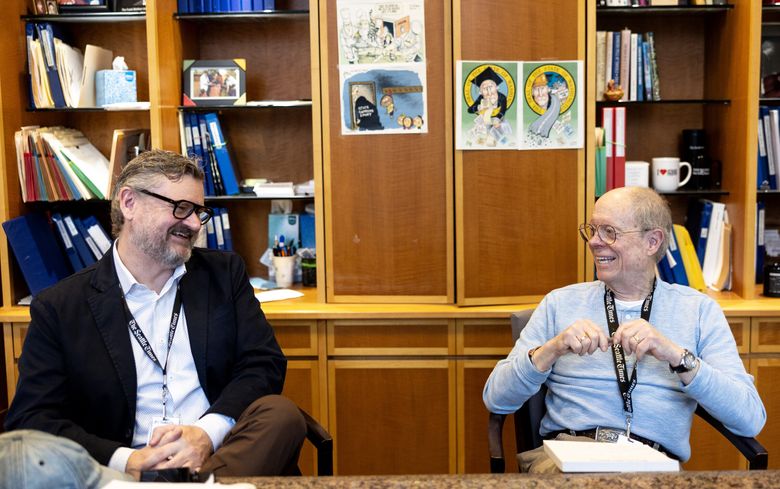
You might have thought that Frank Blethen winced as the wrecking ball gutted The Seattle Times’ landmark building.
It was 2017, and the Blethen family had sold every last acre it owned in downtown Seattle, including its 1931-built headquarters, to pay the bills at The Seattle Times, the newspaper founded by Blethen’s great-grandfather in 1896.
“They were knocking down the building, everybody was in tears and freaking out, and somebody asked Frank, ‘God this must be tearing your heart out,’ ” remembers Michele Matassa Flores, the paper’s executive editor. “And he’s like, ‘Are you kidding? That’s our future. That’s funding our journalism.’ ”

During his 40-year stewardship of The Seattle Times as publisher, Blethen led the paper through economic downturns, a profound loss of print advertising revenue to the internet and a bitter strike. For him, it was always about the newspaper’s survival.
In January, Blethen turned the publisher’s role over to his son Ryan, transitioning The Seattle Times to a fifth generation of local family ownership. Frank Blethen remains chair of the company board; company President Alan Fisco, a longtime leader at The Times, was appointed CEO.
The paper has 108,000 paid digital-only subscribers and a daily print circulation of 60,000, which rises to 105,000 on Sundays. With about 500 employees, including about 170 in the newsroom, it’s the largest paper north of Los Angeles and west of Minneapolis.

Many newspaper owners have bailed on their once-proud publications, but the Blethen family bought out a minority Seattle Times shareholder in 2024 — a journalistic seismic retrofit in an industry subject to tectonic shifts.
The Blethens stuck by the paper even when they could have made a pile selling it. The family has sold nearly all its property — from a state-of-the-art printing plant in Bothell to that prime land in South Lake Union — to keep publishing.
“I heard them say it all the time, and it has always stuck with me,” noted David Boardman, The Times’ former executive editor and senior vice president, “they don’t publish a newspaper to make money, they make money to publish a newspaper.”
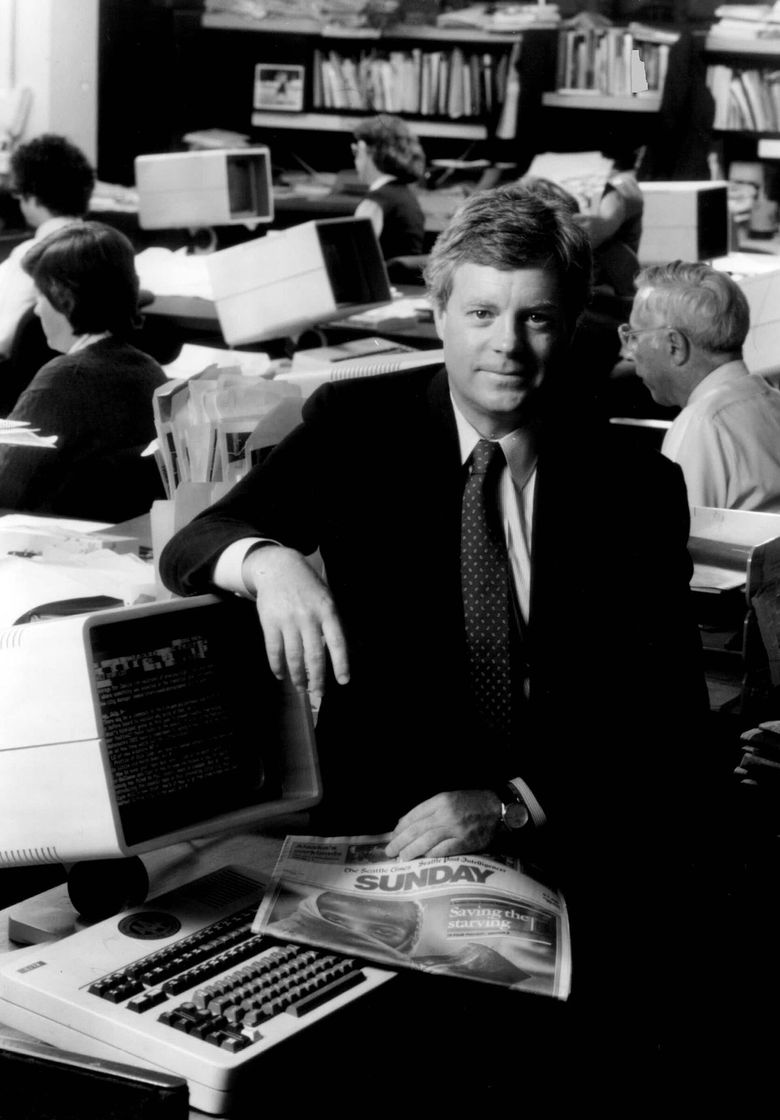
The ‘last of the buckaroo publishers’
During his 58 years at The Seattle Times, Frank Blethen never did work as a journalist.
After his parents divorced, he was raised by his mom out of state. He came to Seattle as a young man, working at the paper in summers to get to know his cousins and his father, Frank Blethen Sr., who was Seattle Times president from 1944 until his death in 1967. Frank Jr. did summer jobs as menial as pushing a broom. He remembers one summer when he made a single brief visit to his father’s corner office; his dad spent the time, Blethen said, complaining about traffic noise coming through the open window.
He never really had a dad, Blethen said. “But I had a great mom.”

His experience growing up mostly in Arizona, raised by his mother as a single parent, was defining. Kathleen Ryan Blethen’s example led to Frank’s own commitment to gender equity when he rose to the newspaper’s top jobs. During his tenure, many of the most important jobs in the company, including executive editor, have been held by women.
Not that it was always easy working for Frank Blethen.
Blethen is no button-down newspaper executive, notes John Hughes, the former chief historian in the Washington secretary of state’s office and former editor and publisher of The Daily World in Aberdeen. Hughes said scholar Sue Lockett John got it right when she described Blethen as “the last of the buckaroo publishers.”
“The neighbor’s dog, that wasn’t the best,” said Alex MacLeod, former managing editor, recalling Blethen’s infamous imbroglio with a neighbor on Mercer Island.
Blethen was charged in 1996 with misdemeanor animal abuse for firing a pellet rifle at a neighbor’s dog — Blethen admitted to shooting at the ground near the dog but said he did not aim at the animal and did not think he hit it. The dog suffered two wounds, one near its heart. Charges eventually were dropped; Blethen did not admit guilt but paid the neighbor’s vet bills and had to do community service.
Then there were the political ads, paid for by the company, that Blethen bought — full-page political ads weighing in on some of the same races the paper’s journalists were covering in the news pages — causing Boardman, then executive editor, to write a column apologizing to readers.
Then, of course, there was the strike.
Seattle Times union workers went on strike over pay and other issues for 49 days, beginning in November 2000. Blethen took it personally. He had windows at the company’s headquarters boarded up and a wire fence erected around the building.
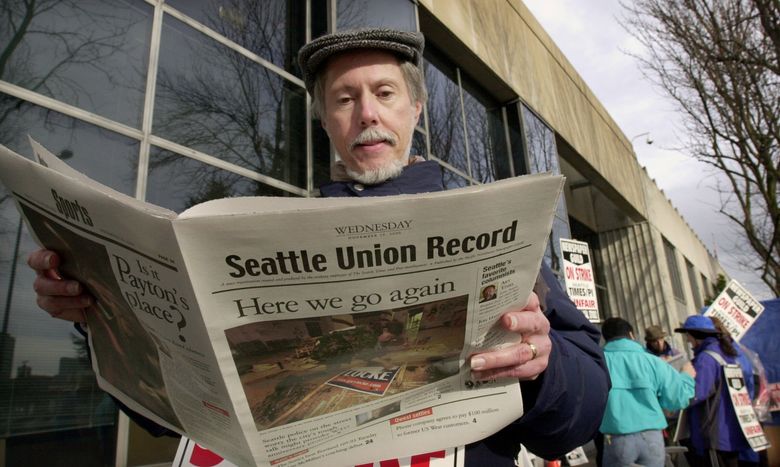
During the strike, Blethen wrote a now-legendary email to a local publisher whose presses had printed the strikers’ newspaper, venting his wrath. “(Expletive) you to death,” Blethen wrote. When the publisher responded with a conciliatory note, Blethen wrote “What part of (expletive) you to death don’t you understand?” — and cc’d every newspaper publisher in the state of Washington.
It took U.S. Sen. Patty Murray to pull the parties together to get a settlement.
“I just deeply care about local news. Frank does too,” the senator said in an interview. “And when The Seattle Times folks went on strike, … I was really worried about the long-term consequences, both losing good reporters and The Seattle Times altogether.
So I called everybody back to my offices in D.C., and I said, ‘We’re going to stay here until we figure this out.’ Because at the end of the day, nobody wants the consequence of our losing our local news.”
Murray, 75, has been reading The Seattle Times since she was a little kid, and she’s known Blethen since she first ran for U.S. Senate in 1992. The paper’s editorial board, on which Blethen still sits as an emeritus member, endorsed Murray’s Republican opponent, U.S. Rep. Rod Chandler, in the 1992 race, though it has since come around on Murray.
“You could disagree with stuff, but at the end of the day, it was a trusted news source that he believed in and passionately fought for,” Murray said.
“I think of so many times over the years where he could have sold it, or given up, and he didn’t do it, because he was tough and because he loved his community. I would attribute that completely to Frank, because I think in all my time of knowing him, the one most repeated sentence he said to me is, ‘We have to have local journalism.’ ”
Without fear or favor
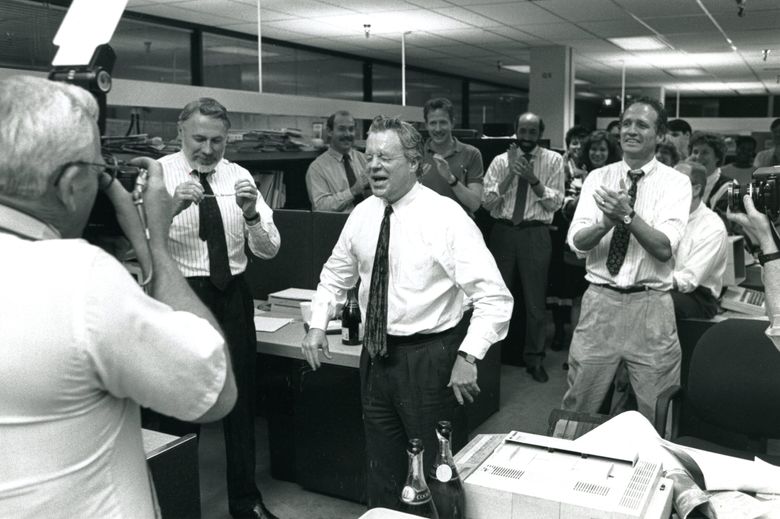
Frank Blethen fostered a culture at The Seattle Times in which reporters worked without fear or favor, and so did their editors.
“He was a dream publisher,” said MacLeod, who, during his time as managing editor, could not remember a single time Blethen interfered with the paper’s coverage. “What that did was give us journalistic freedom.”
“Working for him and with him was one of the great privileges of my life,” said Boardman, now interim provost at Temple University and dean of the Klein College of Media and Communication. “Through his leadership, that newspaper has, over the decades, done more with less than almost any newspaper in America, and it starts with Frank.”
Boardman recalled, as an example, his experience as managing editor overseeing the newspaper’s investigation into allegations that U.S. Sen. Brock Adams, D-Wash., was drugging and sexually assaulting women. When told of the coverage the newspaper was about to publish, Blethen’s one comment for the editors, Boardman said, was “How can we know this and not publish it?”
Adams — who was never criminally charged — denied the allegations but dropped his bid for reelection as soon as the story ran.

Blethen was just as resolved in 1990, when Nordstrom — at the time one of the paper’s biggest advertisers — pulled all of its ads because of the paper’s coverage of its labor dispute, recalled Mike Fancher, executive editor of the paper for 20 years.
“Frank stood up for the newsroom. … He just didn’t flinch at all,” Fancher said.
Matassa Flores was a Seattle Times business reporter when Nordstrom canceled its ads. She said the episode shaped her as a reporter and an editor.
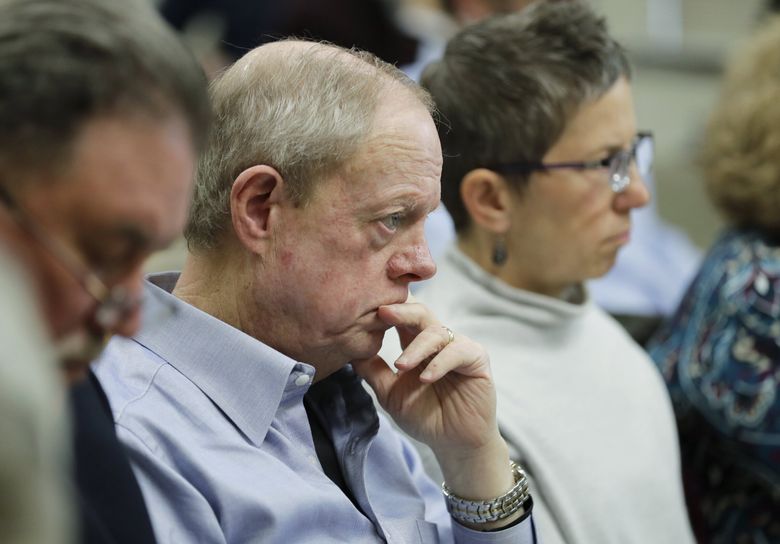
“I still remember Frank’s strength, in terms of backing up our independence when we were covering stories that were pissing off advertisers,” she said.
Survival for The Times has required continual adaptation. The company and its rival, Hearst Corp.’s Seattle Post-Intelligencer, entered a joint operating agreement in 1983. That deal saw the afternoon Times handle the advertising, printing and delivery of its main competitor. The Times switched to morning publication in 2000, taking on the P-I directly. Hearst stopped its print edition of the P-I in 2009.
The Seattle Times is still rebuilding from the days of the wrecking ball. Some things never came back from the fiscal cliff.
The print newspaper shrank in size to cut newsprint costs and went from three sections in the daily paper to two. The company also scaled back daily single-copy delivery and closed suburban news bureaus. It only recently reopened its Washington, D.C., bureau, which had been downsized then closed a decade ago to save money.
As advertising revenue bled away, on Blethen’s watch, the paper implemented a hybrid business model that combines private ownership with community funding — a model launched in 2013 that today has been copied by others around the country.
Today, community donations pay for 25 of the newsroom journalists who cover a range of topics, including climate change, education, homelessness and mental health. The company still guards its journalistic independence, for instance canceling a million-dollar sponsorship after a donor insisted on having special access to a reporter.
The company fights for readers’ right to know, going to battle in court for open records and fighting legislative efforts to conduct the public’s business behind closed doors. And despite its own financial struggles, the newspaper each year raises millions of dollars in its Fund for Those in Need Campaign for local charities that help children, families and older adults.
Golf? ‘A waste of time’
Ryan Blethen was growing up at The Times just as the conventional business model for newspapers was cratering. He has no expectations now of serene stability.
“My generation, we’re just so used to having the ground shift under our feet,” he said in an interview. “I’m always on the watch for that, a little on guard. I don’t think I’ll ever have a time in my career when I’ll be relaxed. The changes are just coming faster now.”
The print newspaper shrank in size to cut newsprint costs and went from three sections in the daily paper to two. The company also scaled back daily single-copy delivery and closed suburban news bureaus. It only recently reopened its Washington, D.C., bureau, which had been downsized then closed a decade ago to save money.
As advertising revenue bled away, on Blethen’s watch, the paper implemented a hybrid business model that combines private ownership with community funding — a model launched in 2013 that today has been copied by others around the country.
Today, community donations pay for 25 of the newsroom journalists who cover a range of topics, including climate change, education, homelessness and mental health. The company still guards its journalistic independence, for instance canceling a million-dollar sponsorship after a donor insisted on having special access to a reporter.
The company fights for readers’ right to know, going to battle in court for open records and fighting legislative efforts to conduct the public’s business behind closed doors. And despite its own financial struggles, the newspaper each year raises millions of dollars in its Fund for Those in Need Campaign for local charities that help children, families and older adults.
Golf? ‘A waste of time’
Ryan Blethen was growing up at The Times just as the conventional business model for newspapers was cratering. He has no expectations now of serene stability.
“My generation, we’re just so used to having the ground shift under our feet,” he said in an interview. “I’m always on the watch for that, a little on guard. I don’t think I’ll ever have a time in my career when I’ll be relaxed. The changes are just coming faster now.”
He’s open to change, but not for change’s sake. “I’m inheriting a healthy newspaper,” Ryan said, “so, don’t break what’s not broken.
“I mean, what we do is journalism, that’s what we focus on, and I think that’s what sets us apart from a lot of other regional papers.”
As he takes over the role of publisher, the 53-year-old has a clear-eyed view of what he faces, particularly at this time in America.
“A big part of our country seems to be OK with having an autocrat” as president, he said. “That is terrible for anyone running a newspaper. I could end up in jail someday, or there could be a lawsuit, not designed to win, but to cripple us.”
The business of journalism also remains fragile.
“I think it shows that Frank has a firm commitment to the mission of local news, that he has guarded and nurtured through the decades,” said Tim Franklin, professor and chair of local news at the Medill School of Journalism at Northwestern University. “The fact that he held on … is just absolutely exceptional when you look at the history of what’s happened in other markets across the country.”
Right now, the country is losing on average more than two newspapers a week, according to Medill’s 2025 State of Local News Project report. The country has lost about 40% of its newspapers in the past 20 years, and about three-quarters of all newspaper journalists, “which is staggering,” Franklin said.
Many of the papers that remain are what he calls “ghost newspapers,” mere shadows of their former selves, with very little original local journalism.
When more hard times come, Ryan Blethen feels he has the solidest of foundations.
“One of the things he has taught me,” he said of his father, “is there is always a path forward.”
As for Frank, his will not be a golfing retirement.
“I tried to take it up,” he said of golf. “I thought, this is a waste of time.”
Boating? How about that? Would that be fun?
“I am not a boater. I hate to boat.”

Seated on the couch at his Mercer Island home holding hands with his wife, Charlene — they have been married since 1994 — he said he does look forward to having more time with her and their grandchildren.
He’ll also be staying involved with The Seattle Times, as chair of its board of directors as well as of The Blethen Corp.
“I want to make sure we continue on the path we are on, that we keep our principles in balance,” Blethen said.
“Can they make it to the next generation?” he said of the family’s ownership of the paper. “It’s really Ryan (I) count on. … I can’t imagine him even thinking of giving it away.”

Ryan would be the first to agree. Like his dad, he started working at the paper as a young man, taking the bus at 13 to work in the stockroom. He rotated through summer jobs around the company, doing grunt work that included “swamping” — unloading papers from the back of large delivery trucks to single-copy vendors. Ryan Blethen worked as a journalist, reporting and editing at newspapers in Yakima, Spokane and Portland, Maine, before returning to the Times newsroom in 2005. Now the eighth publisher of The Seattle Times, he still identifies as a journalist first.
“If we didn’t have The Times, I’d still want to be a journalist,” Ryan said. “But I’d much rather do it at a paper we own.”


The transition to the fifth generation is underway, but from the tattoo on his calf of The Seattle Times mascot — an eagle that for generations graced the paper’s masthead — to his now gray and balding head, at 80, Blethen remains his invincible self.
Any parting words, thoughts, philosophies? He had this to pass on: “You don’t (expletive) with Frank.”
Seattle Times news researcher Miyoko Wolf contributed to this story.


No comments:
Post a Comment