Monday, March 27, 2017

WATCH VIDEO: SHERIFF DAVID SHOAR THREATENS TO ARREST CITIZEN JEFF GRAY AT AWARDS BANQUET ON COUNTY PROPERTY

This is what official oppression looks like:


There was a taxpayer-paid party on Friday, March 24, 2017 and you weren't invited. It's the annual award banquet of the St. Johns County Sheriff's Department, where more than 1000 people dined on Filet Mignon at your expense.

It was held at our lavish St. Johns County Convention Center at World Golf Village is government property, owned by St. Johns County, whose taxpayers are still paying off the $16.9 million bonded indebtedness.

Watch controversial St. Johns County Sheriff DAVID SHOAR and his henchmen, including his arachnid apparatchik, Undersheriff MATTHEW CLINE (his former General Counsel, graduate of a for-profit law school in Jacksonville).

Watch Sheriff SHOAR and Undersheriff CLINE bully Jeff Gray.

Why? Jeff was peaceably videotaping and carrying a sign protesting the Michelle O'Connell and Andrea Sheldon shooting deaths.

Watch Sheriff SHOAR act like a smirky turkey, an angry anti-literate energumen, lying.

"This is our night … our party…. This is private property."

No, it's not, SHOAR.

Watch Sheriff SHOAR emit falsehoods and threats, threatening like a Mississippi or Alabama lawmen of the 1960s.

This Sheriff is about as sharp as a mashed potato sandwich with the crust cut off.

This hick hack political boss has violated peoples' constitutional rights here in Florida's St. Johns County for long enough.

SHOAR had a judge change his surname from "HOAR" in 1994 and was elected Sheriff in 2004.

HOAR/SHOAR brags of getting an "A" in Constitutional law in college (I checked: he did).

Watch Sheriff SHOAR and Undersheriff CLINE act like jackasses -- jackbooted thugs with an army behind them and no principles between them.

Watch Sheriff SHOAR presume to give orders without factual or constitutional basis.

Watch Sheriff SHOAR and Undersheriff CLINE lie about who owns the property as they touch Jeff Gray and his sign and viciously violate the First, Ninth and Fourteenth Amendments to the United States Constitution.

This is not the first time that St. Johns County Sheriff's Department has made false statements about our Convention Center being "private property." In 2005, before former UNESCO Ambassador Alan Keyes spoke at an anti-Gay hate rally held free in the Convention Center, a St. Johns County Sheriff's Lieutenant in the Organized Crime Squad called two women who had posted about it on the Internet, threatening them with arrest.

As RFK once said to an other-directed lawbreaking lawman in California violating farmworkers' civil rights, I say to Sheriff DAVID SHOAR: "I suggest you read the Constitution of the United States.

Justice for Andrea Sheldon. Justice for Michelle O'Connell. Work for justice every day of your life.


Sunday, March 26, 2017

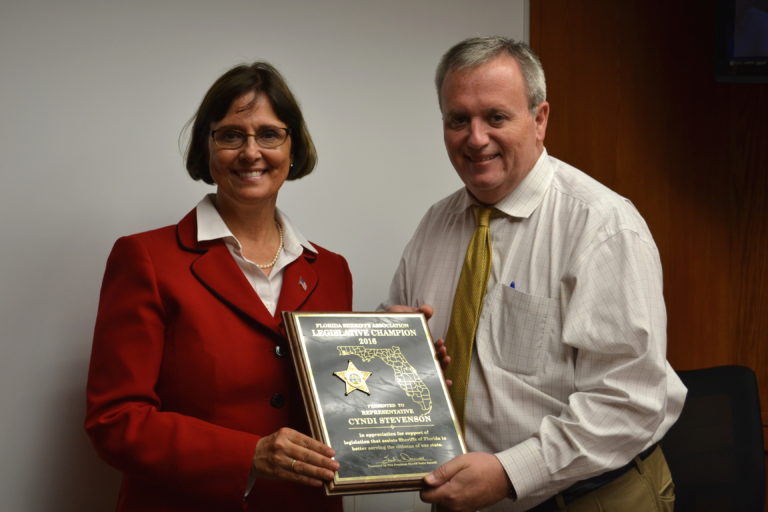
Thank you, State Rep. Cyndi Stevenson, for helping end red light cameras. No thanks to SABPD Chief ROBERT HARDWICK, who tried to inflict these robotic bandits on St. Augustine Beach (we stopped him, for good), inviting salesmen to make presentations on behalf of a company half-owned by GOLDMAN SACHS. Happy ending: red light cameras will soon be banned.


Rep. Cyndi Stevenson (Primary Election Night, 2015)(SAR)


Stevenson supports end of red light cameras in state

3 Comments
43 Share

A bill co-sponsored by Rep. Cyndi Stevenson that just passed the Florida House of Representatives would put a stop to the use of red light cameras in the state.

It’s a bill Stevenson told The Record on Friday that she was willing to get behind even though municipalities in her district are not using the devices.

“There’s a number of people in the House that feel like it is no longer in the best interest of the people of Florida,” she said.

Stevenson said she was happy to see the bill make it out of the House, just as she was last year when she put her name behind a similar bill.

This year’s bill was filed by Republican representatives Bryan Avila, of Hialeah, and Rep. Blaise Ingoglia, of Spring Hill.

Avila said red-light cameras might have been well-intentioned initially but have been used by local governments as a way to generate money.

“It has become less about public safety and more about revenue,” Avila said in a News Service of Florida story.

Opponents of the bill argued that local governments should be able to decide whether to use the cameras to ticket motorists who run red lights and that the cameras have changed drivers’ behavior.

Stevenson said she was aware of those concerns.

“I will say … there probably are some places where it is administered [carefully] and some intersections where it is helpful,” she said. “So I know there is push back on the other side.”

“Personally I can imagine there are ways to do it appropriately,” she added. “But that’s not what I hear about.”

What she does hear about, Stevenson said, are concerns that a private company, which often installs and manages the cameras, as well as issues the violation notices, are profiting from having assumed the responsibility of local government.

And the hefty fines on the tickets, which are sometimes north of $150 dollars, aren’t justified by a noted reduction in accidents.

“The thing that we see most frequently is a … very high ticket cost [and] little latitude for the local governments to administer it and the judiciary to administer it more thoughtfully,” she said. “And we don’t see a safety record to support that heavy burden on individuals.”

That lack of local control was also of concern to her.

“You allow a company to step in the shoes of authority or our law enforcement and the judiciary,” Stevenson said. “And that’s a problem.”

Those concerns have also been noted by Florida’s 4th District Court of Appeal, which according to an April Daytona News-Journal story, ruled in October 2014 that municipalities don’t have the legal authority to delegate traffic citation responsibility to private companies.

Locally, that prompted the city of Palm Coast to reduce the number of traffic cameras in the city from 43 to 5 and shorten its contract with American Traffic Solutions by two years.

While House Bill 6007 passed overwhelmingly, with a 91-22 vote, it remains uncertain what will happen in the Senate.

If it makes it through and is eventually signed into law it wouldn’t go into effect until 2020.

A companion Senate bill (SB 178) has already failed to make it out of the Senate Transportation Committee, according to the News Service.

The Senate now has the option to put the House bill to the committee process or take up a similar repeal bill (SB 630) filed by Democratic Sen. Daphne Campbell of Miami.

Stevenson didn’t offer a prediction as to what would happen in the Senate but did say she was glad the cameras never caught on here.

“I can tell you what I am grateful for,” she said. “I am grateful we don’t have any.”

Comments

Jack (sponger) Harvell
For once I agree with her. Heaven sends us small favors occasionally.

Wayne (mach) Hoyle
Yea, about time someone got rid of that fundraiser for the state or local governments. Unless they have MY PICTURE driving the car, there is no due process.

David Cash
This was always a revenue stream for the municipalities. Has very little to do with safety. In some cases it has actually increased accidents.

"Advocacy group part of St. Augustine’s sea level rise efforts" (SAR)

THANK YOU, MAYOR SHAVER.  In 2014, The St. Augustine Record endorsed your predecessor, Mayor JOE BOLES, saying it desired "business as usual."  We, the People defeated BOLES.  The Record endorsed you in 2016, seeing the light at last.  Mayor Shaver: thank you for not being  "business as usual" -- you are the answer to many of the hopes, prayers and aspirations of the good people of St. Augustine, Florida.  Venceremos1


Advocacy group part of St. Augustine’s sea level rise efforts

Comments
 
CHRISTINA.KELSO@STAUGUSTINE.COM As St. Augustine begins to plan for sea level rise, Mayor Nancy Shaver, photographed along the city’s seawall on Friday, March 24, 2017, has recently become involved in Resiliency Florida, a nonprofit advocacy group dedicated to educating about and planning for sea level rise in a cohesive network. 
As St. Augustine officials dip their toes into sea level rise planning, one of the main issues is uncertainty.
“We are in a position of not knowing exactly how much and not knowing exactly when, but it’s our job to take the best data that is available and do the best planning we can,” Mayor Nancy Shaver said. “And that’s what everyone has to do.”
While there’s a measure of uncertainty, the city is part of a state study on sea level rise and is already trying to address coastal flooding.
In addition to other efforts by the city, Shaver recently joined a group called Resiliency Florida, a fledgling 501c4 that’s dedicated to education and sharing information about planning for sea level rise and with extreme weather events.
“One of my next steps is going to be reaching out to elected officials in surrounding counties to make them aware of it,” said Shaver, adding that much of the activity in Florida governments related to sea level rise has been concentrated in southern Florida.
The nonprofit advocacy group, which stemmed from requests by St. Augustine and Monroe County officials to form the group, is aimed at getting people to plan sfor sea level rise and severe weather events, said Pepper Uchino, an interim board member.
“Our organization is dedicated to getting ahead of the issue … so that catastrophes don’t materialize in the future,” Uchino said.
The board hasn’t officially sat for the first time, but when it does, Shaver will be the vice chair, Uchino said. Uchino is a member of Anfield Consulting, which lobbies for the city and Monroe County.
The group expects to have eight local government representatives from Florida (but no two from the same county), as well as some non-voting private sector members, he said.
At home, the city has already been moving forward for some time with the investigation and planning stage. Reports have shown a range of projections for sea level rise for the city consider, as well as a large number of “what if’” scenarios for impacts on the city.
In 2016, the University of Florida produced a report about effects of sea level rise in the city of 1, 3 and 5 feet over the “mean higher high water” mark, which is an average of high tide numbers for years, according to the study. The report, which the city budgeted $15,000 for, drew from existing projections on sea level rise.
The report said sea level rise could be 0.25 to 6.67 feet within the next 15 to 85 years.
At 3 feet of sea level rise, 18 of the city’s lift stations and 437 of the city’s manholes would be impacted, along with residential areas in western and northern parts of Anastasia Island, according to the report.
Also, a pilot program has opened the door for further study in St. Augustine.
In June, the Florida Department of Economic Opportunity finished an assessment of the city’s vulnerability to sea level rise.
The study, funded by the National Oceanic and Atmospheric Administration, is studying three communities for how they can become more resilient against coastal flooding, according to a report.
Now the department is finishing a plan that will help the city prioritize and plan sea level rise projects.
A draft of the DEO’s adaptation plan says that the city’s wastewater treatment plant is vulnerable to flooding and is expected to become more vulnerable, among a number of other issues the report addresses. It recommends the city start looking at options for dealing with the vulnerability before they have to.
The options are expensive, the report says.
“What we would do is think strategically on a very long-term basis to do short-term-type things over time,” said Martha Graham, public works director.
There are also smaller-scale recommendations to help with coastal flooding. One is to relieve the burden on the city’s stormwater system by encouraging property owners to use less impervious (non-water-penetrable) surfaces.
The city is moving forward on a nuisance-flooding related project, a more than $600,000 effort to upgrade infrastructure in Davis Shores to help prevent tidal flooding.
Graham said people in the city should expect to hear more about sea level rise planning in the future, and she hopes they will be engaged.
“They’re going to be asked to provide their comments, their input,” Graham said.
Areas farther south are having to act faster to deal with flooding.
In the Miami area, officials are planning for a $100-million effort over two years to combat street flooding from sea level rise, according to the Miami Herald. The funding will go toward raising roads and sewer and water upgrades in a couple of neighborhoods as part of a larger effort in the city overall, which is estimated to cost up to $500 million, according to the story.
Costs like that are out of reach of the city of St. Augustine, where the total budget is less than $60 million.
Shaver said that’s the case for many coastal communities in Florida, where “there are very few cities that can marshal the resources” to deal with major sea level rise projects on their own.
Right now, the city doesn’t know for sure what will be affected and how soon.
That’s why information sharing and planning is so important between communities, and that’s the stage the city is at, she said.
“It’s prudent for us to do that,” Shaver said. “It’s prudent for us to learn everything we can learn. It’s prudent for us to share information with other municipalities and just be as in the best possible place to make sure that St. Augustine survives another 450 years.”
Report focuses on sea level rise impacts in St. Augustine
Coastal vulnerability assessment 
Draft adaptation plan
 Coastal_Vulnerability_Assessment.pdf
 Draft_Adaptation_Plan.pdf

Friday, March 24, 2017

200 "Rich and Powerful" Volusia Countians Fete Embry-Riddle University's MicaPlex, named for ex-Rep. JOHN LUIGI MICA (R-BIG OIL)


Was JOHN LUIGI MICA an egomaniac with an edifice complex, or a pathetic putrid puppet with naming rights? PORK BRRREL POLKA POLITICS yields naming rights for corrupt ex-Rep. JOHN LUIGI MICA (R-FL6/BIG OIL), who mis-represented St. Augustine in Congress 2003-2013, as lugubrious a goober as ever made a chair squeak. He spent hundreds of thousands of dollars of campaign contributions on "meals with constituents" at some of the best restaurants in D.C., Florida and elsewhere.

This' phony's entire family is crawling with lobbyists -- two brothers, his son and his daughter, 75% of whom work for Big Oil or its commercial allies. He was redistricted (again) and finally lost re-election in 2016. In 2008 I characterized MICA (with some edits today for grammar and tenses):

In JOHN MICA's world, you get to spend a lot of "party time" at fancy restaurants, exclusive clubs and casinos all over this land. Campaign contributors pay for it in the guise of "meals with constituents." See stories and itemized lists.

In JOHN MICA's world, the world is your oysters and Big Oil and other contributors pay for your Crab Louis, your Oysters Rockefeller, and your Prime Rib.

In JOHN MICA's world, troops in Iraq and Afghanistan don't get proper body armor, wounded soldiers don't get adequate health care, but being more equal than others, JOHN MICA gets the best of everything, paid for with campaign cash.

In JOHN MICA's world, George W. Bush was the Supreme Leader, the National Security State rulesour lives, privacy does not exist, poor people are to be mocked.

In JOHN MICA's world, the minimum wage laws and Family Medical Leave Act would not exist, veterans would not receive adequate benefits, and there would be no stem cell research.

In JOHN MICA's world, everything wrong was Bill Clinton's fault, nothing is the Republican's fault.

In JOHN MICA's world, up is down, down is up, family welfare recipients are "alligators" but corporate welfare recipients get earmarks, veterans and the middle class count for nothing and corporate lobbyists are the bosses.

In JOHN MICA's world, Bill Clinton was "a little booger," with the House finding MICA out of order for his nasty remarks in the 1990s.

In JOHN MICA's world, lobbyists are regularly paying for his Travel and Entertainment (T&E) through campaign contributions.

In JOHN MICA's mind, he was a very important personage. So important, in fact, he flew to Tibet (he claims) to sell airplanes to Communist China.

So important, JOHN MICA felt free to head-bump an ABC News cameraman coming out of a Tom DeLay party or not to return contributions from the likes of TOM DELAY, ABRAMOFF and JIM NEY.

See the list of JOHN MICA 2007-2008 individual and PAC contributions and his campaign expenditures below -- it's enough to gag a maggot. When the contributors read about MICA's antics, they've been gagging too.

While MICA may have good taste in restaurants, bars and casinos, JOHN MICA's got no taste in how he votes in Congress or who he hangs out with -- John Mica is an embarassment to us all. I supported and voted for Faye Armitage in 2008 for Congress -- an economist and mother of five with the sense to speak for the people, not the rich and Big Oil companies.

What do you reckon?

Fond memories of mocking JOHN LUIGI MICA's foibles here:


Embry-Riddle’s MicaPlex opens for research, job creation

Thursday
Posted Mar 23, 2017 at 10:00 PM
Updated Mar 23, 2017 at 10:18 PM
By T.S. Jarmusz
DAYTONA BEACH NEWS-JOURNAL

DAYTONA BEACH — Suddenly Thursday, after 10 years in the making, the John Mica Engineering and Aerospace Innovation Complex became a reality.

Standing before crowd of roughly 200 of Volusia's rich and powerful, the $21 million two-story glass, steel and concrete structure at Embry-Riddle Aeronautical University drew praise and accolades.

It was once just a dream. Before that, a patch of grass. Now, the complex on Clyde Morris Boulevard could be home to the next great idea or tech giant.

"Years and years ago, we dreamed about this. Years and years ago, we talked about this," board Chair Mori Hosseini said at Thursday's illumination commencement. "We doubted ourselves many times, but we never stopped dreaming."

But it's more than just a fancy building or even a university centerpiece. The hybrid research center and startup business incubator represents a new future for Embry-Riddle and possibly Volusia County. It melds minds and money: bringing together scientists, business experts, venture capitalists and top staff from the university's three campuses.

More commonly called the MicaPlex, the building bears the name of former Congressman John Mica, who has supported other Embry-Riddle ventures like its NextGen Florida Test Bed, a National Aerospace System research and demonstration site.

"Kids will have forgotten who John Mica is, but what is significant about this is, you've created opportunity for those students, for our university, for our nation ... for our future," Mica said.

The complex boasts more than 10,000 square feet of flexible lease space, as well as office space, mixed-use space and cutting-edge laboratories. Researchers can use the in-house labs to study everything from drones to climate systems.

The MicaPlex is the crown jewel of a larger research park, which will focus on aviation, space, engineering and unmanned systems. The school has high goals for the project, among them becoming transitioning from teaching institute to a class-leading research university.

But it's not only about research. While having a top-notch research facility should boost the university's master's and Ph.D. retention rates, Hosseini said he's most excited about having people who grow up in the area, stay and work right here in town.

Volusia County Council Chair Ed Kelley called the MicaPlex a "game-changer," and said it will create high-paying jobs in the area.

After a new wind tunnel opens at the research park, when combined with the MicaPlex labs, the two projects will support more than 24 jobs with projected salaries upwards of $100,000, a university document states.

It's not impossible to think that those high-paying jobs will attract other business to the area.

New Embry-Riddle President Barry Butler said the MicaPlex could one day allow the university to become a "global engineering powerhouse" and create an opportunity for "incredible economic growth."

Local growth in the aerospace field could eventually spread down the East Coast and converge with Cape Canaveral. A 2016 PricewaterhouseCooper study ranked Florida second in the nation for aerospace manufacturing attractiveness. A U.S. Department of Labor study also ranked Florida second for aviation, aerospace and space establishments.

The technology and innovation produced at the MicaPlex could one day lead to large aerospace companies doing business in the county, Space Florida president and CEO Frank DiBello said.

The night also held a surprise announcement. Embry-Riddle created a scholarship in Mica's honor. The John Mica Honorary Endowed Scholarship for Engineering Excellence will be used to help support engineering undergraduate students, Butler said.

While the project is now reality, Butler said he wasn't about rest on his laurels.

"Now, the real work begins," Butler said.