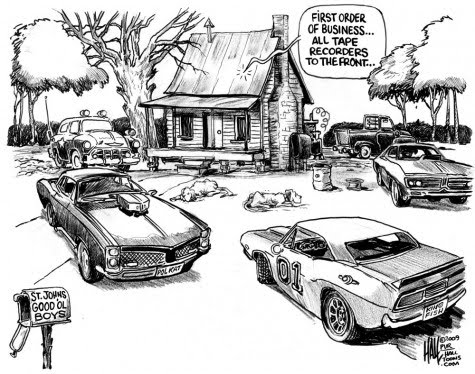
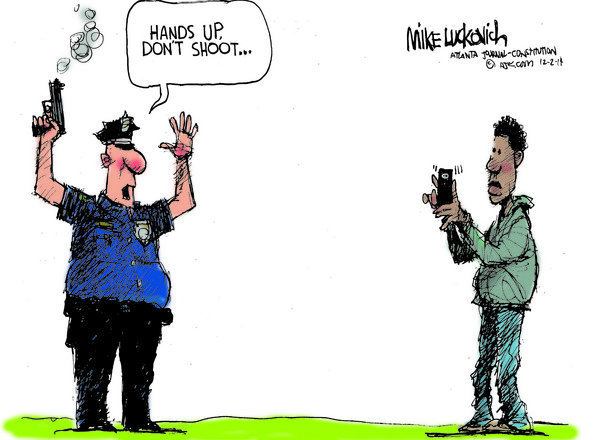
Under FBI investigation, St. Johns County Sheriff DAVID BERNARD SHOAR reminds me of "The Little Boy Who Cried Wolf."
SUED FOR ILLEGAL SURVEILLANCE, SHERIFF SHOAR ONCE accused plaintiff attorney Anna Marie Gennusa of filing the "most frivolous" lawsuit ever. He caused a Bar complaint to be filed against her. His pal, ex-Judge ROBERT KEITH MATHIS, used the same words, as a then-anonymous hate poster on the St. Augustine Record website.
Four federal judges proved them wrong -- the District Court Judge and a three-judge panel of the Eleventh Circuit.
First, what I blogged on April 8, 2014, then the trial and appeals decisions:
Tuesday, April 08, 2014
Sheriff's Office Loses Appeal -- Called Civil Rights Case By Attorney Gennusa "Most Frivolous" He'd Ever Seen
The St. Johns County Sheriff's office violated Fourth Amendment rights of an attorney and her client by listening in to their private conversations in an interview room and stealing a document from the attorney's hands.
So ruled the United States Court of Appeals for the Eleventh Circuit, in a decision posted earlier today.
At issue were our Federal Wiretap Act and our Fourth Amendment.
The case was brught by attorney Anne Marie Gennusa and her client, Joel Sutrdivant, who were both represented by Jacksonville attorney William Sheppard, Brian DeMaggio, Matthew Kachergus and Elizabeth Louis White.
When an attorney and a client are speaking in an interview room and the client is not charged with the crime, they have a reasonable expectation of privacy: listening in is a violation of the Fourth Amendment, a civil rights violation. When an attorney is holding a statement and a deputy grabs it out of her hand, that's a civil rights violation, too.
So ruled United States District Court Judge Timothy Corrigan in 2012.
So ruled the United States Court of Appeals today in Atlanta.
The only surprising thing about today's ruling is that our St. Johns County Sheriff, DAVID BERNARD SHOAR and lawyers JOHN JOLLY and MATTHEW CLINE bothered to appeal on behalf of THOMAS MARMO and BRIAN CANOVA.
The trial court awarded no money damages, only injunctive relief and attorney fees.
This appeal was a waste of the public fisc.
Sheriff SHOAR is ethically impaired.
Sheriff SHOAR had termed this the "most frivolous lawsuit" he'd "ever seen."
Sheriff SHOAR had stated, "It is cases like these that cause members of the public to be very critica of the effetivness of our civil justice system in America."
No Sheriff SHOAR, it is crooked cranky Sheriffs like you.
And all your works and pomps.
And all your camp followers.
And all your scared deputies, who do evil to keep their jobs.
It is also the current and former members of your Department, who long posted hate speech on the St. Augustine Record, its Talk of the Town website, and on MICHAEL GOLD's www.plazabum.com and www.shamefulpeople.com.
What a lugubrious goober. SHOAR knows not that he knows not that he knows not, and he's been elected thrice, twice without opposition, because our somnolent, somnambulistic St. Johns County Democratic Party, not unlike our St. Johns County Sheriff's Office, is reminiscent of Jimmy Breslin's "The Gang That Couldn't Shoot Straight."
This same Sheriff refused to recuse himself on November 2-3, 2010, when Deputy Jeremy Banks' girlfriend, Michelle O'Connell, was found shot to death with his service pistol. Supervising an investigation that was a stench in the nostrils of the Nation, Sheriff DAVID BERNARD SHOAR pronounced it a "suicide."
SHOAR is a criminal, and his credibility is in shreds.
The trial court decision was written by U.S. District Judge Timothy Corrigan, appointed by Presideent G.W. Bush in 2002.
The appeals decision was written by (CORRECTED) Judge Adalberto Jordan, a former federal prosecutor, former U.S. District Judge in Miami and was appointed by President Obama in 2012; he was born in Cuba and clerked for Justice Sandra Day O'Connor.
The decision was joined in by Senior Judge Joel F. Dubina of Alabama, who was appointed a District Judge by President Reagan and an Appeals Judge by President G.H.W.Bush and by Senior Judge Emmett Ripley Cox, appointed by President Reagan and a native of Cottonwood, Alabama.
A federal grand jury needs to investigate Shoar's civil rights violations.
Now.
The whole world is watching.
CNN and NBC News Dateline are next.
So ruled the United States Court of Appeals for the Eleventh Circuit, in a decision posted earlier today.
At issue were our Federal Wiretap Act and our Fourth Amendment.
The case was brught by attorney Anne Marie Gennusa and her client, Joel Sutrdivant, who were both represented by Jacksonville attorney William Sheppard, Brian DeMaggio, Matthew Kachergus and Elizabeth Louis White.
When an attorney and a client are speaking in an interview room and the client is not charged with the crime, they have a reasonable expectation of privacy: listening in is a violation of the Fourth Amendment, a civil rights violation. When an attorney is holding a statement and a deputy grabs it out of her hand, that's a civil rights violation, too.
So ruled United States District Court Judge Timothy Corrigan in 2012.
So ruled the United States Court of Appeals today in Atlanta.
The only surprising thing about today's ruling is that our St. Johns County Sheriff, DAVID BERNARD SHOAR and lawyers JOHN JOLLY and MATTHEW CLINE bothered to appeal on behalf of THOMAS MARMO and BRIAN CANOVA.
The trial court awarded no money damages, only injunctive relief and attorney fees.
This appeal was a waste of the public fisc.
Sheriff SHOAR is ethically impaired.
Sheriff SHOAR had termed this the "most frivolous lawsuit" he'd "ever seen."
Sheriff SHOAR had stated, "It is cases like these that cause members of the public to be very critica of the effetivness of our civil justice system in America."
No Sheriff SHOAR, it is crooked cranky Sheriffs like you.
And all your works and pomps.
And all your camp followers.
And all your scared deputies, who do evil to keep their jobs.
It is also the current and former members of your Department, who long posted hate speech on the St. Augustine Record, its Talk of the Town website, and on MICHAEL GOLD's www.plazabum.com and www.shamefulpeople.com.
What a lugubrious goober. SHOAR knows not that he knows not that he knows not, and he's been elected thrice, twice without opposition, because our somnolent, somnambulistic St. Johns County Democratic Party, not unlike our St. Johns County Sheriff's Office, is reminiscent of Jimmy Breslin's "The Gang That Couldn't Shoot Straight."
This same Sheriff refused to recuse himself on November 2-3, 2010, when Deputy Jeremy Banks' girlfriend, Michelle O'Connell, was found shot to death with his service pistol. Supervising an investigation that was a stench in the nostrils of the Nation, Sheriff DAVID BERNARD SHOAR pronounced it a "suicide."
SHOAR is a criminal, and his credibility is in shreds.
The trial court decision was written by U.S. District Judge Timothy Corrigan, appointed by Presideent G.W. Bush in 2002.
The appeals decision was written by (CORRECTED) Judge Adalberto Jordan, a former federal prosecutor, former U.S. District Judge in Miami and was appointed by President Obama in 2012; he was born in Cuba and clerked for Justice Sandra Day O'Connor.
The decision was joined in by Senior Judge Joel F. Dubina of Alabama, who was appointed a District Judge by President Reagan and an Appeals Judge by President G.H.W.Bush and by Senior Judge Emmett Ripley Cox, appointed by President Reagan and a native of Cottonwood, Alabama.
A federal grand jury needs to investigate Shoar's civil rights violations.
Now.
The whole world is watching.
CNN and NBC News Dateline are next.

UNITED STATES DISTRICT JUDGE TIMOTHY CORGIGAN:
2012 TRIAL COURT DECISION:
GENNUSA v. SHOAR
Email | Print | Comments (0)
Case No. 3:09-cv-1208-J-32MCR.
879 F.Supp.2d 1337 (2012)
Anne Marie GENNUSA, et al., Plaintiffs, v. David SHOAR, et al., Defendants.
United States District Court, M.D. Florida, Jacksonville Division.
July 17, 2012.
Attorney(s) appearing for the Case
Bryan E. DeMaggio, Elizabeth Louise White, Matthew R. Kachergus, William J. Sheppard, Sheppard, White, Thomas & Kachergus, PA, Jacksonville, FL, for Plaintiffs.
John W. Jolly, Jr., Jolly & Peterson, PA, Tallahassee, FL, for Defendants.
ORDER
TIMOTHY J. CORRIGAN, District Judge.
Anne Marie Gennusa, a lawyer, and Joel Studivant, her client, allege that members of the St. Johns County Sheriff's Office
[879 F.Supp.2d 1342]
violated their Fourth Amendment rights and the Federal Wiretapping Act by recording their attorney-client conversations in an interview room at the Sheriff's Office and by forcefully seizing Studivant's written statement. The parties filed cross motions for summary judgment (Docs. 27, 33), and the Court held hearings on these motions on April 1, 2011 and July 29, 2011, the transcripts of which are incorporated by reference (Docs. 35, 39). At the July 29, 2011 hearing, the Court identified several issues with the manner in which the case had been pled. In particular, the Court highlighted that, although no material facts were in dispute, the parties had failed to meet on a number of critical issues, thus leaving the Court unable to grant summary judgment for either party. In light of the Court's comments, the parties agreed that plaintiffs should file a second amended complaint and that the parties should then file new cross-motions. (Docs. 38, 39.)
This case is now before the Court on the parties' cross-motions for summary judgment relating to the Second Amended Complaint. (Docs. 44, 52.) Although the Court allowed the parties to replead so that they could better meet on the substantive issues, many of the parties' arguments have again gone unanswered. Defendants have been particularly unhelpful since, rather than responding to plaintiffs' arguments directly, "Defendants stand on [their] original Memorandum of Law [in support of their motion for summary judgment] as their argument in opposition to Plaintiff's pursuit of summary judgment." (Doc. 54 at 1.) Given the continued lack of engagement between the parties, the Court has deemed many of the parties' arguments to be conceded.
I. BACKGROUND
This case arises from an interview of Studivant relating to his alleged violation of a domestic violence injunction. The interview was conducted by defendant Thomas Marmo, a St. Johns County detective, in an interview room located in the St. Johns County Sheriff's Office. Gennusa attended as Studivant's attorney. Although the interview was recorded and actively monitored by employees of the Sheriff's Office, plaintiffs were given no indication of this fact.1
Due to the recording, the events that transpired during the interview are undisputed.2 When the interview began, Studivant initially agreed to prepare an affidavit relating to the investigation. While Studivant was writing his statement, Marmo left the interview room and closed the door. At this time, when no officers were present, Studivant and Gennusa discussed matters related to the investigation. Gennusa then left the interview room and met with Marmo in his office. When Gennusa returned to the interview room, she informed Studivant that Marmo intended to arrest him. After a discussion with Gennusa, Studivant decided that he no longer wished to give Marmo his written statement.
[879 F.Supp.2d 1343]
Marmo returned to the interview room, and, after a heated discussion, Studivant and Gennusa refused to tender the statement. Marmo then exited the interview room and discussed the matter with his supervisor, defendant Brian Canova, a sergeant in the St. Johns County Sheriffs Office. During their discussion, the officers actively monitored plaintiffs in the interview room and watched Gennusa place the statement on a table. Canova instructed Marmo to return to the interview room and take the statement. (Doc. 28-1 at 6-8.) As Marmo entered the room, he forcibly grabbed the statement from underneath Gennusa's hand. (Doc. 1-1.)
Marmo proceeded to arrest Studivant for violation of the domestic violence injunction and attached Studivant's statement to his arrest report. (Doc. 28-1 at 37-38.) A criminal prosecution was ultimately brought against Studivant, but the charges were dismissed after he entered into a deferred prosecution agreement. (Doc. 26-5 at 8-9.)
Plaintiffs filed this action against Marmo and Canova in their individual capacities and against David Shoar in his official capacity as Sheriff of St. Johns County. Plaintiffs allege defendants violated their Fourth Amendment rights and the Federal Wiretapping Act by seizing Studivant's statement and recording their attorney-client conversations. Plaintiffs seek money damages and an order enjoining the St. Johns County Sheriff's Office from secretly recording attorney-client conversations in the Sheriff's Office. (Doc. 41.)
II. STANDARD OF REVIEW
Summary judgment is proper where "there is no genuine issue as to any material fact" and "the moving party is entitled to judgment as a matter of law." Fed. R.Civ.P. 56(a). "The burden of demonstrating the satisfaction of this standard lies with the movant, who must present `pleadings, depositions, answers to interrogatories, and admissions on file, together with the affidavits, if any,' that establish the absence of any genuine material, factual dispute." Branche v. Airtran Airways, 342 F.3d 1248, 1252-53 (11th Cir.2003) (quoting Fed.R.Civ.P. 56(c)). An issue is genuine when the evidence is such that a reasonable jury could return a verdict for the nonmovant. Anderson v. Liberty Lobby, Inc., 477 U.S. 242, 249-50, 106 S.Ct. 2505, 91 L.Ed.2d 202 (1986). In determining whether summary judgment is appropriate, a court must draw inferences from the evidence in the light most favorable to the nonmovant and resolve all reasonable doubts in that party's favor. Centurion Air Cargo, Inc. v. United Parcel Serv. Co., 420 F.3d 1146, 1149 (11th Cir.2005).
III. DISCUSSION
A. Plaintiffs' Claims Against Marmo and Canova (Counts I, II, III, V)
Counts I, II, III, and V of the Second Amended Complaint assert claims against Marmo and Canova in their individual capacities. Defendants contend that they are entitled to qualified immunity on each count. (Doc. 44.)
"Qualified immunity offers complete protection for government officials sued in their individual capacities." Vinyard v. Wilson, 311 F.3d 1340, 1346 (11th Cir.2002) (quotation omitted). "To receive qualified immunity, the government official must first prove that he was acting within his discretionary authority." Gonzalez v. Reno, 325 F.3d 1228, 1234 (11th Cir.2003).
[879 F.Supp.2d 1344]
Here, the parties do not dispute that Marmo and Canova were acting within their discretionary authority.
"Once the defendants have established that they were acting within their discretionary authority, the burden shifts to the plaintiffs to show that qualified immunity is not appropriate." Id. "Courts utilize a two-part framework to evaluate qualified immunity defenses." Grider v. City of Auburn, Ala., 618 F.3d 1240, 1254 (11th Cir.2010). The court first examines "whether the plaintiff's allegations, if true, establish a constitutional violation. If the facts, construed in the light most favorable to the plaintiff, show that a constitutional right has been violated, another inquiry is whether the right violated was `clearly established.'" Id. (internal citations omitted). "In determining whether a constitutional right was clearly established at the time of violation, the relevant, dispositive inquiry is whether it would be clear to a reasonable officer that his conduct was unlawful in the situation he confronted." Id. at 1266 (quotation omitted); see also Long v. Slaton, 508 F.3d 576, 584 (11th Cir.2007) ("Qualified immunity protects all but the plainly incompetent or those who knowingly violate the law.") (quotation omitted).
Whether qualified immunity applies "is a legal issue to be decided by the court." Cottrell v. Caldwell, 85 F.3d 1480, 1488 (11th Cir.1996). While "the jury itself decides issues of historical fact that are determinative of the qualified immunity defense, ... the jury does not apply the law relating to qualified immunity to those historical facts it finds; that is the court's duty." Johnson v. Breeden, 280 F.3d 1308, 1318 (11th Cir.2002). Here, because there are no material disputes regarding "the who-what-when-where-why type of historical fact issues" that require a determination by the jury, the Court may rule as a matter of law on the qualified immunity issues. See Cottrell, 85 F.3d at 1488.
1. Seizure of Studivant's Statement (Counts II, III)
In Counts II and III of the Second Amended Complaint, plaintiffs allege that Marmo violated their Fourth Amendment rights by "ripping and snatching Mr. Studivant's statement from Ms. Gennusa's hands with such force as to break Ms. Gennusa's finger nail." (Doc. 41 at 8-10.) Plaintiffs further allege that Canova violated their Fourth Amendment rights by ordering Marmo to retrieve the statement and failing to halt or remedy the constitutional violation. (Id.)
In their cross-motions for summary judgment, the parties raise distinct and essentially uncontested arguments. Defendants contend that Marmo did not use excessive force in taking the statement from Gennusa. According to defendants, Marmo merely applied a "de minimis" level of force that was reasonable in nature and thus did not rise to the level of a constitutional violation. (Doc. 44 at 11-14.)3
Plaintiffs, however, do not respond to defendants' excessive force argument. Instead, plaintiffs contend that, regardless of whether Marmo employed excessive force, the seizure of Studivant's statement was per se unreasonable because it was taken without a warrant. (Doc. 52 at 10-13.) Defendants do not argue that any exceptions
[879 F.Supp.2d 1345]
to the warrant requirement apply or otherwise respond to plaintiffs' argument.
At the July 29, 2011 hearing, the Court stated that the parties were "passing each other in the night" because defendants had not responded to plaintiffs' claim of per se unreasonableness and plaintiffs had not responded to defendants' arguments regarding excessive force. (Doc. 39 at 8-9.) After giving the parties an opportunity to reargue their claims, however, they again chose not to address each other's arguments. The Court thus finds that plaintiffs have correctly conceded that Marmo did not use excessive force and defendants have correctly conceded that Marmo seized Studivant's property without any exception to the warrant requirement.
"The Fourth Amendment proscribes all unreasonable searches and seizures." Horton v. California, 496 U.S. 128, 133 n. 4, 110 S.Ct. 2301, 110 L.Ed.2d 112 (1990) (quotation omitted). "A `seizure' of property ... occurs when there is some meaningful interference with an individual's possessory interests in that property." Soldal v. Cook Cnty., Ill., 506 U.S. 56, 61, 113 S.Ct. 538, 121 L.Ed.2d 450 (1992) (quotation omitted). "[I]t is a cardinal principle that searches conducted outside the judicial process, without prior approval by judge or magistrate, are per se unreasonable under the Fourth Amendment — subject only to a few specifically established and well-delineated exceptions." Horton, 496 U.S. at 133 n. 4, 110 S.Ct. 2301 (quotation omitted). "The burden of proving an exception to the warrant requirement rests with the government." United States v. McGough, 412 F.3d 1232, 1237 n. 4 (11th Cir.2005).
Defendants have conceded that the statement, which had been written voluntarily, was Studivant's property.4 Because Marmo's actions interfered with plaintiffs' "possessory interests" in the statement, his actions constituted a "seizure" of property under the Fourth Amendment. Marmo's seizure was unreasonable because he did not obtain a warrant and has not argued that any exception to the warrant requirement applied.5 Moreover, defendants are not entitled to qualified immunity since it would be clear to any reasonable officer that seizing Studivant's personal papers without a warrant or exception to the warrant requirement was unlawful. See e.g., O'Rourke v. Hayes, 378 F.3d 1201, 1208-09 (11th Cir. 2004) (holding that a search conducted
[879 F.Supp.2d 1346]
without a warrant or exigency justifying the search "violated rights that are clearly established under ... general statements of [Fourth Amendment] principle").
Because there are no material disputes of fact, plaintiffs are entitled to summary judgment on their unreasonable seizure claims in Counts II and III.6 Defendants' motion for summary judgment is thus due to be denied as to Counts II and III.
2. Recording of Plaintiffs' Communications (Counts I, V)
Plaintiffs next contend that Marmo and Canova's actions in recording their attorney-client conversations violated the Fourth Amendment and the Federal Wiretapping Act, 18 U.S.C. § 2510, et seq. (Doc. 15 at 12.) "[T]he Fourth Amendment governs not only the seizure of tangible items, but extends as well to the recording of oral statements." Katz v. United States, 389 U.S. 347, 352, 88 S.Ct. 507, 19 L.Ed.2d 576 (1967). "The constitutional question is whether the person invoking its Fourth Amendment protection can claim a `justifiable,' a `reasonable,' or a `legitimate expectation of privacy' that has been invaded by government action." United States v. McKinnon, 985 F.2d 525, 527-28 (11th Cir.1993). To prove a violation, a plaintiff therefore must show both that he had a subjective expectation of privacy and that his "subjective expectation of privacy is one that society is willing to recognize as reasonable." Id.
The Federal Wiretapping Act provides a civil cause of action against any person or entity that intercepts, or procures any other person to intercept, any wire, oral, or electronic communication. §§ 2511(1)(a), 2520(a). An "oral communication" is defined under the Act as "any oral communication uttered by a person exhibiting an expectation that such communication is not subject to interception under circumstances justifying such expectation." § 2510(2). The Eleventh Circuit has held that courts should apply the Fourth Amendment's reasonable expectation of privacy test to determine whether the "oral communication" requirement under the Act has been met. See McKinnon, 985 F.2d at 527-28 ("Hence, the statutory and constitutional test is whether a reasonable or justifiable expectation of privacy exists").
There is no material dispute of fact regarding plaintiffs' subjective expectations that their conversations were private.
[879 F.Supp.2d 1347]
(Docs. 26-1 at 67-72; 26-5 at 58.).7 However, defendants contend that plaintiffs' claims fail because their expectations of privacy were not reasonable. (Doc. 44 at 7-11.) Defendants further assert that, even if the recording violated plaintiffs' rights, qualified immunity applies because those rights were not clearly established. Plaintiffs assert that, while ordinarily a suspect may not have a reasonable expectation of privacy in a police interrogation room, attorney-client conversations are treated differently. (Doc. 52 at 15-20.)
Confidential attorney-client communications are the foundation of the attorney-client privilege, "the oldest of the privileges for confidential communications known to the common law." Cox v. Administrator U.S. Steel & Carnegie, 17 F.3d 1386, 1414 (11th Cir.1994). "The privilege recognizes that sound legal advice or advocacy serves public ends and that such advice or advocacy depends upon the lawyer's being fully informed by the client." Upjohn Co. v. United States, 449 U.S. 383, 389, 101 S.Ct. 677, 66 L.Ed.2d 584 (1981). It "is founded upon the necessity, in the interest and administration of justice, of the aid of persons having knowledge of the law and skilled in its practice, which assistance can only be safely and readily availed of when free from the consequences or the apprehension of disclosure." Id. (quoting Hunt v. Blackburn, 128 U.S. 464, 470, 9 S.Ct. 125, 32 L.Ed. 488 (1888)). Courts have thus held that an expectation of privacy in attorney-client communications is one that society is willing to recognize as reasonable. See, e.g., DeMassa v. Nunez, 770 F.2d 1505, 1506-07 (9th Cir.1985) ("It is axiomatic that the attorney-client privilege confers upon the client an expectation of privacy in his or her confidential communications with the attorney."); In re State Police Litigation, 888 F.Supp. 1235, 1256 (D.Conn.1995) ("[W]here no consent exists, and where conversations consist of privileged communications between clients and their attorneys, an expectation of privacy is reasonable.")
Starting from the premise that an expectation of privacy is reasonable when a lawyer and her client speak alone about privileged matters, the particular facts of this case only reinforce the objective reasonableness of plaintiffs' expectation.8 Because "the Fourth Amendment protects people, not places," Katz, 389 U.S. at 352,
[879 F.Supp.2d 1348]
88 S.Ct. 507, it is not dispositive that plaintiffs' conversation took place in a police interview room. "[I]n the prison setting, attorney-client communications generally are distinguished from other kinds of communications and exempted from routine monitoring." Lonegan v. Hasty, 436 F.Supp.2d 419, 432 (E.D.N.Y.2006); see also, e.g., Evans v. Inmate Calling Solutions, No. 3:08-cv-00353-GMN-VPC, 2011 WL 7470336, at *15 (D.Nev. July 29, 2011) ("[I]t is objectively reasonable for confidential communication between an inmate and his attorney to remain private."); Sowards v. City of Milpitas, No. C-03-3036-JF, 2005 WL 1566540, at *3 (N.D.Cal. July 5, 2005) (holding that the police violated the Fourth Amendment by recording an attorney-client conversation in an interrogation room).9 But see Deegan v. Rudman, No. 3:10-cv-00016, 2011 WL 251226, at *4-5 (W.D.Va. Jan. 26, 2011) (holding that a plaintiff did not have a reasonable expectation of privacy in a telephone conversation with his attorney which took place in a police interrogation room).10 This is because the need for confidential attorney-client communications and the informed legal assistance they facilitate is no less pressing in a police station or jailhouse setting than in other circumstances. See Lanza v. State of New York, 370 U.S. 139, 143-44, 82 S.Ct. 1218, 8 L.Ed.2d 384 (1962) ("[I]t may be assumed that even in a jail, or perhaps especially there, the relationships which the law has endowed with particularized confidentiality must continue to receive unceasing protection.").11
Moreover, when the police take actions during an interview or interrogation
[879 F.Supp.2d 1349]
which suggest that a suspect's conversations will be private, an expectation of privacy is more reasonable. See Cox v. State, 26 So.3d 666, 676 (Fla. 4th DCA 2010); State v. Munn, 56 S.W.3d 486, 496 (Tenn.2001); State v. Calhoun, 479 So.2d 241 (Fla. 4th DCA 1985); see also Larzelere v. State, 676 So.2d 394, 405 (Fla. 1996) (in finding that no Fourth Amendment violation occurred, noting that the police did nothing to foster an expectation of privacy). Here, Marmo's actions in closing the door to the interview room when exiting and allowing plaintiffs to speak alone fostered an expectation of privacy. Cf. North v. Superior Court, 8 Cal.3d 301, 104 Cal.Rptr. 833, 502 P.2d 1305, 1311 (1972). This is especially true given that people generally believe conversations with their attorneys will be kept privileged and confidential. It is also objectively reasonable for a suspect to rely on his attorney's opinions regarding confidentiality and the attorney-client privilege. Gennusa clearly conveyed to Studivant that she believed their conversations were private by providing legal advice, discussing legal strategy (such as whether to provide the written statement to the police), and asking questions regarding the subject of her representation.
As a local criminal defense attorney, Gennusa also had additional reasons to conclude that her conversations with Studivant were private. She testified that, in the past, when police interviews with her clients had been recorded, she had been informed of this fact so that she could arrange for private communications. (Doc. 26-1 at 67-72.) Gennusa further testified that, as a member of the local defense bar, she had been told that the Sheriff's Office recorded only confessions and statements from suspects rather than the full contents of all interviews. (Id.) No reasonable attorney in Gennusa's position would have expected that her conversations with her client were being actively monitored and recorded when no officers were present in the room.
Considering these facts, the Court holds that plaintiffs had a reasonable expectation of privacy in the attorney-client conversations held in the police interview room. The surreptitious recording of these conversations thus violated the Fourth Amendment and constituted an actionable interception of an "oral communication" under the Wiretapping Act.
Moreover, defendants are not entitled to qualified immunity because their actions violated plaintiffs' clearly established rights. Although there appears to be no case precisely on point, the Supreme Court has held that "a constitutional rule already identified in the decisional law may apply with obvious clarity to the specific conduct in question, even though the very action in question has [not] previously been held unlawful." Hope v. Pelzer, 536 U.S. 730, 741, 122 S.Ct. 2508, 153 L.Ed.2d 666 (2002); see also Holloman ex rel. Holloman v. Harland, 370 F.3d 1252, 1277 (11th Cir.2004) ("While officials must have fair warning that their acts are unconstitutional, there need not be a case `on all fours,' with materially identical facts, before we will allow suits against them. A principle of constitutional law can be `clearly established' even if there are notable factual distinctions between the precedents relied on and the case then before the Court, so long as the prior decisions gave reasonable warning that the conduct at issue violated constitutional rights.") (quotations omitted). Since at least the Supreme Court's decision in Katz, it has been clearly established that the Fourth Amendment prohibits the police from electronically
[879 F.Supp.2d 1350]
intercepting communications without a warrant when the speakers have a reasonable expectation of privacy. This is especially clear when the intercepted communications involve privileged attorney-client communications. See Lonegan, 436 F.Supp.2d at 436-39 (holding that, under precedent such as Katz, prison officials were not entitled to qualified immunity with respect to their actions in recording attorney-client conversations). Under the facts of this case, this rule applies "with obvious clarity" to defendants' actions in secretly recording and actively monitoring plaintiffs' private attorney-client conversations. Hope, 536 U.S. at 741, 122 S.Ct. 2508.12
This might be a different case if the recording of attorney-client discussions had been mistaken, inadvertent, or fleeting. But this was none of that: it was a purposeful and advised recording and monitoring of privileged communications by law enforcement officers who then used the information learned to try to advance their case against Studivant.
Because no material facts are in dispute with respect to Counts I and V, plaintiffs' cross-motion for summary judgment is due to be granted, and defendants' motion is due to be denied.
B. Plaintiffs' Claims Against Sheriff Shoar (Counts IV, VI, VII, VIII)
Plaintiffs assert claims against Sheriff Shoar in his official capacity as Sheriff of St. Johns County. "It is well established that a suit against a defendant governmental officer in his official capacity is the same as a suit against the entity of which the officer is an agent." Manders v. Lee, 285 F.3d 983, 990 (11th Cir.2002). Because Sheriff Shoar is an agent of St. Johns County, "in all respects other than name," plaintiffs' claims are against the County. See Cook ex rel. Estate of Tessier v. Sheriff of Monroe Cnty., Fla., 402 F.3d 1092, 1115 (11th Cir.2005).
1. Counts IV and VI
In Counts IV and VI, plaintiffs allege that Sheriff Shoar instituted a policy or custom of taping attorney-client conversations without the knowledge or consent of the attorney or client. Plaintiffs claim this policy violated their rights under the Fourth Amendment and the Federal Wiretapping Act, thus giving rise to municipal liability under section 1983. (Doc. 41 at 10-13.)
"[A] plaintiff seeking to impose liability on a municipality under § 1983 [must] identify a municipal `policy' or `custom' that caused the plaintiff's injury." Board of Cnty. Comm'rs of Bryan Cnty., Okla. v. Brown, 520 U.S. 397, 403, 117 S.Ct. 1382, 137 L.Ed.2d 626 (1997). A plaintiff may establish liability pursuant to a municipal policy when "a deliberate choice to follow a course of action is made from among various alternatives by the official or officials responsible for establishing final policy with respect to the subject matter in question." Pembaur v. City of Cincinnati, 475 U.S. 469, 483, 106 S.Ct. 1292, 89 L.Ed.2d 452 (1986).13 "To prove
[879 F.Supp.2d 1351]
§ 1983 liability against a municipality based on custom, a plaintiff must establish a widespread practice that, although not authorized by written law or express municipal policy, is so permanent and well settled as to constitute a `custom or usage' with the force of law." Griffin v. City of Opa-Locka, 261 F.3d 1295, 1308 (11th Cir. 2001) (quotation omitted).
To demonstrate municipal liability, a plaintiff must also establish a "direct causal link between a municipal policy and the alleged constitutional injury." Amer. Fed'n of Labor and Congress of Indus. Orgs. v. City of Miami, Fla., 637 F.3d 1178, 1187 (11th Cir.2011). "When a municipal policy itself violates federal law, or directs a municipality to do so, resolving issues of fault and causation is straightforward." Id. (citation omitted). However, "[i]f a facially-lawful municipal action is alleged to have caused a municipal employee to violate a plaintiff's constitutional rights, the plaintiff must establish that the municipal action was taken with `deliberate indifference' as to its known or obvious consequences." Id. (citation omitted).
Plaintiffs argue that St. Johns County is liable under section 1983 because "the Sheriff's office standard procedure is to record all interviews without regard to the attorney-client privilege." (Doc. 52 at 14.) The written policy of the Sheriff's Office gives detectives discretion regarding when to record interviews and statements. (Doc. 50-1 at 4.)14 Nothing in the written policy, however, encourages detectives to surreptitiously record attorney-client communications. (See id.)15 Because the County's written policy does not itself violate federal law or direct an officer to do so, plaintiffs must show that the policy was adopted with "deliberate indifference" to their constitutional rights. Plaintiffs, however, have not attempted to make such a showing, and also have failed to establish that the alleged violation of their rights was caused by a custom of St. Johns County. The Court therefore cannot grant summary judgment in plaintiffs' favor.
Sheriff Shoar, however, has not moved for summary judgment on the grounds that the policy or custom requirement has not been met. Instead, Sheriff Shoar simply argues that the County cannot be liable because plaintiffs' rights were not violated. (Doc. 44 at 11.)
The Court alerted the parties to these inadequacies at the July 29, 2011 hearing. Specifically, the Court stated that plaintiffs' evidence was likely insufficient to establish municipal liability, but that Sheriff Shoar had not moved for summary judgment on that ground. (Doc. 39 at 10.)
[879 F.Supp.2d 1352]
While plaintiffs seem to have been unable to discover the required evidence,16 Sheriff Shoar's continued failure to raise such an obvious issue, after the Court's comments, is inexplicable.
Ordinarily, under these circumstances the Court would deny Sheriff Shoar's motion for summary judgment and proceed to trial. However, because the facts of this case are undisputed, the Sheriff's motion is due to be granted on each of plaintiffs' municipal liability claims; it would thus be a waste of resources to go to trial on this issue. Under Rule 56(f), "[a]fter giving notice and a reasonable time to respond, the court may: ... grant the motion on grounds not raised by a party; or, consider summary judgment on its own after identifying for the parties material facts that may not be genuinely in dispute." Fed.R.Civ.P. 56(f)(2); see also Gentry v. Harborage Cottages-Stuart, LLLP, 654 F.3d 1247, 1261 (11th Cir.2011) ("A court may grant a motion for summary judgment on grounds not raised by a party only `after giving notice and a reasonable time to respond.'") (quoting Fed.R.Civ.P. 56(f)). The Court gave plaintiffs sufficient notice at the July 29, 2011 hearing, and, despite undertaking additional discovery, plaintiffs have been unable to develop this issue. (Doc. 39 at 10.) Because, as a matter of law, plaintiffs have not created an issue of fact regarding municipal liability, summary judgment is due to be granted for Sheriff Shoar on Counts IV and VI, and plaintiffs' cross-motion for summary judgment is due to be denied.
2. Counts VII and VIII
In Counts VII and VIII, Gennusa alleges that Sheriff Shoar illegally intercepted her oral communications with different, unnamed clients in attorney-client meeting rooms at the St. Johns County Correctional Facility. (Doc. 41 at 14-16.) These meeting rooms are in a different facility from the interview room at the Sheriff's Office which gives rise to the other counts. Gennusa now concedes that, because the cameras in these meeting rooms have no audio or video recording capability, Sheriff Shoar is entitled to summary judgment on Counts VII and VIII. (Doc. 52 at 15.)
C. Damages
Because summary judgment is due to be granted for defendants on Counts IV, VI, VII, and VIII, plaintiffs no longer have a claim for injunctive relief. While plaintiffs are entitled to summary judgment on Counts I, II, III, and V, it appears that plaintiffs may be entitled only to statutory damages under the Federal Wiretapping Act,17 and attorneys' fees, costs and perhaps relatively minimal compensatory or nominal damages on the other counts.18
[879 F.Supp.2d 1353]
To avoid additional time and expenses, the parties therefore should try to resolve the issues of damages and fees in a settlement conference with Magistrate Judge Richardson.
Accordingly, it is hereby
ORDERED:
1. Plaintiffs' Motion for Summary Judgment (Doc. 52) is GRANTED IN PART AND DENIED IN PART. Summary judgment is GRANTED with respect to Counts I, II, III, and V, but is otherwise DENIED.
2. Defendants' Renewed Motion for Final Judgment (Doc. 44) is GRANTED IN PART AND DENIED IN PART. Summary judgment is GRANTED with respect to Counts IV, VI, VII, and VIII and is otherwise DENIED.
3. This case is referred to the Honorable Monte C. Richardson, United States Magistrate Judge, to conduct a settlement conference. The parties should contact Judge Richardson's chambers at 904-301-6740 to coordinate the settlement conference.
4. If the case is not settled, the Court will set a status conference to determine how to resolve the damages and fees issues.
FootNotes
1. The camera was not obviously recognizable, no signs warned of the possibility of surveillance, and plaintiffs were not told that they were being recorded or monitored. (Docs. 26-1 at 67-72; 26-2 at 30-31.)
Soon after the incidents giving rise to this case, however, the Sheriff's Office posted signs outside its interview rooms which clearly indicate that anyone entering the rooms is subject to recording. (Doc. 50-2 at 53-56.) According to Sheriff Shoar, an attorney who wishes to speak privately with her client must request access to a different room. (Id.)
2. The Court has viewed the recording of the interview, which is attached as an exhibit to the Complaint. (Doc. 1-1.)
3. Defendants also assert that Studivant lacks standing to assert an excessive force claim because the force was directed at Gennusa. (Doc. 44 at 12.)
4. Moreover, the text of the Fourth Amendment specifically identifies a person's "papers" as being entitled to protection. See U.S. Const. amend. IV ("The right of the people to be secure in their persons, houses, papers, and effects, against unreasonable searches and seizures, shall not be violated....") (emphasis added). As Chief Judge Kozinski has explained, "[p]apers are personal property.... What makes papers special — and the reason they are listed alongside houses, persons and effects — is the ideas they embody, ideas that can only be seized by reading the words on the page." United States v. Seljan, 547 F.3d 993, 1017 (9th Cir.2008) (Kozinski, J., dissenting).
5. Both Marmo and Canova are liable for the seizure of Studivant's statement. A supervisory official may be liable under § 1983 "either when the supervisor personally participates in the alleged constitutional violation or when there is a causal connection between actions of the supervising official and the alleged constitutional deprivation." Brown v. Crawford, 906 F.2d 667, 671 (11th Cir. 1990). Although Marmo physically seized the statement, Canova instructed Marmo to enter the room and take the statement. (Doc. 28-1 at 6-8.) Additionally, Canova watched the events transpire and took no action to return the statement or otherwise remedy the situation.
6. Defendants do not challenge either plaintiffs' standing to assert a claim of unreasonable seizure. Even if such a challenge had been raised, however, the Supreme Court has "discarded reliance on concepts of `standing' in determining whether" a Fourth Amendment violation has occurred; instead, the inquiry "is simply whether the defendant's rights were violated by the allegedly illegal search or seizure." United States v. Salvucci, 448 U.S. 83, 87 n. 4, 100 S.Ct. 2547, 65 L.Ed.2d 619 (1980); see also United States v. Thompson, 928 F.2d 1060, 1064 (11th Cir. 1991) ("[T]o determine whether a defendant may challenge a search and seizure as a violation of his Fourth Amendment rights the correct inquiry is no longer whether an individual has standing to challenge a search separate and apart from the merits of his challenge.") (quotation omitted). Because Studivant created the statement and placed it in the care of his attorney, the Court finds that both plaintiffs had a possessory interest in the statement which was entitled to the protections of the Fourth Amendment. See, e.g., DeMassa v. Nunez, 770 F.2d 1505, 1506-07 (9th Cir.1985) (holding that a client had a legitimate expectation of privacy in papers held by his attorney).
7. Defendants have suggested that Gennusa doubted that her conversation was private because, at one point in the video, she cautions Studivant not to discuss something. (Doc. 44 at 9.) After having viewed the video, the Court finds that there is no factual basis to doubt plaintiffs' uncontroverted testimony that they were subjectively unaware of the recording. See Brooks v. Cnty. Comm'n of Jefferson Cnty., Ala., 446 F.3d 1160, 1162 (11th Cir.2006) ("A mere `scintilla' of evidence supporting the opposing party's position will not suffice; there must be enough of a showing that the jury could reasonably find for that party.") (quotation omitted).
8. Plaintiffs' subjective expectation of privacy and that their conversations occurred within the attorney-client relationship readily distinguish this case from many others in which a party has unsuccessfully asserted a Fourth Amendment claim arising from the recording of a conversation with a co-defendant or family member in a police interview room. See, e.g., United States v. Swift, 623 F.3d 618, 622 (8th Cir.2010) (no reasonable expectation of privacy in a conversation with a co-defendant where the suspect "recognized the likelihood that officers were watching him"); United States v. Delibro, 347 Fed.Appx. 474, 475 (11th Cir.2009) (no reasonable expectation of privacy when the suspect "was well aware that law enforcement could be monitoring his conversations" with his mother); State v. Wilkins, 125 Idaho 215, 868 P.2d 1231, 1238 (1994) ("Absent some special circumstance, the overhearing and transcription of a conversation between a person detained and the person's visitors in a jailhouse visiting room does not violate the detained person's Fourth Amendment rights.") Unlike attorney-client communications, society does not have an interest in preserving the confidentiality of such conversations that would override the value of disclosure.
The cases relied on by defendants, Johnson v. State, 730 So.2d 368 (Fla. 5th DCA 1999), and Boyd v. State, 17 So.3d 812 (Fla. 4 DCA 2009) are similarly distinguishable. In Johnson, the court affirmed the trial court's decision not to exclude a recording of a conversation between the defendant and his wife that took place in a police interview room. The court found that the defendant did not have a reasonable expectation of privacy where the police had not fostered any such expectation and there was strong evidence that the defendant and his wife did not subjectively believe their conversation was private. Johnson, 730 So.2d at 369-70. Moreover, in Boyd, the court affirmed the trial court's decision to admit a recording of a conversation between two suspects who were husband and wife. 17 So.3d at 814-17. Because the husband and wife were both suspects (and were aware of this fact), Boyd is analogous to cases in which courts have found that co-defendants did not have reasonable expectations of privacy in similar situations. While there is language in the court's opinion in Boyd that could be construed to suggest that a party can never have a reasonable expectation of privacy in a conversation that is recorded by a third party, 17 So.3d at 818, such an interpretation would put the court's opinion squarely at odds with the Supreme Court's opinion in Katz.
9. The court in Sowards ultimately held that the plaintiff's rights were not clearly established based, in part, on the fact that the attorney was a fact witness to the crime under investigation. Id. at *4.
10. The court's decision in Deegan can be distinguished on two grounds: 1) the plaintiff had already been arrested; and 2) the plaintiff spoke with his attorney over the phone, and only the plaintiff's side of the conversation was recorded. Id.
11. In federal prisons, "[t]he recording of inmate and attorney conversations is generally not permitted except under narrow circumstances." United States v. Ramos-Gonzalez, No. 07-0318(PG), 2010 WL 4181674, at *7 (D.P.R. Oct. 25, 2010) (citing 28 C.F.R. § 543.13(e)). Although the law governing federal prisons is not applicable here, it further demonstrates that society has recognized the need for confidential attorney-client communications in the prison and police station context.
12. While the Court does not pass on its constitutional bona fides, the Sheriff's post-hoc decision to post a sign warning those who enter the interview room they may be recorded arguably might put an attorney on notice to request a different, private location to speak to her client.
13. However, "the mere delegation of authority to a subordinate to exercise discretion is not sufficient." Mandel v. Doe, 888 F.2d 783, 792 (11th Cir.1989). The Eleventh Circuit has "strictly interpreted Monell's policy or custom requirement to preclude § 1983 liability for a subordinate official's decisions when the final policymaker delegates decisionmaking discretion to the subordinate, but retains the power to review the exercise of that discretion. In other words, final policymaking authority over a particular subject matter does not vest in an official whose decisions are subject to meaningful administrative review." Doe v. School Board of Broward Cnty., Fla., 604 F.3d 1248, 1264 (11th Cir.2010) (quotation omitted). However, an official with final policymaking authority may ratify the actions of a subordinate by "actively endorsing or approving" their conduct. Garvie v. City of Fort Walton Beach, Fla., 366 F.3d 1186, 1189 (11th Cir.2004).
14. This discretion is subject to "the approval of his/her supervisor." (Id.)
15. Moreover, plaintiffs have not argued in their motion for summary judgment that any official with final policymaking authority violated their rights or ratified any such violation.
16. In his deposition, Sheriff Shoar made several statements that would refute any claim that the County's policy was adopted with "deliberate indifference." For example, he stated that when the policy was discussed internally at the Sheriff's Office, he believed that people ordinarily assumed they were being recorded and that "99 percent of the time attorneys aren't in those rooms." (Doc. 50-2 at 54-55.) Sheriff Shoar also stated that, prior to the incident at issue in this case, he had not been made aware of a previous instance of an attorney and her client being recorded in an interview room without the presence of an officer. (Id. at 74.)
17. Pursuant to 18 U.S.C. § 2520(c)(2), the Court "may" impose the greater of actual damages suffered by plaintiffs, $100 a day for each day of violation, or $10,000 in statutory damages.
18. Studivant ultimately entered into a deferred prosecution agreement; therefore it does not appear that either the written statement or recording were ultimately used against him.
http://www.leagle.com/decision/In%20FDCO%2020120717C93.xml/GENNUSA%20v.%20SHOAR

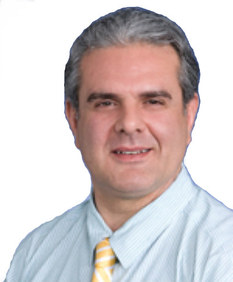
HONORABLE ADELBERTO JORDAN OF FLORIDA, UNITED STATES COURT OF APPEALS JUDGE WHO WROTE APPELLATE DECISION AFFIRMING JUDGE CORRIGAN'S GENNUSA v. SHOAR DECISION
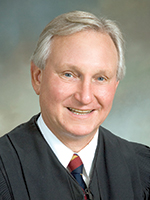
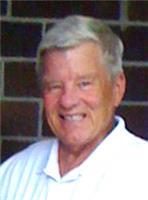
HONORABLE JOEL F. DUBINA OF ALABAMA, UNITED STATES COURT OF APPEALS JUDGE WHO CONCURRED IN APPELLATE DECISION AFFIRMING JUDGE CORRIGAN'S DECISION IN GENNUSA V. SHOAR

HONORABLE EMMETT RIPLEY COX OF ALABAMA, UNITED STATES COURT OF APPEALS JUDGE WHO CONCURRED IN GENNUSA DECISION
2014 11TH CIRCUIT COURT OF APPEALS DECISION:
United States Court of Appeals,Eleventh Circuit.
Anne Marie GENNUSA, Joel Studivant, Plaintiffs–Appellees Cross Appellants, v. Brian CANOVA, individually, Thomas Marmo, individually, Defendants–Appellants Cross Appellees.
No. 12–13871.
Decided: April 8, 2014
Before JORDAN, COX, and DUBINA, Circuit Judges. Bryan E. Demaggio, Matthew R. Kachergus, William J. Sheppard, Elizabeth Louise White, Sheppard White & Kachergus, PA, Jacksonville, FL, D. Gray Thomas, Law Office of D. Gray Thomas, P.A., Jacksonville, FL, for Plaintiffs–Appellees. John W. Jolly, Jr., Jolly & Peterson, PA, Tallahassee, FL, for Defendants–Appellants.
While investigating an alleged misdemeanor violation of a domestic violence injunction, Detective Thomas Marmo and Sergeant Brian Canova monitored, intercepted, and listened to privileged conversations between their suspect, Joel Studivant, and his attorney, Anne Marie Gennusa, who were in an interview room at the St. Johns County Sheriff's Office. They did so without any notice to Mr. Studivant and Ms. Gennusa, and without a warrant. Det. Marmo also seized from Ms. Gennusa, on Sgt. Canova's order, a statement written by Mr. Studivant. This too was done without a warrant.
In a thorough and well-reasoned summary judgment order, see Gennusa v. Shoar, 879 F.Supp.2d 1337 (M.D.Fla.2012), the district court ruled that the surreptitious electronic eavesdropping violated the Fourth Amendment and the Federal Wiretap Act, 18 U.S.C. § 2510 et seq., and that the seizure of Mr. Studivant's written statement contravened the Fourth Amendment. The district court further concluded that Det. Marmo and Sgt. Canova were not protected by qualified immunity. Det. Marmo and Sgt. Canova appeal, asserting that they are entitled to qualified immunity on the Fourth Amendment claims.1
After review of the record, and with the benefit of oral argument, we affirm. First, it has long been clearly established that the warrantless interception of private conversations—like the privileged ones here—offends the Fourth Amendment. Second, Det. Marmo and Sgt. Canova did not properly assert in the district court that the seizure of Mr. Studivant's statement was permitted by the exigent circumstances exception to the Fourth Amendment's general warrant requirement.
I
We conduct plenary review of the district court's grant of summary judgment, viewing the facts in the light most favorable to the non-moving parties. Summary judgment is appropriate if there are no genuine issues of material fact and a party is entitled to judgment as a matter of law. See Fed.R.Civ.P. 56(a); Bradley v. Franklin Collection Serv., Inc., 739 F.3d 606, 608 (11th Cir.2014). As the district court noted, see Gennusa, 879 F.Supp.2d at 1342–43, the relevant facts, which we set out below, are undisputed.
In the summer of 2009, Det. Marmo was investigating Mr. Studivant's possible misdemeanor violation of a domestic violence injunction. On June 8, 2009, in the course of that investigation, Det. Marmo conducted a non-custodial interview of Mr. Studivant at the St. Johns County Sheriff's Office. Ms. Gennusa was present during the interview as Mr. Studivant's attorney. The interview was conducted in an interview room at the Sheriff's Office that was 10 feet by 10 feet, contained a table, and had a small window on the door.
Unbeknownst to Mr. Studivant or Ms. Gennusa, all that took place in the interview room—including their privileged attorney-client conversations—was being recorded and actively monitored by members of the Sheriff's Office (including Det. Marmo and Sgt. Canova) through a concealed camera in the room. The camera was not obviously recognizable, no signs warned visitors of the possibility of electronic surveillance, and Mr. Studivant and Ms. Gennusa were not told that they were being recorded or monitored. See id. at 1342 n. 1.
When the interview began, Mr. Studivant agreed to prepare a sworn written statement. As Mr. Studivant began writing his statement, Det. Marmo left the interview room and closed the door. While they were alone in the room, Mr. Studivant and Ms. Gennusa discussed matters related to the investigation.
Ms. Gennusa then left the interview room and met with Det. Marmo in his office. When she returned to the interview room, Ms. Gennusa closed the door and informed Mr. Studivant that Det. Marmo was going to arrest him. Following a discussion with Ms. Gennusa, Mr. Studivant decided he no longer wanted to give Det. Marmo a written statement.
Det. Marmo came back to the interview room and demanded Mr. Studivant's written statement. After a somewhat heated discussion, Mr. Studivant and Ms. Gennusa refused to turn over the statement. Det. Marmo left the room again and went to see his supervisor, Sgt. Canova. During their conversation, Det. Marmo and Sgt. Canova actively monitored Mr. Studivant and Ms. Gennusa in the interview room, and saw Ms. Gennusa place the written statement on the table. Sgt. Canova instructed Det. Marmo to return to the interview room and retrieve the statement.
As he came back into the room, Det. Marmo forcibly grabbed the statement from underneath Ms. Gennusa's hand. He then arrested Mr. Studivant for violation of the domestic violence injunction, and later attached the written statement to his arrest report. Mr. Studivant ultimately entered into a deferred prosecution agreement, and the criminal charge against him was dismissed.
Mr. Studivant and Ms. Gennusa filed suit in federal district court against Det. Marmo and Sgt. Canova in their individual capacities. They asserted claims under 42 U.S.C. § 1983 for violations of the Fourth Amendment (based on the warrantless recording of their privileged conversations and the seizure of the written statement), and under 18 U.S.C. § 2520(a) for violations of the Federal Wiretap Act (based on the warrantless recording).2
II
“The doctrine of qualified immunity protects government officials from liability for civil damages insofar as their conduct does not violate clearly established statutory or constitutional rights of which a reasonable person would have known. Qualified immunity gives government officials breathing room to make reasonable but mistaken judgments, and protects all but the plainly incompetent or those who knowingly violate the law.” Stanton v. Sims, 134 S.Ct. 3, 4–5 (2013) (internal citations and quotation marks omitted).
Because it is undisputed that Det. Marmo and Sgt. Canova were acting within the scope of their discretionary authority, Mr. Studivant and Ms. Gennusa bear the burden of establishing that qualified immunity is not appropriate. See Lee v. Ferraro, 284 F.3d 1188, 1194 (11th Cir.2002). To satisfy this burden, they must show two things—first, that Det. Marmo and Sgt. Canova violated the Fourth Amendment, and second, that at the time of the incidents in question it was clearly established that the challenged conduct was unconstitutional. See, e.g., McCullough v. Antolini, 559 F.3d 1201, 1205 (11th Cir.2009).
III
We begin with the warrantless monitoring and recording of the attorney-client conversations of Mr. Studivant and Ms. Gennusa. The district court held that Det. Marmo and Sgt. Canova violated the Fourth Amendment because Mr. Studivant and Ms. Gennusa had a “subjective expectation[ ] that their conversations were private” and because this expectation, given the confidential attorney-client nature of the conversations, was “objectively reasonable.” See Gennusa, 879 F.Supp.2d at 1346–49. The district court also denied qualified immunity to Det. Marmo and Sgt. Canova. Acknowledging that there was “no case precisely on point,” the district court explained that since the late 1960s “it has been clearly established that the Fourth Amendment prohibits the police from electronically intercepting communications without a warrant when the speakers have a reasonable expectation of privacy.” See id. at 1349–50.
On appeal, Det. Marmo and Sgt. Canova challenge the district court's qualified immunity ruling on two grounds. They argue that neither Mr. Studivant nor Ms. Gennusa had a reasonable expectation that their attorney-client conversations in the interview room would be private, and that, as a result, there was no constitutional violation. See Br. for Appellants at 15–16. They also contend that it was not obvious to a reasonable officer in June of 2009 that monitoring and recording those conversations without a warrant violated the Fourth Amendment. See id. at 16–18. As we explain, neither argument carries the day.
A
The Fourth Amendment, as applied to the states by way of the Fourteenth Amendment, see Mapp v. Ohio, 367 U.S. 643, 646–47 (1961), protects “[t]he right of the people to be secure in their persons, houses, papers, and effects, against unreasonable searches and seizures.” U.S. Const. amend. IV. For our purposes, a Fourth Amendment search occurs “when the government violates a subjective expectation of privacy that society recognizes as reasonable.” Kyllo v. United States, 533 U.S. 27, 33 (2001).
Almost 50 years ago, the Supreme Court held that a “ ‘conversation [is] within the Fourth Amendment's protections,” and that “the use of electronic devices to capture it [is] a ‘search’ within the meaning of the Amendment.” See Berger v. New York, 388 U.S. 41, 51 (1967) (invalidating a New York statute that authorized the electronic interception of private conversations by the police (through recording devices installed in various offices) pursuant to a court order, on the ground that the procedures for obtaining the order were insufficient to comply with the Warrants Clause of the Fourth Amendment). In a number of cases following Berger, the Supreme Court similarly ruled that the warrantless electronic interception of private conversations by the government violates the Fourth Amendment. See Katz v. United States, 389 U .S. 347, 353–59 (1967) (warrantless interception of conversation conducted from public phone booth in case involving use of wires to make bets or wagers); United States v. U.S. Dist. Court for the E. Dist. of Mich., 407 U.S. 297, 318–21 (1972) (warrantless interception of calls in case involving domestic threat to national security—a plot to bomb the office of the Central Intelligence Agency); Mitchell v. Forsyth, 472 U.S. 511, 531–34 (1985) (warrantless wiretap of anti-war group which had made plans to blow up heating tunnels connecting office buildings in Washington, D.C.). Mitchell, while granting qualified immunity to the Attorney General because the warrantless wiretapping at issue there had been authorized prior to Katz, explained that Katz “held that no recognized exception to [the Fourth Amendment's] warrant requirement could justify warrantless wiretapping in an ordinary criminal case.” Mitchell, 472 U.S. at 531. These cases stand for the now-unremarkable proposition that, because society recognizes as reasonable an expectation of privacy for confidential conversations between individuals, the government needs a warrant to intercept or record such conversations.3
The only question, then, is whether the subjective expectation of privacy held by Mr. Studivant and Ms. Gennusa about their privileged attorney-client conversations is one that society recognizes as reasonable, and we easily conclude that it is. An expectation of privacy is deemed reasonable, the Supreme Court has said, if it “has a source outside of the Fourth Amendment, either by reference to concepts of real or personal property or to understandings that are recognized and permitted by society.” Rakas v. Illinois, 439 U.S. 128, 143 n. 12 (1978). See also Minnesota v. Carter, 525 U.S. 83, 88 (1998) (same). Mr. Studivant and Ms. Gennusa have pointed to such a source: the attorney-client privilege, which is the “oldest of the privileges for confidential communications known to the common law.” Upjohn Co. v. United States, 449 U.S. 383, 389 (1981) (citation omitted). See Hunt v. Blackburn, 128 U.S. 464, 470 (1888) (explaining that the attorney-client privilege “is founded upon the necessity, in the interest and administration of justice, of the aid of persons having knowledge of the law and skilled in its practice, which assistance can only be safely and readily availed of when free from the consequences or the apprehension of disclosure”). Given that the intercepted conversations had to do with the ongoing criminal investigation of Mr. Studivant by Det. Marmo, they fell squarely within the attorney-client privilege. See Upjohn Co., 449 U.S. at 389. Cf. United States v. Ofhse, 817 F.2d 1508, 1511, 1516 n. 6 (11th Cir.1987) (characterizing as “reprehensible” the government's use of a defense attorney as an informant against his indicted client, and the placement of a body bug on the attorney “to conduct ․ electronic surveillance of the conversations” between he and his client).
The Supreme Court has also held that whether an expectation of privacy is “ ‘legitimate’ or ‘reasonable’ necessarily entails a balancing of interests.” See Hudson v. Palmer, 468 U.S. 517, 527 (1984) (holding that an inmate has no reasonable expectation of privacy in his prison cell). Under this formulation, we come to the same conclusion. Here the competing interests are the interest of society in monitoring attorney-client conversations in a non-custodial setting at a sheriff's office and the interest of the attorney and client in keeping their privileged conversations in such a setting private. Given these interests, we readily strike the balance in favor of privacy. The government has no weighty law-enforcement, security, or penological interest in recording, without a warrant, the attorney-client conversations of a person who has not been arrested, even if those conversations take place in an interview room at a sheriff's office. On the other hand, the need for privacy is very strong when a person who is not under arrest or otherwise in custody is speaking to his attorney on privileged matters, even within the confines of an interview room at a sheriff's office. “One threat to effective assistance of counsel posed by government interception of attorney-client communications lies in the inhibition of free exchanges between defendant and counsel because of the fear of being overheard.” Weatherford v. Bursey, 429 U.S. 545, 554 n. 4 (1977). So, even if the Hudson balancing test applies, Mr. Studivant and Ms. Gennusa had an objectively reasonable expectation of privacy when they discussed privileged matters in the interview room.
In an effort to demonstrate that Mr. Studivant and Ms. Gennusa did not have an objectively reasonable expectation of privacy, Det. Marmo and Sgt. Canova point to a number of cases involving the recording of certain conversations at police stations. These cases, however, are distinguishable because they involved individuals who had been arrested, were in police custody, and/or had some indication that they were being monitored. See United States v. Delibro, No. 09–11995, 2009 WL 3059064, 347 Fed. App'x 474, 475 (11th Cir. Sept. 25, 2009) (arrestee and his mother did not have a reasonable expectation of privacy in an actively-monitored police interview room, as arrestee was “well aware” that police could be monitoring his conversations, and as a result there was no basis to suppress conversations between them that the police had recorded without a warrant); Johnson v. State, 730 So.2d 368, 370 (Fla.Dist.Ct.App.1999) (police did not violate the Fourth Amendment by recording, without a warrant, conversations between a husband, who had been arrested, and his wife in an interview room at a police station because no reasonable expectation of privacy existed and wife admitted that she did not know if they were being surveilled or recorded); Deegan v. Rudman, Civil Action No. 3:10–cv–00016, 2011 WL 251226, at *3–*4 (W.D.Va. Jan. 26, 2011) (arrestee did not have a reasonable expectation of privacy in an interrogation room at a police station, where video and audio monitoring was “routine,” and therefore police did not violate the Fourth Amendment by recording his side of a conversation with his attorney on an officer's cell phone).
The status of the persons being recorded matters because, as the Supreme Court has said on various occasions, “the expectations of privacy of an individual taken into police custody ‘necessarily [are] of a diminished scope.’ “ Maryland v. King, 133 S.Ct. 1958, 1978 (2013) (citation omitted). Unlike the individuals in Delibro, Johnson, and Deegan, Mr. Studivant was not under arrest at the time of his privileged conversations with Ms. Gennusa, and his interview with Det. Marmo was non-custodial. And, unlike certain of the individuals in those cases, who had some indication that they were being surveilled and monitored, Mr. Studivant and Ms. Gennusa had no idea that Det. Marmo, Sgt. Canova, and other members of the St. Johns Sheriff's Office were eavesdropping on them. Indeed, as the district court put it, they were “given no indication of this fact.” See Gennusa, 879 F.Supp.2d at 1341 & n. 1. Cf. United States v. Duncan, 598 F.2d 839, 852 (4th Cir.1979) (holding, in criminal prosecution under the Federal Wiretap Act, that IRS agents conducting an audit at a bank had a reasonable expectation of privacy in an office assigned to them by the bank, and distinguishing cases holding that “statements made by a prisoner in police custody may not be considered justifiably private”: “The significant fact in the cases involving statements uttered while in police custody is not the hostility between officer and suspect; it is the fact that the speaker was in police custody. Those cases simply announce a societal decision that one may not reasonably expect his utterances to be private while he is held in police custody for violation of the law.”).4
In sum, Mr. Studivant and Ms. Gennusa had a reasonable expectation of privacy for their privileged attorney-client conversations in the interview room of the St. Johns County Sheriff's Office. The surreptitious recording and monitoring of those attorney-client conversations, without notice to Mr. Studivant or Ms. Gennusa, and without a warrant, violated the Fourth Amendment .5
B
We next address whether, in June of 2009, it was clearly established that the Fourth Amendment prohibited the warrantless recording of attorney-client conversations between a non-incarcerated suspect and his attorney under the circumstances presented here. Like the district court, see Gennusa, 879 F.Supp.2d at 1349–50, we answer that question in the affirmative.
We do not always “require a case directly on point before concluding that the law is clearly established, but existing precedent must have placed the statutory or constitutional question beyond debate.” Stanton, 134 S.Ct. at 5. In other words, a “constitutional rule already identified in the decisional law may apply with obvious clarity to the specific conduct in question, even though the very action in question has [not] previously been held unlawful.” Hope v. Pelzer, 536 U.S. 730, 741 (2002). See also Coffin v. Brandau, 642 F.3d 999, 1014–15 (11th Cir.2011) (en banc) (“To find that a broad principle of law clearly establishes the law as to a specific set of facts, it must do so with obvious clarity to the point that every objectively reasonable government official facing the circumstances would know that the official's conduct did violate federal law when the official acted.”) (internal quotation marks and citation omitted). In the end, the “touchstone is whether the right would be apparent to a reasonable officer.” Gilmore v. Hodges, 738 F.3d 266, 277 (11th Cir.2013).
It has long been clear that the electronic interception of oral conversations constitutes a search under the Fourth Amendment. See Berger, 388 U.S. at 51. It has also long been clear that in ordinary criminal cases the warrantless interception of private phone calls violates the Fourth Amendment because it infringes the reasonable expectation of privacy of the conversants. See Katz, 389 U.S. at 353–59. And, finally, it has long been clear that even in sensitive cases involving domestic threats to national security law enforcement officials need a warrant before electronically intercepting private communications. See U.S. Dist. Court, 407 U.S. at 318–21; Mitchell, 472 U.S. at 531–34. The cases establishing these principles—Berger, Katz, U.S. District Court, and Mitchell—and their reasoning, see Hope, 536 U.S. at 743, made it obvious and apparent to any reasonable law enforcement official in June of 2009 that the Fourth Amendment requires that a warrant be secured before non-custodial privileged communications between attorneys and their clients—communications which are normally entitled to be kept confidential as a matter of law—can be electronically monitored, intercepted, or recorded.
That the attorney-client conversations here took place inside an interview room at a sheriff's office does not mean that Det. Marmo and Sgt. Canova lacked clear notice that their warrantless electronic surveillance was illegal. As the Supreme Court has explained, “[o]fficials can still be on notice that their conduct violates established law even in novel factual circumstances,” as long as the “state of the law [at the relevant time] gave [them] fair notice that their [actions] w[ere] unconstitutional,” Hope, 536 U.S. at 741, and that is the case here. Although locale can matter, see, e.g., McKinnon, 985 F.2d at 527–28 (holding that a suspect does not have a reasonable expectation of privacy in the back seat of a police car), it is not dispositive. We held more than 20 years ago that the “location of the conversations that [are] intercepted is not determinative; the proper inquiry is whether the government's activities in electronically listening to and recording the conversations violated privacy upon which [the participants] justifiably relied.” United States v. Shields, 675 F.2d 1152, 1158 (11th Cir.1982). Here Mr. Studivant had not been arrested, and his liberty had not been curtailed in any way. His status therefore did not result in a diminished expectation of privacy.
Stated differently, the “fact that the [monitoring and recording] took place in the context of [an interview room at a sheriff's office] does not materially distinguish this case from [Supreme Court] precedent [on electronic surveillance of private conversations].” Skrtich v. Thornton, 280 F.3d 1295, 1304 (11th Cir.2002) (excessive force claim in prison setting). See also O'Rourke v. Hayes, 378 F.3d 1201, 1208 (11th Cir.2004) (warrantless search of home: “[E]ven if a factually similar case did not exist, [the warrantless search] would still have violated rights that are clearly established under ․ general statements of principle.”). The district court therefore correctly held that Det. Marmo and Sgt. Canova were not entitled to qualified immunity for their warrantless monitoring and recording of the privileged attorney-client conversations between Mr. Studivant and Ms. Gennusa.
IV
We now turn to the Fourth Amendment seizure claim. Det. Marmo and Sgt. Canova argue that the warrantless seizure of Mr. Studivant's written statement was constitutional because there were exigent circumstances, i.e., the threat of destruction of evidence. See Br. for Appellants at 20–22. They also maintain that Ms. Gennusa was not seized (because Detecive Marmo never touched her), and that, in any event, they are protected by qualified immunity. See id. at 22–24.
In relevant part, the Fourth Amendment protects the “right of the people to be secure in their “papers[ ] and effects[ ] against unreasonable searches and seizures.” U.S. Const. amend. IV. After Ms. Gennusa refused to give Mr. Studivant's written statement to him, Det. Marmo returned to the interview room and forcibly took the statement from underneath Ms. Gennusa's hand. This constituted a seizure of the statement for purposes of the Fourth Amendment, as Det. Marmo “meaningful[ly] interfere[d] with [the] possessory interests [of Mr. Studivant and Ms. Gennusa] in [an item] of property.” Sodal v. Cook Cnty., Ill., 506 U.S. 56, 61 (1992) (citation and internal quotation marks omitted). It matters not, therefore, that Ms. Gennusa herself was not physically touched or restrained.
“[I]n ‘the ordinary case,’ seizures of personal property are ‘unreasonable within the meaning of the Fourth Amendment,’ without more, ‘unless ․ accomplished pursuant to a judicial warrant,’ issued by a neutral magistrate after finding probable cause.” Illinois v. McArthur, 531 U.S. 326, 330 (2001) (quoting United States v. Place, 462 U.S. 696, 701 (1983)). There are, of course, certain limited exceptions to the Fourth Amendment's warrant requirement. One of those is exigent circumstances, which can exist when there is a “need to prevent the imminent destruction of evidence.” Brigham City v. Stuart, 547 U.S. 398, 403 (2006). To determine whether a police officer “faced an emergency that justified acting without a warrant,” a court “looks to the totality of circumstances.” Missouri v. McNeely, 133 S.Ct. 1552, 1559 (2013).
Det. Marmo and Sgt. Canova, as the government actors responsible for the warrantless seizure, “ha[d] the burden of proof of showing exigent circumstances.” United States v. Tovar–Rico, 61 F.3d 1529, 1535 (11th Cir.1995). According to the district court, however, Det. Marmo and Sgt. Canova “d[id] not argue that any exceptions to the warrant requirement appl [ied],” and it therefore found that they had “conceded that [Det.] Marmo seized [Mr.] Studivant's property without any exception to the warrant requirement.” Gennusa, 879 F.Supp.2d at 1344–45. Det. Marmo and Sgt. Studivant contest this determination, asserting that they raised exigent circumstances as a justification for the seizure of the statement, see Br. for Appellants at 20–22, but our review of the record indicates that the district court was correct. To explain why the district court got it right, we detail the relevant filings in the case.
In their second amended complaint, Mr. Studivant and Ms. Gennusa alleged in Counts II and III that the warrantless seizure of the statement violated their Fourth Amendment rights. See D.E. 41 at ¶¶ 40–41, 64–66, 70–73. They also alleged that, in grabbing the statement, Det. Marmo used excessive force in violation of the Fourth Amendment and broke Ms. Gennusa's fingernail. See id. at ¶ 67. So, as pled, Counts II and III contained an unreasonable seizure claim (based on the seizure of the statement) and an excessive force claim (based on the broken fingernail).
In their renewed motion for summary judgment, Det. Marmo and Sgt. Canova explicitly recognized that the second amended complaint pled a distinct Fourth Amendment unreasonable seizure claim based upon the taking of the statement without a warrant. See D.E. 44 at 6, 11.6 When they addressed that claim on the merits, they argued that the “single instantaneous grab of a piece of paper [wa]s of no constitutional dimension” because no force (or justified minimal force) had been used and because any physical contact with Ms. Gennusa was incidental and accidental. See id. at 12–13. They also argued, in a single sentence, that Det. Marmo “sought to prevent the arguable destruction of or tampering with evidence” in violation of Florida law. See id. at 13 (citing Florida cases). Finally, they argued that they were entitled to qualified immunity because there was no binding precedent (from the Supreme Court, the Eleventh Circuit, or the Florida Supreme Court) prohibiting a police officer from “grab[bing] evidence plainly visible but which is covered in part by the hand of a criminal defense lawyer who seems determined to decide unilaterally through self-help what information law enforcement officers can and cannot obtain.” See id. at 14.
When they responded to this summary judgment motion, and themselves moved for summary judgment, Mr. Studivant and Ms. Gennusa argued that the seizure of the statement without a warrant constituted a seizure that was per se unreasonable under the Fourth Amendment. They also asserted that “none of the exceptions to the warrant requirement [were] present.” See D.E. 52 at 10. Det. Marmo and Sgt. Canova did not file a response/reply memorandum or otherwise respond to the per se violation argument.
“[I]f ․ part[ies] hope[ ] to preserve a claim, argument, theory, or defense on appeal, [they] must first clearly present it to the district court, that is, in such a way as to afford the district court an opportunity to recognize and rule on it.” In re Pan Am. World Airways, Inc., 905 F.2d 1457, 1462 (11th Cir.1990). See also Bogle v. McClure, 332 F.3d 1347, 1355 n. 5 (11th Cir.2003) (concluding that officials waived a certain qualified immunity argument as a result of a stipulation they entered into). The single, passing reference to the prevention of the “arguable destruction of or tampering with evidence” by Det. Marmo and Sgt. Canova in their renewed summary judgment motion—unaccompanied by any discussion or elaboration—was insufficient to preserve an exigent circumstances argument. First, the reference was devoid of any factual support. Nowhere in their statement of facts or memorandum of law did Det. Marmo and Sgt. Canova present any evidentiary support for the purported reason Det. Marmo seized the statement. Nor did they cite to any evidence suggesting that they reasonably believed that there was an emergency because Ms. Gennusa—an officer of the court—was going to destroy the statement or tamper with it before they could secure a warrant. Second, there was no mention, and certainly no discussion, of the exigent circumstances standard under the Fourth Amendment. Third, there was no citation to any federal authorities. Fourth, the two Florida cases cited in the motion did not deal with exigent circumstances. See McNeil v. State, 438 So.2d 960, 961–63 (Fla.Dist.Ct.App.1983) (sufficiency of the evidence challenge to conviction for tampering with evidence); Smigiel v. State, 439 So.2d 239, 242–43 (Fla.Dist.Ct.App.1983) (challenge, in case involving tampering with evidence, to affidavit submitted in support of application for search warrant).
Simply put, the district court was not required to address an exigent circumstances argument that Det. Marmo and Sgt. Canova failed to properly articulate. It was not obliged “to distill [a] potential argument that could [have] be[en] made based upon the materials before it on summary judgment.” Resolution Trust Corp. v. Dunmar Corp., 43 F.3d 587, 599 (11th Cir.1995). We note, as well, that the answer of Det. Marmo and Sgt. Canova to the second amended complaint did not put the district court on notice that they were relying on exigent circumstances, for that pleading did not mention exigent circumstances when it listed qualified immunity as an affirmative defense. See D.E. 43 at 7.
In any event, assuming that the single, passing reference to Det. Marmo seeking to “prevent the arguable destruction of or tampering with evidence” was sufficient to present and preserve an exigent circumstances argument, the qualified immunity argument defense fails on the merits. As noted, Det. Marmo and Sgt. Canova did not point to or present any evidence to justify an objectively reasonable belief that they were facing an emergency justifying a warrantless seizure, and “[m]ere speculation [about exigent circumstances], without factual support, is not enough to overcome the warrant requirement.” United States v. Santa, 236 F.3d 662, 671 (11th Cir.2000). There was no explanation, for example, about why Det. Marmo could not have told Ms. Gennusa to preserve the statement because he was going to seek a warrant for it. And, because the warrantless seizure of personal property is unreasonable under the Fourth Amendment unless one of the exceptions to the warrant requirement applies, see McArthur, 531 U.S. at 330, qualified immunity does not apply. “[Det. Marmo and Sgt. Canova] did not have a search warrant, and can point to no exigency justifying [the seizure]. Consequently, even if a factually similar case did not exist, [their] actions would still have violated rights that are clearly established under these general statements of principle.” O'Rourke, 378 F.3d at 1208.
V
“The greatest dangers to liberty lurk in insidious encroachment by men of zeal, well-meaning but without understanding.” Olmstead v. United States, 277 U.S. 438, 479 (1928) (Brandeis, J., dissenting). The monitoring and recording of the privileged attorney-client conversations between Mr. Studivant and Ms. Gennusa, without notice and without a warrant, violated their clearly established Fourth Amendment rights. So too, on this record, did the warrantless seizure of Mr. Studivant's written statement from Ms. Gennusa. The district court's grant of summary judgment in favor of Mr. Studivant and Ms. Gennusa is affirmed, and the case is remanded for further proceedings.
Affirmed.
FOOTNOTES
1. Det. Marmo and Sgt. Canova do not address the Federal Wiretap Act in their brief, even though a claim for intentional interception of an oral communication under the Act, 18 U.S.C. §§ 2510(2) & 2511(a)(1), requires a showing that the plaintiff had a subjective expectation of privacy “that society is willing to recognize as reasonable.” United States v. McKinnon, 985 F.2d 525, 527–28 (11th Cir.1983). We therefore do not address the claims under the Act.
2. Mr. Studivant and Ms. Gennusa also sued St. Johns County Sheriff David Shoar, but the district court's rulings on the official capacity claims against Sheriff Shoar are not before us in this appeal.
3. A warrant is not needed if one of the parties to the conversation consents to the interception or recording. See, e.g., United States v. Caceres, 440 U.S. 741, 744 (1979). Here, however, there was no consent.
4. A number of published cases rejecting the Fourth Amendment claims of inmates or detainees whose prison/jail calls were recorded are based on the rationale that the institution in question provided sufficient notice or warning that all calls would be recorded and that, as a result, the inmates or detainees were deemed to have consented to the recordings. See, e.g., United States v. Novak, 531 F.3d 99, 101–03 (1st Cir.2008); United States v. Lucas, 499 F.3d 769, 780 (8th Cir.2007) (en banc); United States v. Friedman, 300 F.3d 111, 123 (2d Cir.2002); Jackson v. State, 18 So.3d 1016, 1030 (Fla.2009). This rationale does not apply here, as Mr. Studivant and Ms. Gennusa were not given any notice or indication that their privileged conversations would be monitored and recorded. Cf. United States v. Noriega, 917 F.2d 1543, 1551 (11th Cir.1990) (“[If] Noriega did sign a valid release evidencing his understanding that all of his telephone conversations, including those with members of his defense team, would be recorded[,] ․ it is conceivable that the District Court could find that Noriega's attorney-client privilege would not prohibit the government's recording of Noriega's telephone conversations with his defense attorneys because he had no reasonable expectation of privacy.”).
5. Cf. Lanza v. New York, 370 U.S. 139, 143–44 (1962) (plurality opinion) (noting in dicta that “it may be assumed that even in a jail, or perhaps especially there, the relationships which the law has endowed with particularized confidentiality must continue to receive unceasing protection”); United States v. Harrelson, 754 F.2d 1153, 1169–70 (5th Cir.1985) (holding that arrestee and his wife did not have a reasonable expectation of privacy as to their conversations at a county jail, but nonetheless noting in dicta: “Nor would our observations here translate directly to attorney-client visitations, where the parties have a right to assured confidentiality and are, in the normal case, entitled to assume—and if necessary to demand—it.”).
6. Their understanding was not surprising, for at a hearing before the filing of the second amended complaint, the district court told the parties that, as it interpreted the first amended complaint, Mr. Studivant and Ms. Gennusa were alleging that the taking of the statement without a warrant was per se unreasonable under the Fourth Amendment. See D.E. 39 at 8–9.
JORDAN, Circuit Judge
https://www.gpo.gov/fdsys/pkg/USCOURTS-ca11-12-13871/pdf/USCOURTS-ca11-12-13871-0.pdf
http://caselaw.findlaw.com/us-11th-circuit/1662877.html